
How Much Water Should You Drink a Day?Free Daily Water Intake Calculator (by Weight, Age, Activity & Climate)
Get your personalized daily fluid target in seconds, see exactly how many bottles, cups, ounces, and liters that works out to, and learn the one-second urine-color check that beats counting every glass.
🔬 Smart Hydration Target Calculator
Enter a few details below. The tool blends the National Academies (NASEM) baseline, the half-bodyweight rule of thumb, and a sweat-rate adjustment to give you a realistic daily water requirement — total fluid, plain water target, and the exact bottle count.
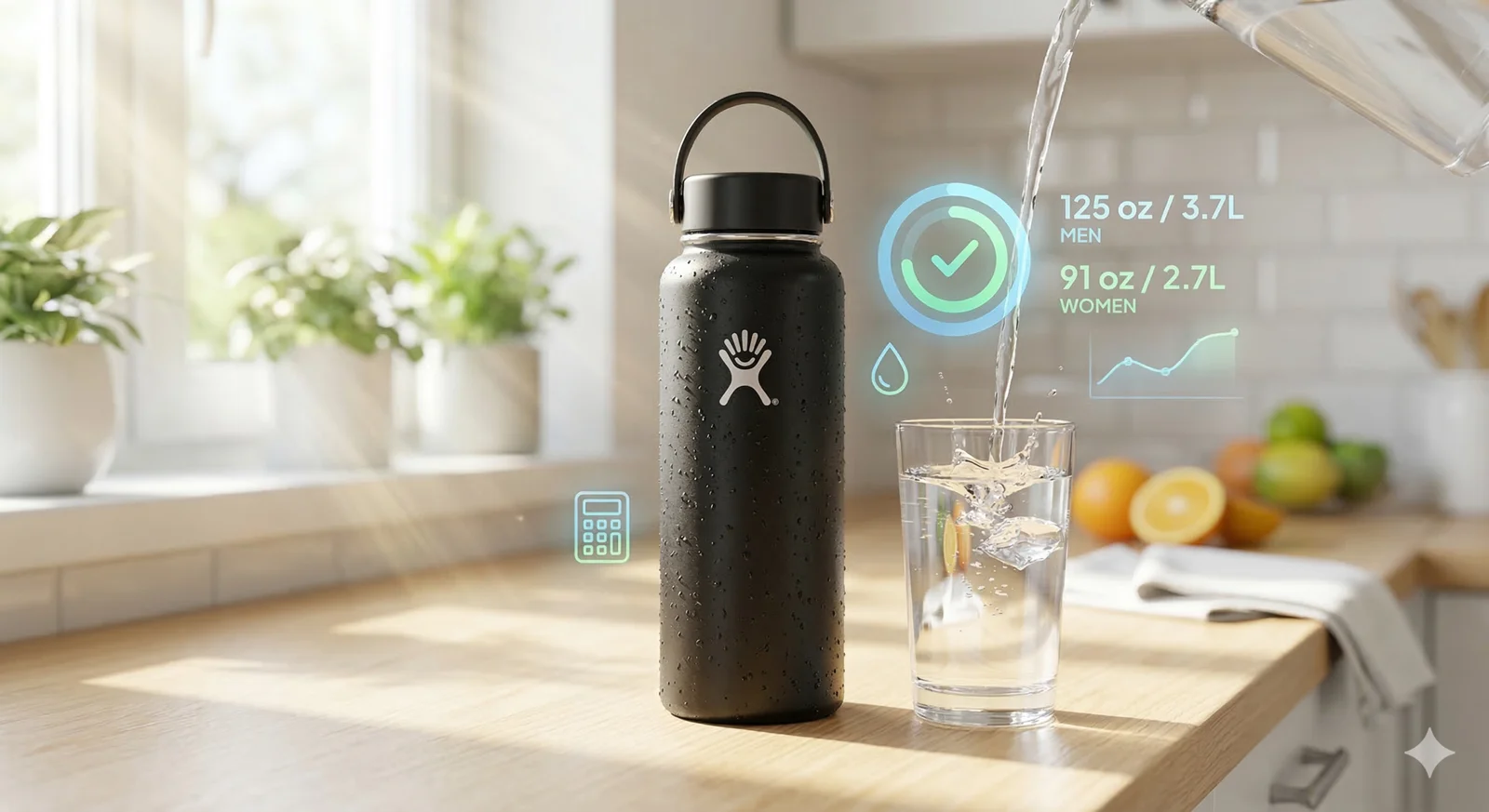
Quick answer for adults (no calculator needed): Most health authorities point to 11.5 cups (2.7 L / ~92 oz) of total water per day for women and 15.5 cups (3.7 L / ~124 oz) for men, including water from food and other beverages. Roughly 4–6 cups of plain water covers most of the active-drinking portion — but your real number depends on body size, activity, climate, age, and life stage.
💧 Why your daily water intake actually matters
Roughly 60% of your body weight is water. Every cell, tissue, organ, and bone relies on it for fluid balance, temperature regulation, nutrient absorption, digestion, and waste removal. Blood is mostly water. Muscles are about 75% water. Even bones are 30% water.
When you fall a few cups short, the effects show up faster than most people expect. A fluid loss of just 1–2% of body weight is enough to dent attention, short-term memory, mood, and exercise performance. Research from the Hydration Science Lab and a long line of peer-reviewed cognition studies put the threshold at about 1.36% dehydration for measurable mental fog. That is roughly the amount most desk-bound adults drift into by mid-afternoon without noticing.
On the upside, getting your daily fluid intake right pays dividends across kidney health (lower stone risk), urinary tract health (reduced UTI risk), constipation prevention, healthy aging, athletic performance, and — for some people — gentler appetite control during a weight-loss push.
The catch? There is no single magic number. The famous “8 glasses a day” rule is a memorable starting point, not a science-backed prescription. Your real daily water requirement shifts with sex, body weight, activity level, climate, altitude, age, pregnancy, illness, and which medications you take. That is what this page exists to unpack.
📊 What the calculator returns — a real example
That’s what the tool returned for a real test case: a 180-lb male, age 35, moderately active, 45 minutes of training, temperate climate. The plain-water target lands at 100 oz, the total-water number (food + drinks) at 124 oz, and the bottle count at about 5.9 standard 16.9-oz bottles across the day.
🧪 What is “daily water intake,” exactly?
It’s two numbers, not one — and the difference is where most advice gets confused.
Total water intake covers every drop you take in: plain water, coffee, tea, milk, juice, soup broth, smoothies, the water hidden in fruit, the water hidden in yogurt, even the metabolic water your body makes when it burns carbs. The Dietary Reference Intake (DRI) values from the National Academies of Sciences, Engineering, and Medicine — and the Adequate Intake (AI) numbers from the older Institute of Medicine — describe this total figure.
Plain-water intake is the portion you actively drink as water. Because roughly 20% of total daily water comes from food and another big slice comes from non-water beverages, the active-drinking target is far smaller than the total. Harvard Health calls it 4 to 6 cups of plain water as a baseline for most generally healthy adults.
~3.7 L (15.5 cups / ~124 oz) for adult men, ~2.7 L (11.5 cups / ~92 oz) for adult women, from all sources. NASEM benchmark.
About 4–6 cups (32–48 oz) for many adults — your active drinking goal, on top of beverages and water-rich foods.
Eight 8-ounce glasses = 64 oz ≈ 1.9 L. Easy to remember, not a science requirement. Useful as a floor for sedentary adults, irrelevant for athletes.
Keeping those two numbers straight is the single most common fix to bad hydration advice on the internet. When a headline says “you only need four cups,” that’s plain water. When it says “you need fifteen cups,” that’s total fluid. Both can be true at once.
⚡ Three reasons knowing your number matters
Mild dehydration (about 1–2% body weight loss) measurably impairs concentration, working memory, mood, and reaction time. Hydration is one of the cheapest performance levers there is. Jump to the benefits →
Adequate fluid intake genuinely lowers the risk of kidney stones and urinary tract infections, and keeps bowel movements regular. This is one of the strongest evidence-based wins. See the evidence-graded list →
Under-drinking causes dehydration symptoms. Over-drinking — especially fast, during endurance events or viral water-challenge culture — can trigger hyponatremia. Your number is a guardrail in both directions. Read the safety section →
🧭 How to use the daily water intake calculator
The tool combines three accepted approaches — the NASEM baseline, the half-bodyweight rule, and exercise sweat estimates — and applies the higher of the two so you don’t under-shoot.
Use the LB / KG toggle to match your scale. The body-weight floor uses the half-your-bodyweight-in-ounces rule (e.g., 170 lb → ~85 oz) as one of the inputs, then compares it against the NASEM baseline.
Men’s baseline total fluid is about 3.7 L; women’s is about 2.7 L. Older adults get a small upward nudge because the thirst signal becomes less reliable with age.
The tool adds roughly 12 oz of water per 30 minutes of sweating — a widely used field rule that approximates moderate sweat losses without forcing you to weigh yourself before and after a workout.
Hot and humid weather, dry desert heat, and altitude above 5,000 feet all increase fluid needs. Pregnancy bumps the target to about 10 cups a day; breastfeeding bumps it to about 12–13 cups.
You get plain-water target (oz), liters, 8-oz cups, and standard 16.9-oz bottles. The “total water” card shows the full DRI figure including food. Use plain-water as your action number for the day.
The calculator gives you a target. Your urine tells you whether you actually hit it. See the urine chart →
📋 Daily water intake by body weight, sex, and age
These numbers blend NASEM, IOM, the Academy of Nutrition and Dietetics, and the Mayo Clinic / Cleveland Clinic ranges. They are plain-water targets for moderately active, generally healthy adults in a temperate climate. Add 12 oz per 30 minutes of exercise; add 16–32 oz in heat or at altitude.
| Group | Plain water (oz) | Cups | Liters | 16.9-oz bottles |
|---|---|---|---|---|
| Adult man, 120 lb | 60 oz | 7.5 | 1.8 L | 3.6 |
| Adult man, 160 lb | 80 oz | 10 | 2.4 L | 4.7 |
| Adult man, 200 lb | 100 oz | 12.5 | 3.0 L | 5.9 |
| Adult man, 240 lb | 120 oz | 15 | 3.5 L | 7.1 |
| Adult woman, 110 lb | 55 oz | 7 | 1.6 L | 3.3 |
| Adult woman, 140 lb | 70 oz | 8.8 | 2.1 L | 4.1 |
| Adult woman, 170 lb | 85 oz | 10.6 | 2.5 L | 5.0 |
| Adult woman, 200 lb | 100 oz | 12.5 | 3.0 L | 5.9 |
| Teen 13–18 | 64–88 oz | 8–11 | 1.9–2.6 L | 3.8–5.2 |
| Child 4–8 | 40 oz | 5 | 1.2 L | 2.4 |
| Child 1–3 | 32 oz | 4 | 0.9 L | 1.9 |
| Older adult, 65+ | 64–80 oz | 8–10 | 1.9–2.4 L | 3.8–4.7 |
| Pregnant woman | 80 oz | 10 | 2.4 L | 4.7 |
| Breastfeeding | 104 oz | 13 | 3.0 L | 6.2 |
| Athlete (90+ min sweat) | 120–160+ oz | 15–20+ | 3.5–4.7+ L | 7–9.5+ |
Heads up on bottle math. A “bottle of water” is not a fixed unit. A standard single-serve disposable bottle is 16.9 oz (500 ml). Tall ones run 20 oz. Hydro-style reusables run 24, 32, or 40 oz. If you’d like the breakdown in gallons, see our companion guide: How Many Ounces in a Gallon? (Full Hydration Conversion Guide).
▶ Suggested visual aid: An infographic translating each row of this table into a “bottle stack” image.📐 What makes a “good” daily hydration target?
If you only ever read one paragraph on this page, make it this one. A useful daily water target is the smallest number that gets you to pale-straw urine 4–6 times a day, no fatigue, no headaches, no muscle cramps — and the largest number that doesn’t make you pee clear, force you to interrupt sleep, or dilute electrolytes. Anything in that window is fine. Everything else is decoration.
Three accepted ways to estimate your number
- NASEM/IOM Adequate Intake: 15.5 cups (men) or 11.5 cups (women) of total water per day, including food. Think of this as the “you won’t fall short” reference value.
- Half-bodyweight rule: body weight in pounds ÷ 2 = ounces of plain water per day (so 170 lb → ~85 oz). Popular and roughly correct, but it ignores climate and sweat.
- Metric / 30–35 mL per kg: body weight in kilograms × 30–35 mL = daily fluid goal (so 77 kg → 2.3–2.7 L). Lines up with the half-bodyweight rule almost perfectly.
The bonus method — used by athletes — is the 4-step sweat-rate self-test: weigh yourself nude before a one-hour workout, weigh again after towel-drying, and replace every pound lost with about 16 oz of fluid. Repeat across hot and cool conditions to learn your personal sweat curve.
🧫 The “8 glasses a day” myth — and what the 2022 Science study actually proved
Where did “drink 8 glasses a day” even come from?
The rule traces back to a 1945 U.S. Food and Nutrition Board recommendation of roughly 2.5 liters per day, or “1 mL of water per calorie of food”. The same report explicitly added that “most of this quantity is contained in prepared foods.” That second sentence got cut off in popular retellings, leaving only the “drink eight glasses” half of the story.
In 2002, Dartmouth kidney physiologist Heinz Valtin, MD, reviewed the published literature in the American Journal of Physiology. His conclusion: no scientific evidence supports 8×8 for healthy adults in temperate climates. A 2008 paper by Negoianu and Goldfarb in the Journal of the American Society of Nephrology reached the same verdict — there is no clear evidence of benefit from drinking increased amounts of water beyond thirst.
What the 2022 Science study showed
In a landmark 2022 paper, Yamada and colleagues — using the IAEA Doubly Labeled Water Database — measured water turnover in 5,604 people aged 8 to 96 across 23 countries. The doubly labeled water method is the gold standard. They found water turnover ranged from about 1 liter to 10 liters per day, with the biggest drivers being physical activity, sex, environment (Human Development Index, temperature, humidity, altitude), age, and body size. Men’s turnover peaked in their 20s. Women plateaued from about age 20 to 55. Newborns turned over the highest share — about 28% of their body water per day.
The paper’s headline takeaway in plain English: a one-size-fits-all rule for drinking water is not supported by the evidence. The exact 8×8 figure is “not backed up by objective evidence.” That is the cleanest scientific obituary the rule has yet received.
For a sedentary adult who is not great at tracking thirst, “drink eight glasses a day” is a reasonable, harmless minimum. Better than under-drinking by default.
If you train hard or live in heat or at altitude, 64 oz is dramatically too little. Use the sweat-rate method instead.
“You must drink 8 glasses a day” has no evidence base. Quoting it as a medical requirement is misinformation.
🔍 How to tell if you’re drinking enough (no counting required)
Your bladder is the most accurate hydration sensor you own. The pee chart below is used everywhere from NHS clinics to military training programs because it works.
Caveat: B-vitamins, beets, asparagus, and certain medications can shift urine color independent of hydration. Track the pattern over a day, not a single reading.
Other tells worth knowing
- Thirst — reliable for most healthy adults, but blunted in older adults, pregnant women, and during heavy exercise. The “thirst means you’re already dehydrated” line is overstated for everyday life, but it is true that mild thirst lags behind a measurable drop in plasma volume.
- Urination frequency — peeing 4 to 7 times per day in pale-straw color is the well-hydrated baseline. Going more than 8 hours without urinating is a real warning sign.
- Dehydration symptoms — dry mouth, fatigue, sluggishness, dizziness, low blood pressure, headache, muscle cramps, constipation, dark urine, infrequent urination, and (severe) confusion or rapid heartbeat. The Cochrane review on older adults concluded thirst and urine signals are not reliable for that population, so seniors should drink on a schedule, not on demand.
🛡 Can you drink too much water? Yes. Here’s the honest version.
Most hydration content treats this as a footnote. It deserves a real section. In healthy adults with normal kidneys, it is genuinely hard to over-hydrate through ordinary eating and drinking — the kidneys process roughly 0.8 to 1.0 liter of water per hour, and your thirst signal usually steps in before you push past that. The problem starts when people force intake past that ceiling.
Hyponatremia — the actual risk
Hyponatremia means blood sodium below 135 mmol/L (normal is 135–145). Water dilutes sodium, cells swell, and the dangerous endpoint is cerebral edema — brain swelling — which can cause seizures, coma, and in rare cases death. Symptoms run from nausea, headache, swelling, and confusion at the mild end to seizures at the severe end.
Endurance athletes who force-drink more than 3 L during a marathon or triathlon; viral “gallon a day” or 8-8-8 social-media challenges done fast; infants given plain water (their kidneys can’t keep up); psychogenic polydipsia.
Advanced heart failure, kidney or liver disease, certain thyroid conditions, and some medications (diuretics, SGLT2 inhibitors like Farxiga) all change your safe fluid range. If you have any of these, your doctor’s number wins.
For a healthy adult who sips steadily, eats normally, and stops drinking when full, water intoxication is genuinely rare. Slow and steady beats chugging.
If you exercise hard for over an hour, replacing sweat with plain water alone is what triggers most hyponatremia cases in the wild. Add electrolytes (sodium, potassium, magnesium) or use an oral rehydration solution. This is also where electrolyte powders earn their keep.
☕ Does coffee, tea, soda, milk, and food count toward your daily water intake?
Short answer: yes — almost all of them. The “caffeine dehydrates you” claim is a myth at normal intakes. A meta-analysis of caffeine and fluid balance concluded that habitual coffee and tea drinkers net positive hydration from those drinks. Even alcohol, the worst case, still nets slightly positive in moderation (it just has bigger downsides on the other side of the ledger).
| Beverage | Hydration verdict | Notes |
|---|---|---|
| Plain water (tap, filtered, bottled, sparkling, mineral) | Best | Calorie-free, sugar-free, always available. Filtered tap is fine for most people. |
| Coffee & tea (caffeinated) | Counts | Net positive hydration up to ~400 mg caffeine/day for most adults. |
| Herbal tea & decaf | Counts | Effectively as hydrating as water. |
| Milk & lower-fat milk | Counts | Hydrating and nutrient-dense; one Scottish study found milk slightly out-hydrated water. |
| 100% fruit juice | Counts, watch sugar | Hydrating but calorie-dense. NHS caps juice at about 150 ml/day. |
| Soda & sugary drinks | Counts, limit | Hydrating in liquid terms but a major source of added sugar. |
| Sports drinks & electrolyte powders | Use case-specific | Useful for >60 min hard exercise, illness, or heat. Overkill for desk work. |
| Energy drinks | Caution | Caffeine + sugar + stimulants. Hydrating, but not the right tool. |
| Alcohol | Net negative impact | Diuretic effect; offset every drink with a glass of water. |
Water-rich foods that quietly fill your tank
About 20% of total daily water comes from food. Front-load your plate with high-water-content options and your plain-water target drops:
- 90–95% water: cucumber, lettuce, celery, watermelon, strawberries, cantaloupe, oranges, grapefruit, tomatoes, zucchini, squash.
- 80–90% water: yogurt, broccoli, spinach, applesauce, peaches, plums, apples, grapes, soups.
- Bonus: the fiber in fruits and vegetables prevents the constipation that mild dehydration tends to cause.
👨👩👧 How much water for special groups
Children & teens
Infants under 6 months should not be given plain water — breast milk or formula only. Their kidneys can’t handle plain water and they can develop hyponatremia quickly. Children 1–3 need about 4 cups of total fluid a day, 4–8 year olds about 5 cups, and teens about 6–8 cups. Anything beyond is fine if the kid is active or in heat.
Pregnant and breastfeeding women
The IOM-based recommendation is roughly 10 cups (≈2.4 L) a day during pregnancy and 12–13 cups (≈3 L) while breastfeeding. Pregnancy increases blood volume and amniotic fluid needs; lactation literally exports water into milk. Thirst is a less reliable guide in both states — drink on schedule.
Older adults (65+)
The thirst mechanism dulls with age, kidneys become less efficient at concentrating urine, and many seniors take medications that change fluid balance. Dehydration is one of the leading causes of preventable hospitalization in older adults. Aim for 64–80 oz a day on schedule — don’t wait to feel thirsty.
Athletes & the creatine question
Endurance athletes can lose more than 1 L of sweat per hour in heat. The default “drink 8 glasses” approach is dangerously under-spec. Use the sweat-rate method: weigh in, weigh out, replace each lost pound with 16 oz of fluid. For sessions over 60 minutes, replace electrolytes (sodium and potassium especially), not just water. If you take creatine, add an extra 16–32 oz to your daily intake — creatine pulls water into muscle cells and increases overall fluid demand. Most strength athletes notice the cramp difference inside a week of adjusting.
Illness, fever, and recovery
Fever, vomiting, and diarrhea all crank up fluid losses fast. Lean on oral rehydration solutions (the WHO/UNICEF formula or commercial equivalents) rather than plain water alone — the sodium and glucose accelerate absorption. This is the one situation where electrolytes are genuinely lifesaving.
🧰 Practical tips to actually hit your daily water intake
Most people fail at hydration not because they don’t know the number but because their drinking habits are scattered. Three patterns fix this for almost everyone.
1. Front-load your morning
You wake up dehydrated. Six to eight hours without fluid empties the tank. Drink 16–24 oz before coffee — it’s the single highest-leverage habit on this list. Bonus: pre-meal water (about 500 ml ≈ 2 cups before each meal) modestly supports appetite control and has been linked to small weight-loss gains in trials.
2. Match a bottle to a behavior
An insulated water bottle keeps water cold for 8–24 hours depending on construction. Cold water is psychologically easier to drink and may add a small thermogenic effect (one study put it at about 23 extra calories per day). A hydrogen water bottle dissolves molecular hydrogen into the water; early research suggests antioxidant benefits, though the field is young. The bottle’s job is to make hydration the default, not to be a magic potion.
3. Habit-stack your sips
Pin water to anchors you already hit every day: one glass after brushing teeth, one with each meal, one when you sit down to work, one with any caffeine, one after every bathroom trip. Five anchors × 8 oz = 40 oz before you’ve even thought about it. Add 2–3 bottle refills and you’re at target.
Other levers that work
- Flavor with citrus slices, cucumber, mint, or berries — turns plain water into something you reach for.
- Sparkling water counts the same as still. Some people find bubbles more satisfying.
- Set bottle milestones on the side: “to here by lunch, to here by 5 pm.”
- Use a hydration app or wearable nudge if you genuinely forget. Tracking improves intake by about 15% in most behavioral studies.
🏆 Evidence-graded benefits of staying properly hydrated
Hydration is oversold in some places and undersold in others. Here’s a calibrated read.
Lower risk of kidney stones and recurrent UTIs. Reduced constipation. Maintained exercise performance in heat. Improved short-term cognition and mood at the 1–2% dehydration threshold.
Weight management. Pre-meal water (500 ml before meals) modestly reduces calorie intake; cold water has a small thermogenic effect (~23 cal/day). Helpful but not magic.
Skin “glow,” acne reduction, headache prevention in non-dehydrated people. Real effects exist for the dehydrated; minimal benefit beyond adequate intake.
The lesson is the same one your grandmother already knew: drink when you’re thirsty, drink a bit more in heat or exercise, and don’t expect water to perform miracles outside its lane.
❓ Frequently asked questions
Your daily water number is yours, not a slogan’s. Use the calculator above to set a target. Use the urine color chart to confirm you hit it. Lean on thirst for everyday adjustments, but drink on schedule if you’re pregnant, breastfeeding, older, or training hard. Forget chasing exact ounces — chase pale-straw urine four to six times a day, no headaches, no cramps. That’s the whole game.
This article is part of the broader Hydration Tools & Calculators hub on waterbottleinfo.com. For the unit-conversion companion piece, see How Many Ounces in a Gallon?.
👤 About the author

Disclaimer: This guide is informational, not medical advice. If you have heart failure, kidney disease, liver disease, thyroid conditions, diabetes, or take diuretics or other medications that affect fluid balance, talk to your clinician before changing your daily water intake.
📚 Sources & references
- National Academies of Sciences, Engineering, and Medicine (NASEM) — Dietary Reference Intakes for water, sodium, and chloride.
- Mayo Clinic — Water: How much should you drink every day?
- Harvard Health Publishing — How much water should you drink? (4–6 cups plain water).
- Harvard T.H. Chan School of Public Health, The Nutrition Source — How much water do you need?
- Cleveland Clinic — How much water you should drink every day (73–104 oz).
- Yamada Y. et al. Variation in human water turnover associated with environmental and lifestyle factors. Science, 2022 (IAEA Doubly Labeled Water Database Consortium).
- Valtin H. “Drink at least eight glasses of water a day.” Really? American Journal of Physiology, 2002.
- Negoianu D, Goldfarb S. Just add water. Journal of the American Society of Nephrology, 2008.
- Academy of Nutrition and Dietetics (eatright.org) — How much water do you really need?
- Centers for Disease Control and Prevention (CDC) — Water and healthier drinks.
- NHS — Water, drinks and hydration (Eatwell Guide).
- MD Anderson Cancer Center — How much water should you drink a day?