

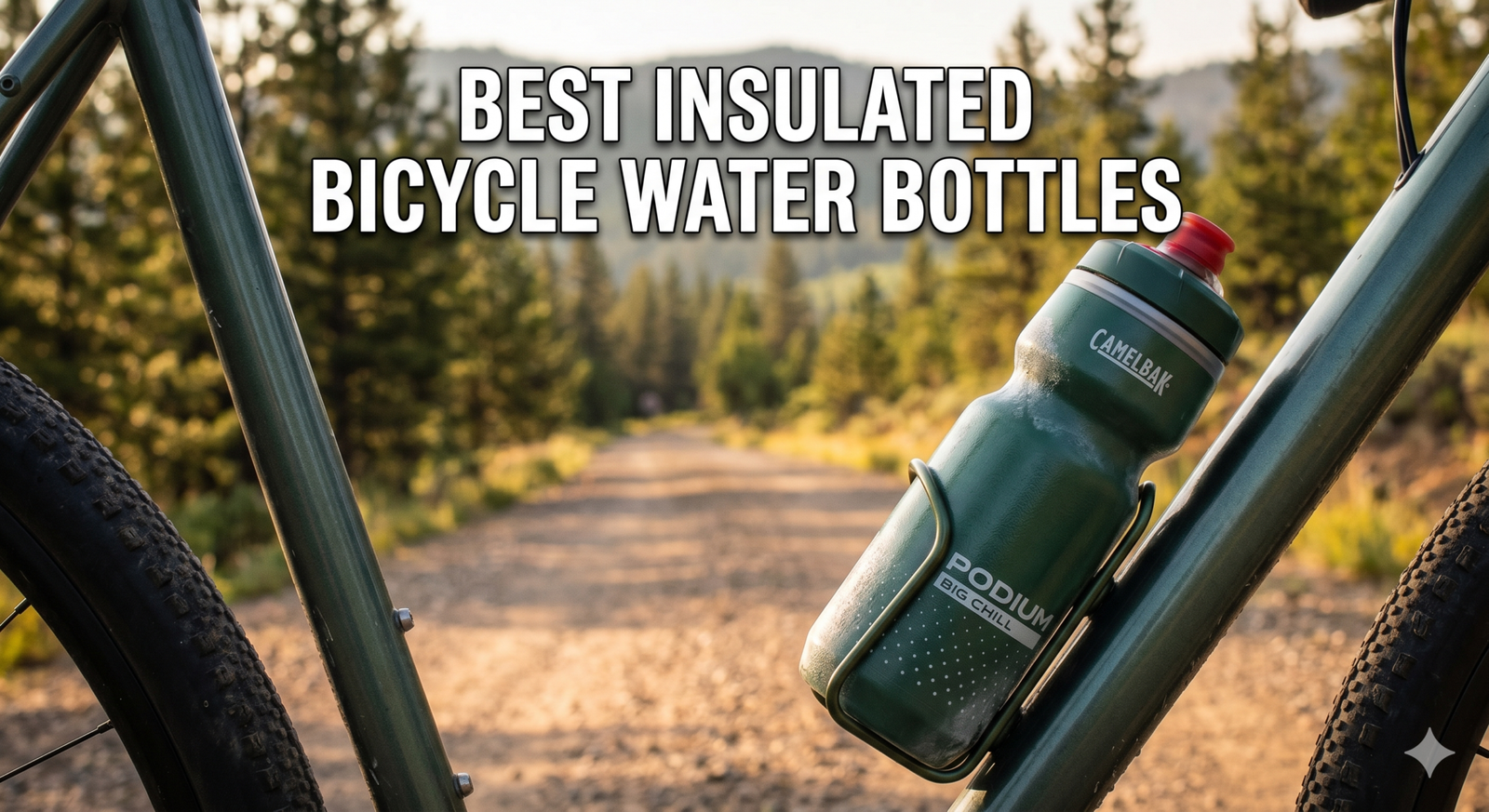
Warm water on a hot ride is one of those low-key miserable experiences that sneaks up on you. You fill your bottle at home, start pedaling, and 45 minutes later you’re drinking something that tastes like it sat on a car dashboard. An insulated bicycle water bottle fixes this — but not all of them fix it equally well.
We spent months testing over 15 bottles across road rides, gravel, mountain trails, and long touring days to figure out which ones actually live up to their cold-temperature claims. Some impressed us. A few disappointed. One cost 25 alternative.
This guide covers the best insulated bicycle water bottles you can buy in 2026, along with a detailed buying guide to help you pick the right one for your riding style, frame size, and budget.
- Quick Picks: Best Insulated Bicycle Water Bottles at a Glance
- What Actually Makes a Bicycle Water Bottle "Insulated"?
- The 7 Best Insulated Bicycle Water Bottles in 2026
- 1. CamelBak Podium Chill 21 oz — Best Overall
- 2. Bivo Trio 621 ml — Best Stainless Steel Insulated Bottle
- 3. CamelBak Podium Steel 650 ml — Best for Extreme Cold Retention
- 4. Elite Deboyo Race 550 ml — Best for Performance Cyclists
- 5. Polar Bottle Breakaway 24 oz — Best Budget Insulated Option
- 6. CamelBak Podium Big Chill 24 oz — Best Large Capacity Insulated
- 7. HydraPak Polar Surge 700 ml 2-Pack — Best Value Pack
- Insulation Type Head-to-Head: Which Actually Works?
- How to Choose the Right Insulated Bicycle Water Bottle
- How Long Do Insulated Bicycle Water Bottles Actually Keep Water Cold?
- Frequently Asked Questions
- The Bottom Line
Quick Picks: Best Insulated Bicycle Water Bottles at a Glance
Bottle | Best For | Insulation Type | Capacity | Weight | Price |
|---|---|---|---|---|---|
CamelBak Podium Chill 21 oz | Best Overall | Double-wall plastic | 21 oz (621 ml) | 3.5 oz | ~$20 |
Bivo Trio 621 ml | Best Stainless Steel | Vacuum-insulated steel | 21 oz (621 ml) | 9.5 oz | ~$49 |
CamelBak Podium Steel 650 ml | Longest Cold Retention | Vacuum-insulated steel | 22 oz (650 ml) | 12.5 oz | ~$40 |
Elite Deboyo Race 550 ml | Best for Racing | Vacuum-insulated steel | 18.6 oz (550 ml) | 9.9 oz | ~$50 |
Polar Bottle Breakaway 24 oz | Best Budget Insulated | Tri-Layer reflective | 24 oz (710 ml) | 3.5 oz | ~$18 |
CamelBak Podium Big Chill 24 oz | Best Large Capacity | Double-wall plastic | 24 oz (710 ml) | 4.3 oz | ~$25 |
HydraPak Polar Surge 700 ml | Best Value Pack | Tri-Layer insulated | 24 oz (700 ml) | 4.2 oz | ~$35 (2-pack) |
What Actually Makes a Bicycle Water Bottle “Insulated”?
Not all insulated bottles work the same way. The term covers three pretty different technologies, and understanding which is which will save you a lot of disappointment.
Double-wall plastic bottles (like the CamelBak Podium Chill) sandwich a thin foam or air layer between two plastic walls. They’re lightweight, squeezable, and affordable. The trade-off is that the insulation only slows heat transfer — it doesn’t stop it. Expect your water to stay reasonably cool for 1–2 hours, maybe 3 if you’re lucky and the weather isn’t brutal.
Reflective tri-layer insulation (used by Polar Bottle) adds a foil-like reflective material between the walls. This works better than plain air insulation because it reflects radiant heat from the sun. In direct sunlight tests, Polar Bottle consistently outperformed standard double-wall plastic bottles.
Double-wall vacuum insulation is the technology used in stainless steel bottles from brands like Bivo, CamelBak, and Elite. There’s a vacuum — literally no air — between the two metal walls. With nothing to conduct heat, these bottles hold cold temperatures for 12–24 hours. They’re heavier and can’t be squeezed, but the performance difference is significant.
The 7 Best Insulated Bicycle Water Bottles in 2026
1. CamelBak Podium Chill 21 oz — Best Overall
Who it’s for: Riders who want a reliable, affordable insulated bottle that fits any cage and is easy to use one-handed.
The Podium Chill is the bottle that keeps showing up at the top of every roundup, year after year — and there’s a straightforward reason for that. It works. The self-sealing nozzle opens when you squeeze and closes when you don’t. No fumbling with a cap while you’re descending. No dribbling down your chin.
At 21 oz, it fits most standard bottle cages, including under frame bags, which matters if you’re running a bikepacking setup. The double-wall plastic construction cuts enough heat transfer to keep your water noticeably cooler than an uninsulated bottle for roughly 60–90 minutes in direct heat, which covers most people’s rides.
What we really like is the Jet Valve nozzle. The flow rate is excellent — you get a strong, controllable stream without having to tip the bottle at a weird angle. And when you’re not drinking, it doesn’t leak.
The main criticism: the nozzle is harder to clean thoroughly than it looks. If you’re using electrolyte mixes regularly, you’ll need to disassemble the cap fully after rides. Skip that, and things get funky.
Specs at a Glance
Spec | Detail |
|---|---|
Capacity | 21 oz (621 ml) |
Material | Polypropylene plastic |
Insulation | Double-wall foam |
Weight | 3.5 oz (99 g) |
Valve | Self-sealing squeeze nozzle |
Cage Fit | Standard (fits most cages) |
Dishwasher Safe | No (lid yes) |
What we liked: Affordable, lightweight, excellent one-handed use, strong flow rate, trusted long-term reliability.
What we didn’t: Moderate insulation only (1–2 hours in heat), nozzle needs careful post-ride cleaning, hand-wash only for bottle body.
2. Bivo Trio 621 ml — Best Stainless Steel Insulated Bottle
Who it’s for: Cyclists who want genuinely cold water on long summer rides and don’t want any plastic touching their drink.
The Bivo Trio is a premium bottle, and it earns that label. The double-wall vacuum construction keeps drinks cold for 12+ hours in real riding conditions. We filled it with ice water at 8am, left it in direct sun strapped to a bike frame, and it was still icy cold at 6pm. That’s the kind of performance you only get with a vacuum flask.
What sets the Trio apart from other stainless steel bike bottles is the patented high-flow nozzle. Steel bottles normally have a slower flow because you can’t squeeze them to push water out. Bivo’s design uses a gravity-fed system with an internal air vent, and the result is a noticeably faster, smoother stream compared to competitors like the CamelBak Podium Steel. One of their engineers apparently came from an aerospace background, and the flow mechanics reflect that.
The silicone exterior coating serves a real purpose: it grips in your hand and in the cage, and dampens the rattling that steel bottles produce on rough roads.
The downsides are real too. It’s nearly three times heavier than the Podium Chill, and at $49 it’s priced more like a Hydro Flask than a standard bike bottle. Riders who need to throw back a big gulp during a sprint may find the gravity-fed flow frustrating compared to a squeezable plastic bottle.
Specs at a Glance
Spec | Detail |
|---|---|
Capacity | 21 oz (621 ml) |
Material | Double-wall stainless steel |
Insulation | Vacuum-insulated (12+ hours cold) |
Weight | 9.5 oz (270 g) |
Valve | Push-pull gravity-fed nozzle |
Cage Fit | Universal (tested with major cage brands) |
Free From | BPA, BPS, BPF, phthalates, lead |
What we liked: Exceptional cold retention, no plastic taste, food-grade silicone, excellent cage grip, fast flow for a steel bottle.
What we didn’t: Heavy, expensive, slower flow than squeezable plastic, hand-wash only.
3. CamelBak Podium Steel 650 ml — Best for Extreme Cold Retention
Who it’s for: Long-distance road cyclists and randonneurs who need water to stay cold for an entire day without refilling.
In controlled temperature testing, the Podium Steel kept water at 2°C (36°F) six hours into a test conducted on a surface hitting 40°C (104°F). That’s a remarkable result. Even the Bivo Trio and CamelBak Podium Titanium (which costs $100) warmed up faster.
The 650 ml capacity is useful for riders doing long stints between refills. The Jet Valve system uses a twist-lock mechanism — you tilt and drink, gravity does the work — and the flow is serviceable, if slower than the Bivo’s gravity-fed design.
The real trade-off is weight. At 354g empty, two of these bottles on your bike equals nearly 700g before a drop of water is added. For touring cyclists and long-distance riders who aren’t watching grams, it’s irrelevant. For anyone racing or counting every ounce, it’s a dealbreaker.
Specs at a Glance
Spec | Detail |
|---|---|
Capacity | 22 oz (650 ml) |
Material | 18/8 stainless steel |
Insulation | Double-wall vacuum (14+ hours cold) |
Weight | 12.5 oz (354 g) |
Valve | Twist-lock Jet Valve |
Warranty | CamelBak Lifetime Guarantee |
What we liked: Best-in-class cold retention, large capacity, covered by lifetime guarantee, no plastic taste.
What we didn’t: Very heavy, no squeeze function, expensive for the category.
4. Elite Deboyo Race 550 ml — Best for Performance Cyclists
Who it’s for: Road and gravel cyclists who want real insulation without giving up a fast flow rate.
The Deboyo Race tackles a problem most insulated steel bottles don’t bother solving: how to get water out quickly when you’re breathing hard at race pace. Elite claims the flow is three times better than competing steel bottles, and test results back this up. In use, it’s noticeably easier to get a quick drink from than the Podium Steel.
It ships with two caps — a push-pull nozzle for riding and a screw-on steel cap for touring or hot drinks. That versatility makes it useful year-round: cold water in summer, hot coffee for winter bikepacking. In testing, it kept liquids hot for over 10 hours and cold for 12.
At 280g for 550ml, it’s lighter than the Podium Steel. The raw steel exterior means no paint to chip, which is practical if your bottle and cage have an abrasive relationship. The stainless interior resists corrosion and won’t hold onto electrolyte flavors between rides.
The 550ml capacity is the main caveat — smaller than most of the bottles on this list. For hot-weather or multi-hour rides, you’ll want a second bottle.
Specs at a Glance
Spec | Detail |
|---|---|
Capacity | 18.6 oz (550 ml) |
Material | Stainless steel (AISI 304) |
Insulation | Vacuum-insulated (12 hrs cold, 10+ hrs hot) |
Weight | 9.9 oz (280 g) |
Includes | Push-pull nozzle cap + steel screw cap |
Temp Rating | Up to 100°C — suitable for hot drinks |
What we liked: Fast flow for a steel bottle, two caps included, handles hot and cold drinks, no paint to scratch.
5. Polar Bottle Breakaway 24 oz — Best Budget Insulated Option
Who it’s for: Recreational riders and cyclists on a budget who want better-than-average plastic insulation.
Polar Bottle has been making insulated cycling bottles since 1994, and the Breakaway is where they’ve landed after decades of iteration. The Tri-Layer insulation — plastic outer, reflective foil middle, plastic inner — works better than plain double-wall foam for a specific reason: it reflects solar radiation. When the sun is directly beating on your bottle cage, that difference is measurable.
In direct sunlight testing, the Polar Bottle consistently outperformed the CamelBak Podium Chill in cold retention. Not by a huge margin, but noticeably — and at a similar (sometimes lower) price.
The “dash handle” on the MoFlo cap is genuinely useful. It’s the only bottle on this list where you can hook a finger into the cap to pull it cleanly out of a cage while riding, one-handed. The MoFlo cap also delivers a high-volume flow, which is satisfying for hot-weather chugging.
At 24 oz it’s a larger bottle, which won’t fit on smaller frames. And opening the cap fully still takes two hands. But as a budget insulated option, nothing beats it.
Specs at a Glance
Spec | Detail |
|---|---|
Capacity | 24 oz (710 ml) |
Material | BPA-free plastic |
Insulation | Tri-Layer reflective |
Weight | 3.5 oz (99 g) |
Valve | MoFlo wide-channel cap |
Interior Coating | Silicon dioxide (prevents odors/mold) |
What we liked: Affordable, large capacity, reflective insulation outperforms standard foam, useful dash handle, SiO2 coating prevents mold.
What we didn’t: Larger size won’t fit all frames, cap needs two hands to open, insulation still can’t match vacuum steel.
6. CamelBak Podium Big Chill 24 oz — Best Large Capacity Insulated
Who it’s for: Road cyclists who want maximum water capacity with the reliability of the familiar Podium system.
The Podium Big Chill is the Podium Chill with extra room — same self-sealing Jet Valve, same double-wall construction, same ease of use, but 3 extra ounces. That might not sound like much, but on a hot summer climb when you’re rationing sips, the extra capacity genuinely matters.
Road bikes with their large main triangles are the natural home for this bottle. It’s too tall for many mountain bike and gravel frames. On smaller frames with a half-frame bag installed, it simply won’t fit.
The insulation performance mirrors the standard Podium Chill — adequate for 1–2 hours. It’s not the bottle you’d buy purely for insulation performance, but it keeps things cool enough for the typical 1.5–2 hour ride, and the extra capacity means you’re drinking more, which matters more than temperature.
Specs at a Glance
Spec | Detail |
|---|---|
Capacity | 24 oz (710 ml) |
Material | Polypropylene plastic |
Insulation | Double-wall foam |
Weight | 4.3 oz (122 g) |
Valve | Self-sealing Jet Valve |
Frame Fit | Best for medium–large road bike frames |
What we liked: Extra capacity vs. standard Chill, same trusted Podium nozzle, lightweight, affordable, great for road bikes.
What we didn’t: Too tall for smaller and MTB frames, moderate insulation only, hand-wash only.
7. HydraPak Polar Surge 700 ml 2-Pack — Best Value Pack
Who it’s for: Riders who want two insulated bottles at a good price, particularly for hot-weather gravel or road rides where you run two cage positions.
The Polar Surge doesn’t get as much attention as the CamelBak or Bivo bottles, but the value here is hard to argue with. At roughly $35 for two 700ml bottles, you’re getting a pair of well-designed insulated bottles that fit standard cages and deliver a fast, clean stream through the high-flow cap.
The 700ml capacity is larger than most bottles on this list. The cap is fully disassemblable for cleaning, which matters on rides where you’re going through multiple sugary drink mixes. Both bottles are BPA-free and sit securely in standard cages.
It’s a workhorse bottle — not flashy, not premium, just reliable at a price that makes it easy to justify keeping a dedicated set purely for cycling.
Specs at a Glance
Spec | Detail |
|---|---|
Capacity | 24 oz (700 ml) each |
Pack | 2-bottle pack |
Insulation | Tri-Layer (Polar reflective technology) |
Valve | High-flow squeeze cap |
BPA-Free | Yes |
Cage Fit | Standard |
What we liked: Excellent value for a pair, large capacity, good flow rate, fully disassemblable cap, BPA-free.
What we didn’t: Plastic insulation only, heavier than single-wall bottles.
Insulation Type Head-to-Head: Which Actually Works?
This is the question most buying guides dance around. Here it is directly.
In testing conducted by Escape Collective, three vacuum-insulated stainless steel bottles were placed on a surface reaching 52°C (126°F) for six hours, alongside a standard plastic insulated bottle and an uninsulated bottle. The results tell the whole story.
After 2 hours (32°C ambient air):
Vacuum stainless (all brands tested): ~1°C — barely above freezing
Double-wall plastic (Podium Chill): 25°C — lukewarm
Uninsulated stainless: 35°C — genuinely hot
After 6 hours (28°C ambient):
Best vacuum stainless (CamelBak Podium Steel): 2°C
Bivo Trio: 7°C — still cold, still refreshing
CamelBak Podium Chill: Far warmer, effectively near ambient
The conclusion is clear: vacuum-insulated steel is in a different category from plastic insulated bottles. That’s not a criticism of plastic insulated bottles — for rides under 90 minutes, they’re usually fine and far cheaper. But if you’re out for a long day in summer heat, the steel options deliver a fundamentally different experience.
How to Choose the Right Insulated Bicycle Water Bottle
Ride Length and Heat
This is the real filter. For rides under an hour in moderate weather, a double-wall plastic bottle like the Podium Chill keeps water cool enough that most riders won’t feel the gap between it and a premium steel bottle. The math changes on longer rides and in serious heat. If you regularly ride 2+ hours in summer temperatures above 30°C (86°F), vacuum insulation is worth both the cost and the weight.
Material: Plastic vs. Stainless Steel
Plastic wins on: Weight (99–122g vs. 270–354g empty), price, squeezability, and flexibility in tight cages.
Stainless steel wins on: Insulation performance, taste neutrality, longevity, and safety from bisphenols. Metal doesn’t degrade over time or develop microcracks the way plastic does after repeated squeezing. It also works with hot drinks, which most plastic bottles don’t.
If you want to avoid all bisphenols (BPA, BPS, BPF) and heavy metals, brands like Bivo explicitly certify their materials and post their testing results publicly. That level of transparency is worth something.
Capacity and Frame Fit
Standard road bikes can usually fit 700–750ml bottles in both cage positions. Mountain bikes and gravel bikes with smaller frames or half-frame bags may be limited to 620ml or less. Double-wall steel bottles are physically wider than equivalent plastic bottles, so their labeled capacity can be misleading — the actual interior volume is smaller than it looks.
The waist (narrow section) on a bottle should sit about 6 inches from the base. That’s what your cage grips. Any bottle missing that indentation won’t stay put over bumps.
Valve and Nozzle Type
Auto-sealing squeeze valve (CamelBak Jet Valve): The gold standard for plastic bottles. Squeeze for water, release to seal. Works entirely one-handed.
Push-pull gravity-fed nozzle (Bivo, Elite Deboyo): Standard on rigid stainless bottles. You pull the nozzle to open, push to close. Works without squeezing. The Bivo’s high-flow version is significantly faster than competitors.
Twist-lock: An extra security layer that prevents the nozzle from opening during crashes or transport. Some riders love it, others find it slows things down mid-ride.
Weight
For commuting and casual riding, the 200–250g difference between plastic and steel bottles is negligible. For race days, long climbs, or any ride where you’re counting grams, it’s real. Two stainless steel bottles plus water can add 1.3kg+ to your setup. Worth knowing before you commit.
Cleaning
Every bottle on this list is hand-wash only for the bottle body. Dishwashers destroy vacuum seals in steel bottles and warp plastic insulated bodies. Most lids are dishwasher-safe. The CamelBak Jet Valve nozzle requires removing two inner pieces to clean thoroughly — a mild hassle, but it’s necessary if you’re using anything other than plain water.
How Long Do Insulated Bicycle Water Bottles Actually Keep Water Cold?
Here’s a practical quick-reference based on real-world use and testing:
Insulation Type | In Shade | Light Sun | Direct Sun / Hot Day |
|---|---|---|---|
Uninsulated plastic | ~30 min | 15–20 min | Under 15 min |
Double-wall plastic (foam) | 60–90 min | 45–60 min | 30–45 min |
Tri-Layer reflective plastic | 90–180 min | 75–120 min | 60–90 min |
Vacuum stainless steel | 12+ hours | 8–12 hours | 6–10 hours |
A few things that move these numbers significantly:
Starting temperature: The colder the water when you leave, the longer it stays cold. Starting with ice water rather than refrigerator-cold water can extend cold retention by 30–60 minutes in plastic bottles and several hours in steel.
Fill level: A full bottle holds temperature longer than a half-empty one. The air space inside warms up faster than liquid. Keeping your insulated bottle full is the single easiest way to improve its performance.
Cage position: Down tube cages face direct sun throughout most rides. If you have a choice, put your insulated bottle in the seat tube position, where it sees less direct sunlight.
The freezing trick: For plastic bottles only — fill 2/3 full, lay sideways in the freezer overnight, fill the rest with cold water before your ride. This can double the effective cold retention time. Never do this with vacuum-insulated steel (expanding ice will rupture the seal).
Frequently Asked Questions
Are insulated bicycle water bottles worth it?
For rides over 90 minutes in warm weather, yes, clearly. The difference between drinking cold and lukewarm water on a hot ride affects both how much you drink and how refreshed you feel — which in turn affects performance and enjoyment. For short, temperate rides, the non-insulated version of the same bottle (usually lighter and cheaper) works fine.
Do insulated bike water bottles fit standard cages?
Most do, but not all. Vacuum-insulated stainless bottles tend to be slightly wider than standard plastic bottles and sometimes shorter. Check the maximum diameter against your cage specs before ordering. Standard cages hold bottles up to approximately 3 inches (77mm) in diameter. The Bivo Trio at 77mm is right at this limit — it fits most cages but may be snug in some narrow carbon race cages.
Can I put hot drinks in an insulated bicycle water bottle?
Some, but not all. Double-wall plastic insulated bottles (CamelBak Podium Chill, etc.) are not rated for hot liquids and can warp. Vacuum-insulated stainless options — the Elite Deboyo Race (rated to 100°C), CamelBak Podium Steel, and Bivo Trio — all handle hot drinks safely. For winter rides where you want a warm coffee or tea on the bike, a steel vacuum bottle is the way to go.
What’s the best insulated bike water bottle for mountain biking?
The Bivo Trio handles MTB conditions well: the silicone exterior grips in muddy or wet conditions, the universal cage fit works with the variety of cage styles MTB setups use, and the nozzle cover option keeps trail grit off the drinking tip. For riders who want lighter and don’t need as long of cold retention, the CamelBak Podium Chill Dirt Series adds a MudCap.
Can I freeze an insulated water bottle?
Never freeze a vacuum-insulated stainless steel bottle. The expanding ice will crack the vacuum seal — permanently ruining the insulation. You can partially freeze plastic insulated bottles (fill 2/3 with water, lay sideways in the freezer, top up with cold water in the morning). This is a popular trick for extending cold retention on long rides.
Are BPA-free bike bottles actually safe?
BPA-free is better than BPA, but it’s worth knowing that BPS (a common BPA replacement) has raised similar concerns in recent studies. If you want to avoid all bisphenols entirely, vacuum-insulated stainless steel is the cleaner choice. Brands like Bivo go further than “BPA-free” — they test and certify for BPA, BPS, BPF, phthalates, and heavy metals, and publish those results.
The Bottom Line
For most riders: CamelBak Podium Chill 21 oz. It’s affordable, fits any cage, is easy to use mid-ride, and keeps water cool enough for the vast majority of everyday rides. It’s been the default cycling bottle for years because it genuinely delivers on what it promises.
For long summer days when you want water that’s still cold at mile 60: Bivo Trio 621ml. The performance gap between vacuum insulation and plastic foam is significant and real in hot conditions. You pay for it in weight and price — $49 is a lot for a water bottle — but if you’re spending serious hours in the saddle during summer months, the investment makes sense.
For the absolute longest cold retention and riders who don’t mind the weight: CamelBak Podium Steel 650ml won nearly every temperature test we found. In one six-hour test, it still had water at 2°C.
And if budget is the real constraint: Polar Bottle Breakaway 24 oz consistently outperforms standard foam-insulated bottles thanks to its reflective tri-layer design, at a price that leaves money over for post-ride food.