
You cannot scroll through social media, walk into a fitness center, or sit in a modern office without spotting one. The Stanley water bottle has transcended being a simple hydration tool; it has become a full-blown cultural phenomenon and the ultimate “emotional support” accessory. The trend has become so massive that retail experts at CNN have noted it is one of the most culturally defining retail products of the decade.
But once you strip away the viral TikTok unboxings, the long lines at Target, and the limited-edition color drops, a highly practical question remains: are you just paying for a trendy logo, or is this actually the best water bottle on the market? With premium prices ranging from $30 to $50, you need to know if the brand’s century-old engineering still holds up to the modern hype.
In this comprehensive Stanley water bottle review, we are cutting through the aesthetics to bring you the unfiltered truth. We will break down the real-world performance of their top models—including the cult-favorite Quencher, the rugged IceFlow, and the sleek All Day Slim Bottle. From strict ice-retention tests to addressing the infamous lid leaks, here is everything you need to know to decide which Stanley model is actually the right fit for your lifestyle.
The Stanley Legacy & The Viral Craze
From Classic Thermos to WaterTok Phenomenon
If you had told me five years ago that the rugged, heavy-duty thermos my grandfather used on camping trips would become the ultimate fashion accessory, I would not have believed it. For over a century, Stanley built its reputation on manufacturing indestructible gear for outdoor enthusiasts and blue-collar workers. But recently, the brand completely shifted gears.
Thanks to the massive power of the #WaterTok community and a brilliant shift toward female-focused marketing, Stanley transformed the humble water bottle into a viral “emotional support” accessory. The demand has been so unprecedented that Stanley’s annual revenue skyrocketed from around $70 million in 2019 to an estimated $750 million by 2023. Today, it feels like everywhere I go—from the gym to the office—there is a pastel Stanley cup sitting on a desk. But past the viral TikTok unboxings and aesthetic Instagram posts, buyers need to know: is the performance actually there?
Material Quality: 304 Stainless Steel vs. Cheaper Dupes
With the flagship Stanley Quencher costing around $45, the internet is flooded with cheap dupes and knock-offs. I frequently see people asking on forums if a $10 off-brand tumbler works just as well. The short answer is no, and it all comes down to the metallurgy.
Stanley bottles are manufactured using premium 18/8 (also known as 304) food-grade stainless steel. This means the metal composition is exactly 18% chromium and 8% nickel.
- The Chromium: Binds to oxygen to create an invisible, self-healing layer that prevents the bottle from rusting, even after years of holding liquids.
- The Nickel: Adds immense structural durability and maintains that bright, clean finish without holding onto weird metallic tastes or odors.
Cheaper dupes (like many fraction-of-the-cost models found online) frequently use lower-grade 200-series steel. While they might look identical on the outside, they lack the high nickel content needed for long-term durability. After a few months of heavy use or dishwasher cycles, those cheap dupes are far more likely to rust, dent easily, and ultimately lose their vacuum seal. When you buy a real Stanley, you are paying for an authentic 304 stainless steel build that will actually survive being dropped on the pavement.
Top Stanley Water Bottles Reviewed (Pros & Cons)
The Quencher H2.0 FlowState Tumbler
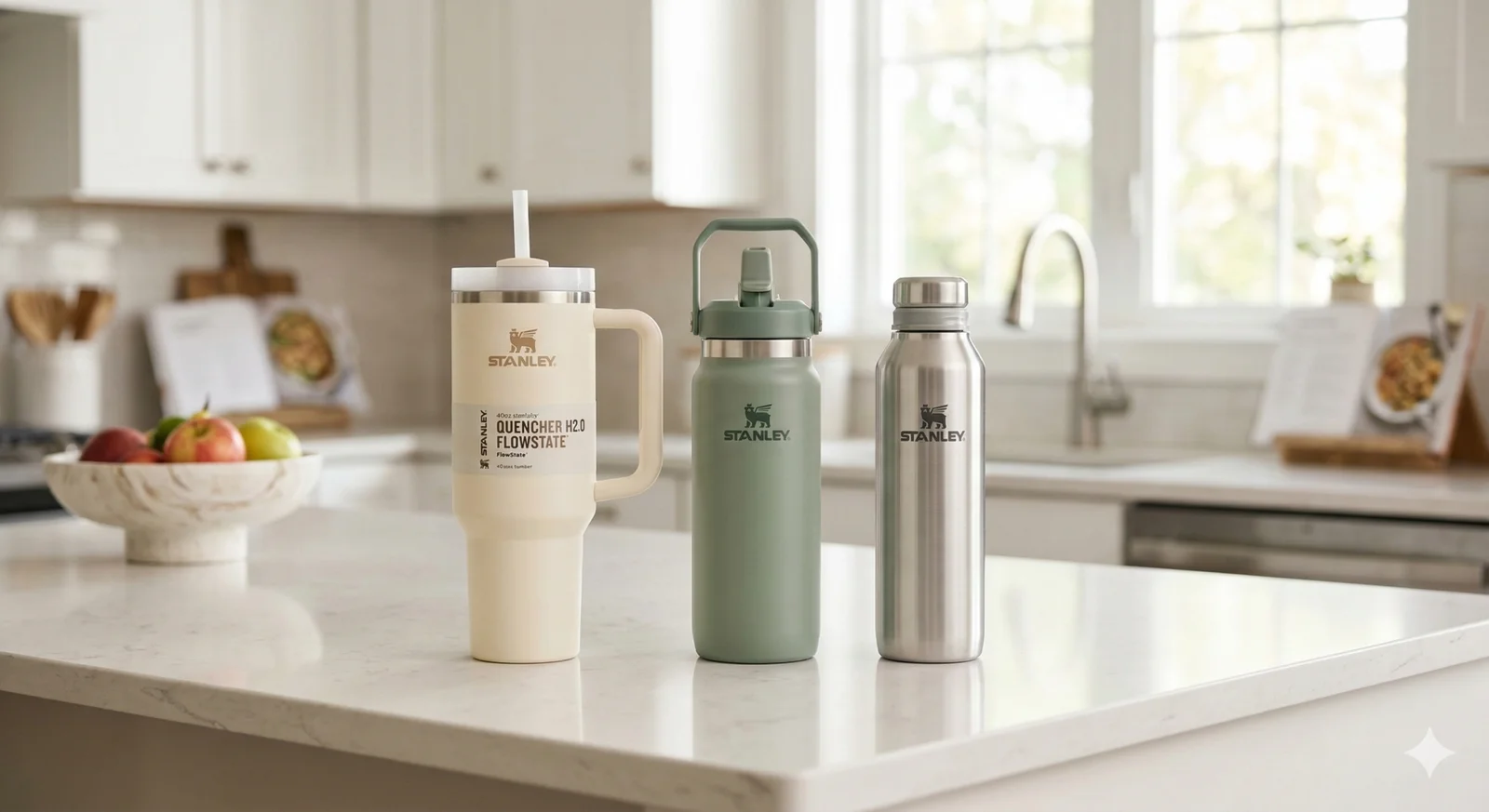
Often just called “The Stanley,” this is the heavyweight champion of the hydration trend. Manufactured from 90% recycled 18/8 stainless steel, it features double-wall vacuum insulation that keeps water cold for up to 11 hours. The Mayo Clinic recommends that the average healthy adult consume roughly 11.5 to 15.5 cups of total fluid daily—meaning a single 40oz Quencher knocks out nearly half of your hydration goals before lunch.
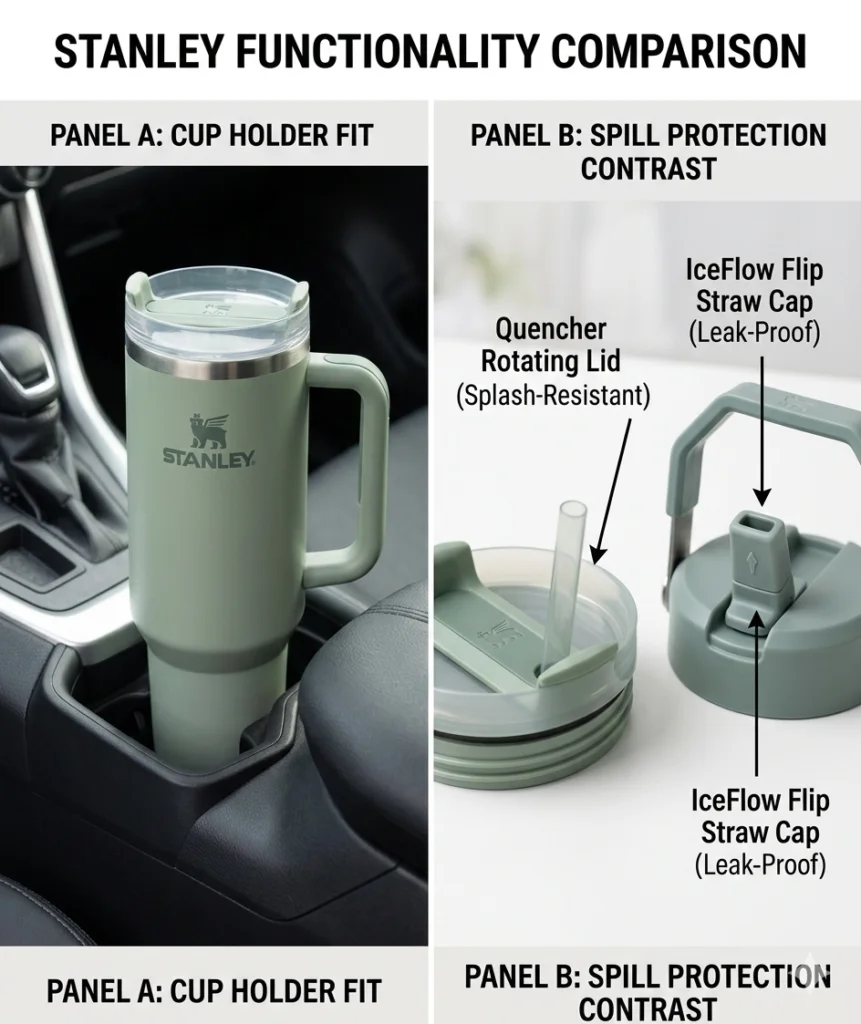
- Pros: Massive capacity, excellent temperature retention, an ergonomic handle that reduces wrist fatigue, and a narrow base engineered specifically to fit into standard vehicle cup holders.
- Cons: It is incredibly heavy when full (weighing over 3 lbs). More importantly, the 3-in-1 FlowState lid is only “splash-resistant,” meaning water will leak from the straw opening if the tumbler is tipped over on a car seat or knocked off a desk.
The IceFlow Flip Straw Jug & Classic Thermos
While the Quencher dominates office desks, the IceFlow line (and Stanley’s legacy Classic Legendary Thermos) is what you actually want if you lead a highly active lifestyle or spend your weekends outdoors. The IceFlow series replaces the open-straw concept with a heavy-duty flip straw that snaps tightly into place.
- Pros: When the flip straw is snapped shut, the IceFlow is 100% leak-proof, making it safe to toss into a gym bag or backpack. It also features a built-in top handle and a fence hook. Furthermore, Stanley manufactures the IceFlow using recycled plastics sourced from discarded fishing nets, preventing hundreds of pounds of waste from entering our oceans.
- Cons: The flip-straw mechanism requires more effort to deep-clean than the Quencher’s simple lid, and the larger “Jug” sizes do not fit in standard cup holders.
The All Day Slim Bottle
If you find the Quencher too bulky and the IceFlow too rugged, the All Day Slim Bottle is Stanley’s sleek, minimalist alternative. It completely ditches the large side handle in favor of an iconic, slender profile.
- Pros: Uniquely designed with a two-piece opening, the bottle unscrews at the shoulder so you can easily fill it with large blocks of ice, while the smaller top cap provides a smooth, splash-free drinking experience. Because it is completely leak-proof and highly packable, it easily slips into narrow laptop bags and tote side-pockets where a Quencher simply wouldn’t fit.
- Cons: The lack of a handle makes it slightly less convenient to carry in your hand for long walks, and its smaller capacities (usually 20oz or 34oz) mean more frequent trips to the water cooler.
Real-World Testing: Insulation, Leaks, and Safety
The Ice Test & Heat Retention
When you are spending premium money on a water bottle, the most critical question is whether it actually performs its primary function: temperature control. Stanley’s official specifications claim that the 40oz Quencher keeps water cold for 11 hours and iced for up to 48 hours.
In real-world conditions, these numbers hold up surprisingly well, though with a slight caveat. If you fill the tumbler with ice in the morning and leave it in a hot car, the ice itself will likely melt within 12 to 14 hours. However, the water inside will remain refreshingly cold well past the 11-hour mark.
For hot beverages, Stanley’s traditional designs have a legendary reputation. A classic Stanley vacuum flask can hold hot coffee in the freezing woods for upwards of 24 hours. The modern Quencher tumbler, due to its wider plastic lid and straw opening, is rated for 7 hours of heat retention—which is still more than enough to get you through a morning commute and a long meeting.
The Spill-Proof Test: Do They Leak?
This is where the distinction between Stanley’s different models becomes incredibly important. The biggest complaint plastered across the internet regarding the viral Quencher is that it leaks.
To be completely clear: the Quencher’s 3-in-1 FlowState lid is designed to be splash-resistant, not leak-proof. If you knock a full 40oz tumbler over on your desk or it tips over on your car seat, water will quickly spill from the straw opening.
Conversely, if spill protection is your top priority, you need to look at the IceFlow or the All Day Slim lines. The IceFlow features a folding straw cap that completely seals the bottle when snapped shut. You can hold an IceFlow completely upside down, shake it vigorously, and it will not drop a single bead of water.
Plastic Lid Safety & Hot Liquids
A frequent concern raised on forums like Quora is whether the plastic lids on these stainless steel bottles are actually safe, especially when exposed to hot liquids like boiling water or fresh tea.
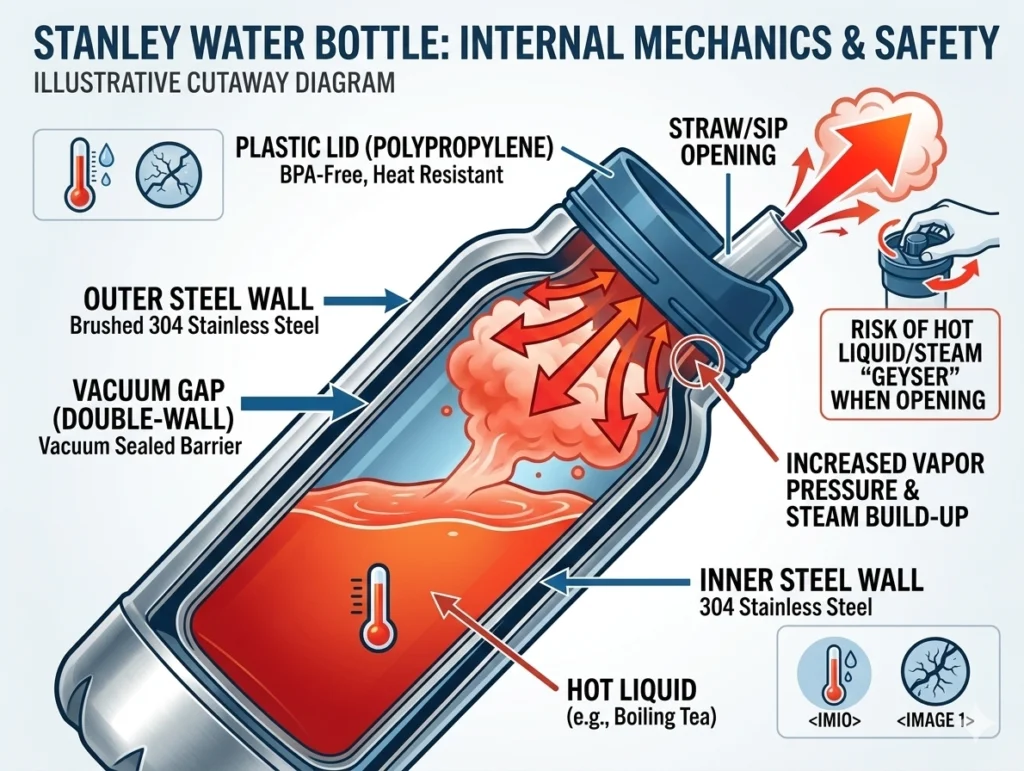
Stanley manufactures its lids using high-quality, food-grade polypropylene (often marked with recycling code 5). According to medical experts, polypropylene is naturally BPA-free and highly heat-resistant, meaning it does not leach harmful bisphenol-A chemicals into your beverages, even when exposed to high temperatures.
However, there is a physical safety risk to putting boiling water into an insulated bottle with a straw lid. When you seal near-boiling water inside a vacuum flask, the trapped steam drastically increases the internal vapor pressure. If you are using a flip-straw model, opening the straw can cause this trapped pressure to forcefully eject a geyser of hot liquid, potentially causing burns. For piping hot liquids, always use a classic twist-cap thermos or the “sip” setting on a tumbler, and never seal a boiling liquid until it has cooled slightly to reduce the pressure buildup.
Stanley vs. The Top Competition
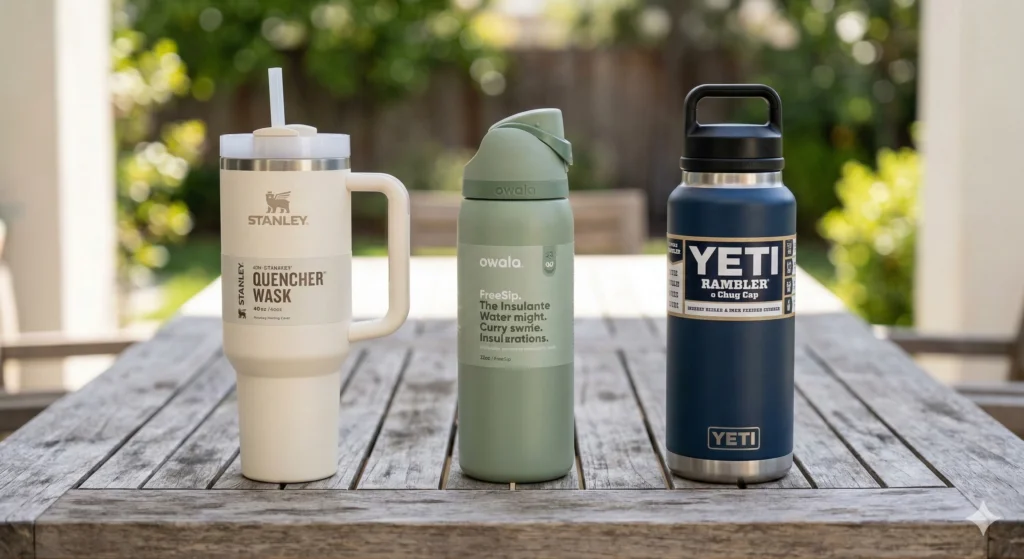
Stanley vs. Owala FreeSip
If there is one brand currently challenging Stanley for the top spot on TikTok and in office spaces, it is Owala. While the Stanley Quencher relies on a simple, large straw and an ergonomic handle, the Owala FreeSip focuses heavily on lid innovation and absolute spill protection.
The most significant difference is the lid design. Owala utilizes a patented FreeSip spout that functions as a 2-in-1 system: you can hold the bottle upright to sip through a hidden built-in straw, or tilt it back to swig through a wider mouth opening. Crucially, when you push the Owala lid closed, it snaps completely shut, rendering the bottle 100% leak-proof. Stanley wins on sheer capacity options and cup-holder compatibility (since the Owala base can be a bit wide depending on the size), but Owala is the clear winner if you are tired of your bottle leaking in your car or bag.
Stanley vs. Hydro Flask
Before Stanley took over, Hydro Flask was the undisputed king of the modern reusable water bottle movement. The choice between these two brands comes down to your daily aesthetic and how you prefer to carry your water.
Hydro Flask leans into a clean, minimalist design with a highly durable, sweat-free powder coat. They utilize their proprietary TempShield double-wall vacuum insulation to keep drinks cold for 24 hours, often outperforming the Stanley Quencher’s 11-hour baseline. However, traditional Hydro Flask bottles require you to unscrew the cap to drink (unless you buy a separate straw lid), and the classic cylindrical shape lacks the convenient side handle that makes carrying a massive Stanley so effortless. If you want a lightweight, classic bottle to toss into a backpack, Hydro Flask is the better bet; if you want a desk companion, Stanley wins.
Stanley vs. Yeti Rambler
When it comes to the battle between Stanley and Yeti, you are comparing two giants of outdoor gear. Both brands use premium 18/8 kitchen-grade stainless steel, but Yeti engineers its Rambler line to be nearly indestructible.
If you drop a Stanley Quencher on concrete, the plastic lid may crack, and the steel base will almost certainly dent. If you drop a Yeti Rambler, it will likely chip the concrete. Yeti focuses on extreme, rugged durability, offering heavy-duty caps and puncture-resistant bodies designed to survive job sites and white-water rafting trips. Stanley, particularly in recent years, has pivoted slightly toward ergonomics, lighter everyday commuting, and visual aesthetics. If you need a bottle that can survive the apocalypse, buy a Yeti. If you want a comfortable, stylish handle for a road trip, stick with Stanley.
Final Verdict: Are Stanley Water Bottles Worth the Investment?
When you strip away the TikTok aesthetic, the WaterTok recipes, and the celebrity endorsements, you are left with a very simple question: should you actually spend $45 on a water bottle?
For the vast majority of people, the answer is yes, but it completely depends on buying the right model for your lifestyle. If you sit at a desk all day or want a massive cup that fits in your car’s center console for long road trips, the Quencher H2.0 is an unbeatable companion. However, if you are throwing your bottle into a gym bag or hiking a trail, you should skip the viral Quencher and invest in the 100% leak-proof IceFlow or All Day Slim bottle instead.
What truly justifies the premium price tag over cheap online dupes is the construction and the guarantee. Because they are manufactured with high-grade 18/8 stainless steel, Stanley backs their thermal performance with a Lifetime Warranty that covers any failure of the vacuum insulation. You are not just buying a trendy cup; you are buying a hydration tool designed to last for decades.
Frequently Asked Questions (FAQs)
Why is my Stanley sweating on the outside?
If you pour ice water into your Stanley and notice condensation (sweat) forming on the outside of the bottle, it means the vacuum seal has failed. The invisible vacuum barrier between the inner and outer steel walls prevents heat transfer. If that barrier breaks, the cold from the inside transfers directly to the outer wall, causing the moisture in the warm room air to condense against the cold steel. If a genuine Stanley sweats, it is considered a defect and is usually eligible for a warranty replacement.
How do vacuum flasks suddenly stop working?
A thermos suddenly losing its ability to keep drinks cold or hot is almost always due to physical damage. If you drop a vacuum-insulated bottle hard enough, the outer steel wall can dent inward until it physically touches the inner steel wall. This creates a “thermal bridge,” allowing heat to instantly bypass the vacuum space. In other cases, microscopic cracks in the factory welds can slowly let air into the vacuum chamber over several months, ruining the insulation.
Is it safe to take a metal water bottle through checked luggage?
Yes, it is perfectly safe to travel with a metal water bottle. The Transportation Security Administration (TSA) explicitly allows empty metal water bottles in both your carry-on bags and checked luggage. If you are putting it in your checked luggage, it is highly recommended to leave the lid slightly unscrewed or completely off. The extreme changes in cabin pressure during a flight can cause a tightly sealed vacuum bottle to become incredibly difficult to open once you land.
How do you open a vacuum-sealed lid that is stuck or crooked?
If you accidentally cross-thread your lid or changes in atmospheric pressure have essentially vacuum-locked it onto the bottle, do not use brute force, which can damage the plastic threads. Instead, use the science of thermal expansion. Run the lid (and only the lid) under very hot water for about 60 seconds. The heat causes the material of the lid to expand at a slightly faster rate than the steel body of the bottle, breaking the friction seal and allowing you to twist it off effortlessly.
