
How Many Ounces in a Gallon?
A US gallon holds 128 fluid ounces. A UK (Imperial) gallon holds 160. Run the calculator, see the full chart, and find out how many water bottles really make a gallon.
⚡ Quick Answer
There are 128 fluid ounces in a US gallon and 160 imperial fluid ounces in a UK gallon.
The gallon is a unit of volume. In US customary units, 1 gallon = 4 quarts = 8 pints = 16 cups = 128 fl oz. Half a gallon is 64 oz, a quart is 32 oz, a pint is 16 oz, and a cup is 8 oz. The Imperial gallon is about 20% larger than the US gallon, which is the entire reason 128 and 160 both exist.
- ½ gal · 64 fl oz (US)
- 1 gal · 128 fl oz (US)
- 2 gal · 256 fl oz
- 5 gal · 640 fl oz
- 1 gal · 3.785 L · 8.34 lb
🧪 The Universal Hydration Converter
Pick a mode. Type a number. Get an answer in oz, gallons, quarts, pints, cups, liters, and mL — plus how many water bottle refills it takes.
🎯 Why This Conversion Matters
If you have ever tried to scale a recipe, hit a daily water intake target, or figure out how many 16.9 oz bottles to bring on a hike, you have hit the same wall. The unit is everywhere. The math is hostile. Cookbooks use cups. American grocery aisles use gallons. Your reusable bottle is labeled in milliliters. The hydration influencer on your feed is counting ounces.
This page gives you one resource that closes the gap. The calculator above handles every common volume unit — fluid ounce, gallon, quart, pint, cup, liter, milliliter, tablespoon, teaspoon — in both the US customary system and the British Imperial system. Below it, you get the full conversion chart, the formula in plain English, the dry-vs-fluid disambiguation that most recipe blogs skip, and a sourced look at the hydration guidance from the National Academies of Sciences, Engineering, and Medicine.

I research and write about water bottles and hydration for this site. Every number on this page has been cross-checked against USGS water-density data, NIST volume references, and the National Academies’ fluid-intake findings — not just copied from another blog.
- Quick Answer
- The Free Converter Tool
- What Is a Gallon?
- What Is a Fluid Ounce?
- US vs Imperial vs Dry Gallon
- Full Conversion Chart 1–10 Gallons
- Water Bottles per Gallon
- Best Bottle Sizes for a Gallon Goal
- The Formula (with examples)
- Should You Drink a Gallon a Day?
- Cooking, Baking & Brewing
- Water vs Milk vs Ice Cream
- A Short History of the Gallon
- Final Cheat Sheet
- FAQ
🔬 What Is a Gallon?
A gallon is a unit of volume — specifically, a unit of liquid capacity. It belongs to two parallel measurement systems that still operate side by side in 2026: the US customary system and the British Imperial system. The metric system (the International System of Units, or SI) uses liters and milliliters instead.
The US liquid gallon is defined as exactly 231 cubic inches, which works out to 3.785411784 liters. That definition is fixed by NIST and dates back to the old English wine gallon of 1707. Divide it into 128 equal fluid ounces and the math stops being a puzzle.
The Imperial gallon, used in the UK and historically in Canada, Ireland, Australia, and former British territories, is bigger. It was redefined in 1824 as the volume of 10 pounds of water at 62 °F, which standardized to 4.54609 liters — about 20% more than its American cousin. Split that into 160 imperial fluid ounces and you have the second answer.
There is also a third, much rarer one: the US dry gallon. It is a leftover from grain-trade history, equal to 268.8025 cubic inches or about 4.405 liters, which is exactly one-eighth of a US bushel. You will almost never see it on a label. If you do, it is for produce like apples or berries, not drinks.
⚖️ What Is a Fluid Ounce? (And Why It’s Not the Same as a Weight Ounce)
This is the single most-confused topic on the entire page. A fluid ounce measures volume. A dry ounce (or “weight ounce”) measures mass. They share a name and almost nothing else.
A US fluid ounce equals 29.5735 mL, and it is exactly 1/128 of a US gallon (0.0078125 gallon, if you ever need the decimal). An Imperial fluid ounce equals 28.4131 mL — a touch smaller — and it is 1/160 of an Imperial gallon. Structurally, a US fluid ounce is 1/16 of a US fluid pint, while an Imperial fluid ounce is 1/20 of an Imperial pint — that 16-vs-20 split is exactly why the UK ounce is smaller even though the UK gallon is larger. Yes, the smaller ounce belongs to the larger gallon. Blame history, not the math.
A weight ounce — what cookbooks and shipping labels usually mean by just “ounce” — is part of the avoirdupois system. It is 1/16 of a pound, or about 28.3495 grams. The apothecary and troy ounces (used for medicine and precious metals) are different again. None of them are interchangeable with fluid ounces unless you know the density of the liquid.
For pure water, the two systems happen to align almost exactly: 1 US fl oz of water ≈ 1.043 oz by weight. That coincidence is why “a pint’s a pound the world around” survives as a kitchen rule of thumb, even though it is only approximately true.
Fluid ounce (fl oz). Measures how much space a liquid fills. Use for water, milk, juice, soda, and recipe liquids.
Avoirdupois ounce (oz). Measures mass. Use for flour, butter, meat, postage, and shipping.
Treating “1 oz” on a recipe as fluid when it means weight (or vice versa). Always check the ingredient — solid vs liquid.
🌍 US Gallon vs Imperial Gallon vs Dry Gallon
Three gallons, three different numbers — and that is exactly what trips people up. Here they are side by side, with the conversion factor each one uses.
| Gallon Type | Fl Oz | Cubic Inches | Liters | Used Where | Status |
|---|---|---|---|---|---|
| 1 US Liquid Gallon | 128 US fl oz | 231 in³ | 3.785 L | United States — fuel, milk jugs, paint, water bottles | Default |
| 2 Imperial (UK) Gallon | 160 Imp fl oz | 277.42 in³ | 4.54609 L | UK, Liberia, Myanmar; historical use in Canada, Australia, Ireland | Regional |
| 3 US Dry Gallon | ≈148.95 dry oz | 268.8025 in³ | 4.405 L | Agriculture only — grain, fruit, dry produce. Equals ⅛ of a US bushel. | Rare |
An Imperial gallon is roughly 1.2 US gallons, or about 20% larger. That is why a “gallon of gas” in the UK costs more than the same number in the US even before you compare prices — it is literally more fuel.
Because the two ounces are different sizes, the same gallon reads as two different ounce counts. An Imperial gallon is 160 Imperial fl oz — about 153.7 US fl oz — while a US gallon is 128 US fl oz, or roughly 133.2 Imperial fl oz. Same liquid, different rulers, which is exactly the “153.6” figure you will see quoted on other sites.
When an American website, recipe, jug, or hydration goal says “gallon,” it means the US liquid gallon = 128 fl oz. Assume that unless something explicitly says “imperial,” “UK,” or “British.” Almost every search query for “how many ounces in a gallon” is asking about the US version.
📊 Full Conversion Chart — Gallons to Ounces, Liters & More
Every common fractional gallon (¼, ⅓, ½, ¾) and every whole gallon from 1 to 10, mapped to ounces, quarts, pints, cups, and liters. Bookmark it and it is one tap away whenever you need it.
| Gallons | US Fl Oz | Imp Fl Oz | Quarts | Pints | Cups | Liters |
|---|---|---|---|---|---|---|
| ¼ gal | 32 oz | 40 oz | 1 | 2 | 4 | 0.946 L |
| ⅓ gal | 42.67 oz | 53.33 oz | 1.33 | 2.67 | 5.33 | 1.262 L |
| ½ gal | 64 oz | 80 oz | 2 | 4 | 8 | 1.893 L |
| ¾ gal | 96 oz | 120 oz | 3 | 6 | 12 | 2.839 L |
| 1 gal | 128 oz | 160 oz | 4 | 8 | 16 | 3.785 L |
| 2 gal | 256 oz | 320 oz | 8 | 16 | 32 | 7.571 L |
| 3 gal | 384 oz | 480 oz | 12 | 24 | 48 | 11.356 L |
| 4 gal | 512 oz | 640 oz | 16 | 32 | 64 | 15.142 L |
| 5 gal | 640 oz | 800 oz | 20 | 40 | 80 | 18.927 L |
| 10 gal | 1,280 oz | 1,600 oz | 40 | 80 | 160 | 37.854 L |
The Halving Mnemonic (memorize this once, never look it up again)
Walk down by half each step: 128 → 64 → 32 → 16 → 8. That’s 1 gallon, ½ gallon, quart, pint, cup. Five numbers, four divisions, every common conversion in the US kitchen.
Conversion Ladder (US)
1 gallon = 4 quarts = 8 pints = 16 cups = 128 fl oz = 256 tablespoons = 768 teaspoons. Going the other way: 32 tablespoons = 1 pint, 16 tablespoons = 1 cup, 3 teaspoons = 1 tablespoon. The gill (½ cup, 4 oz) and the bushel (8 dry gallons) exist for completeness; you will rarely meet them.
🍼 How Many Water Bottles Are in a Gallon?
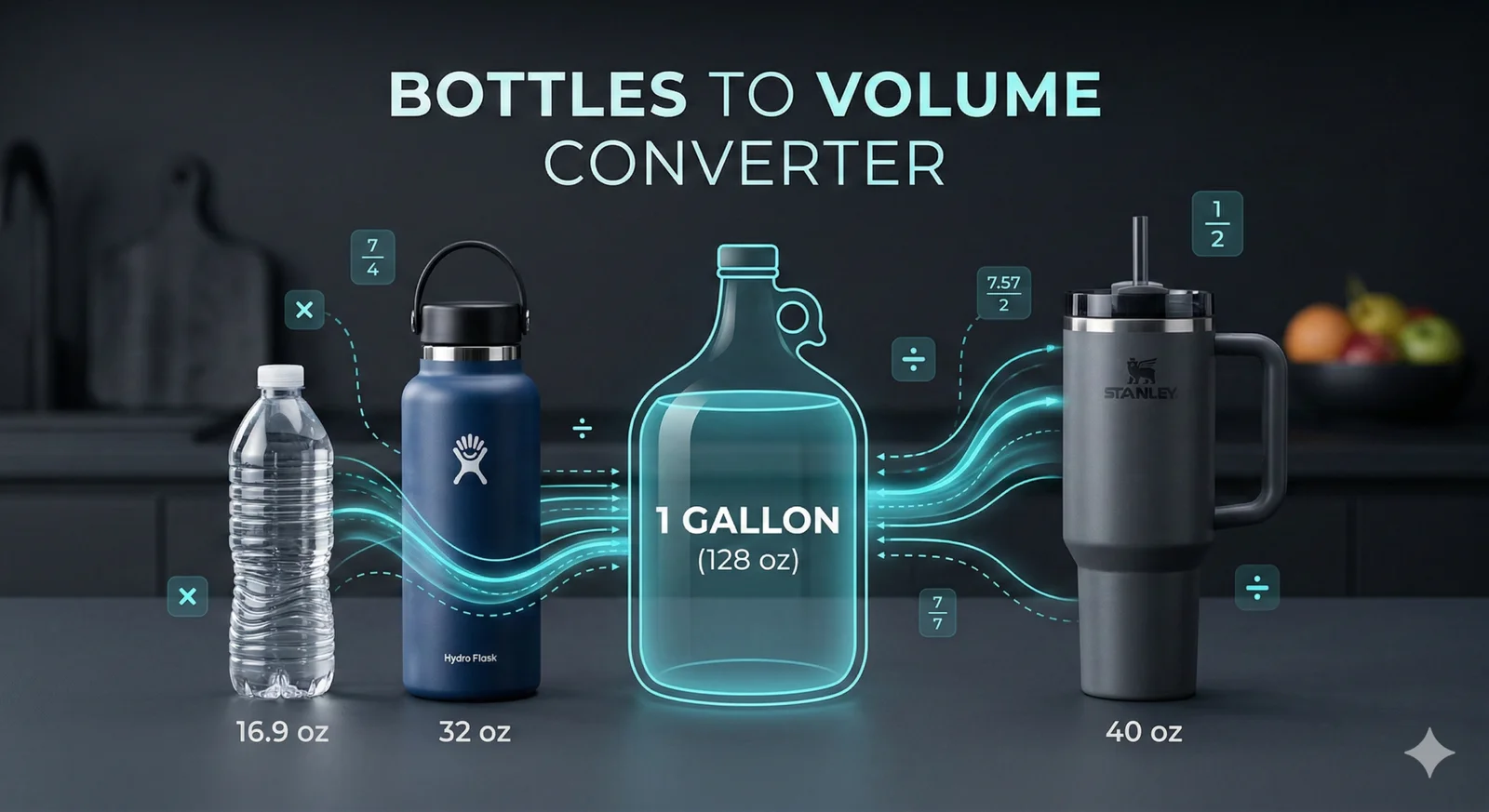
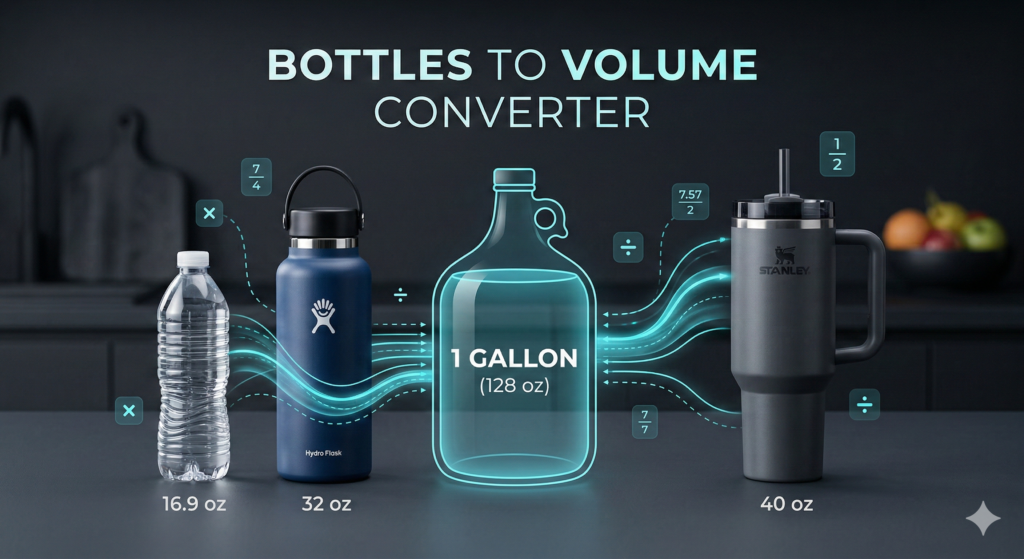
This is the question that brings most hydration searchers to a conversion page. The formula is dead simple: Bottles per gallon = 128 ÷ bottle size (in fl oz). The number is rarely whole. Round up for practical refills.
| Bottle Size | Math | Exact Bottles | Practical Count | Notes |
|---|---|---|---|---|
| 8 oz (kid / mini) | 128 ÷ 8 | 16 | 16 | The “8×8 rule” of 8 glasses ≈ ½ gallon |
| 12 oz (slim can size) | 128 ÷ 12 | 10.67 | ~11 | Last bottle two-thirds full |
| 16 oz (sport) | 128 ÷ 16 | 8 | 8 | Clean whole number |
| 16.9 oz / 500 mL (standard disposable) | 128 ÷ 16.9 | 7.57 | ~8 | The famous “8 bottles” answer; 8th ≈ 57% full |
| 20 oz (insulated) | 128 ÷ 20 | 6.4 | ~7 | Last bottle ~40% full |
| 24 oz | 128 ÷ 24 | 5.33 | ~6 | Last bottle one-third full |
| 32 oz (large flask) | 128 ÷ 32 | 4 | 4 | Clean whole number; one quart each |
| 40 oz (tumbler) | 128 ÷ 40 | 3.2 | ~4 | Last refill 20% to top off |
| 64 oz (half-gallon jug) | 128 ÷ 64 | 2 | 2 | Two refills = one gallon |
🛒 Bottle Sizes That Make Hitting a Gallon Easier
If your daily goal is a gallon, the bottle size you choose decides how often you refill. Bigger bottles mean fewer trips to the sink, but they trade portability and dishwasher-rack space. Here is how the four most popular categories break down. Features and benefits only — confirm current availability and pricing on the retailer site, since both move.
The hydration-tracker sweet spot. Double-walled vacuum insulation keeps water cold for 24+ hours in most quality models. Wide-mouth options accept ice cubes; flip-straw lids work one-handed at the gym. Stainless interior resists flavor transfer.
The “tumbler” form factor — handle, straw, cupholder-friendly base. Reduces refills versus a 20 oz bottle by half, which matters in long meetings, road trips, or full workdays. Look for a tight gasket if you sling it in a bag.
Half-gallon jugs — two of them and you are done for the day. Time markers printed up the side give you intra-day milestones. Heavier when full (about 4 lb of water), so a padded handle or shoulder sleeve helps.
The full gallon jug. One fill in the morning is the whole day. Best at a desk, in a car, or by a treadmill — not for commuting. Look for a built-in straw, an external handle, and BPA-free Tritan or food-grade stainless construction.
Stainless steel (18/8), BPA-free Tritan, silicone seals, dishwasher-safe lid. Insulated walls if you want temperature stability.
Mouth opening (ice cubes need ≥ 2″), strap or handle quality, replacement-part availability for gaskets and straws.
Bottles that don’t disclose material grade, single-walled metal in hot climates (sweats), and lids without a sealing gasket — they leak in bags.
🧮 How to Convert Ounces to Gallons (and Gallons to Ounces)
One conversion factor, two directions. Memorize 128 (US) or 160 (UK) and you are done.
Three Worked Examples
- Recipe scaling. A brine calls for 3 quarts of water but your Dutch oven is calibrated in gallons. 3 ÷ 4 = 0.75 gallon. Or in ounces, 3 × 32 = 96 fl oz.
- Daily hydration. Your goal is 1 gallon. Your bottle is 24 oz. 128 ÷ 24 = 5.33, so you need 6 refills with the last bottle a third full.
- Kombucha brewing. The first ferment calls for 1.25 gallons of sweet tea. 1.25 × 128 = 160 fl oz, or about 4.73 L — useful when your kettle is metric.
💧 Should You Drink a Gallon of Water a Day?
The internet says yes. The science says it depends. Here is the sourced version.
The National Academies of Sciences, Engineering, and Medicine (NASEM) recommends a total daily water intake of roughly 125 fl oz (3.7 liters) for adult men and 91 fl oz (2.7 liters) for adult women. That total includes water from food and all beverages, not just from your bottle. Most adults get about 20% of their water from food, which means actual fluid intake targets are closer to 100 oz for men and 73 oz for women — still less than a full gallon.
The popular “8×8 rule” — eight 8-ounce glasses a day — adds up to 64 fl oz, or exactly half a gallon. It is a rule of thumb, not a clinical recommendation. The Mayo Clinic notes that thirst, urine color, and activity are better day-to-day signals than chasing a fixed number.
Drinking a literal gallon (128 oz) per day is well above the average adult requirement but is widely practiced by athletes, manual laborers, and people in hot climates. For most desk-bound adults it offers diminishing returns, and in rare cases excessive water with no electrolytes can cause hyponatremia. Use your bodyweight, activity level, climate, and how you feel as the real guide.
🥣 Ounces and Gallons in Cooking, Baking & Brewing
Kitchen math runs on small numbers. You almost never need a full gallon at home, but you constantly need to convert between cups, pints, quarts, and fluid ounces — and that whole ladder lives inside the gallon.
A full gallon brewed pitcher needs about 8 cups of brewed concentrate plus ice. The classic Southern ratio is 1 cup sugar per gallon.
Most starter recipes call for a 1-gallon vessel. Use the converter for the 1.25-gallon and 2-gallon scale-ups when your SCOBY grows.
A standard 4-quart stockpot is exactly 1 gallon. A 6-quart Dutch oven is 1.5 gallons. The number on the lid is your fastest cheat sheet.
A gallon container holds 128 fl oz by volume, but it weighs less than water (around 4.5 lb) because of trapped air whipped into the mix.
Recipe scaling is the highest-use case for the gallon-ounce conversion. A recipe doubled from 1 quart to 2 quarts becomes 64 fl oz. Tripled, 96 fl oz. Quadrupled, you have 128 fl oz — one full gallon. That ladder of 32 / 64 / 96 / 128 is worth memorizing for anyone who batches.
🥛 Does It Matter What Liquid Is in the Gallon?
For volume, no. A gallon is a gallon. 1 US gallon of water, milk, juice, gasoline, motor oil, or any other liquid all equal 128 fluid ounces by volume. The container holds what the container holds.
For weight, yes — and this is where searches like “how much does a gallon of milk weigh” come from.
| Liquid | Volume | Weight per Gallon | Notes |
|---|---|---|---|
| Water (room temp) | 128 fl oz | ≈8.34 lb (3.78 kg) | The USGS reference value. Slightly heavier when colder. |
| Whole Milk | 128 fl oz | ≈8.6 lb (3.9 kg) | Denser than water due to fat and protein content. |
| Ice Cream | 128 fl oz | ≈4.5 lb (2.0 kg) | Air (“overrun”) whipped into the mix drops the weight dramatically. |
| Gasoline | 128 fl oz | ≈6.0 lb (2.7 kg) | Less dense than water, which is why oil and gas float. |
| Honey | 128 fl oz | ≈11.8 lb (5.4 kg) | One of the densest household liquids by volume. |
When someone asks “how many ounces in a gallon of milk,” they almost always mean fluid ounces — and the answer is the same as water: 128. If they mean weight, the answer is about 8.6 lb (137.6 oz). Context tells you which one they need.
Temperature nudges water weight slightly, because it changes density. A US gallon of water weighs about 8.34 lb at ~70 °F (room temperature, the standard USGS figure), a hair more — roughly 8.345 lb — near 39 °F (4 °C, where water is densest), and a touch less when hot. The whole swing across normal temperatures is only a fraction of an ounce, which is why 8.34 lb is the number to remember.
📜 A Short History: Why a Gallon Has 128 Ounces
The number 128 looks weirdly arbitrary. The history behind it explains why.
The English word “ounce” comes from the Latin uncia, meaning “a twelfth.” A Roman pound (the libra) was divided into twelve unciae, which is also where the abbreviation “oz” eventually comes from (via the Italian onza). The same root gives us the word “inch” — twelve to the foot.
The word “gallon” traces back through Old Northern French galon to Late Latin galleta, possibly with Gaulish roots in galla, a vessel. By the late medieval period, England had several gallons running in parallel — the wine gallon, the ale gallon, and the corn (dry) gallon — all different sizes for different goods.
In 1707, Queen Anne formalized the English wine gallon at 231 cubic inches. When the American colonies inherited British measures, they kept this wine gallon. After independence, the US standardized it as the official US liquid gallon. That choice locked in 128 fluid ounces as the answer in America forever.
Britain, meanwhile, replaced its mess of historical gallons with the Imperial gallon in 1824. They defined it cleanly as the volume of ten pounds of distilled water at 62 °F. That definition standardized to 4.54609 liters and 160 imperial fluid ounces. Two countries, two histories, two numbers.
Modern measurements lock both definitions to the metric system: the US fluid ounce is exactly 29.5735295625 mL by law, and the imperial fluid ounce is exactly 28.4130625 mL. The conversion factors haven’t budged since the 1959 international yard and pound agreement, which is why you can trust the calculator above to be precise to the milliliter.
📋 The One-Screen Cheat Sheet
- 1 US gal = 128 fl oz
- 1 UK gal = 160 fl oz
- ½ gal = 64 fl oz
- 1 qt = 32 fl oz
- 1 pt = 16 fl oz
- 1 cup = 8 fl oz
- 1 US gal = 3.785 L
- 1 US fl oz = 29.5735 mL
- Bottles/gal = 128 ÷ size
- 16.9 oz · ~8 bottles/gal
- Weight · 1 gal H₂O ≈ 8.34 lb
- 8×8 rule = ½ gallon
❓ Frequently Asked Questions
A US gallon holds 128 fluid ounces. An Imperial (UK) gallon holds 160 imperial fluid ounces. The US version is the default any time you see “gallon” on a label, recipe, or hydration plan in the United States.
No. 64 fluid ounces is exactly half a US gallon. A full US gallon is 128 fl oz. The 64 oz misconception comes from large flask bottles often being labeled “½ gal” or “half gallon.”
About 7.57 bottles (128 ÷ 16.9). Since you cannot pour a fraction of a bottle, you need 8 standard 16.9 oz (500 mL) bottles to fill or exceed one gallon. The eighth bottle will end up roughly 57% full.
64 US fluid ounces. That equals 2 quarts, 4 pints, 8 cups, or 1.893 liters. In Imperial measurement, half a UK gallon is 80 imperial fluid ounces.
An Imperial (UK) gallon equals 160 imperial fluid ounces, which is 4.54609 liters. It is about 20% larger than the US gallon, which is why the two numbers (128 vs 160) appear all over the internet.
1 US gallon = 16 cups = 8 pints = 4 quarts = 128 fluid ounces. Walk down by half each step (128 → 64 → 32 → 16 → 8) and you have gallon, half-gallon, quart, pint, and cup in order.
Multiply each by 128. 2 gallons = 256 oz. 3 gallons = 384 oz. 4 gallons = 512 oz. 5 gallons = 640 fluid ounces. 10 gallons is 1,280 oz.
By volume, all three are 128 fl oz per US gallon — the container size is what matters, not the contents. By weight, water is ~8.34 lb/gal, whole milk is ~8.6 lb, and ice cream is only ~4.5 lb because the manufacturing process whips in air (“overrun”).
Sixteen. 128 ÷ 8 = 16. That is why the popular “8×8 rule” (8 glasses of 8 oz) adds up to 64 oz — exactly half a gallon.
About 8.34 pounds (3.785 kg) at room temperature, according to the USGS. Cold water is slightly denser and weighs a touch more; warm water is slightly lighter.
A US dry gallon contains roughly 148.95 US dry ounces (≈4.405 liters, or 268.8 cubic inches). The dry gallon is mostly used in agriculture for grain and produce, not in everyday liquid measurement.
Because the US gallon is defined as 231 cubic inches — the old English wine gallon standardized in 1707. That cubic-inch definition divides cleanly into 128 fluid ounces, which is itself a clean power of two (2⁷). Britain redefined its gallon in 1824 as the volume of 10 lb of water, which produced the 160-ounce imperial version instead.
1 US gallon = 3.785411784 liters. 1 Imperial gallon = 4.54609 liters. Going the other way, 1 liter ≈ 0.264 US gallons or 0.220 Imperial gallons.
For most healthy adults, drinking a gallon a day is safe and well above general intake guidance (NASEM recommends ~125 oz for men, ~91 oz for women total fluid). It can support athletes, manual workers, and people in hot climates. Pregnancy, kidney conditions, and certain medications change requirements — consult a healthcare professional before chasing a gallon-a-day goal.
“gal” is the standard abbreviation. “fl oz” or “oz” is used for fluid ounce. You will sometimes see “US gal” vs “imp gal” to disambiguate the two systems, especially on imported products.