
What Is a Hydrogen Water Bottle? How It Works, What the Science Says & What to Avoid
Updated September 5, 2026 — rechecked against the 2024 IJMS systematic review, FDA GRAS notice GRN 520, and current SPE/PEM testing practice.
The technology is real, and the chemistry behind it is ordinary, well-established fuel-cell chemistry. The industry is where the scam problem lives: independent testing repeatedly finds cheap bottles delivering a fraction of what their labels claim, and the 2024 systematic review that looked hardest at the evidence flagged possible commercial bias in what gets published. So the useful question is not whether hydrogen water works. It is whether the particular bottle in front of you produces what it claims, and whether the size of the effect is worth the money to you. This guide answers both.
If you’ve spent five minutes on wellness TikTok in the past year, you’ve seen them. The glowing blue bottles. The post-workout shots. The “this changed my life” testimonials from people who, you suspect, also drink celery juice for breakfast. Somewhere between the legitimate science and the influencer-grade hype, a real question got buried: what is a hydrogen water bottle actually doing, and is any of it worth your money?
I’ve spent a long time with the peer-reviewed literature on molecular hydrogen (the studies that aren’t sponsored by sellers), with the independent lab reports the better brands publish, and with H2Blue titration, the cheap home test that shows what a bottle is really delivering. This guide is everything I’d want a friend to know before they spent a cent on one. If you already know the science and just want the shortlist, our best hydrogen water bottles roundup is the shortcut.
Key Takeaways
- What it is: A portable hydrogen water generator that uses electrolysis to dissolve molecular hydrogen (H₂) into your drinking water at concentrations measured in PPM or PPB.
- How it works: SPE/PEM technology splits water at platinum-coated titanium electrodes, vents the oxygen byproduct through a dual-chamber system, and forces H₂ into solution under pressure (per Henry’s Law).
- The science: The molecular-hydrogen literature now runs past 1,000 papers, and a 2024 systematic review of 25 human trials found that hydrogen acts as a selective antioxidant that neutralizes only the most toxic free radicals (hydroxyl radicals), not the ones your body needs.
- The catch: Dissolved hydrogen escapes fast. The water must be consumed within 20–30 minutes for full benefit, and you need a quality SPE/PEM bottle (not a cheap chemical-reaction unit) for any of this to matter.
- Worth it? If you’ll actually use it daily and buy from a brand with independent lab testing, yes. Otherwise it joins your foam roller in the closet.
Hydrogen Water Bottle Explorer
Five tabs. Real data from peer-reviewed studies and SPE/PEM lab tests. No marketing spin.
FILL
300–500 ml filtered or RO water. Tap water introduces chlorine your PEM has to fight.
ELECTROLYZE
Microprocessor-controlled current splits water into H₂ at the cathode and O₂ at the anode, across platinum-coated electrolysis plates.
SEPARATE
The Nafion PEM lets only protons through. O₂, ozone and chlorine vent out the second chamber.
DRINK
Sealed headspace fills with pure H₂ and Henry’s Law pushes it into solution. Drink within 20–30 min.
Set how many minutes have passed since your bottle finished its cycle. The dissolved H₂ concentration drops as gas escapes through the seal and (faster) once you open the lid.
Hydrogen Water
- Active ingredient: dissolved molecular hydrogen gas (H₂)
- Mechanism: selective antioxidant — neutralizes hydroxyl radicals only
- pH: neutral to mildly alkaline
- Evidence: 1,000+ peer-reviewed studies
- Effect duration: dose-dependent; H₂ exits the body fast
Alkaline Water
- Active ingredient: minerals raising pH (8.5–10+)
- Mechanism: buffers stomach acid; minerals act on systemic pH minimally
- pH: 8.5–10+ (electrolyzed reduced water, ERW)
- Evidence: limited and mixed
- Risk note: pH > 9.8 ERW linked to hyperkalemia risk
Molecular hydrogen has one of the cleanest safety records in functional beverages. In 2014 the FDA raised no objection to a GRAS notice for hydrogen gas as a food ingredient (GRN 520). That is the agency saying it has no questions about the safety conclusion, not an approval. A 2024 systematic review in the International Journal of Molecular Sciences screened 590 records, analyzed 25 human studies, and found hydrogen water “mostly considered safe, with no to minimal side effects,” with no cytotoxicity even at higher concentrations.
Who should be cautious
What Is a Hydrogen Water Bottle?
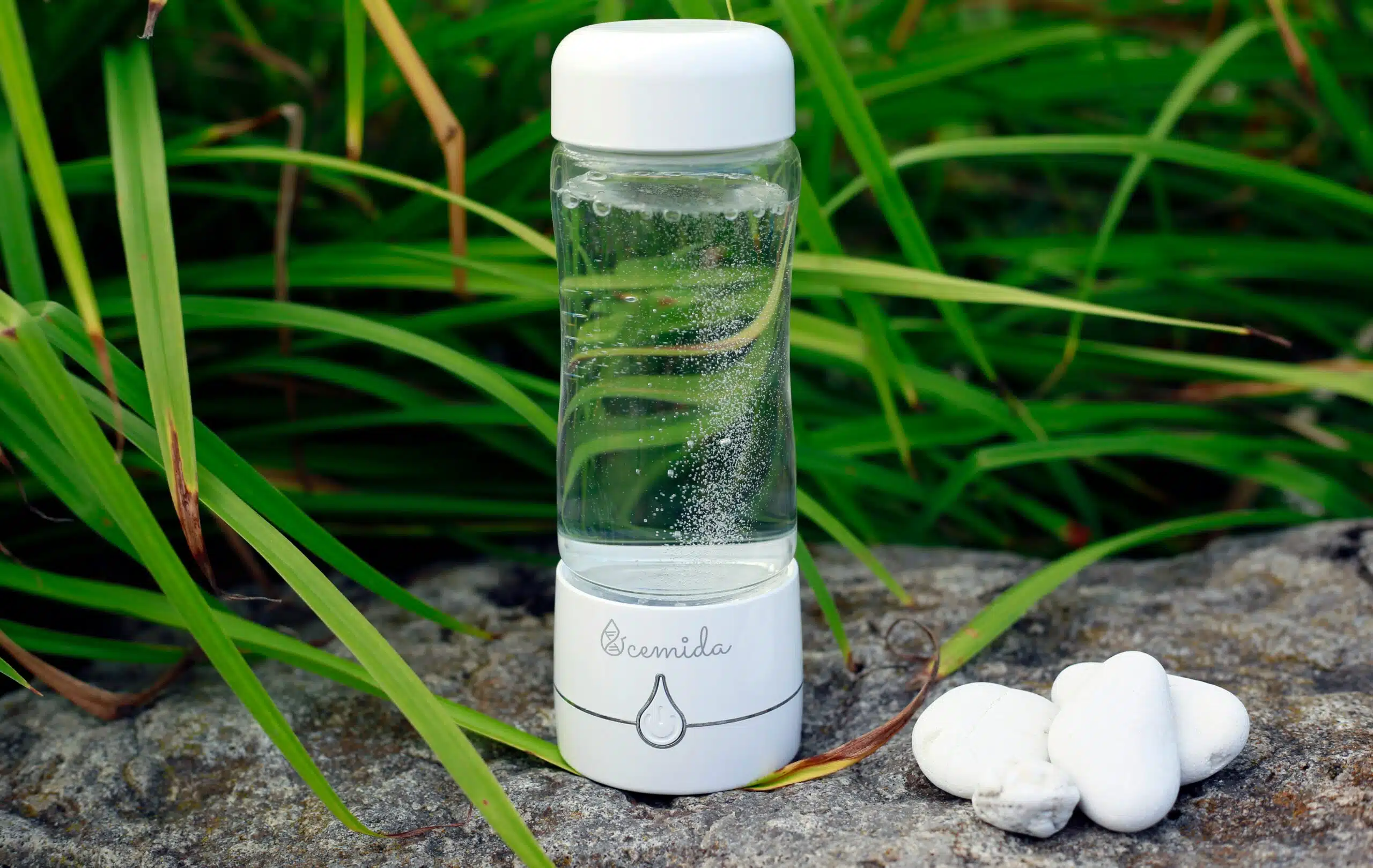
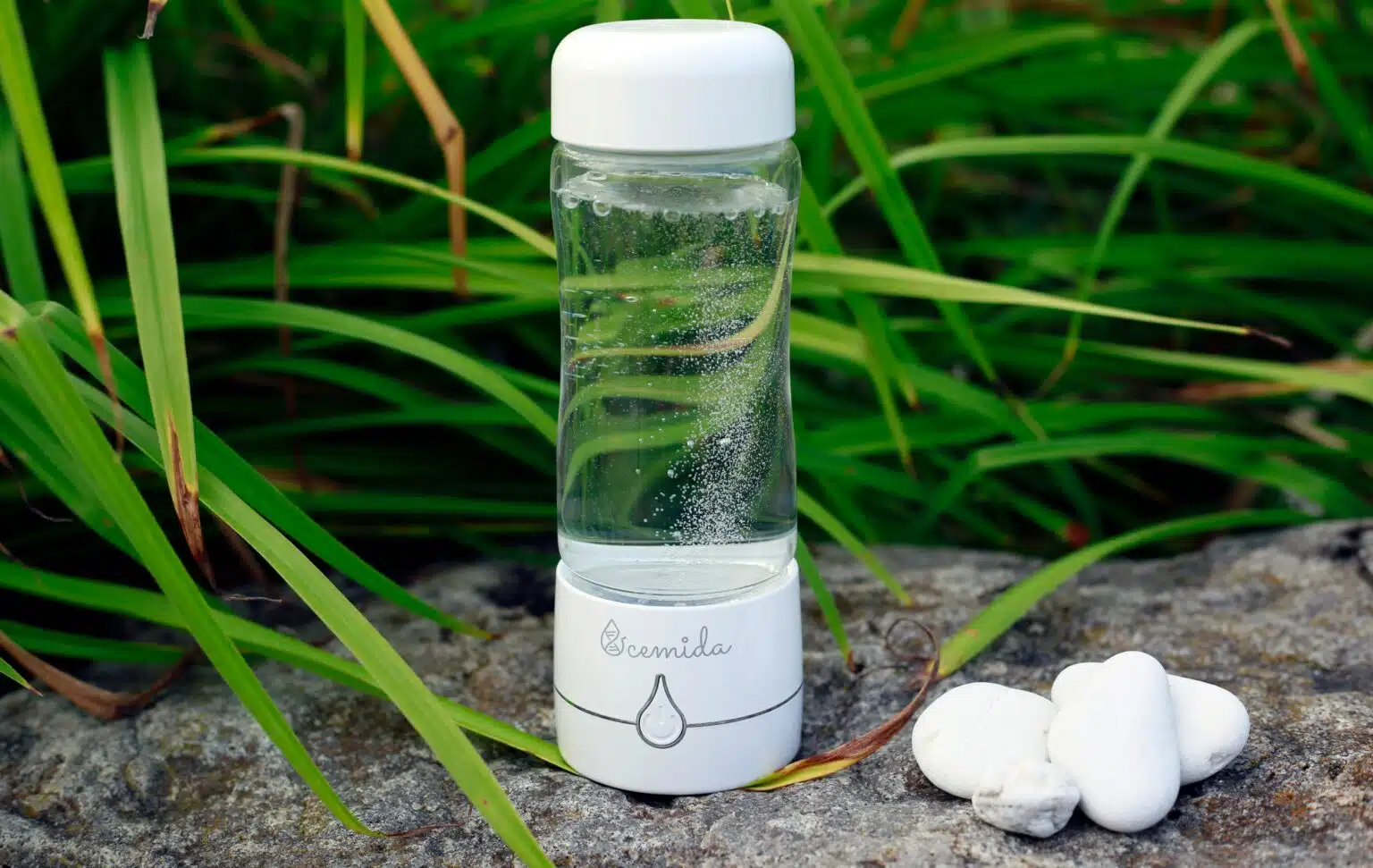
A hydrogen water bottle is a small, rechargeable appliance that turns ordinary drinking water into hydrogen-infused water on demand. The device looks like a stainless-steel travel bottle with a glowing base, holds 300–500 ml (about 10–17 oz) of water, and connects to USB charging like a phone. Press a button, and inside the bottle a tiny electrolysis chamber pulls apart water molecules (H₂O) and dissolves the resulting hydrogen gas (H₂) back into the water you drink. The oxygen byproduct is routed out a separate vent so it never enters your glass.
The resulting drink is called hydrogen-rich water, hydrogenated water, or hydrogen-infused water. They all mean the same thing: water with measurable concentrations of dissolved molecular hydrogen, expressed in either parts per million (PPM) or parts per billion (PPB). 1 PPM = 1,000 PPB. Marketing prefers PPB because 1,400 PPB reads bigger than 1.4 PPM, and it is the same number. A well-built portable hydrogen water bottle delivers somewhere between 0.8 and 2.0 PPM per cycle. Cheap chemical-reaction units sometimes claim 5,000+ PPB on the label and deliver less than a tenth of that when tested independently.
The category sits next to two cousins you’ll see in the same wellness aisle: water ionizers (countertop appliances that produce alkaline water, sometimes with H₂ as a side effect) and hydrogen tablets (effervescent tabs that release H₂ via a magnesium-rod chemical reaction, covered in our hydrogen water bottle vs hydrogen tablets head-to-head). Bottles win on portability and consistency. Ionizers win on volume. Tablets win on shelf life but lose on dose control.
“Hydrogen water” does not mean water-with-extra-hydrogens. Plain H₂O already has hydrogen atoms covalently bound to oxygen. The difference is dissolved molecular hydrogen gas (H₂) — two hydrogen atoms loosely held in solution, free to do their antioxidant work in your body.
What it does
- Dissolves molecular hydrogen (H₂) into ordinary water on demand
- Runs off a rechargeable battery, so it works away from a socket
- Vents oxygen, ozone and chlorine away from the chamber you drink from
- Gives a repeatable dose you can check at home with test drops
What it doesn’t do
- Filter or purify water. Put clean water in.
- Meaningfully raise pH. It is not an alkaline ionizer.
- Add minerals, electrolytes or vitamins.
- Improve hydration. Hydrogen-rich water hydrates exactly as well as the water you poured in, no better and no worse. The H₂ is a separate thing riding along in it.
- Treat, cure or prevent any disease.
Who actually buys one? Three groups, mostly. Endurance and strength athletes, where the evidence for reduced exercise fatigue is strongest. People managing an inflammatory or metabolic condition alongside their medical care, never instead of it. And anyone already buying pre-bottled hydrogen water who wants to stop paying several dollars a serving for it. It is not established for use in pregnancy or in children.
If you’re after a deeper walkthrough of the engineering, our companion guide how does a hydrogen water bottle work goes into the chemistry step-by-step. Everything else we publish on the category is collected in our hydrogen water bottle hub.
How Does a Hydrogen Water Bottle Work?
Here’s the short version: a hydrogen water bottle runs a controlled electrical current through the water in its base. That current splits H₂O into hydrogen and oxygen at two electrodes. The hydrogen ends up dissolved in your drink. The oxygen gets routed out a separate chamber so it never lowers the H₂ saturation of your water.
Doing that without electrocuting you, and without leaving chlorine and ozone in the water, is the part worth understanding.
The chemistry: water molecule splitting
Electrolysis runs on a simple reaction: pass DC current through water, and at the negative electrode (the cathode) you get hydrogen reduction — two H⁺ ions pick up two electrons and combine into H₂ gas. At the positive electrode (the anode) you get oxidation — water loses electrons and releases O₂ gas, plus trace ozone and (if there’s any chlorine in your water) some Cl₂.
That last part is why budget bottles can’t be trusted. Cheap “electrolysis” units don’t separate the products. They generate H₂ and O₂ and Cl₂ in the same chamber, then ask you to drink the mixture. You don’t want that.
Why Henry’s Law decides whether this works at all
Hydrogen has the lowest solubility of any common gas. At normal atmospheric pressure, water at room temperature can dissolve roughly 1.6 PPM of H₂ before it just escapes back into the air. To hold a useful dose long enough for you to drink it, the bottle has to seal. What the seal buys you is purity rather than brute pressure. In an open glass the H₂ escapes into an atmosphere that is essentially hydrogen-free; seal the lid and the headspace fills with pure hydrogen at a little above atmospheric pressure. That’s Henry’s Law in action: dissolved gas concentration is proportional to the partial pressure of that gas above the liquid, so roughly one atmosphere of pure H₂ gives you about 1.6 PPM, which is exactly the range a good portable bottle delivers.
This is also why a bottle with a loose lid, a cracked seal, or a worn gasket produces useless water. The pressure escapes, the hydrogen escapes with it, and you’re drinking marketing copy.
The four stages, in order
- Fill with filtered water
Filtered or reverse-osmosis water gives the cleanest electrolysis. Tap water works but loads the PEM with chlorine the membrane has to deal with. Distilled water is too pure. Without dissolved minerals the reaction runs slowly. - Trigger the 3–10 minute cycle
A microprocessor-controlled circuit ramps the current up gradually. You’ll see indicator LEDs, an OLED display, or sometimes a haptic buzz when the cycle ends. Cheaper bottles dump full current immediately and burn out faster. - Separate at the membrane
The SPE/PEM membrane between the two chambers conducts protons (H⁺) one way while blocking everything else. The hydrogen forms in the drink chamber. The oxygen, ozone, and any chlorine vent out a one-way pressure valve. - Drink within the window
Once you crack the lid, the pressure equalises with the atmosphere and H₂ starts off-gassing. Drink within 20–30 minutes to get most of the dose. Sealed and refrigerated, you keep useful concentrations for several hours.
If you’d rather skip the bottle and try the DIY route: our how to make hydrogen water at home guide covers magnesium-rod methods, tablets, and the (very small) list of methods that genuinely produce H₂ at therapeutic concentrations.
SPE/PEM Technology: The Only Standard That Matters
“SPE/PEM” is plastered across hydrogen water bottle marketing the way “non-stick” is on pans. The acronyms stand for Solid Polymer Electrolyte and Proton Exchange Membrane, and they describe the single most important piece of technology inside any legitimate bottle. Without it, you’re not buying a hydrogen water generator. You’re buying a glorified flashlight that fizzes.
Where it came from
PEM technology isn’t new. NASA and General Electric developed proton exchange membranes in the 1960s for the Gemini space program — they needed a way to generate oxygen and electricity inside a spacecraft. The same fuel-cell chemistry now powers everything from hydrogen vehicles to portable hydrogen water bottles. The dominant membrane material, DuPont Nafion, is a sulfonated fluoropolymer that conducts protons but blocks gases and electrons. It’s the same membrane material inside a Toyota Mirai’s fuel cell. Just smaller.
What it actually does
The membrane sits in the middle of the bottle’s electrolysis cell, sandwiched between the two electrodes in what’s called a Membrane Electrode Assembly (MEA). The cathode side is typically titanium coated with platinum. The anode side is platinum-coated titanium too, or sometimes iridium-oxide for longer life. When current flows, the membrane does three jobs at once:
- Proton conduction: H⁺ ions migrate from anode to cathode through the membrane to complete the circuit, where they pick up electrons and form H₂.
- Gas separation: The dense fluoropolymer blocks O₂ molecules from crossing back, keeping the hydrogen chamber free of oxygen.
- Ion exchange and filtration: Free chlorine in tap water gets oxidized and largely separated to the vent chamber. The Nafion structure also blocks heavier contaminants from migrating to the drink side.
SPE/PEM vs cheap electrolysis bottles
Real SPE/PEM bottle
- Dual-chamber design with physical oxygen vent port
- Platinum-titanium electrode plates
- DuPont or equivalent Nafion membrane
- Microprocessor-controlled current ramp
- Independent lab-tested PPM output
Budget chemical-reaction bottle
- Single chamber — you drink the H₂ and the O₂, ozone and Cl₂
- Stainless or graphite electrodes that corrode
- No real membrane, sometimes just a plastic divider
- Full current always on — short lifespan
- PPB claims based on theoretical maximum, not measurement
If a bottle costs around the price of a takeaway pizza, it does not have a Nafion membrane. The membrane material alone costs more than that. If the marketing avoids the words “SPE” and “PEM” entirely, assume it doesn’t have either.
Health Benefits of Hydrogen Water (What the Science Says)
The research base for molecular hydrogen is bigger than most people expect. The pivotal paper is Ohsawa et al., published in Nature Medicine in 2007. It showed that inhaled H₂ selectively neutralized the most cytotoxic reactive oxygen species (ROS) — hydroxyl and peroxynitrite radicals — without scavenging the beneficial ROS your immune system uses for cell signalling. That “selective antioxidant” mechanism is what makes hydrogen interesting. Vitamin C, glutathione and other classic antioxidants are blunt instruments by comparison; they hit good radicals along with the bad.
Since 2007, the published literature has grown to over 1,000 peer-reviewed studies. A 2023 review covering 80+ clinical trials and a 2024 systematic review of human randomized controlled trials (RCTs) reach the same broad conclusion: molecular hydrogen has measurable anti-inflammatory and antioxidant effects across multiple body systems, with an exceptionally clean safety profile. The effects are real. The size of the effect is moderate, not miraculous.
Clinical evidence at a glance
Scroll the table sideways to see every column.
| Condition / Outcome | Study Type | Year | Result | Evidence |
|---|---|---|---|---|
| Oxidative stress markers (general) | Meta-analysis | 2023 | Significant reductions in MDA, 8-OHdG | Strong |
| Exercise fatigue & recovery | RCTs (athletes) | 2012–2024 | Reduced lactate, faster recovery | Strong |
| Metabolic syndrome / A1c | RCTs | 2010–2023 | Modest A1c & cholesterol reductions | Moderate |
| NAFLD (fatty liver) | RCTs | 2017, 2024 | Improved liver enzymes | Moderate |
| Mood / anxiety symptoms | RCTs | 2020–2023 | Reduced anxiety scores, inflammatory cytokines | Moderate |
| Radiation therapy side effects | RCT (cancer pts) | 2011, 2021 | Reduced fatigue, improved QoL | Moderate |
| COVID-19 inflammatory response | Multiple trials | 2020–2022 | Reduced cytokine storm markers | Emerging |
| Angina & cardiovascular markers | Pilot studies | 2018–2023 | Reduced inflammation, mixed clinical endpoints | Emerging |
| Kidney function / dialysis support | Small RCTs | 2012–2020 | Improved tolerability of dialysis | Emerging |
| Anti-aging (skin, cellular markers) | Small studies | 2017–2022 | Some skin elasticity gains | Early |
What the research consistently supports
Selective antioxidant action
H₂ neutralizes hydroxyl radicals, the most damaging reactive oxygen species and the ones that leak from mitochondrial energy production and from inflammation, without touching the ROS your body uses for normal cell signalling. This is the unique mechanism. No other dietary antioxidant works this way.
Anti-inflammatory effects
Multiple studies show H₂ reduces activation of the NF-κB pathway, which is the master switch for inflammatory cytokine production. Inflammatory markers like TNF-α and IL-6 drop in trial after trial. It also appears to reduce apoptosis (cell death) in immune cells under oxidative stress.
Athletic performance and recovery
Studies on athletes consistently show reduced exercise fatigue, lower blood lactate after intense effort, improved muscle recovery and modest gains in exercise endurance. The effect is most reliable in trained subjects performing high-intensity work, which is where it has been measured most often.
Metabolic health
Several RCTs report improvements in metabolic syndrome markers: small A1c reductions in pre-diabetic and Type 2 diabetic patients, modest cholesterol improvements, and improvements in liver enzymes in NAFLD. Effect sizes are moderate, not life-changing on their own.
Gut health and cognitive function
Your gut bacteria naturally produce small amounts of hydrogen during fiber fermentation, which is part of why hydrogen-rich water seems to be well tolerated and may support a healthier microbiome. Trials on cognitive function show smaller effects than the anti-inflammatory data — improvements in subjective alertness and some objective working-memory measures, especially in older adults.
If you’d like the full deep-dive on benefits and the underlying biochemistry, our long-form article hydrogen water bottle benefits walks through every category with source citations.
What about energy, sleep and brain fog?
These three are the loudest claims in hydrogen-water marketing and the thinnest part of the evidence base. Reduced exercise fatigue is well supported in trained athletes. Subjective alertness and some working-memory measures improved in small trials, mostly in older adults. Sleep quality has essentially no controlled evidence. And “brain fog” is not a measured clinical endpoint at all; where it turns up in trials it is captured as fatigue or mood. If a brand’s headline is “more energy, better sleep, no more brain fog”, that is marketing running well ahead of the literature.
Honest scientific limitations
Most studies are small. Many run for 8–12 weeks, which isn’t long enough to draw conclusions about chronic disease prevention. Relatively few are double-blind and placebo-controlled, and the 2024 systematic review explicitly flags possible commercial bias in what gets published. The minimum effective dose most commonly cited in the literature is 0.5 mg of H₂ per liter (0.5 PPM) per day, but very few studies have rigorously tested whether more is better. The Molecular Hydrogen Institute (MHI) and the International Hydrogen Standards Association (IHSA) both note that delivery method, total daily dose (PPM multiplied by volume), and consistency over weeks matter more than peak concentration on a marketing label.
The effects described here come from early and still-emerging research. Hydrogen water is not a medicine and is not intended to diagnose, treat, cure or prevent any disease. Nothing on this page is medical advice. Always consult a qualified healthcare professional, especially if you have an existing health condition, are pregnant or nursing, or take regular medication.
How Long Does Hydrogen Stay in Water? (The Decay Problem)
Want to try the numbers yourself? The decay timer in the interactive explorer higher up this page runs on exactly the figures in this section.
This is the single most under-explained part of hydrogen water — and the easiest place to waste money. Dissolved H₂ doesn’t stay dissolved. Once the bottle finishes its cycle, the hydrogen starts leaving solution the moment internal pressure drops. The rate depends on temperature, seal integrity, and how often you open the lid.
Dissolved H₂ Over Time (Sealed, Room Temp)
- Drink within 20 minutes for the bulk of the dose. After 30 minutes you’ve lost half your H₂.
- Sealed, it fades more slowly — but not for hours. A bottle with a good gasket holds above the 0.5 PPM minimum effective dose for roughly an hour, and is down to about a tenth of peak by four hours. Refrigeration slows it, but nothing on the market holds a therapeutic dose overnight. That is the honest limit of the format.
One more thing worth knowing: most of the H₂ you ingest is exhaled within 60 minutes. That’s not a flaw — it’s the mechanism. Hydrogen does its antioxidant work, then leaves your body as exhaled gas. Which means consistency matters more than concentration. One small dose in the morning beats heroic gulps once a week.
Hydrogen Water vs Alkaline Water
People confuse these two constantly, and the marketing doesn’t help. Hydrogen water and alkaline water are not the same thing — they work via entirely different mechanisms, even though some appliances claim to produce both. Here’s the side-by-side.
Scroll the table sideways to see every column.
| Attribute | Hydrogen Water | Alkaline Water |
|---|---|---|
| Active ingredient | Dissolved molecular hydrogen (H₂) | Minerals raising pH (Ca²⁺, Mg²⁺, K⁺, Na⁺) |
| pH | Neutral to mildly alkaline (7.0–8.5) | 8.5–10+ (electrolyzed reduced water, ERW) |
| Mechanism | Selective antioxidant; neutralizes hydroxyl radicals | Buffers stomach acid; raises body pH minimally |
| Strongest evidence | Anti-inflammation, exercise recovery, oxidative stress | Reflux symptom relief, limited systemic data |
| Production method | SPE/PEM electrolysis under pressure | Ionizer or added mineral concentrate |
| Effect duration | ~60 min (most H₂ exhaled) | Until stomach acid neutralizes buffer |
| Safety concern | None significant at standard doses | pH > 9.8 may raise hyperkalemia risk in some users |
| Typical price (device) | Portable bottles generally $80–$250 (2026) | Countertop ionizers generally $500–$3,000 (2026) |
If you only care about one mechanism, hydrogen has the science. Alkaline water has anecdote, a small evidence base for digestive comfort, and a meaningful safety caveat at the high end of the pH range. Plenty of bottles market both at once, the Gosoit among them, so read closely to see which of the two claims a brand actually substantiates.
Bottle vs tablets vs pre-bottled vs inhalation
A bottle is not the only way to get molecular hydrogen, and the decay problem above is what decides between the options. Here is how the four compare.
Scroll the table sideways to see every column.
| SPE/PEM bottle | Hydrogen tablets | Pre-bottled water | Inhalation | |
|---|---|---|---|---|
| How the H₂ gets in | Electrolysis, on demand | Magnesium-rod chemical reaction | Dissolved at the factory | Breathed directly from a generator |
| Typical dose delivered | 0.8–2.0 PPM per cycle | Can peak higher, but varies batch to batch | Depends entirely on packaging and shelf time | Not measured in PPM; dose is set by flow rate and session length |
| Dose control | Good and repeatable | Poor, and adds a magnesium load | Unknowable once it has sat on a shelf | Good, but equipment-dependent |
| Cost per day | One purchase, then filtered tap water | Low to moderate per dose, ongoing | Highest by a wide margin, ongoing | High up front, low per session |
| Portability | Fits a gym bag | Best in class: a tube of tablets | Heavy for what it is | Not portable |
| Best for | Daily use where consistency matters | Travel and occasional use | Convenience only | Clinical and research settings |
Aluminium pouches and cans of pre-made hydrogen water are the format most affected by the decay curve: the dose that reaches you depends on how the packaging was sealed and how long it sat. Tablets and bottles both make the hydrogen at the moment you drink it, which is the whole advantage.
Is It Safe? Side Effects & Who Should Avoid It
The safety profile of molecular hydrogen is unusually clean. In 2014 the FDA raised no objection to a GRAS (Generally Recognized as Safe) notice for hydrogen gas as a food ingredient, recorded as GRAS Notice GRN 520. A GRAS notice is not an approval: it is the agency saying it has no questions about the notifier’s own safety conclusion. The 2024 systematic review in the International Journal of Molecular Sciences, bluntly titled Hydrogen Water: Extra Healthy or a Hoax?, screened 590 records and analyzed 25 human studies. It found hydrogen water “mostly considered safe, with no to minimal side effects,” and reported no cytotoxicity even at higher concentrations. The wider molecular-hydrogen literature now runs past 1,000 papers, though most of those studies are small and short. The National Cancer Institute classifies hydrogen-rich water as a nutritional supplement with potential antioxidant and anti-inflammatory activity, and the Molecular Hydrogen Institute (MHI) tracks the literature continuously.
Reported side effects (and how common they are)
The most commonly reported issue is mild, temporary bloating in roughly 5–10% of new users — usually self-limiting within the first week. Some users report transient detox-style fatigue, although this is harder to pin on the hydrogen itself versus the placebo of starting any new wellness habit.
Who should be cautious
- People with kidney impairment: high-pH electrolyzed reduced water (ERW), especially anything above pH 9.8, has been linked to hyperkalemia risk.
- Pregnant people: insufficient evidence either way. Most studies excluded pregnancy, so the cautious default is to wait.
- Anyone on medications affected by gastric pH: some drug absorption depends on stomach acidity. If you’re on iron supplements, certain antibiotics, or HIV antiretrovirals, ask your prescriber.
- Children: no clear contraindication, but no strong pediatric evidence either. Talk to your pediatrician.
“Electrolysis produces hydrogen peroxide in your water.” No — not in a properly designed SPE/PEM bottle. The dual-chamber-vent architecture exists specifically to push oxidative byproducts (H₂O₂, O₃, residual Cl₂) out the vent port. The drink chamber contains dissolved H₂ and water.
How to Use a Hydrogen Water Bottle
The basic usage takes about 30 seconds of effort. Getting the most from it takes a few habits.
- Charge fully before first use Most bottles need a 2–4 hour first charge via USB. A full charge typically gives 8–12 cycles depending on the model.
- Fill with filtered or RO water Avoid distilled (too pure to electrolyze efficiently) and unfiltered tap (too much chlorine). Leave a small air gap below the fill line.
- Seal the lid tightly Without a proper seal, the bottle can’t build the pressure needed to dissolve H₂ at therapeutic concentrations. Henry’s Law, again.
- Run a single 3–10 minute cycle Most modern bottles auto-time the cycle. Don’t run consecutive cycles back-to-back. It overheats the membrane and shortens its lifespan.
- Drink within 20–30 minutes Decay starts the second you open the lid. Sealed and refrigerated you can stretch this to a few hours, but the dose drops fast.
- Clean the chamber weekly Mineral scale on the electrodes is the #1 reason bottles lose output over time. A weekly rinse with a citric acid solution keeps the plates clean.
Leave a small puddle of water inside the bottle after each cleaning. The electrolysis cell shouldn’t dry out completely. A membrane that stays hydrated lasts longer.
Our standalone guide on how to use a hydrogen water bottle covers more edge cases (travel, altitude, hot weather). For deep cleaning, our how to clean a hydrogen water bottle walkthrough handles descaling, biofilm and stuck odours.
How to Choose the Best Hydrogen Water Bottle
Almost every dishonest claim in this category rests on one fact: it’s hard to verify what a bottle is producing without a lab. Brands know this. Some abuse it. Here’s the five-point checklist we apply to every bottle in our roundup.
- SPE/PEM electrolysis, not chemical reaction. If the brand doesn’t explicitly name the membrane technology, it doesn’t have it. Look for “DuPont Nafion,” “platinum-titanium electrodes,” and “dual-chamber design” in the spec sheet.
- Independent lab-tested PPM output. Brand-supplied “up to 5,000 PPB” numbers are meaningless. Ask for a third-party lab report with measured dissolved hydrogen concentration. The PurePebrix H8000 is one of the few in this price range that publishes independent certification. The honest answer for a quality portable bottle is 1.0–1.6 PPM in a single cycle.
- A physical vent port for oxygen and chlorine. You should be able to see (or feel) the second chamber’s outlet. If the bottle is sealed top-to-bottom with no vent, it’s a single-chamber unit.
- Quality materials throughout. Borosilicate glass or food-grade Tritan plastic for the body. Stainless steel or food-grade silicone for the seals. BPA-free is the floor, not the ceiling. CE certification and RoHS compliance for the electronics.
- Realistic battery and lifespan claims. A genuine bottle gives 8–15 cycles per charge and lasts 2–5 years before the membrane needs replacement; we break those numbers down in how long a hydrogen water bottle lasts. Anything claiming “lifetime” or “1000 cycles per charge” is a red flag.
What about features beyond the basics?
An OLED display is a nice-to-have, not a must. A self-cleaning mode (usually a low-power ozone or UV sterilization cycle) is useful if you’ll be lazy about maintenance. USB-C charging is the modern default, and battery life matters more than the spec sheet suggests: a bottle that genuinely manages 8–15 cycles per charge is a bottle you will actually keep using. A capacity of 300–500 ml is the sweet spot — bigger sounds better until you realize larger volumes need longer cycles to reach the same PPM.
If you want to compare specific models head-to-head, our review library covers the most-asked options: the Echo Go, Echo Flask, Piurify, IonBottles Pro, Evolv, and direct comparisons like Echo Flask vs Echo Go and Piurify vs Echo Go Plus. For family-sized options see our best hydrogen water pitcher.
7 Red Flags When Buying a Hydrogen Water Bottle
These are the patterns that separate a real SPE/PEM bottle from a light-up water bottle. A cheap device that claims to be several things at once, like the H2 Life bottle, generator cap and inhaler in one, is worth checking against every flag below.
- Wildly inflated PPB claims. Anything above ~2,000 PPB (2.0 PPM) as a sustained output is physically improbable in a 300–500 ml portable unit. “Up to 5,000 PPB” is a theoretical maximum, not a measurement. Watch for the trick underneath it: the peak concentration inside a sealed chamber at the instant a cycle finishes is not the same number as what reaches your mouth at atmospheric pressure a few minutes later. The decay table further up this page shows how fast those two figures separate.
- No mention of SPE or PEM technology. If the spec sheet doesn’t name the membrane, there isn’t one.
- No visible vent port. Inspect the bottle (or product photos) for the second chamber’s outlet. A sealed monolith is a single-chamber unit.
- No independent or third-party lab reports. Brand-supplied “in-house testing” should not count. Ask for the lab name and the date of the test.
- Magnesium-rod construction marketed as electrolysis. Magnesium rods produce H₂ via chemical reaction, not electrolysis. They shouldn’t be sold as “SPE/PEM bottles.”
- Lifetime warranty with no return policy. The “lifetime” usually means the brand’s lifetime, which is 12–18 months for the worst offenders.
- Aggressive social-proof language without testable claims. “Loved by athletes worldwide” is not a spec. “1.4 PPM measured at 5-minute cycle by Lab X on date Y” is.
If you already own a bottle and want to confirm it’s producing actual H₂, H2Blue test drops are the standard hobbyist tool. They titrate dissolved hydrogen by color change. Each drop neutralized by H₂ is roughly 0.1 PPM. Methylene-blue-based, dirt cheap, and accurate enough to expose fakes.
Environmental Impact & Cost Savings
The least-discussed reason to buy a hydrogen water bottle is the boring one: it replaces a lot of plastic.
Pre-bottled hydrogen water — the kind sold in pouches and aluminum bottles by certain wellness brands — runs roughly $3–$7 per serving. A daily habit at $5/serving works out to about $1,800 a year, with the matching pile of single-use packaging.
A quality portable hydrogen water bottle costs $80–$250 once, then runs for 2–5 years on filtered tap water. The break-even point versus pre-bottled is somewhere between three weeks and three months depending on consumption. After that, you’re saving money and cutting single-use plastic from your daily wellness routine.
The Hydrogen Water Market in 2026
Hydrogen water began as a Japanese category and still centers there, where molecular hydrogen therapy has been mainstream since the early 2000s, alongside South Korea and China. The fast-growing segment now is the US one, driven by biohacking communities and athletes. Published market-size and growth forecasts for the category vary widely between analyst houses, and we have not been able to verify any of them against a primary source, so we are not going to quote numbers we cannot stand behind.
What this means in practice: prices are stabilizing, more brands are publishing real lab data, and the worst offenders are being weeded out by reviewers and consumer pressure. It’s a better moment to buy than 2022 was.
How to Verify Your Bottle Is Producing Hydrogen
Three methods, in order of confidence:
- H2Blue titration drops. Cheap, fast, works at home. Each drop that turns blue → clear corresponds to ~0.1 PPM of dissolved H₂. Twelve drops cleared means roughly 1.2 PPM, which is a solid working number for a portable bottle.
- A dissolved hydrogen meter (an ORP, or oxidation-reduction potential, probe). A $150–$400 piece of lab equipment. Overkill for casual use but unambiguous.
- Send a sample to a lab. Real third-party testing runs $50–$150 per sample. Worth it once if you’re skeptical, unnecessary as a habit.
The visual “see the bubbles” test is meaningless. Plenty of bottles produce visible bubbles via cheap electrolysis without any of those bubbles dissolving into useful H₂. Bubbles are not the dose.
Frequently Asked Questions
Is a hydrogen water bottle worth it?
If you’ll use it daily, buy from a brand with independent SPE/PEM lab testing, and drink the water within 20–30 minutes of generation: yes. It’s a one-time purchase, lasts years, and the underlying science is solid. If you’ll use it twice and forget it, no — but that’s true of every wellness product.
What does a hydrogen water bottle do?
It dissolves molecular hydrogen gas (H₂) into ordinary drinking water using SPE/PEM electrolysis. The H₂ acts as a selective antioxidant in the body, neutralizing the most damaging hydroxyl free radicals without scavenging the beneficial reactive oxygen species your immune system needs.
Are hydrogen water bottles legit, or are they a scam?
The technology is legit. The science is legit. The industry has scammy operators selling cheap chemical-reaction bottles that produce contaminated water rather than proper hydrogen-rich water. The fix is choosing a bottle with verified SPE/PEM technology and independent lab testing, not avoiding the category entirely. The long-form version of that answer is in the evidence review linked at the end of this guide.
How long does hydrogen stay in water?
Sealed at room temperature it stays above the 0.5 PPM minimum effective dose for roughly an hour, and is down to about a tenth of peak by four hours. Once the lid is opened: half of the dose is gone within 30 minutes. Most of the H₂ you ingest is exhaled within 60 minutes — which is why daily consistency matters more than peak PPB.
What’s the difference between hydrogen water and alkaline water?
Hydrogen water contains dissolved H₂ gas (a selective antioxidant). Alkaline water contains minerals that raise the pH. They’re produced by different processes, work via different mechanisms, and have different evidence bases. The science on hydrogen is much stronger; alkaline water above pH 9.8 carries some hyperkalemia risk in vulnerable users.
How many PPM should a good hydrogen water bottle produce?
0.5 PPM is the minimum effective dose cited across the major reviews. A quality SPE/PEM portable bottle delivers 0.8–1.6 PPM per cycle. Anything above 2.0 PPM in a small portable unit is physically improbable as a sustained dose — be skeptical of higher claims unless they’re backed by third-party lab data.
Is hydrogen water safe to drink every day?
Yes for the vast majority of users. The FDA raised no objection to a GRAS notice for hydrogen gas in 2014, the wider molecular-hydrogen literature now runs past 1,000 papers, and the 2024 systematic review of 25 human studies found no significant adverse effects at standard doses. Mild bloating in roughly 5–10% of users tends to resolve within the first week.
Can you use tap water in a hydrogen water bottle?
Technically yes, but the chlorine in tap water shortens the PEM’s lifespan and adds work to the venting chamber. Filtered tap water or reverse-osmosis water is ideal. Avoid distilled, which is too pure to electrolyze efficiently.
How long does a hydrogen water bottle last?
Most quality bottles last 2–5 years. The membrane and electrodes degrade over time, especially with hard tap water and consecutive cycles. With weekly cleaning and filtered water you’ll get to the upper end of that range.
What does hydrogen water do to your gut?
Molecular hydrogen has well-documented anti-inflammatory effects, and several studies suggest it soothes the epithelial lining of the gastrointestinal tract while supporting a healthier microbiome balance.
Hydrogen water bottle vs hydrogen tablets — which is better?
Tablets are cheaper per dose and have a better shelf life. Bottles give more consistent concentrations, no aftertaste, and no magnesium loading. For daily use, bottles win on consistency and cost over a year. For occasional use or travel, tablets are fine.
Does hydrogen water taste different?
Subtly. Many people describe it as smoother or slightly sweeter than the starting water. The difference is mild enough that you’ll forget about it after a week.
Final Thoughts: Should You Get One?
If you’ve made it this far, you already know the answer is somewhere between “probably” and “depends on you.” Hydrogen water isn’t a miracle. It also isn’t a scam. It’s a reasonably well-studied selective antioxidant that’s safe, increasingly affordable, and now available in a portable form that fits in a gym bag.
The biggest variables aren’t the bottle — they’re you. Daily consistency. Buying from a brand that publishes real lab data. Drinking the water inside the dose window. Cleaning the chamber so it keeps producing what it’s supposed to. Get those four right and the device earns its space on your counter. Get them wrong and it joins the rest of the wellness graveyard.
If you want a curated short-list built from independent lab data and verified owner reports, head to our hydrogen water bottle roundup. If you’re still on the fence, the honest verdict on whether the category is worth the hype lives at do hydrogen water bottles really work.
Sources
- Ohsawa I. et al. (2007). Hydrogen acts as a therapeutic antioxidant by selectively reducing cytotoxic oxygen radicals. Nature Medicine 13, 688–694. The paper that established the selective-antioxidant mechanism.
- Sim M. et al. (2024). Hydrogen Water: Extra Healthy or a Hoax? A Systematic Review. International Journal of Molecular Sciences. 590 records screened, 25 human studies analyzed.
- Health Benefits of Electrolyzed Hydrogen Water: Antioxidant and Anti-Inflammatory Effects in Living Organisms. Background for the anti-inflammatory findings summarized above.
- FDA GRAS Notice GRN 520, hydrogen gas (2014). The notice the “FDA GRAS” badge on this page refers to.
- Molecular Hydrogen Institute: concentration and solubility of H₂. The solubility figures behind the 1.6 PPM ceiling used throughout this guide.