

As an Amazon Associate we earn from qualifying purchases, at no additional cost to you. waterbottleinfo.com is reader-supported: we were not given this product and we do not accept payment for a favourable review.
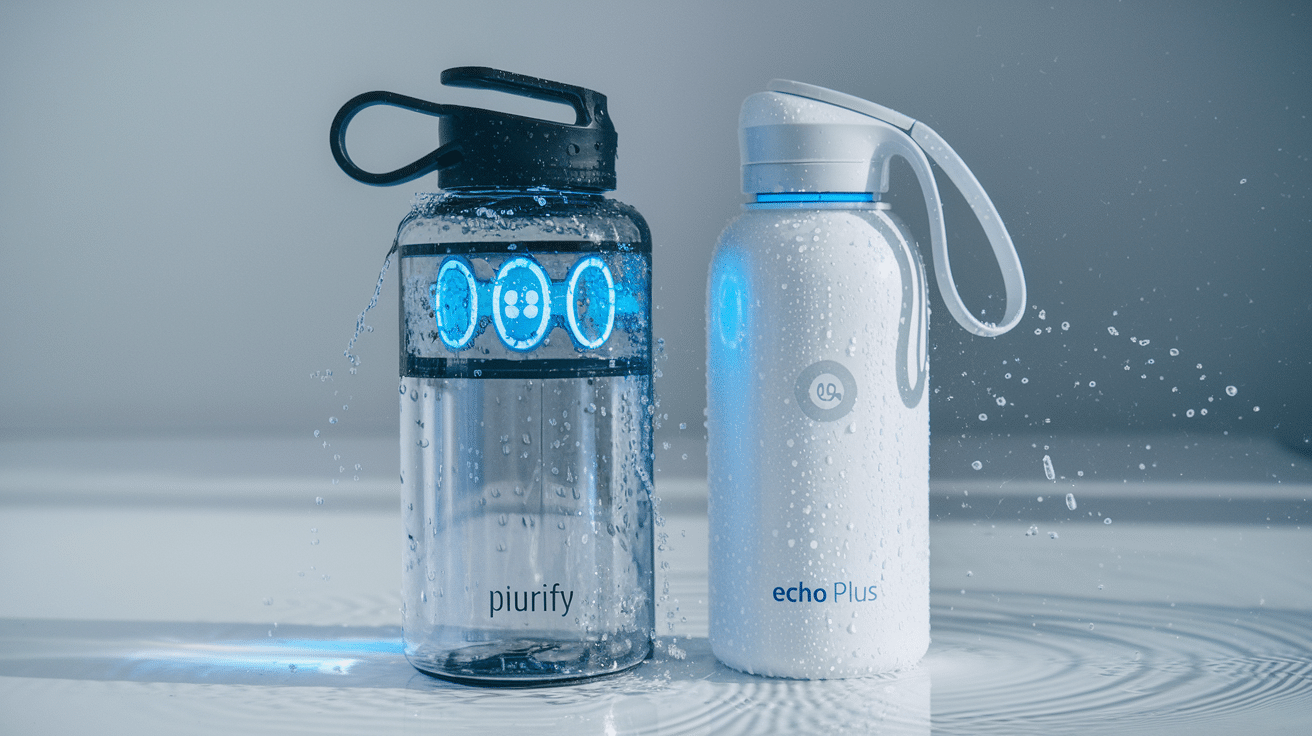
The Piurify vs Echo Go+ decision is usually framed as a spec fight, and that is the wrong frame. Both are portable hydrogen bottles, both hold about 9.5 fluid ounces, both run the same five- and ten-minute electrolysis cycles, and both turn up on lists of top hydrogen water bottles. What actually separates them is whose hydrogen figure has been measured by somebody other than the manufacturer, and the fact that one of the two costs roughly twice as much as the other.
Both bottles make similar promises: more antioxidant capacity, better hydration, faster recovery after training. The research behind those promises is early and mostly small-scale, and nothing below treats it as settled. What this page can settle is narrower and more useful than a health claim anyway: what each bottle actually does, how much of that has been verified, and which buyer each one suits.
- The Short Answer: Which One Should You Buy?
- Piurify vs Echo Go+: Side-by-Side Comparison
- Comprehensive Technology Comparison
- Design and User Experience Features
- Performance and Practical Considerations
- Health Benefits and Effectiveness
- Value and Price Analysis
- FAQ
- What technology do these hydrogen water bottles use?
- How much hydrogen do these bottles produce?
- What materials are these bottles made from?
- How long does it take to generate hydrogen-rich water?
- Do these bottles have self-cleaning functions?
- What are the health benefits of hydrogen-rich water?
- What are the main differences between Echo Go and Echo Go+ models?
- Which bottle has better insulation?
- Which bottle has better battery life?
- Where These Figures Come From
- Conclusion
The Short Answer: Which One Should You Buy?
Buy the Piurify Hydrogenator if you want the most dissolved hydrogen for your money and you care that the number has been checked by somebody other than the seller. It is the cheaper of the two by a wide margin, it is the lighter one to carry, and its ten-minute output is the only figure in this comparison that an independent laboratory has published.
Buy the Echo Go+ if you want the larger battery, the clearer warranty and a manufacturer with a broader product line behind it. Echo publishes a five-year warranty and a 60-day return window, and its dual-chambered cell is designed to vent oxygen and ozone away from the water. You will pay roughly twice the Piurify price, and you will be taking the 4.5 ppm output figure on Echo’s word, because no independent measurement of it could be found.
One thing to know before you choose the Echo Go+: Echo’s own product page for the Go+ now resolves to the Echo Flask, its successor model. The Go+ is still sold on Amazon by the official Echo Water store, but it is no longer the bottle Echo leads with.
If you are buying purely on the health claims, neither. The research on hydrogen-rich water is early and most of the studies are small. Both bottles do what they say mechanically; what that does for you is a much less settled question, and the sections below treat it that way.
Which Piurify and Which Echo Are We Comparing?
Both brands sell several models, and most of the confusion online comes from comparing the wrong two. This page compares the Piurify Hydrogenator bottle, the 280 ml (9.5 fl oz) unit that H2HUBB tested, against the Echo Go+, Echo’s 9.5 fl oz portable bottle.
Piurify also sells a larger 17 oz generator, a 12 oz Flask and a 50 oz countertop pitcher, all quoting different hydrogen figures. Echo sells the entry-level Echo Go and the newer Echo Flask alongside it. If you see a review quoting borosilicate glass, stainless steel or a 50 oz capacity for “the Piurify”, it is describing a different product from this one.
Piurify vs Echo Go+: Side-by-Side Comparison
| Criterion | Piurify Hydrogenator | Echo Go+ |
|---|---|---|
| Price, one against the other | The cheaper of the two, by a wide margin. | Roughly twice the Piurify. |
| Hydrogen, 10-minute cycle | 4,090 ppb, certified by H2 Analytics. H2HUBB separately measured about 3.85 mg/L average and 4.03 mg/L peak. | Up to 4.5 ppm — Echo’s own published figure. |
| Hydrogen, 5-minute cycle | About 2.80 mg/L (H2HUBB). | 2.5 ppm (Echo). |
| Measured by an independent lab? | Yes — two laboratories, both published. | None found that names a laboratory. |
| Capacity | 280 ml / 9.5 fl oz (H2HUBB). Amazon’s listing rounds it to 10 fl oz. | 9.5 fl oz (Echo). Amazon’s listing rounds it to 10 fl oz. |
| Body material | Food-grade polycarbonate. Piurify states it uses PC rather than glass because the cell builds gas pressure. | Food-grade, BPA-free polycarbonate. Amazon’s structured material field reads Polycarbonate. |
| Cell and electrodes | DuPont SPE/PEM membrane, platinum-coated electrodes, with a separate anode port to vent off-gas. | Dual-chambered PEM that vents oxygen and ozone away from the water, titanium and platinum electrodes, polarity-reversing to limit mineral buildup. |
| Battery | 1800 mAh (about 6.66 Wh), roughly 7 to 10 cycles per charge. | 2200 mAh (7.4 Wh), 5 to 10 cycles per charge, and usable while charging. |
| Display | An estimated ppb readout. H2HUBB found this is prediction software rather than a dissolved-hydrogen sensor, and that the displayed value did not reliably track the measured one. | A countdown timer for the running cycle. |
| Cleaning | Not documented by the manufacturer. | Automatic cleaning included (Echo). |
| Weight | 12.96 oz. | 1.3 lb. |
| Warranty | 60-day money-back. The listing states the warranty two ways: 10+ years in the title, lifetime in the bullet points. | 60-day returns and a 5-year warranty (Echo). |
| Still the maker’s current model? | Yes. | Echo’s own Go+ product URL now resolves to the Echo Flask, its successor. |
|
Independently lab-tested

|
Larger battery, longer warranty

|
|
Description: The Piurify Hydrogenator is a 280 ml (9.5 fl oz) portable hydrogen generator built around a DuPont SPE/PEM membrane. Its ten-minute output has been certified at 4,090 ppb by H2 Analytics and independently measured by H2HUBB at about 3.85 mg/L. The body is food-grade polycarbonate, not glass and not steel. Piurify states the warranty two different ways on the same listing: 10+ years in the title, lifetime in the bullet points. |
Description: The Echo Go+ infuses water through a dual-chambered SPE/PEM cell, which Echo rates at 2.5 ppm on the five-minute cycle and up to 4.5 ppm on the ten-minute one. The body is food-grade, BPA-free polycarbonate. Echo publishes a five-year warranty with a 60-day return window. The output figure is Echo's own; no independent measurement of it could be found. |
|
Key Features & Benefits:
|
Key Features & Benefits:
|
|
Pros:
|
Pros:
|
|
Cons:
|
Cons:
|
The Piurify Hydrogenator is a 280 ml (9.5 fl oz) portable hydrogen generator built around a DuPont SPE/PEM membrane. Its ten-minute output has been certified at 4,090 ppb by H2 Analytics and independently measured by H2HUBB at about 3.85 mg/L. The body is food-grade polycarbonate, not glass and not steel. Piurify states the warranty two different ways on the same listing: 10+ years in the title, lifetime in the bullet points.
- Certified output: 4,090 ppb on the ten-minute cycle, certified by H2 Analytics
- Independently measured: about 3.85 mg/L average and 4.03 mg/L peak (H2HUBB, 24 October 2024)
- Dual cycles: five minutes for about 2.80 mg/L, or ten minutes for the full figure
- DuPont SPE/PEM cell: works with any water type, including distilled, and vents by-products through a separate anode port
- Battery: 3.7 V, 1800 mAh, USB-C, roughly seven to ten cycles per charge
- OLED display: countdown and battery level. H2HUBB found the on-screen ppb figure is prediction software rather than a sensor
- Body: food-grade polycarbonate, 280 ml (9.5 fl oz), 12.96 oz on the scales
- A nasal cannula is included in the box, though Amazon's structured components list omits it. H2HUBB does not recommend using any hydrogen water bottle as an inhalation device
- Output certified by one laboratory and independently measured by another
- The cheaper of the two bottles by a wide margin
- Lighter to carry, at 12.96 oz
- Works with any water type, including distilled
- No detectable chlorine or ozone in H2HUBB testing
- 280 ml (9.5 fl oz) per cycle is a small serving
- The on-screen ppb figure is an estimate, not a measurement
- No cleaning cycle is documented, and it is hand wash only
- Warranty stated two different ways on the same listing
- Needs recharging every seven to ten cycles
The Echo Go+ infuses water through a dual-chambered SPE/PEM cell, which Echo rates at 2.5 ppm on the five-minute cycle and up to 4.5 ppm on the ten-minute one. The body is food-grade, BPA-free polycarbonate. Echo publishes a five-year warranty with a 60-day return window. The output figure is Echo's own; no independent measurement of it could be found.
- Hydrogen output: Echo rates it at 2.5 ppm on five minutes, up to 4.5 ppm on ten
- Dual-chambered PEM: vents oxygen and ozone away from the water you drink
- Battery: 2200 mAh (7.4 Wh), five to ten cycles per charge, and usable while charging
- Automatic cleaning cycle, with polarity-reversing electrodes to limit mineral buildup
- Display: a countdown timer for the running cycle
- Body: food-grade, BPA-free polycarbonate, 9.5 fl oz, 1.3 lb
- Warranty: five years, with a 60-day return window
- Larger 2200 mAh battery, and it can be used while charging
- Automatic cleaning cycle documented by the manufacturer
- Five-year warranty stated unambiguously
- Dual-chambered cell keeps oxygen and ozone out of the water
- Backed by a manufacturer with a wider product range
- Roughly twice the price of the Piurify
- The output figure is the manufacturer's own, with no independent measurement found
- Heavier, at 1.3 lb
- 9.5 fl oz may need frequent refills for heavy users
- Echo's own product page for the Go+ now resolves to the Echo Flask
Comprehensive Technology Comparison
A. SPE and PEM Technology Explained
Both the Echo Go+ and Piurify hydrogen water bottles utilize cutting-edge technologies known as Solid Polymer Electrolysis (SPE) and Proton Exchange Membrane (PEM) to generate hydrogen-rich water. These technologies represent the forefront of portable hydrogen water generation systems.
SPE technology works by using a solid polymer electrolyte membrane to separate water molecules into hydrogen and oxygen. The PEM system then allows hydrogen ions to pass through while blocking oxygen, resulting in water that’s enriched with molecular hydrogen. Neither bottle adds chemicals or tablets to the water. If the underlying chemistry is what brought you here, we cover it on its own in how hydrogen water bottles actually work.
These advanced technologies enable both devices to produce therapeutic levels of hydrogen concentration in water, delivering potential health benefits in a convenient, portable format.
B. Hydrogen Concentration: Echo Go+ (2.5-4.5 PPM) vs. Piurify (4100+ PPB)
One of the most critical factors in comparing hydrogen water bottles is their hydrogen concentration capacity. The Echo Go+ generates hydrogen concentrations ranging from 2.5 to 4.5 parts per million (PPM), which represents a significant therapeutic level.
Piurify quotes more than 4,100 parts per billion (PPB) for the same ten-minute cycle. Since 4,100 PPB is 4.1 PPM, the two headline figures sit within a few tenths of a PPM of each other, and Echo’s is nominally the higher of the two. Piurify’s newer listing headline of 6,300+ PPB is a different measurement: the seller’s own instructions say that number requires three consecutive ten-minute cycles, while a single cycle gives the 4,100+ PPB quoted here.
Whether a few tenths of a PPM is a difference you would notice is not established. The research that exists has mostly compared hydrogen-rich water against ordinary water, not one concentration against another, so treat the gap between these two figures as a specification difference rather than a health one.
What the Independent Testing Actually Shows
This is the part most comparisons skip, and it is the only part that really separates these two bottles. Both quote a headline hydrogen figure. Only one of those figures has been checked by somebody with no stake in the sale.
Piurify’s ten-minute output has been measured twice, independently. H2 Analytics certified 4,090 ppb. H2HUBB ran its own titration test on 24 October 2024 and recorded an average of about 3.85 mg/L, peaking near 4.03 mg/L, with about 2.80 mg/L on the five-minute cycle. Those two results agree with each other and with the number on the box.
For the Echo Go+, we could not find an equivalent. Echo’s 2.5 to 4.5 ppm range is Echo’s own figure. Two pages that appear to offer independent readings did not survive checking: one is served from a host with a broken security certificate, so it cannot be authenticated at all, and the other attributes its numbers only to testing that has “generally confirmed” such claims, without naming a laboratory. H2HUBB has published reports on several bottles in this category; the Echo Go+ is not among them.
That does not mean the Echo Go+ underperforms. It means one of these two claims is evidenced and the other is asserted, and if you are spending the larger sum it is worth knowing which is which.
C. Materials and Construction Quality
The Echo Go+ is built from food-grade, BPA-free polycarbonate. Echo states this on its own product comparison page, and Amazon’s structured material field for the bottle reads Polycarbonate. We look at this model on its own terms in echo go plus tested.
The Piurify uses the same class of material, and its listing is unusually direct about why. Because the cell generates gas and pressure during electrolysis, Piurify says it uses food-grade PC rather than glass, which can crack under those conditions. Neither bottle is glass and neither is stainless steel. If you have read otherwise about either one, that description belongs to a different model or a different brand. For a fuller account of this bottle on its own, see our piurify review.
Neither manufacturer claims any insulation for these models, so treat both as ordinary single-temperature bottles rather than flasks. Both are listed as hand-wash only.
D. Electrode Technology and Efficiency
Electrode quality significantly impacts hydrogen generation efficiency and device longevity. The Echo Go+ features platinum-coated titanium electrodes, known for their excellent conductivity and resistance to corrosion. These electrodes resist corrosion through the bottle’s 5- or 10-minute generation cycles.
Piurify uses platinum-coated electrolysis components behind a DuPont SPE/PEM membrane, with a separate anode port that vents oxygen and other by-products away from the water you drink.
Echo documents an automatic cleaning cycle on the Go+, plus polarity-reversing electrodes that reduce mineral buildup between cleans. Piurify does not document an equivalent function for the Hydrogenator. On this point the two are different rather than equivalent, and we found no independent source establishing that the Piurify self-cleans.
Design and User Experience Features
Water Capacity and Portability Comparison
Both bottles are made to be carried, and they are closer in size than most comparisons suggest. The Piurify Hydrogenator holds 280 ml, which H2HUBB records as 9.5 fl oz. Echo lists the Go+ at 9.5 fl oz as well. Amazon rounds both listings up to 10 fl oz. On capacity, this one is a tie.
Where they genuinely differ is weight, and not in the direction the pricing suggests. Amazon lists the Piurify at 12.96 oz and the Echo Go+ at 1.3 lb, which makes the cheaper bottle the lighter one by a clear margin. The Piurify measures 2.3 inches across and 9 inches tall, so either will sit in a bag without trouble.
Operating Cycles and Generation Times
Both bottles run two fixed cycles rather than a continuously adjustable setting. Echo rates the Go+ at 2.5 ppm on the five-minute cycle and up to 4.5 ppm on the ten-minute one. The Piurify uses the same two lengths, and H2HUBB measured about 2.80 mg/L after five minutes and about 3.85 mg/L after ten.
In practice that means a short wait either way, and on both bottles the longer cycle is the one worth using. The Echo Go+ can be run while it charges, which matters if you want several cycles in a day. Piurify quotes roughly seven to ten cycles per charge from an 1800 mAh cell; Echo quotes five to ten from a larger 2200 mAh one.
Self-Cleaning Functionality and Maintenance Requirements
Echo documents an automatic cleaning cycle on the Go+, along with polarity-reversing electrodes that limit mineral buildup between cleans. That is a published feature of this model, and it is worth stating plainly because a number of comparison articles attribute self-cleaning only to the newer Echo Flask.
Piurify publishes no equivalent cleaning function for the Hydrogenator, and we found no independent source confirming one, so this page does not claim it has one. Both bottles are listed as hand-wash only, and both will need regular manual cleaning if you fill them with tap water that carries any mineral content.
Digital Displays and User Interface
The Piurify Hydrogenator has an OLED screen showing a countdown, a battery level and an estimated hydrogen figure in ppb. That last number needs a caveat. H2HUBB found the display estimates concentration using prediction software rather than measuring it, and that the value shown did not reliably track what its titration actually measured. Treat it as a progress indicator rather than an instrument.
The Echo Go+ takes the opposite approach. Its screen is a countdown timer for the running cycle rather than a concentration readout, so there is less to read and correspondingly less to misread.
Performance and Practical Considerations
Battery is the clearest practical difference between the two. The Echo Go+ carries a 2200 mAh cell, which Echo rates at five to ten cycles per charge and which can be used while it is plugged in. The Piurify runs an 1800 mAh cell that H2HUBB puts at roughly seven to ten cycles. So Echo has the physically larger battery, while the Piurify gets a comparable number of cycles out of a smaller one. Neither manufacturer publishes a charging time, so any claim that one charges faster than the other is guesswork.
Both bottles are hand-wash only according to the care instructions on their listings, and neither is dishwasher safe. Echo counters mineral buildup with polarity-reversing electrodes and the automatic cleaning cycle described above. Piurify documents no cleaning function, so if you are filling from hard water, expect to clean the Piurify by hand more often.
Water type matters less than you might expect. An SPE/PEM cell works with any water, including distilled, because the membrane rather than the water’s mineral content carries the current. H2HUBB reported no detectable chlorine or ozone in the Piurify’s output, and the bottle vents by-products through a separate anode port. Echo’s dual-chambered PEM is built to do the same job, keeping oxygen and ozone away from the water you drink.
Hydrogen does not stay in the water indefinitely. Both bottles are meant to be drunk from soon after a cycle ends rather than filled and left standing, and dissolved hydrogen escapes faster from an open container. A six-hour retention figure circulates for the Piurify; it does not appear in H2HUBB’s report or in Piurify’s current listing, so this page does not repeat it as fact.
Health Benefits and Effectiveness
Antioxidant Properties and Free Radical Neutralization
Both the Piurify and Echo Go+ hydrogen water bottles generate water infused with molecular hydrogen (H2), which research suggests possesses therapeutic antioxidant properties. According to systematic reviews, hydrogen-rich water (HRW) may help mitigate oxidative stress by neutralizing free radicals in the body. These antioxidant effects are central to many of the proposed health benefits, as they help protect cells from damage that can lead to various health conditions. The molecular hydrogen gas is tasteless, colorless, and odorless, allowing users to enjoy the potential benefits without altering the water’s sensory qualities.
Hydration Enhancement and Cellular Benefits
Beyond basic hydration, hydrogen water bottles like the Piurify and Echo Go+ may offer enhanced cellular benefits. Studies indicate that hydrogen-rich water might exert anti-inflammatory and anti-apoptotic effects at the cellular level. While both devices deliver hydrogen-infused water, their effectiveness may vary based on concentration levels and stability of the dissolved hydrogen. Research suggests that hydrogen molecules can easily penetrate cell membranes, potentially providing hydration benefits that reach deeper than regular water, though experts emphasize that further research is needed to confirm whether these benefits surpass those of regular water.
Athletic Recovery and Performance Improvements
For fitness enthusiasts comparing the Piurify and Echo Go+, preliminary findings suggest hydrogen water may enhance physical performance and endurance in athletes. Studies reviewed by researchers indicate that consuming hydrogen-rich water could reduce fatigue during intense physical activity and potentially improve recovery times. Athletes using portable hydrogen water generators might experience improved endurance and decreased recovery time between training sessions. However, the research emphasizes the need for larger, well-designed studies to fully validate these performance-enhancing claims.
Skin Health and Visible Results
Skin is the thinnest part of the hydrogen-water literature. What exists is small and early, and any effect would run through the same antioxidant pathway as everything else above rather than through anything specific to skin. Both bottles produce the same gas, so there is nothing to choose between them here, and anyone promising visible results from either one is ahead of the evidence.
One caution before the price section: research into hydrogen-rich water is at an early stage, and most published studies are small. Nothing on this page is medical advice. If you have a health condition or take medication, talk to a clinician before adding anything new to your routine.
Value and Price Analysis
Cost Comparison and Investment Assessment
This is where most write-ups of these two bottles go wrong, including earlier versions of this one. The Echo Go+ is not the budget option. It is the expensive one, at roughly twice the Piurify’s price, and the Piurify is the more affordable of the two by a wide margin.
That inverts the usual question. You are not weighing whether the Piurify’s features justify a premium, because there is no premium to justify. You are weighing whether the Echo Go+ is worth paying about double for. What the extra buys is a larger battery, a published five-year warranty, a documented automatic cleaning cycle, and a manufacturer with a wider product line and a real support operation behind it.
What the extra does not buy is more verified hydrogen. Echo’s ceiling figure is nominally higher, but it is Echo’s own. Piurify’s is slightly lower and has been confirmed twice by outside laboratories. If your reason for buying is dissolved hydrogen per pound spent, the Piurify wins that comparison and it is not close.
Warranty and Customer Support
Both warranties are published, and they are not equivalent. Echo covers the Go+ for five years with a 60-day return window. Piurify offers a 60-day money-back guarantee but states the warranty itself two different ways on the same listing: the product title says 10+ years, while the bullet points say lifetime. H2HUBB’s write-up records a lifetime warranty. If warranty length is part of why you are buying, ask Piurify to confirm in writing which applies before you order. It is also worth remembering that a long warranty is only as good as the company standing behind it, which is harder to judge for the smaller of these two brands.
Best Use Cases for Each Model
Piurify Hydrogen Water Bottle:
- Anyone who wants the hydrogen figure independently verified rather than asserted
- Buyers watching the price, since it is the cheaper of the two by a wide margin
- People who want the lighter bottle to carry, at 12.96 oz
- Anyone content to clean a bottle by hand, since no cleaning cycle is documented
Echo Go+ Hydrogen Water Bottle:
- Buyers who want the longer published warranty and the larger battery
- People who value a documented automatic cleaning cycle
- Anyone who prefers an established brand with a wider range and easier support
- Buyers comfortable taking the output figure on the manufacturer’s word
Expert Recommendations Based on User Priorities
If your priority is verified performance for the money, the Piurify is the stronger buy. It costs far less, weighs less, and its output is the only figure here that an independent laboratory has published.
If your priority is support and longevity, the Echo Go+ makes a better case. The battery is larger, the five-year warranty is unambiguous, the cleaning cycle is documented, and Echo is the more established company. You are paying roughly double for that reassurance.
If portability is your main concern, the Piurify is the lighter bottle at 12.96 oz against the Echo Go+ at 1.3 lb. Both hold about 9.5 fl oz, so there is nothing to choose between them on capacity. If neither is quite right, the larger and newer sibling in Echo’s range is covered in echo flask tested.
FAQ
What technology do these hydrogen water bottles use?
Both use solid polymer electrolysis with a proton exchange membrane, usually shortened to SPE and PEM. A membrane between two electrodes splits water and lets hydrogen into the water you drink while venting the oxygen and other by-products away. Piurify uses a DuPont membrane; Echo uses a dual-chambered design. No chemicals or tablets are involved in either.
How much hydrogen do these bottles produce?
Echo rates the Go+ at 2.5 ppm on its five-minute cycle and up to 4.5 ppm on its ten-minute cycle. Piurify quotes more than 4,100 ppb, which is 4.1 ppm, for the same ten-minute cycle. The important difference is not the figures but their backing: H2 Analytics certified the Piurify at 4,090 ppb and H2HUBB independently measured about 3.85 mg/L, while Echo’s range is the manufacturer’s own and we found no independent measurement of it.
What materials are these bottles made from?
Both are food-grade, BPA-free polycarbonate with platinum and titanium electrodes. Neither is glass and neither is stainless steel. Piurify explains on its own listing that it avoids glass deliberately, because the cell builds gas pressure during electrolysis.
How long does it take to generate hydrogen-rich water?
Both bottles offer a five-minute and a ten-minute cycle, and on both the longer cycle is the one that reaches the quoted output.
Do these bottles have self-cleaning functions?
Echo documents an automatic cleaning cycle on the Go+, together with polarity-reversing electrodes that limit mineral buildup. Piurify publishes no equivalent function for the Hydrogenator and we found no independent source confirming one, so we do not claim it has one. Both are hand-wash only.
What are the health benefits of hydrogen-rich water?
Both bottles produce the same gas, so any difference between them is a matter of how much, not of what it does. The research is early and most of the studies are small. These are the areas it has looked at, rather than outcomes you should expect:
- Whether molecular hydrogen behaves as a selective antioxidant, reacting with the hydroxyl radical rather than quenching radicals the body uses for signalling
- Markers of oxidative stress
- Inflammatory markers at the cellular level
- Fatigue and recovery time in athletes
- Self-reported energy, which is among the harder things to measure well
- Skin condition, where the evidence is thinnest of all
What are the main differences between Echo Go and Echo Go+ models?
The Echo Go+ produces more hydrogen than the standard Echo Go, adds a digital display, and can be used while charging. It also costs considerably more. If you are weighing those two against each other rather than against the Piurify, we cover it in detail in our echo go tested review. Note too that Echo’s own product page for the Go+ now resolves to the Echo Flask, its newer model.
Which bottle has better insulation?
Neither. This is a claim that circulates widely and it is wrong for both bottles. Both are single-wall food-grade polycarbonate, and neither manufacturer claims any insulation for these models. If you want water to stay cold, neither of these is the bottle for it.
Which bottle has better battery life?
Echo has the larger battery at 2200 mAh against Piurify’s 1800 mAh, and the Echo Go+ can be used while charging. Piurify quotes roughly seven to ten cycles per charge and Echo five to ten, so the usable cycle counts overlap. Neither company publishes a charging time, so claims that one charges faster than the other are not supported by either manufacturer.
Where These Figures Come From
Every specification above comes from one of four places, and each is named where it is used rather than pooled at the end. Manufacturer claims are labelled as manufacturer claims; laboratory figures are labelled with the laboratory.
- H2HUBB’s published test of the Piurify Hydrogenator, dated 24 October 2024, using H2Blue titration. Source for the 2.80 and 3.85 mg/L figures, the 280 ml capacity, the 1800 mAh battery, the display caveat and the inhalation caution.
- H2 Analytics, which certified the same bottle at 4,090 ppb on its ten-minute cycle.
- Echo Water’s own Go+ and Flask comparison. Source for the 2.5 to 4.5 ppm range, the 9.5 fl oz capacity, the polycarbonate body, the 2200 mAh battery, the automatic cleaning cycle and the five-year warranty.
- The two Amazon product listings, used only for the structured material, capacity, weight and care fields.
Where a manufacturer contradicts itself, this page reports the contradiction rather than picking a side; the Piurify warranty is the clearest case. Where a figure could not be traced to a manufacturer or a named laboratory, it has been left out rather than repeated.
Conclusion
The two bottles are far closer on paper than the price gap suggests. Same electrolysis method, same two cycle lengths, the same 9.5 fl oz capacity, the same food-grade polycarbonate body, and headline outputs within a few tenths of a PPM of each other. On specifications alone you would struggle to separate them.
Two things do separate them. The first is evidence: Piurify’s ten-minute output has been certified by H2 Analytics and independently measured by H2HUBB, while the Echo Go+ figure is Echo’s own and no independent measurement of it could be found. The second is price, and it runs opposite to the reputations, because the Echo Go+ costs roughly twice as much. So the Piurify is the better buy on evidence and on value, and it is the lighter bottle. The Echo Go+ earns its price if you want the larger battery, the unambiguous five-year warranty, the documented cleaning cycle and a bigger company behind the purchase, and if you are comfortable that Echo’s own product page now points to the Flask instead.
