

Hydrogen water bottles are everywhere these days, but finding the best hydrogen water bottle under $100 that actually works is harder than it looks. You do not need to spend $200 or more to get a real dose of dissolved hydrogen.
This guide is for anyone curious about hydrogen water, whether you are into fitness, chasing a recovery edge, or just want to try the thing without breaking the bank. We’ll cover which features actually matter (spoiler: it’s not always the ones they advertise loudest), how to spot bottles that deliver real hydrogen levels versus marketing hype, and which safety certifications you should never skip.
We’ll break down the top-performing hydrogen water bottles that cost less than $100, plus give you the inside scoop on what hydrogen concentrations you need for actual results and which materials won’t leach chemicals into your water.
- Top 3 Hydrogen Water Bottles Under $100 Comparison: Side by Side
- How We Picked the Best Hydrogen Water Bottle Under $100
- Essential Features to Look for in Budget Hydrogen Water Bottles
- 9 Best Hydrogen Water Bottles Under $100 (Budget-Friendly Picks)
- 1. Fakllod Hydrogen Water Bottle (Best Value Pick Under $100)
- 2. Beveck Hydrogen Water Bottle (Cheapest Pick)
- 3. Hydroh Hydrogen Water Bottle (Stainless Steel Pick)
- 4. Aqua Vital Hydrogen Water Bottle (Largest Capacity)
- 5. LevelUpWay Hydrogen Water Bottle (Just Over Budget)
- 6. Hydrohealth Hydrogen Water Bottle (Most Power Behind the Cell)
- 7. Buzio Hydrogen Water Bottle (Best Overall Under $100)
- 8. Echo Go Hydrogen Water Bottle (Best Known Brand)
- 9. H2 Life Hydrogen Water Bottle (Two Output Modes)
- All Nine Compared
- Performance Specifications That Matter Most
- Safety and Quality Considerations
- Conclusion
- FAQs
- What makes hydrogen water different from regular water?
- How long does hydrogen stay in the water?
- Are cheap hydrogen water bottles safe to use?
- How often should I clean my hydrogen water bottle?
- What's the difference between SPE and PEM technology?
- Can I use any type of water in my hydrogen water bottle?
- How do I know if my bottle is producing hydrogen?
- Is hydrogen water worth the investment for health benefits?
Disclosure: As an Amazon Associate we earn from qualifying purchases. If you buy through a link on this page it costs you nothing extra, and it does not change which bottles we recommend.
Top 3 Hydrogen Water Bottles Under $100 Comparison: Side by Side
|
Ultra-Fast Hydrogen Generation

|
Budget-Conscious Choice

|
Sleek Glass Design

|
|
Our Rating:
4.0
|
Our Rating:
4.0
|
Our Rating:
3.9
|
|
Key Features & Benefits:
|
Key Features & Benefits:
|
Key Features & Benefits:
|
- Advanced SPE/PEM Technology: Removes chlorine/ozone and generates hydrogen in 3 minutes
- Premium Borosilicate Glass: Durable, heat-resistant glass with anti-slip EVE base
- Optimal 460ML Capacity: Portable size for travel, office, or gym use
- Rechargeable Battery: Cordless operation with reliable battery power
- One-Button Operation: Simple controls with LED indicators
- Self-Cleaning Function: Maintains electrodes and removes mineral buildup
- Advanced PEM-SPE Technology: Generates up to 3000 PPB hydrogen in 3 minutes
- Premium Borosilicate Glass: Durable, heat-resistant, ensures pure taste
- USB Rechargeable Battery: Cordless, portable operation on the go
- Compact 420ml Capacity: Perfect personal size, highly portable
- One-Touch Operation: Easy activation with blue LED indicator
- Easy Maintenance Design: Top and bottom fully unscrew for cleaning
- Countertop Compatible: Stable EVA pad base prevents slipping
- Zero Harmful Substances: Produces chlorine-, heavy metal-, and ozone-free water
- Ideal Capacity: 15 oz size for daily hydration
- Glass Body, Steel Base: Food-grade, durable construction
- Compact & Portable: Slim design fits bags and cup holders
- Leak-Proof Design: Secure lid prevents spills
- USB Charging: Convenient modern charging option
- Chlorine Reduction: Improves water taste and quality
- Manual Operation: Simple, user-friendly controls
How We Picked the Best Hydrogen Water Bottle Under $100
Being straight about method, because nobody else on this search result is: we have not run gas chromatography on these bottles, and neither has any other site ranking for this term. What we did instead was read the published SPE/PEM specifications and stated PPB output for every bottle selling under $100, cross-check those numbers against owner reviews at volume, and keep the nine where output, materials and warranty all survived scrutiny. Where a figure rests only on the manufacturer’s word, the entry says so.
Two things you can verify yourself for less than the price difference between any two bottles here. H2 Blue is a methylene-blue titration reagent: add drops until the blue stops vanishing, and each drop stands for roughly 0.1 ppm. An ORP meter (oxidation-reduction potential) is the other option, though it confirms the water changed without telling you by how much.
What we weighted, in order: measured or credibly published hydrogen output; whether the cell is a real SPE/PEM stack rather than bare electrolysis; the electrode, which should be platinum-coated titanium because anything cheaper corrodes; the body material, where borosilicate glass tastes cleanest, Tritan copolyester survives being dropped and stainless steel does both but hides the water; and the warranty, which is the only number a manufacturer publishes that costs it money to get wrong.
Essential Features to Look for in Budget Hydrogen Water Bottles
SPE/PEM Technology for Effective Hydrogen Generation
When evaluating the best hydrogen water bottle under $100, the electrolysis technology stands as the most critical factor determining performance quality. SPE/PEM (Solid Polymer Electrolyte/Proton Exchange Membrane) technology represents the gold standard for affordable hydrogen water bottles, offering superior hydrogen generation efficiency compared to basic electrolysis methods.
This advanced electrolysis technology ensures optimal hydrogen concentration and purity, making it essential for budget hydrogen water generators that deliver professional-grade results. SPE/PEM systems work by using a specialized membrane that separates hydrogen and oxygen during the electrolysis process, preventing contamination and ensuring clean hydrogen-rich water production.
Safe Materials Like Borosilicate Glass or BPA-Free Polycarbonate
Material safety remains paramount when selecting portable hydrogen water makers within budget constraints. The construction materials directly impact both health safety and long-term durability of your investment.
Borosilicate glass offers exceptional chemical resistance and temperature stability, ensuring no harmful substances leach into your hydrogen water. This premium material maintains water purity while providing excellent durability for daily use. Alternatively, BPA-free polycarbonate presents a lightweight, shatter-resistant option that meets food-grade safety standards without compromising hydrogen water bottle performance.
Both materials ensure that your top rated hydrogen water bottles maintain their integrity during the electrolysis process, preventing chemical interactions that could compromise water quality or pose health risks.
Battery Performance and Cycle Duration Specifications
Understanding battery specifications proves crucial for practical daily use of budget hydrogen water generators. Optimal battery performance typically supports cycle durations ranging from 3 to 10 minutes, accommodating different hydrogen concentration preferences and usage patterns.
Quality affordable hydrogen water bottles provide 10 to 20 complete cycles per single charge, ensuring consistent availability throughout your day. This specification directly impacts convenience and usability, particularly for individuals with active lifestyles or frequent travel requirements.
The cycle duration flexibility allows users to customize hydrogen concentration levels based on personal preferences, while adequate battery capacity ensures reliable operation without frequent charging interruptions.
Safety Certifications and RoHS Compliance
Certification is the cheapest signal you get. RoHS (Restriction of Hazardous Substances) compliance means the manufacturing process excludes lead, mercury and other toxic substances. A bottle that cannot show a certificate of analysis or a named certification is a bottle nobody independent has looked at, and at this end of the market that is common.
These certifications provide assurance that your chosen device meets international safety standards, protecting both user health and environmental sustainability. When consulting any hydrogen water bottle buying guide, prioritizing certified products ensures long-term safety and regulatory compliance, making your investment both responsible and reliable.
9 Best Hydrogen Water Bottles Under $100 (Budget-Friendly Picks)
1. Fakllod Hydrogen Water Bottle (Best Value Pick Under $100)

Fakllod Hydrogen Water Bottle
The Fakllod bottle uses SPE/PEM electrolysis to make hydrogen-rich water (about 1,600–2,000 PPB, a maker figure) in about 3 minutes, and it vents chlorine and ozone. It has a borosilicate glass body, a rechargeable battery, one-button use, and an anti-slip base.
- Maker Output: 1,600–2,000 PPB in 3 minutes
- Body: borosilicate glass with an anti-slip base
- Capacity: 460 ml (about 15.5 oz)
- Cleaning: 5-minute self-clean mode for limescale
- Operation: one button, automatic shut-off
- Fast 3-minute hydrogen water generation
- High-quality borosilicate glass construction
- Rechargeable and completely portable
- Self-cleaning function for easy maintenance
- One-button operation with LED indicators
- Professional-grade SPE/PEM technology
- Perfect size for daily use and travel
- Limited to 460ML capacity per cycle
- Requires regular charging for portable use
- Performance depends on source water mineral content
- May need periodic deep cleaning for optimal function
The cheapest bottle here that still publishes a real output figure. An SPE/PEM cell rated at 1600 to 2000 ppb per three-minute cycle, in a 460 ml borosilicate body, which is the largest capacity anywhere near this price. A second five-minute mode flushes the electrode plate, and the cell strips residual chlorine and ozone rather than pushing them into the glass with the hydrogen.
Best for: the most hydrogen per pound spent, and the roomiest cheap bottle on the page.
Skip it if: you want steel rather than glass, or a bottle that survives being dropped on a gym floor.
Specs: 1600–2000 ppb · 460 ml · borosilicate glass · 3-minute cycle · SPE/PEM · under $40
Full write-up: fakllod hydrogen water bottle review.
2. Beveck Hydrogen Water Bottle (Cheapest Pick)
Beveck Hydrogen Water Bottle
A budget SPE/PEM bottle that advertises up to 3,000 ppb of dissolved hydrogen in a three-minute cycle. Simple one-button operation and cordless USB charging make it an easy first hydrogen bottle, but there is no display, no third-party test documentation and no published battery figure, so you cannot verify what it actually produces.
- SPE/PEM dual-chamber cell: vents oxygen and by-products out of the base
- Advertised up to 3,000 ppb hydrogen in a 3-minute cycle (manufacturer claim)
- USB rechargeable for cordless use; the connector is not USB-C
- Compact 420 ml (14 fl oz) capacity
- One-touch operation with LED indicator
- Quick 3-minute hydrogen generation
- Easy one-button operation
- Portable and travel-friendly design
- Top and bottom unscrew fully for cleaning
- No display or third-party test documentation
- No published battery capacity or charge time
- Limited to 420 ml (14 fl oz) per cycle
The lowest price on the page, and it still claims up to 3000 ppb per cycle from an SPE and PEM stack. You get 420 ml of borosilicate glass, a three-minute cycle and a genuinely small footprint at roughly two inches across.
Best for: trying hydrogen water without committing much money to the question.
Skip it if: you want a corroborated number. 3000 ppb at this price is the least independently supported claim in the group, and worth checking with an H2 Blue drop count before you believe it.
Specs: up to 3000 ppb · 420 ml · borosilicate glass · 3-minute cycle · SPE+PEM · under $30
Full write-up: Beveck Hydrogen Water Bottle Review.
3. Hydroh Hydrogen Water Bottle (Stainless Steel Pick)
Hydroh Hydrogen Water Bottle
The Hydroh Hydrogen Water Bottle uses SPE/PEM electrolysis to dissolve molecular hydrogen into ordinary drinking water, venting the oxygen and chlorine released along the way. The listing gives the material as stainless steel; it runs a 3-minute cycle at an entry-level price. Hydroh publishes several different output figures for it and no independent laboratory report, and owners report inconsistent bubbling, thin instructions, and early failures.
- Capacity: 15 oz
- Membrane: SPE/PEM
- Build: the listing gives the material as stainless steel
- Lid: leak-proof
- Output: no figure on the current listing
- Advanced SPE/PEM technology for effective hydrogen infusion
- Simple manual operation
- Convenient 15 oz capacity for daily use
- Portable design perfect for travel
- Easy USB charging system
- Requires regular charging for operation
- Processing time needed between uses
The only stainless-steel body here. Roughly eight inches tall and 15.2 oz, running the same SPE/PEM arrangement as the glass bottles, but built like an ordinary flask rather than a gadget.
Best for: anyone who has already broken a glass bottle, or who carries one in a bag with keys in it.
Skip it if: you want to watch the bubbles, or you want the highest output per pound. Steel costs you visibility and a little money.
Specs: SPE/PEM · 15.2 oz · stainless steel · ~8 in tall · high $60s
Full write-up: hydroh hydrogen water bottle review.
4. Aqua Vital Hydrogen Water Bottle (Largest Capacity)

Aqua Vital Hydrogen Water Bottle
The Aqua Vital uses SPE/PEM electrolysis to add hydrogen to plain water in a 3-minute cycle. It has a 16 oz (470 ml) borosilicate glass body on a brushed-steel base and a USB-rechargeable 1,000 mAh battery rated for about 10 cycles. The maker publishes no output figure, and owner reviews are mixed on reliability.
- Cycle: 3 minutes, beeps when ready
- Body: borosilicate glass, 470 ml (16 oz)
- Battery: 1,000 mAh, about 10 cycles (maker)
- Base: brushed steel with a silicone pad
- Opening: wide mouth for filling and cleaning
- Fast 3-minute hydrogen generation
- 16 oz / 470 ml means fewer refills
- Borosilicate glass keeps the taste clean
- USB charging, no filters to replace
- Easy one-button operation
- Auto shut-off ends each cycle
- Requires regular charging
- Glass construction needs careful handling
- Higher upfront cost than regular bottles
- No published hydrogen concentration figure
The biggest bottle on the page at 16 oz, or 470 ml, with USB-C charging and an automatic shut-off. It is filter-free, so there is no consumable to replace and no recurring cost.
Best for: one fill covering a morning rather than a single glass.
Skip it if: 8.1 inches is too tall for your bag or your car cup holder. Capacity is the whole point of this one, and it costs you pocketability.
Specs: SPE/PEM · 470 ml (16 oz) · glass · USB-C · auto shut-off · mid $50s
Full write-up: aqua vital hydrogen water bottle review.
5. LevelUpWay Hydrogen Water Bottle (Just Over Budget)
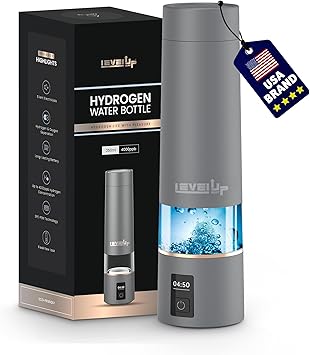
The Level Up Way hydrogen water bottle is a 250 ml (about 8.5 fl oz) generator built around SPE/PEM electrolysis. The manufacturer says it reaches up to 5,000 ppb of dissolved hydrogen and reduces chlorine; no independent laboratory has published a measurement for this model. One button starts a six- or twelve-minute cycle and a digital display shows the status. A hydrogen breathing adapter is included. It is cordless, weighs about a pound, and works with tap water up to 1100 ppm TDS.
- Maker Output: up to 5,000 PPB (no third-party report)
- Cycles: 6 or 12 minutes, one-touch, with a digital display
- Body: stainless steel, per the listing, 250 ml
- Extras: hydrogen breathing adapter included
- Brand: says it's based in the USA
- Manufacturer claims up to 5,000 ppb hydrogen
- Breathing adapter included in the box
- Six- or twelve-minute cycle, one-button start
- Digital display shows the cycle status
- Cordless and light, around 1 lb
- Works with tap water up to 1100 ppm TDS
- Only 250 ml per cycle, about 8.5 fl oz
- No independently published hydrogen measurement for this model
- Manufacturer publishes no warranty terms for this model
- Owner reports of battery and leak problems
- Needs regular charging and periodic descaling
Straight away: this one sits above $100, so it breaks the rule the rest of this page follows. It keeps its place because it claims the highest output here, up to 5000 ppb from a 250 ml bottle, and it ships with a breathing adapter that nothing else at this end of the market includes.
Best for: the highest concentration on the page, if your ceiling is soft.
Skip it if: you want to stay strictly under $100. This one is above the line, and we would rather say so than quietly leave it in the list.
Specs: up to 5000 ppb · 250 ml · SPE/PEM · breathing adapter · above $100
Full write-up: Level Up Way Hydrogen Water Bottle Review.
6. Hydrohealth Hydrogen Water Bottle (Most Power Behind the Cell)

Hydrohealth Hydrogen Water Bottle
The Hydrohealth bottle uses SPE/PEM electrolysis with platinum-plated titanium layers, and the maker rates it at 1,600 PPB after a 3-minute cycle. Owner reviews mention easy use but uneven reliability and thin instructions.
- Maker Output: up to 1,600 PPB in 3 minutes
- Cell: SPE/PEM with platinum-plated titanium layers
- Venting: removes chlorine during the cycle, per the maker
- Operation: fill, press, and drink when the light goes off
- Size: about 8.2 inches tall
- Maker-rated 1,600 PPB in 3 minutes
- Simple one-button cycle
- Platinum-plated titanium electrodes
- Self-cleaning cycle
- Auto shut-off
- Requires regular charging for continued use
- 14 oz capacity may need frequent refills for heavy users
- Initial investment higher than regular water bottles
A 10 W SPE/PEM cell rated at 1600 ppb in a 14 oz body, with Type-C charging. HydroHealth markets this one heavily on kidney support; that is the brand’s positioning rather than a demonstrated result, and the bottle is better judged on the number it produces than on the claim it carries.
Best for: buyers who want the most electrical power behind the cell at this price.
Skip it if: you are near the ceiling and want more ppb for the money. The Buzio produces more for less.
Specs: 1600 ppb · 10 W cell · 14 oz · SPE/PEM · Type-C · right at $100
Full write-up: Hydrohealth Hydrogen Water Bottle Review.
7. Buzio Hydrogen Water Bottle (Best Overall Under $100)

BUZIO Hydrogen Water Bottle
The BUZIO Hydrogen Water Bottle uses SPE/PEM electrolysis with a DuPont proton exchange membrane. BUZIO states up to 4,000 PPB in about 10 minutes, or 1,600 PPB in 5, and the bottle vents ozone and chlorine byproducts at its base. It has an OLED display for hydrogen level, battery, and timer, and it charges over USB-C. BUZIO says H2 Analytics certified it, but no report has been published, so read the figure as the maker’s.
- Maker Output: 4,000 PPB at 10 min, 1,600 PPB at 5 min
- Certificate: H2 Analytics certification claimed; report not published
- Membrane: DuPont PEM with a drain vent at the base
- Display: OLED shows PPB estimate, timer, and battery
- Battery: 1,800 mAh, USB-C, about 8 ten-minute cycles
- BUZIO-stated 4,000 PPB in 10 minutes
- Quick 5–10 minute generation time
- Easy-to-read OLED display with real-time monitoring
- DuPont SPE/PEM membrane with byproduct venting
- Long-lasting battery with convenient USB-C charging
- Lightweight and portable design
- Must be kept upright during operation
- 10-ounce capacity may be small for some users
- Requires regular charging for continued use
The most measurable bottle here, and our pick of the nine. An OLED display shows what the cell is actually doing, and a fifth-generation SPE/PEM stack with a DuPont membrane produces 4000 ppb on a ten-minute cycle or 1600 ppb on a five-minute one. The 1800 mAh battery is rated for 15 short cycles or 8 long ones per charge.
Best for: anyone who would rather see the number than trust it. If you buy one bottle from this page, buy this one.
Skip it if: 10 oz is too small for how you drink, or you have no interest in a screen on a water bottle.
Specs: 4000 ppb / 1600 ppb · 10 oz · Gen5 SPE/PEM · DuPont membrane · OLED · 1800 mAh · around $80
Full write-up: Buzio Hydrogen Water Bottle Review.
8. Echo Go Hydrogen Water Bottle (Best Known Brand)

380 ml Glass Hydrogen Water Bottle (sold under the Echo Go brand name)
A 380 ml borosilicate glass hydrogen water bottle. It uses SPE/PEM electrolysis to dissolve hydrogen into the water, and the seller quotes 1.2 ppm on the 3-minute cycle and 1.8 ppm on the 10-minute cycle. USB rechargeable, with automatic shut-off at the end of each cycle. Drawbacks: the glass body needs careful handling, 380 ml is a small serving, the hydrogen dissipates soon after the cycle ends, and it needs purified water plus regular descaling.
- Advanced Electrolysis Technology: SPE/PEM system produces 1.2–1.8 ppm hydrogen
- Dual Timing Options: 3- or 10-minute cycles with automatic shut-off
- Premium Glass Construction: 380ml borosilicate glass for durability and pure taste
- Portable & Lightweight Design: Compact size fits cup holders for travel or gym
- USB Rechargeable: Battery-powered with included USB adapter
- Ion Exchange Purification: Built-in system ensures clean, healthy water
- Quick hydrogen production in just 3 minutes
- High hydrogen concentration (1.2-1.8 ppm)
- Durable borosilicate glass construction
- Convenient USB charging
- Automatic shut-off safety feature
- Portable and travel-friendly
- Limited to 380ml capacity
- Temperature restriction (max 60°C)
- Requires regular charging
- Glass material needs careful handling
Quoted in ppm rather than ppb: 1.2 ppm on a three-minute cycle and 1.8 ppm on the ten-minute one, from 380 ml of borosilicate glass. One constraint is worth knowing before you buy: keep the water under 60 °C or the internals suffer.
Best for: a recognisable name at a mid-range price, from a brand with a real support history.
Skip it if: you put anything hot in your bottle. At 11 inches tall it is also the least pocketable bottle on this page.
Specs: 1.2–1.8 ppm · 380 ml · borosilicate glass · 60 °C limit · around $80
Full write-up: echo go hydrogen water bottle review.
9. H2 Life Hydrogen Water Bottle (Two Output Modes)

H2 Life Hydrogen Water Bottle
The H2 Life Hydrogen Water Bottle uses advanced PEM electrolysis with a platinum‑coated membrane to generate hydrogen‑rich water (3–5 mg/L) and includes a versatile 3‑in‑1 design for drinking, bottled attachment, or nasal inhalation. Users report hydration, recovery, energy, and skin benefits. It’s premium priced with rechargeable battery, BPA‑free build, and warranty, but scientific support and consistent performance vary.
- Advanced Electrolysis Technology: SPE/PEM systems produce antioxidant-rich hydrogen water
- Dual Usage Modes: Full unit for home or detach base for bottles on the go
- Premium Materials: Food-grade PC and DuPont 117 membrane with platinum coating
- Portable Design: 320ml (10.8 oz) lightweight bottle with USB charging
- Easy Maintenance: Detachable parts for thorough cleaning
- Professional Quality: Micro nanobubble tech ensures optimal hydrogen concentration
- Dual-mode functionality for versatile use
- Professional-grade electrolysis technology
- Safe materials suitable for all ages
- Portable and travel-friendly design
- Easy to clean with detachable parts
- USB charging for convenience
- Limited 320ml capacity may require frequent refills
- Requires charging for operation
- Higher price point compared to regular water bottles
Dual-mode: a standard cycle and a longer one rated to 5000 ppb, in a 320 ml bottle weighing about eight ounces. The two modes are the reason to pick it, covering both a quick top-up and a full-strength serving from one device.
Best for: people who want two output levels without buying two bottles.
Skip it if: 320 ml is not enough for how you drink, or you would rather have a simpler bottle that does one thing well.
Specs: up to 5000 ppb · 320 ml · dual mode · SPE/PEM · ~8 oz · high $80s
Full write-up: H2 Life Hydrogen Water Bottle Review.
All Nine Compared
Every figure below is the manufacturer’s published specification, not a measurement we took. Where a brand does not publish a number, the cell says so rather than guessing.
| Bottle | Hydrogen output | Capacity | Material | Cycle | Price band | Best for |
|---|---|---|---|---|---|---|
| Fakllod | 1600–2000 ppb | 460 ml | Borosilicate glass | 3 min | under $40 | Best value |
| Beveck | up to 3000 ppb | 420 ml | Borosilicate glass | 3 min | under $30 | Cheapest |
| Hydroh | SPE/PEM, not stated | 15.2 oz | Stainless steel | not stated | high $60s | Durability |
| Aqua Vital | SPE/PEM, not stated | 470 ml (16 oz) | Glass | 3 min | mid $50s | Largest capacity |
| LevelUpWay | up to 5000 ppb | 250 ml | not stated | not stated | above $100 | Highest output |
| Hydrohealth | 1600 ppb (10 W cell) | 14 oz | not stated | not stated | right at $100 | Most power |
| Buzio | 4000 ppb / 1600 ppb | 10 oz | not stated | 10 min / 5 min | around $80 | Best overall |
| Echo Go | 1.2–1.8 ppm | 380 ml | Borosilicate glass | 3 min / 10 min | around $80 | Best-known brand |
| H2 Life | up to 5000 ppb | 320 ml | not stated | dual mode | high $80s | Two output modes |
Before you buy, four things worth reading: if the technology is still a black box, start with what is a hydrogen water bottle explained. If you want the criteria rather than the picks, we set them out in full in our guide to choose hydrogen water bottle. And if you are weighing two specific models against each other, our echo go+ vs echo flask head-to-head shows how we compare like for like. And if you are still deciding between a device and tablets at all, read the hydrogen water bottle vs hydrogen tablets comparison first.
Performance Specifications That Matter Most
Hydrogen output levels from 800 ppb to 9000 ppb capacity
When evaluating the best hydrogen water bottle under $100, hydrogen output levels represent one of the most critical performance specifications to consider. Available models in the budget-friendly market offer a remarkably wide range of hydrogen output capacity, spanning from a minimum baseline of 800 ppb designed for general wellness applications up to impressive concentrations of 9000 ppb for those seeking maximum therapeutic potential.
The 800 ppb threshold serves as the entry point for meaningful hydrogen water benefits, making it suitable for users new to hydrogen water or those with basic wellness goals. Mid-range affordable hydrogen water bottles typically deliver concentrations between 1200-3000 ppb, providing a balanced approach for regular consumption. Premium models within the under-$100 category can achieve the higher 9000 ppb range, offering professional-grade hydrogen saturation comparable to much more expensive alternatives.
Generation time ranging from 3 to 18 minutes
Generation time flexibility significantly impacts user experience and convenience in budget hydrogen water generators. The most efficient models feature rapid 3-minute boost cycles, perfect for users with busy lifestyles who need quick hydrogen water preparation. These quick cycles typically produce moderate hydrogen concentrations suitable for immediate consumption.
More comprehensive hydrogen generation occurs through extended cycles ranging from 3 to 18 minutes. Longer generation times generally correlate with higher hydrogen concentrations, allowing users to customize their hydrogen water strength based on specific needs. Many portable hydrogen water maker models offer multiple cycle options, enabling users to select shorter times for convenience or longer cycles for maximum hydrogen saturation.
Battery life supporting 10-20 uses per charge
Battery performance directly affects the practicality of hydrogen water bottle features for daily use. Standard battery life in quality under-$100 models typically supports 10 to 20 complete hydrogen generation cycles per charge, ensuring users can maintain their hydrogen water routine without frequent charging interruptions.
Some high-end models within this price range excel with exceptional battery longevity, offering up to 28 hours of total battery life. This extended performance makes them ideal for travel, outdoor activities, or users who prefer less frequent charging maintenance.
Capacity options from 8 oz portable bottles to 50 oz pitchers
Hydrogen water bottle performance varies significantly based on capacity options available in the budget market. Compact 8 oz portable bottles represent the most travel-friendly option, perfect for on-the-go hydrogen water generation while maintaining portability. These smaller units typically focus on personal use and maximum convenience.
Mid-range capacity options include popular 10 oz, 12 oz, and 16 oz bottles that balance portability with practical serving sizes for individual daily consumption. For users seeking larger volumes, 50 oz pitcher-style models provide family-sized hydrogen water production, making them cost-effective for households with multiple users while remaining within the affordable price range.
Safety and Quality Considerations
Food-grade materials that prevent chemical leaching
When selecting the best hydrogen water bottle under $100, prioritizing food-grade materials is essential for ensuring your safety and health. Quality hydrogen water bottles are typically constructed from safe, food-grade materials like borosilicate glass or BPA-free plastics, which are specifically designed to prevent chemical leaching. These materials maintain the purity of your hydrogen-enriched water while eliminating concerns about harmful chemicals migrating into your drinking water. Borosilicate glass offers exceptional chemical resistance and thermal stability, making it an ideal choice for portable hydrogen water makers. BPA-free plastics provide durability and lightweight portability without compromising safety standards.
Waterproof ratings like IPX7 for durability
Durability considerations are crucial when evaluating affordable hydrogen water bottles, particularly regarding moisture protection. Some models feature an IPX7 waterproof rating, which indicates enhanced durability and protection against water ingress. This rating ensures that the electronic components of your budget hydrogen water generator remain protected even when exposed to splashing or brief submersion. The IPX7 certification provides peace of mind for users who plan to use their hydrogen water bottles in various environments, from gym sessions to outdoor activities.
OLED displays and touchscreen interfaces for user convenience
Modern hydrogen water bottle designs incorporate sophisticated user interfaces to enhance the overall experience. Many top-rated hydrogen water bottles feature interactive LED displays, OLED displays, and touchscreen or LCD touch screen interfaces that significantly improve user convenience. These advanced display systems allow users to monitor hydrogen concentration levels, track electrolysis cycles, and adjust settings with precision. OLED displays provide clear visibility of operational status, while touchscreen interfaces offer intuitive control over various functions, making these affordable hydrogen water bottles user-friendly for all experience levels.
Universal adapters and USB-rechargeable functionality
Convenience features play a significant role in the practicality of budget hydrogen water generators. Many bottles offer USB-rechargeable functionality, eliminating the need for proprietary charging systems and ensuring compatibility with common charging devices. Universal adapters may be included to provide broader compatibility across different regions and charging standards. This USB charging capability allows users to power their hydrogen water bottles using power banks, laptop computers, or standard wall adapters, making them ideal for travel and daily use without worrying about specialized charging equipment.
Conclusion
So, to put it plainly. If you buy one bottle from this page, buy the Buzio: it is the only one that shows you what the cell is actually doing, and 4000 ppb for around $80 is the best output per pound here. If you want to spend as little as possible, the Beveck is under $30 and still runs a real SPE/PEM stack. If you have already broken a glass bottle once, take the Hydroh in steel.
And if you are not sure hydrogen water is for you at all, buy the cheapest bottle that publishes a real PPB figure, check it yourself with an H2 Blue kit, and decide from your own numbers rather than anyone else’s. For the wider picture see more on hydrogen water bottle, the full ranked field in our best hydrogen water bottles roundup, or go cheaper still with the best hydrogen water bottle under $50 we tested. If you would rather skip the hardware for now, we have how to make hydrogen water at home explained, from tablets to DIY electrolysis.
Important Disclaimer: The benefits described here are based on early and emerging research. Hydrogen water is not a medicine and is not intended to diagnose, treat, cure, or prevent any disease. Always consult a qualified healthcare professional for medical advice, especially if you have an existing health condition.
FAQs
What makes hydrogen water different from regular water?
Hydrogen water contains dissolved molecular hydrogen gas (H2) that’s infused into regular water through electrolysis. While regular water has the chemical formula H2O, hydrogen water has additional H2 molecules dissolved in it. These extra hydrogen molecules act as selective antioxidants, potentially neutralizing harmful free radicals in your body. The best hydrogen water bottle under $100 uses electrolysis technology to split water molecules and infuse the resulting hydrogen gas back into the water.
How long does hydrogen stay in the water?
Hydrogen gas naturally escapes from water over time since it’s the smallest molecule in the universe. Most affordable hydrogen water bottles produce water with hydrogen concentrations that remain stable for about 30-60 minutes when stored in a sealed container. The concentration typically ranges from 0.5 to 1.6 parts per million (ppm) in quality devices. That’s why you should drink hydrogen water immediately after generation for maximum benefits.
Are cheap hydrogen water bottles safe to use?
Quality budget hydrogen water generators that meet safety standards are perfectly safe when used properly. Look for bottles with certifications like FDA food-grade materials, BPA-free construction, and proper electrical safety ratings. Avoid extremely cheap knockoffs that might use inferior materials or lack proper safety features. Reputable brands under $100 typically include safety features like automatic shut-off, overheat protection, and quality platinum-coated electrodes.
How often should I clean my hydrogen water bottle?
Clean your portable hydrogen water maker after every 10-15 uses or weekly with regular use. Most bottles require a simple rinse with clean water and occasional deep cleaning with a vinegar solution. The electrodes need special attention: gently clean them with a soft brush to remove mineral deposits. Some models have self-cleaning modes that run a reverse electrolysis cycle to maintain electrode efficiency.
What’s the difference between SPE and PEM technology?
SPE (Solid Polymer Electrolyte) and PEM (Proton Exchange Membrane) are often used interchangeably in hydrogen water bottle reviews, but PEM is technically more advanced. PEM technology separates hydrogen and oxygen gases more effectively, preventing the production of harmful byproducts like ozone or chlorine. Top rated hydrogen water bottles under $100 typically use PEM technology with platinum-coated electrodes for better performance and longer lifespan.
Can I use any type of water in my hydrogen water bottle?
Most hydrogen water bottle features work best with filtered or distilled water. Tap water with high mineral content can damage the electrodes over time and reduce efficiency. Very pure distilled water might not conduct electricity well enough for proper electrolysis. The sweet spot is filtered water with moderate mineral content: this provides enough conductivity while protecting your device’s internal components.
How do I know if my bottle is producing hydrogen?
Look for visible bubbles during the electrolysis process: this indicates hydrogen production. Many bottles have LED indicators that show when the process is active. You can also use hydrogen test reagents or electronic meters to measure actual concentration levels. Quality devices should produce water with at least 0.5 ppm hydrogen concentration. The water might taste slightly different, often described as smoother or lighter than regular water.
Is hydrogen water worth the investment for health benefits?
Research on hydrogen water shows promising results for reducing inflammation and oxidative stress, though more human studies are needed. Many users report increased energy and better hydration, but individual results vary. The key is choosing a reliable device that consistently produces hydrogen-rich water. Hydrogen water bottle safety should be your first priority when selecting any device, regardless of potential health benefits.
