
- Quick Picks: 4 Top Hydrogen Water Bottles
- Why You Can Trust This Guide
- Hydrogen Water Bottle Comparison Tables
- What Is Hydrogen Water? What the Research Says
- How We Chose and Rated These Bottles
- Best Hydrogen Water Bottles: All 22 Reviewed and Ranked
- Essential Features to Look for in a Hydrogen Water Bottle
- Build Quality and Design
- Output Claims vs. Real-World Results
- Important Safety and Filtration Considerations
- What Actually Goes Wrong With These Bottles
- How to Spot a Misleading Hydrogen Water Bottle
- Pricing, Warranties, and Value
- Hydrogen Water Bottles vs. Tablets vs. Machines: Which Should You Buy?
- How to Use a Hydrogen Water Bottle, Step by Step
- Is a Hydrogen Water Bottle Worth It?
- So, What Is the Best Hydrogen Water Bottle?
- Hydrogen Water Myths vs. Facts
- Hydrogen Water Bottle FAQ
- Sources
This guide contains affiliate links. As an Amazon Associate we earn from qualifying purchases, at no extra cost to you.
Quick Picks: 4 Top Hydrogen Water Bottles
| Category | Bottle | Get Your Choice |
|---|---|---|
| Best Overall | PIURIFY Hydrogenator (10 oz) | |
| Best for Maximum Output | PUREPEBRIX Hydrogen Water Bottle | |
| Best Smart Bottle | Echo Flask | |
| Best Compact Stainless Pick | LevelUpWay Hydrogen Water Bottle |
These four are the top-rated hydrogen water bottles on our scoring, out of 22 we compared from what’s on the market right now. If you’d rather put two bottles side by side, the comparison tool underneath does it for you.
Hydrogen Water Bottle
Complete Guide & Analyzer
Everything in the article — distilled into one interactive tool. Compare bottles, explore the science, plan your purchase, and get honest answers.
PPB ↔ PPM Converter
Comparison Engine
Human studies used varying daily amounts; there is no established dose for any health outcome.
Research at a Glance
How Electrolysis Works — Animated
Why H₂ Works — Molecular Biology Visual
What H₂ Water Actually Does
Antioxidant Research
Unlike broad antioxidants, dissolved H₂ selectively targets the most damaging reactive oxygen species (hydroxyl radicals) without disrupting normal oxidative processes.
Most ResearchedInflammation Research
Some small human studies report reduced inflammatory markers after regular intake. If oxidative stress decreases, inflammatory signaling may follow. Results are promising, not conclusive.
Short-term StudiesExercise Research
Controlled trials observed reduced blood lactate buildup after exercise and faster recovery times. A 2024 review found promise in reducing fatigue — though results aren't fully consistent.
2024 ReviewMetabolic Research
Early studies explore effects on insulin sensitivity and cholesterol markers. Sample sizes remain small. Not a weight-loss solution — but supportive metabolic effects are being studied.
ExploratoryCommon Misconceptions
H₂ Retention Deep Dive
H₂ is the smallest molecule in existence — great for crossing cell membranes, challenging for retention. Here's how long your hydrogen water stays potent:
Before First Use (Mandatory Setup)
Charge Fully First
Charge your bottle completely before first use — typically 2 hours via USB-C. Never run the bottle when the battery is critically low.
Fill to the Marked Line
Fill with clean filtered water up to the marked fill line. Leave roughly ¼ of space at the top for proper hydrogen infusion. Do not overfill.
Secure the Lid
Close the lid securely — but do not overtighten the generator module. The silicone seal can be damaged from excessive force.
Start the Cycle
Press the power button. Wait for the electrolysis cycle to complete — 3 to 10 minutes depending on the model. The LED indicator will turn off or change color when done.
Drink Within 10–30 Minutes
Drink the hydrogen-rich water immediately or within 10–30 minutes for maximum potency. Hydrogen gas dissipates over time — don't let it sit for hours.
What NOT to Do
Cleaning & Maintenance
After Every Use
Rinse the bottle body with warm water. Avoid leaving water sitting inside for extended periods — mineral deposits accumulate on the PEM membrane and reduce hydrogen output over time.
Monthly Deep Clean
Fill with 1 part white vinegar to 4 parts water. Run one cycle (discard output), soak 15–20 minutes, then rinse 2–3 times. This dissolves calcium and magnesium scale on the electrode membrane.
Critical Rule
Never submerge the electrical base/generator module in water. It contains the electrolysis chamber and charging components — water contact here will permanently destroy the bottle.
Signs It Needs Cleaning
Reduced bubble production during a cycle, slight metallic taste in output, or noticeably lower hydrogen readings. A proper deep clean often fully restores performance.
Bottles vs Tablets vs Machines
| Format | H₂ Output | Portability | Cost | Consistency | Best For |
|---|---|---|---|---|---|
| Portable Bottle RECOMMENDED | 1,100–9,060 PPB | ★★★★★ Excellent | $30–$300 | High | Daily use on-the-go |
| Countertop Machine | 1,000–2,000 PPB | ★☆☆☆☆ Poor | $200–$600+ | Very High | Household family use |
| Hydrogen Tablets | Variable | ★★★★★ Excellent | Low / Moderate | Low | Travel backup only |
What Water to Use
✓ Ideal
Lightly filtered tap water or spring water with TDS 50–300 PPM. This mineral range supports efficient electrolysis while staying clean enough to avoid harmful byproducts.
⚠ Use With Caution
RO or distilled water (TDS near 0). Without sufficient ions, electrolysis runs inefficiently. Fix: add a pinch of trace minerals or mix with filtered tap water to reach 50–300 PPM TDS.
✗ Never Use
Carbonated water, flavored water, juice, tea, or coffee. These damage the electrolysis membrane and void most warranties. Plain water only — no exceptions.
How Our Rating Works (5 Criteria)
All 22 Bottles at a Glance
Output is each bottle’s main-cycle figure; bars are scaled to the highest (PUREPEBRIX, 6,590 PPB at 10 minutes). Score = Our Rating × 20. Tap a name to jump to its review.
| # | Bottle | Score | Output per Cycle | Best For | Amazon |
|---|
White-Label Bottles
Side Effects & Safety
Molecular hydrogen holds GRAS status for beverage use, and the clinical trials reviewed to date have reported no significant adverse effects from regular consumption.
Who Should Consult a Doctor First
🧬 People Undergoing Chemotherapy or Radiation
Some oncology teams prefer to control all antioxidant inputs during treatment. Always check with your oncologist first.
💊 People on Oxidative-Sensitive Medications
Certain cancer therapies involve controlled oxidative stress. If your treatment plan relies on oxidative mechanisms, speak with your doctor before adding any antioxidant.
🫀 Severe Kidney Disease
Very high daily water intake, regardless of type, may need to be managed carefully. Consult your nephrologist.
🤰 Children and Pregnant Women
Not enough research exists on these groups. Consult a healthcare professional before use. For the vast majority of healthy adults, hydrogen water is considered safe.
Frequently Asked Questions
Is It Worth It? Final Verdict
If you're buying a hydrogen water bottle expecting it to cure a disease or replace medical treatment — no. The science, while promising, is still developing.
If you already have the fundamentals in place (good sleep, a balanced diet, regular movement) and you’re curious about a drink the research is still studying — then yes, a quality hydrogen water bottle is a reasonable investment.
The key word is quality. A $20 bottle with no SPE/PEM technology is almost certainly a waste of money. An $80–$150 bottle from a brand with third-party testing and a solid warranty gives you the real technology the research is based on.
Charging costs next to nothing in electricity, and the real running cost is wear on the membrane and battery. If you’re realistic about what hydrogen water can and cannot do, these bottles are genuinely worth trying.
A hydrogen water bottle is a small electrolysis cell with a cap. Press the button, two plates split a little of the water, and hydrogen gas dissolves into what you drink. Picking the best hydrogen water bottles is harder than it should be, because the number on the box is rarely measured the same way twice.
So I compared 22 of them on what can actually be checked: the maker’s spec sheet, any lab certificate published for that exact model, and what owners say after months of use. I haven’t tested these bottles myself. Every output figure below tells you whose number it is and how long the cycle ran to get it.
Short on time? The Quick Picks above give the answer, and the comparison tool puts any two bottles side by side. The full reviews cover output evidence, build, battery, and warranty, including where each bottle falls short.
Why You Can Trust This Guide
This guide is written and maintained by Mahmudul, owner of WaterBottleInfo.com. I haven’t tested these bottles, in a lab or at home. Each one is compared on what can be checked: the maker’s published specs, third-party lab reports (H2 Analytics and H2HUBB) and the IHSA registrations some brands cite, and the patterns in owner reviews over months of use.
Every output figure is labeled as a published lab result, a lab report the maker cites, or the maker’s own claim, so you can see how much weight it carries. Where a bottle’s evidence is thin, its review says so. And hydrogen water is a wellness drink, not a medical treatment; nothing here is a health claim.
Hydrogen Water Bottle Comparison Tables
All 22 Hydrogen Water Bottles Side by Side
Every bottle in the table below gets the same row of facts, so you can scan straight to the one that decides it for you. If you are still choosing a format rather than a model, start with hydrogen water tablets vs bottle, which covers the trade-off most people get wrong.
If you drink mostly at home and care more about volume than portability, a countertop unit will serve you better than anything on this list, which is what our best hydrogen water generator guide is for.
Scroll sideways to compare all 22 bottles →
|
Best Overall

|
Bigger Servings

|
Maximum Output
|
Best Smart Bottle

|
High-Output Flask

|
Compact Stainless
|
Budget, Lab-Proven
|
Proven Over Time

|
Mid-Price Pick

|
Biggest Capacity

|
Best Sealed Lid
|
Large Glass Body

|
Dr.Water Portable

|
Inhaler Port

|
Budget Glass Pick

|
Popular Budget Glass

|
Long-Battery Glass

|
Quick 3-Minute Cycle

|
Ultra-Budget Starter

|
Wide-Mouth Glass

|
Carry-Handle Pick

|
15 oz Everyday

|
|
Our Rating:
4.9
|
Our Rating:
4.3
|
Our Rating:
4.7
|
Our Rating:
4.6
|
Our Rating:
4.1
|
Our Rating:
4.4
|
Our Rating:
4.4
|
Our Rating:
4.3
|
Our Rating:
4.2
|
Our Rating:
4.1
|
Our Rating:
4.0
|
Our Rating:
4.0
|
Our Rating:
3.9
|
Our Rating:
3.9
|
Our Rating:
3.8
|
Our Rating:
3.8
|
Our Rating:
3.7
|
Our Rating:
3.7
|
Our Rating:
3.6
|
Our Rating:
3.6
|
Our Rating:
3.5
|
Our Rating:
3.5
|
Best-Rated Hydrogen Water Bottles at a Glance
| Bottle | Best For | Our Rating | Output per Cycle | Evidence | Material | Capacity | Price Tier | Get Your Choice |
|---|---|---|---|---|---|---|---|---|
| 1. PIURIFY Hydrogenator (10 oz) | Overall | 4.9 / 5 | 4,090 PPB @ 10 min | Published lab report | Food-grade polycarbonate | 10 oz | Mid | |
| PIURIFY Hydrogenator (17 oz, With Handle) (paired with #1) | Bigger servings | 4.3 / 5 | 4,240 PPB @ 10 min | Maker-cited lab report | Food-grade polycarbonate | 17 oz | Premium | |
| 2. PUREPEBRIX Hydrogen Water Bottle | Maximum output | 4.7 / 5 | 6,590 PPB @ 10 min | Maker-cited lab report | BPA-free Tritan | 9 oz | Premium | |
| 3. Echo Flask | Smart tracking | 4.6 / 5 | 6,070 PPB @ 10 min | Published lab report | ABS, PC, and PPSU | 12 oz | Premium | |
| PIURIFY Flask (paired with #3) | High-output flask | 4.1 / 5 | 4,860 PPB @ 10 min | Certificate claimed, no report | BPA-free copolyester | 12 oz | Premium | |
| 4. LevelUpWay Hydrogen Water Bottle | Compact stainless | 4.4 / 5 | 5,000 PPB @ 12 min | Maker figure | Stainless steel | 8.5 oz | Mid | |
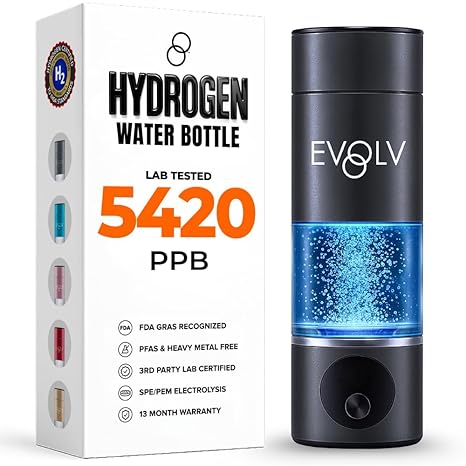
| 5. EVOLV Hydrogen Water Bottle | Budget with lab proof | 4.4 / 5 | 4,550 PPB @ 10 min | Published lab report | Aluminum shell, PC interior | 7.8 oz | Budget | |
| 6. Echo Go+ | Long-term lab record | 4.3 / 5 | 4,590 PPB @ 10 min | Published lab report | Polycarbonate | 10 oz | Premium | |
| 7. BUZIO Hydrogen Water Bottle | Mid-price pick | 4.2 / 5 | 4,000 PPB @ 10 min | Certificate claimed, no report | Polycarbonate | 10 oz | Mid | |
| 8. Dr.Water Hydrogen Tumbler (32 oz) | Big capacity | 4.1 / 5 | 1,100 PPB @ 10 min (earlier model) | Earlier model lab-tested | Tritan | 32 oz | Premium | |
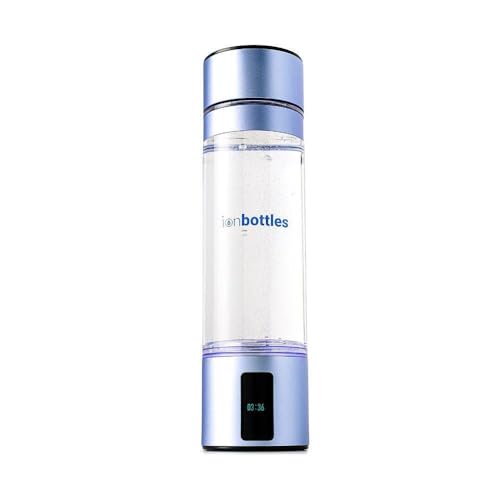
| 9. IonBottles ATOM | Sealed lid | 4.0 / 5 | 5,000 PPB @ 10 min | Certificate claimed, no report | Tritan, stainless base | 10 oz | Premium | |
| 10. ENERGILZ Hydrogen Water Bottle | Large glass bottle | 4.0 / 5 | 3,000 PPB by its own math (claims 6,000) | Maker figure | Borosilicate glass | 16.2 oz | Mid | |
| 11. Dr.Water Hydrator Pro | Dr.Water portable | 3.9 / 5 | 3,500–6,000 PPB (5 and 10 min modes) | Certificate claimed, no report | Tritan or aluminum (listing unclear) | 10 oz | Premium | |
| 12. IonBottles Pro | Inhaler port | 3.9 / 5 | 3,000 PPB (cycle not stated) | Maker figure | Borosilicate glass | 14 oz | Mid | |
| 13. Curety Hydrogen Water Bottle | Cheap glass entry | 3.8 / 5 | 1,500 PPB @ 5 min | Maker figure | Borosilicate glass | 14.2 oz | Budget | |
| 14. Fakllod Hydrogen Water Bottle | Popular budget glass | 3.8 / 5 | 1,600–2,000 PPB @ 3 min | Maker figure | Borosilicate glass | 15.5 oz | Budget | |
| 15. WIYYH Hydrogen Water Bottle (14 oz) | Budget 14 oz glass | 3.7 / 5 | 1,800 PPB @ 3 min | Maker figure | Borosilicate glass | 14 oz | Budget | |
| 16. Hydrohealth Hydrogen Water Bottle | Quick 3-minute cycles | 3.7 / 5 | 1,600 PPB @ 3 min | Maker figure | Not stated | Not stated | Mid | |
| 17. BEVECK Hydrogen Water Bottle (14 oz) | Ultra-budget starter | 3.6 / 5 | 3,000 PPB @ 3 min | Maker figure | Borosilicate glass | 14 oz | Budget | |
| 18. Aqua Vital Hydrogen Water Bottle | 16 oz glass | 3.6 / 5 | Not published | Not published | Borosilicate glass | 16 oz | Budget | |
| 19. GOSOIT Hydrogen Water Bottle | Carry handle | 3.5 / 5 | Not published | Not published | Tritan or glass (listing unclear) | 17 oz | Budget | |
| 20. Hydroh Hydrogen Water Bottle | 15 oz everyday | 3.5 / 5 | Not published | Not published | Stainless steel | 15 oz | Mid |
How to read the output column: each figure carries the cycle length it was measured or claimed at, because a 20-minute figure isn’t comparable with a 3-minute one. The Evidence column says whose number it is: a published third-party lab report, a report the maker cites but hasn’t made public, a certificate claimed with no report, the maker’s own figure, or nothing published at all.
Hydrogen output by bottle (PPB), and how it changes with cycle length
Published third-party lab result Maker or maker-cited figure. The solid bar is the main cycle; the faded extension is a longer cycle or the top of the maker’s range.
No output figure published: Aqua Vital, GOSOIT, and Hydroh. Output also varies with water quality and the bottle’s condition.
What Is Hydrogen Water? What the Research Says
Hydrogen water is regular water with free molecular hydrogen (H₂) gas dissolved in it, separate from the hydrogen already bonded to oxygen in H₂O. Because H₂ is a very small, neutral molecule, early research suggests it can pass through cell membranes and act as a selective antioxidant, reacting with the most damaging free radicals (hydroxyl radicals) and leaving normal oxidative processes alone. The 2007 Nature Medicine study that first described this is still the field’s most cited work.
New to the category? Our guide to what is a hydrogen water bottle covers the basics before you spend anything. For the electrolysis side of it, see how do hydrogen water bottles work.
Inflammation research
Long-term inflammation is linked to reduced energy, slower recovery, and metabolic problems. Some small human studies have reported lower inflammatory markers after regular intake of hydrogen-rich water. The proposed mechanism is simple: if oxidative stress decreases, inflammatory signaling may follow. Most of these studies are short and small, though, so the results are promising rather than conclusive.
Antioxidant research
This is the most researched area. Unlike broad antioxidants that neutralize all free radicals, molecular hydrogen appears to target only the most damaging reactive oxygen species (ROS). Research published in Frontiers in Physiology and Medical Gas Research has explored this selective behavior and what it might mean for cells.
Exercise and recovery research
Some controlled trials have observed lower blood lactate after exercise, fewer post-workout muscle fatigue markers, and faster recovery in certain groups. A 2024 review of multiple studies found hydrogen water showed promise for fatigue and endurance, though not every study agreed.
Metabolic research
Early studies have looked at hydrogen water and insulin sensitivity and cholesterol markers, though the samples are small. It would be misleading to call it a weight-loss solution; its possible metabolic effects are still being studied. Each of these is covered, with its citations, in our breakdown of the benefits of hydrogen water bottles.
Addressing Common Misconceptions About Hydrogen Water
“It’s just regular water”
Not quite. H₂O already contains hydrogen, but that hydrogen is chemically bonded to oxygen. In hydrogen water, free molecular hydrogen gas (H₂) is dissolved separately, and that dissolved gas is what the research is investigating.
“The hydrogen escapes instantly”
Hydrogen does leave the water over time, especially from an open container, which is why drinking it within 10–30 minutes of a cycle is recommended. A sealed, well-designed bottle can hold meaningful hydrogen for 2–6 hours.
“There’s no real evidence”
There is peer-reviewed research on PubMed and in journals like Frontiers in Physiology and Medical Gas Research, including a 2024 systematic review in the International Journal of Molecular Sciences. The field is still growing, and more large-scale human trials are needed. The research base is not zero, though.
“More PPB is always better”
Hydrogen saturates in water at about 1.6 mg/L, or 1,600 PPB, at room temperature and normal air pressure, and most published research works at or below that level. Anything far above it is only reachable under pressure inside a sealed chamber, and the excess starts escaping the moment the lid comes off. So treat a headline 8,000 PPB as a peak at the instant the cycle ends, not as what reaches your glass, and look for independently tested output rather than marketed maximums.
The balanced take
Molecular hydrogen holds GRAS (Generally Recognized As Safe) status for use in beverages, and the FDA closed that notice saying it had “no questions.” A review in Medical Gas Research counted 321 original studies in the field’s first eight years, most of them in animals, and a 2024 systematic review concluded hydrogen-rich water is “mostly considered safe, with no to minimal side effects.”
The science is real but still early: hydrogen water is best seen as a wellness drink, not a cure. We went through the evidence claim by claim in our answer to do hydrogen water bottles work.
How We Chose and Rated These Bottles
Marketing runs well ahead of the science in this category, so the picks here were built to cut through it. We started from the hydrogen bottles US buyers actually find on Amazon and kept the 22 you can buy at a US address. The ones we dropped are listed after the reviews, with the reason. On Amazon most of these are listed as “hydrogen water bottle generators”; we say “bottle” throughout, and the two mean the same thing.
To be clear about method: we did not run lab or home tests of dissolved hydrogen. Every output figure comes from one of three places, and each is labeled: a third-party lab report published for that exact model, a lab report the maker cites but hasn’t made public, or the maker’s own number. Concentration also depends on the water, its temperature, and how soon you drink, so membrane design and the owner record count as much as the headline figure.
Each bottle is scored out of 5 on the same five criteria: hydrogen output (judged against its cycle time and how strong the evidence is), technology and safety (a proper SPE/PEM membrane that vents ozone and chlorine), build quality, ease of use, and value for money. Our Rating is the straight average of the five, shown in each bottle’s rating table so you can check the arithmetic.
That’s how we picked the best-rated hydrogen water bottles here; it’s an editorial score, not an Amazon star rating.
Owner reviews mattered too. We read the long-term ones, because that’s where the bottles that quietly stop producing hydrogen after a few months show up, and every review below summarizes what owners report. Where a bottle’s evidence is thin, its review says so plainly.
Best Hydrogen Water Bottles: All 22 Reviewed and Ranked
The bottles run from #1 to #20 in order of Our Rating. Two sit unnumbered beside the bottle they’re most often weighed against: the 17 oz PIURIFY directly under the 10 oz version, and the PIURIFY Flask directly under the Echo Flask. Each review covers the output evidence, the build, and what owners report, and ends with the scores behind its rating.
1. PIURIFY Hydrogenator (10 oz) – Best Overall

PIURIFY Hydrogenator (10 oz)
- Certified Output: 4,090 PPB on the 10-minute cycle (H2 Analytics)
- Independent Check: 3.85 mg/L on the 10-minute cycle (H2HUBB)
- Cycles: 5 or 10 minutes; higher maker figures need stacked cycles
- Venting: SPE/PEM cell vents ozone and chlorine out of the water
- Body: food-grade polycarbonate, 10 oz (280 ml)
- Output backed by two published lab results
- H2HUBB found no chlorine or ozone in the water
- Lifetime warranty stated by the maker
- One button runs a 5- or 10-minute cycle
- 10 oz per cycle is a small serving
- The 6,300 PPB headline needs three back-to-back cycles
- Polycarbonate body, if you'd rather drink from glass
Best for: buyers who want the most independently checked output.
Skip it if: you want a bigger serving; the 17 oz version sits directly below.
Why it won “Best Overall”: Two published third-party results for this exact model.
What the Output Evidence Says
Two labs have published results for this exact bottle. H2 Analytics certified 4,090 PPB on the 10-minute cycle (report H2AR-240821-1), and H2HUBB measured 3.85 mg/L on the same cycle, about 1.08 mg of hydrogen per fill, with no chlorine or ozone found in the water. The listing headline of 6,300+ PPB is real but needs three 10-minute cycles run back to back.
Build, Battery, and Cleaning
The body is food-grade polycarbonate, chosen over glass because the cycle builds pressure. It holds 10 oz (280 ml), runs a 5- or 10-minute program from one button, and charges over USB-C. PIURIFY states a lifetime warranty, though the same listing also says 10+ years, so check the terms when you register.
What Owners Report
Owner reviews like the clean taste and how easy it is to run. The common complaints are the small serving and the battery: a noticeable group report units that stopped holding a charge within weeks, which PIURIFY generally replaces. Retention is covered in more depth in our PIURIFY hydrogen water bottle reviews.
Detailed Rating
| Criteria | Rating |
|---|---|
| Hydrogen Output | 4.8 / 5 |
| Technology & Safety | 5.0 / 5 |
| Build Quality | 4.8 / 5 |
| Ease of Use | 5.0 / 5 |
| Value for Money | 4.9 / 5 |
| Overall | 4.9 / 5 |
PIURIFY Hydrogenator (17 oz, With Handle) – Best for Bigger Servings
Paired with #1: the same PIURIFY design in a 17 oz size, placed here so you can compare the two directly. It isn’t ranked separately.
PIURIFY Hydrogenator (17 oz, With Handle)
- Maker-Cited Lab Figure: 4,240 PPB at 10 min (H2AR-251025-1)
- Long Cycle: 6,290+ PPB at 20 min, per the maker
- Capacity: 17 oz with a built-in handle
- Battery: 2,200 mAh, up to 10 cycles (maker)
- Body: food-grade polycarbonate with ozone and chlorine venting
- Nearly twice the serving of the 10 oz model
- Maker publishes the report number
- Handle makes it easy to carry
- USB-C charging
- The 9,970 PPB headline needs stacked long cycles
- Fewer owner reviews than the 10 oz model
- Heavier to carry, about 1.2 lb
Best for: one large serving per cycle.
Skip it if: you want the most independently checked bottle; that’s the 10 oz version just above.
Why it won “Best for Bigger Servings”: The largest PIURIFY with a cited lab figure.
What the Output Evidence Says
PIURIFY cites H2 Analytics report H2AR-251025-1 for this model: 4,240 PPB on the 10-minute cycle and 6,290+ PPB on the 20-minute one. We couldn’t open that report ourselves, so read the figures as the maker’s citation. The 9,970 PPB headline needs two long cycles stacked.
Build, Battery, and Cleaning
It’s the 10 oz bottle scaled up to 17 oz, with a built-in handle and a larger 2,200 mAh battery that PIURIFY rates for about 10 cycles. The body is the same food-grade polycarbonate with a vent for ozone and chlorine. It charges over USB-C and weighs about 1.2 lb.
What Owners Report
Early owner reviews are positive on build quality, ease of use, and taste, and several say the bigger serving is the reason they chose it. The review base is still much smaller than the 10 oz model’s, so long-term reliability is less clear.
Detailed Rating
| Criteria | Rating |
|---|---|
| Hydrogen Output | 4.6 / 5 |
| Technology & Safety | 4.5 / 5 |
| Build Quality | 4.4 / 5 |
| Ease of Use | 4.2 / 5 |
| Value for Money | 3.8 / 5 |
| Overall | 4.3 / 5 |
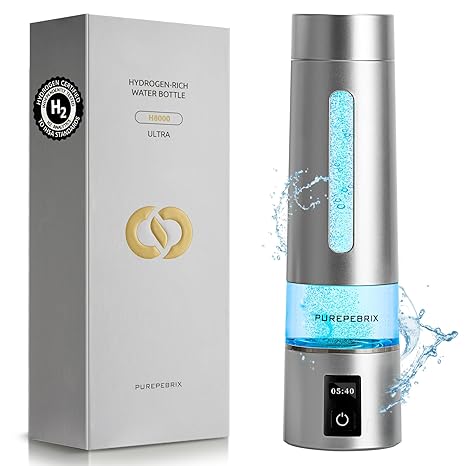
2. PUREPEBRIX Hydrogen Water Bottle – Best for Maximum Output
PUREPEBRIX Hydrogen Water Bottle
- Maker's Lab Figures: 4,340 PPB at 5 min, 6,590 PPB at 10 min
- Longer Cycles: 8,160 PPB at 20 min, 9,060 PPB at 30 min
- Electrodes: platinum-iridium coated, with a dual-chamber SPE/PEM vent
- Battery: up to 20 cycles per charge (maker)
- Body: BPA-free Tritan, 270 ml (about 9 oz)
- The most detailed published output figures here
- Lab report linked from the box by QR code
- Up to 20 cycles per charge
- Maker promises a refund if an independent lab finds it below spec
- 270 ml per cycle, the smallest serving in the top four
- Warranty is 1 year, plus “lifetime technical assurance”
- Its lab figures come from a single report the maker commissioned
Best for: the most hydrogen per sip.
Skip it if: you want a result from more than one lab (#1).
Why it won “Best for Maximum Output”: The highest maker-published figures, cycle by cycle.
What the Output Evidence Says
PUREPEBRIX publishes the most detailed output ladder of any bottle here, from an H2 Analytics gas chromatography report linked by a QR code on the box: 4,340 PPB at 5 minutes, 6,590 at 10, 8,160 at 20, and 9,060 at 30. It also cites an IHSA registration. No second lab has published a result for it.
Build, Battery, and Cleaning
Platinum-iridium coated electrodes sit in a dual-chamber SPE/PEM cell that vents exhaust gas separately. The body is BPA-free Tritan holding 270 ml (about 9 oz), and the battery is rated for up to 20 cycles per charge. The warranty is one year, plus what the maker calls lifetime technical assurance, and it promises a refund if an independent lab finds output below spec.
What Owners Report
Owners rate the build quality highly and mention the high PPB figures and ease of use. Battery life draws mixed comments. What sets it apart at this price is how much output data the maker publishes. Our PUREPEBRIX hydrogen water bottle review goes through the figures in full.
Detailed Rating
| Criteria | Rating |
|---|---|
| Hydrogen Output | 5.0 / 5 |
| Technology & Safety | 4.6 / 5 |
| Build Quality | 4.6 / 5 |
| Ease of Use | 4.8 / 5 |
| Value for Money | 4.5 / 5 |
| Overall | 4.7 / 5 |
3. Echo Flask – Best Smart Bottle
Echo Flask
- Lab Result: 6.07 mg/L at 10 min, 8.25 mg/L at 20 min (H2 Analytics)
- Tracking: touch screen and intake logging in the Echo app
- Capacity: 12 oz (350 ml)
- Membrane: SPE/PEM with adjustable hydrogen levels
- Body: ABS, polycarbonate, and PPSU, per Echo's listing
- Highest published lab result here at 20 minutes
- Full lab report posted on Echo's support site
- Screen and app show how much you drink
- Sold by Echo Water's own store
- Top price band
- Owner reviews are more mixed than the price suggests
- The app adds a step if you only want the water
Best for: tracking intake plus lab-checked output.
Skip it if: you don’t want an app. The PIURIFY Flask, directly below, quotes a similar 20-minute figure without one.
Why it won “Best Smart Bottle”: A published H2 Analytics report and real tracking features.
What the Output Evidence Says
Echo posts an H2 Analytics report for the Flask on its own support site: 6.07 mg/L after a 10-minute cycle (2.17 mg per fill) and 8.25 mg/L after 20 minutes (2.89 mg), measured by gas chromatography in about 350 ml of distilled water. That is the highest published 20-minute result in this guide.
Build, Battery, and Cleaning
The Flask holds 12 oz (350 ml), with an LCD touch screen and intake tracking in the Echo app. Echo’s listing names ABS, polycarbonate, and PPSU for the body. It recharges over USB, and it ships with a little distilled water inside by design.
What Owners Report
Owners like the design and the tracking. The weak points in reviews are battery life (some say it dies partway through a cycle) and a lid that can be hard to open, and opinions on value are split at this price. For the full picture see our Echo Flask hydrogen water bottle review.
Detailed Rating
| Criteria | Rating |
|---|---|
| Hydrogen Output | 5.0 / 5 |
| Technology & Safety | 4.8 / 5 |
| Build Quality | 4.5 / 5 |
| Ease of Use | 4.4 / 5 |
| Value for Money | 4.3 / 5 |
| Overall | 4.6 / 5 |
PIURIFY Flask – Best High-Output Flask
Paired with #3: a 12 oz flask in the same format as the Echo Flask, without the app, placed here so you can compare the two directly. It isn’t ranked separately.
PIURIFY Flask
- Maker Output: about 4,860 PPB at 10 min, 8,630 PPB at 20 min
- Certificate: H2 Analytics claimed; no report number published
- Battery: 5,000 mAh, about 200 minutes of run time
- Capacity: 12 oz (350 ml), BPA-free copolyester
- Cleaning: built-in self-cleaning mode
- Highest maker-quoted 20-minute figure on this list
- Very large battery for its size
- Self-cleaning mode
- No app needed
- No published report number
- Premium price band
- 12 oz per cycle
Best for: Echo Flask-level output claims without an app.
Skip it if: you want the published report; that’s the Echo Flask just above.
Why it won “Best High-Output Flask”: The highest 20-minute figure quoted by any maker here.
What the Output Evidence Says
PIURIFY quotes about 4,860 PPB on the 10-minute cycle and up to 8,630 PPB on the 20-minute cycle, and the listing says H2 Analytics certified it. We couldn’t find a report number for the Flask, so read those as the maker’s figures.
Build, Battery, and Cleaning
It’s a 12 oz (350 ml) flask in BPA-free copolyester with a vent for ozone and chlorine, a self-cleaning mode, and a 5,000 mAh battery that PIURIFY rates for about 200 minutes of run time. Unlike the Echo Flask just above, there’s no app or touch screen.
What Owners Report
Early reviews are strongly positive, mostly about ease of use, taste, and battery life. One owner reports a unit that failed in days and was replaced quickly. The review base is still small.
Detailed Rating
| Criteria | Rating |
|---|---|
| Hydrogen Output | 4.6 / 5 |
| Technology & Safety | 4.0 / 5 |
| Build Quality | 4.2 / 5 |
| Ease of Use | 4.2 / 5 |
| Value for Money | 3.5 / 5 |
| Overall | 4.1 / 5 |
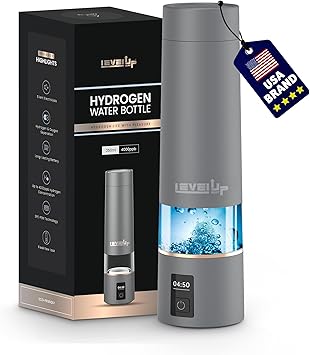
4. LevelUpWay Hydrogen Water Bottle – Best Compact Stainless Pick
LevelUpWay Hydrogen Water Bottle
- Maker Output: up to 5,000 PPB (no third-party report)
- Cycles: 6 or 12 minutes, one-touch, with a digital display
- Body: stainless steel, per the listing, 250 ml
- Extras: hydrogen breathing adapter included
- Brand: says it's based in the USA
- Stainless body instead of plastic or glass
- Two cycle lengths with a status display
- Breathing adapter in the box
- Light and easy to carry
- 250 ml (8.5 oz) per cycle
- No independent output measurement
- Fewer owner reviews than most bottles here
Best for: a compact metal bottle.
Skip it if: you want lab-checked output; EVOLV (#5) has it.
Why it’s here: The only stainless body in our top four, with a simple two-cycle routine.
What the Output Evidence Says
LevelUpWay rates it up to 5,000 PPB on the 12-minute cycle. No independent lab has published a figure for this model, and at least one owner with a test kit reports readings well below the claim.
Build, Battery, and Cleaning
The body is stainless steel, per the listing, holding 250 ml (about 8.5 oz). One button runs a 6- or 12-minute cycle, a digital display shows progress, and a hydrogen breathing adapter comes in the box. The brand says it is based in the USA; it is sold by NV17, and no warranty terms are published for the model.
What Owners Report
Owners call it easy to use and well built. The complaints are output below the advertised figure, a few leaks, and a wish for a glass body at this price. Our Level Up Way hydrogen water bottle review has more.
Detailed Rating
| Criteria | Rating |
|---|---|
| Hydrogen Output | 4.5 / 5 |
| Technology & Safety | 3.8 / 5 |
| Build Quality | 4.6 / 5 |
| Ease of Use | 5.0 / 5 |
| Value for Money | 4.1 / 5 |
| Overall | 4.4 / 5 |
5. EVOLV Hydrogen Water Bottle – Best Budget Pick With Lab Proof
EVOLV Hydrogen Water Bottle
- Lab Result: 4.55 mg/L at 10 min, 2.50 mg/L at 5 min (H2HUBB)
- Maker Rating: up to 5.4 PPM
- Venting: built-in exhaust valve for chlorine and ozone
- Body: aircraft-grade aluminum shell, about 7.8 oz
- Materials: SGS heavy-metal leaching test, per the maker
- Published independent result in the budget band
- H2HUBB found no chlorine or ozone
- Sturdy aluminum shell
- Sold directly by EVOLV
- About 8 oz per cycle
- Battery life isn't stated on the listing
- The lab figure applies to the 10-minute cycle only
Best for: lab-checked output without a premium price.
Skip it if: you want a large serving.
Why it won “Best Budget Pick With Lab Proof”: An H2HUBB seal and published numbers at the lowest price band.
What the Output Evidence Says
H2HUBB measured 2.50 mg/L on the 5-minute cycle and 4.55 mg/L on the 10-minute cycle, about 1.0 mg of hydrogen per fill, and found no chlorine or ozone. EVOLV rates it at up to 5.4 PPM and says it verifies output by gas chromatography.
Build, Battery, and Cleaning
An aircraft-grade aluminum shell surrounds a food-grade polycarbonate interior holding about 7.8 oz. A built-in exhaust valve vents chlorine and ozone, and EVOLV says the membrane is a DuPont SPE/PEM made in Japan. Battery life isn’t stated on the listing.
What Owners Report
Owners rate the quality and construction well. Reliability is the split: some report years of use, others a unit that stopped working after a few weeks. Many wish it held more than one small glass. Our EVOLV hydrogen water bottle review covers it in depth.
Detailed Rating
| Criteria | Rating |
|---|---|
| Hydrogen Output | 4.7 / 5 |
| Technology & Safety | 4.8 / 5 |
| Build Quality | 4.3 / 5 |
| Ease of Use | 4.3 / 5 |
| Value for Money | 3.9 / 5 |
| Overall | 4.4 / 5 |
6. Echo Go+ – Best Long-Term Lab Record
Echo Go+
- Lab Result: 4.59 mg/L at 10 min, 2.43 mg/L at 5 min (H2 Analytics)
- One-Year Retest: 2.80 and 4.59 mg/L on a used bottle (H2 Analytics)
- Status: Echo's Go+ page now redirects to the Echo Flask
- Body: food-grade polycarbonate, 10 oz
- Top: sealed lid for spill-free carry
- Output held up in a one-year retest
- Two published H2 Analytics results
- Echo still sells replacement parts
- Compact enough for a bag or desk
- Echo's own store now lists only Go+ parts
- Top price band for a 10 oz bottle
- Battery life isn't stated on the listing
Best for: proof that output lasts.
Skip it if: you want the model Echo sells today; that’s the Echo Flask (#3).
Why it won “Best Long-Term Lab Record”: The only bottle here with a published retest after a year of use.
What the Output Evidence Says
Echo posts two H2 Analytics results for the Go+: 2.43 mg/L on the 5-minute cycle and 4.59 mg/L on the 10-minute cycle (April 2023), and a retest of a bottle after a year of use (report H2AR-241125-1) that came back at 2.80 and 4.59 mg/L. No other bottle here has a published long-term retest.
Build, Battery, and Cleaning
It’s a 10 oz food-grade polycarbonate bottle with a sealed top and adjustable hydrogen levels, charged over USB. Echo now redirects its own Go+ product page to the Echo Flask and sells Go+ parts in its store; Amazon still lists the bottle through a reseller.
What Owners Report
Owners describe it as well made and easy to clean, with several on their second Echo. Complaints center on battery life after long use and on the price for a 10 oz bottle. Deciding between the two generations? See how the Echo Go and Echo Go+ stack up, and if you are torn between the two current Echo designs, see Echo Go+ vs. Echo Flask compared. Our full Echo Go Plus review covers the rest.
Detailed Rating
| Criteria | Rating |
|---|---|
| Hydrogen Output | 4.6 / 5 |
| Technology & Safety | 4.8 / 5 |
| Build Quality | 4.4 / 5 |
| Ease of Use | 4.4 / 5 |
| Value for Money | 3.3 / 5 |
| Overall | 4.3 / 5 |
7. BUZIO Hydrogen Water Bottle – Best Mid-Price Pick
BUZIO Hydrogen Water Bottle
- Maker Output: 4,000 PPB at 10 min, 1,600 PPB at 5 min
- Certificate: H2 Analytics certification claimed; report not published
- Membrane: DuPont PEM with a drain vent at the base
- Display: OLED shows PPB estimate, timer, and battery
- Battery: 1,800 mAh, USB-C, about 8 ten-minute cycles
- Big owner-review base for its price band
- Clear OLED status screen
- DuPont membrane with byproduct venting
- USB-C charging
- Has to stay upright while running
- 10 oz per cycle
- Output figure not independently published
Best for: an easy-to-read display at a mid price.
Skip it if: you need a published lab report (#1, #3, #5, #6).
Why it won “Best Mid-Price Pick”: A strong membrane spec and the widest owner feedback in its band.
What the Output Evidence Says
BUZIO states 4,000 PPB after 10 minutes and 1,600 PPB after 5, and the listing says H2 Analytics certified it. We found no published report, so read those as the maker’s figures.
Build, Battery, and Cleaning
The cell uses a DuPont proton exchange membrane with a drain vent at the base for ozone and chlorine. The body is lightweight food-grade polycarbonate holding 10 oz, and an OLED screen shows a PPB estimate, the countdown, and battery level. The 1,800 mAh battery charges over USB-C; BUZIO rates it for about 8 ten-minute cycles. Keep it upright while it runs.
What Owners Report
Owners rate the quality and value well. Complaints cluster on the lid seal leaking and on batteries that stop charging. Some reviews on the listing describe a different BUZIO product, so read them with care. Our BUZIO hydrogen water bottle review has more detail.
Detailed Rating
| Criteria | Rating |
|---|---|
| Hydrogen Output | 4.4 / 5 |
| Technology & Safety | 4.2 / 5 |
| Build Quality | 4.0 / 5 |
| Ease of Use | 4.6 / 5 |
| Value for Money | 3.8 / 5 |
| Overall | 4.2 / 5 |
8. Dr.Water Hydrogen Tumbler (32 oz) – Best Big-Capacity Tumbler
Dr.Water Hydrogen Tumbler (32 oz)
- Earlier-Model Lab Result: 1.10 mg/L at 10 min, 1.60 at 20 (H2HUBB)
- Dose per Fill: about 1.4 mg in roughly 900 ml (earlier model)
- Capacity: 32 oz, BPA-free Tritan
- Cleaning: self-cleaning electrodes; dishwasher-safe body and cap
- Lid: built-in sipper straw
- By far the largest bottle here
- Design lineage has a published H2HUBB result
- Easy to clean
- Straw lid for all-day sipping
- Low concentration per sip
- The current version hasn't been tested
- Bulky to carry
Best for: all-day sipping volume.
Skip it if: you want a strong concentration in one glass.
Why it won “Best Big-Capacity Tumbler”: The only big-capacity bottle with any published lab data.
What the Output Evidence Says
H2HUBB tested Dr.Water’s earlier HydroStanley version of this tumbler: 1.10 mg/L after 10 minutes and 1.60 mg/L after 20, about 1.4 mg of hydrogen in a 900 ml fill, with no chlorine or ozone found. The current version hasn’t been tested, and its listing quotes 2,000 to 3,000 PPB.
Build, Battery, and Cleaning
It’s a 32 oz BPA-free Tritan tumbler with a built-in sipper straw, self-cleaning electrodes, and a dishwasher-safe body and cap. It’s far bigger than anything else here, which makes it a desk or car bottle rather than a pocket one.
What Owners Report
Owners like the capacity and say the water tastes clean. Reliability is mixed, with some units failing within weeks, and a few report leaks from the top or base.
Detailed Rating
| Criteria | Rating |
|---|---|
| Hydrogen Output | 3.4 / 5 |
| Technology & Safety | 4.2 / 5 |
| Build Quality | 4.6 / 5 |
| Ease of Use | 4.2 / 5 |
| Value for Money | 4.1 / 5 |
| Overall | 4.1 / 5 |
9. IonBottles ATOM – Best Sealed Lid for Drinking Later
IonBottles ATOM
- Maker Output: 5 PPM at 10 min, 2.5 PPM at 5 min
- Lab Claim: ISO/IEC 17025 lab cited; full report not found
- Lid: airtight seal, up to 13 hours retention (maker)
- Display: OLED shows time, mode, and battery
- Body: BPA-free Tritan with a stainless base, 10 oz
- Highest output in the IonBottles range, per the maker
- Sealed lid for drinking later in the day
- DuPont dual-chamber membrane
- USB-C, 12–15 cycles per charge
- Very few owner reviews so far
- Lab report not public
- 10 oz per cycle
Best for: making hydrogen water to drink hours later.
Skip it if: you want a long owner track record.
Why it won “Best Sealed Lid for Drinking Later”: The strongest retention claim here, on a well-specified membrane.
What the Output Evidence Says
IonBottles rates the ATOM at 5 PPM after 10 minutes and 2.5 PPM after 5, and says an ISO/IEC 17025 accredited lab verified it. We couldn’t find the full report, so read those as the maker’s figures.
Build, Battery, and Cleaning
A DuPont dual-chamber membrane with a pressure-relief valve vents ozone and chlorine. The body is BPA-free Tritan on a stainless base, holding 10 oz. An OLED screen shows the cycle and battery, USB-C charging takes under two hours, and the maker rates it for 12 to 15 cycles per charge. The airtight lid is claimed to hold hydrogen for up to 13 hours.
What Owners Report
There are only a handful of owner reviews so far. Two report units that stopped working within weeks of purchase.
Detailed Rating
| Criteria | Rating |
|---|---|
| Hydrogen Output | 4.6 / 5 |
| Technology & Safety | 4.4 / 5 |
| Build Quality | 4.0 / 5 |
| Ease of Use | 4.2 / 5 |
| Value for Money | 2.8 / 5 |
| Overall | 4.0 / 5 |
10. ENERGILZ Hydrogen Water Bottle – Best Large Glass Bottle
ENERGILZ Hydrogen Water Bottle
- Maker Output: up to 6,000 PPB at 10 min
- Dose Stated: 1.44 mg of H₂ per 480 ml fill
- Body: borosilicate glass, 16.2 oz (480 ml), silicone cover
- Battery: 1,200 mAh, up to 30 cycles (maker)
- Extras: inhalation tube included
- Large glass serving
- Protective silicone cover
- Long battery claim
- Large owner-review base
- The maker's PPB and dose figures don't agree
- Listing leans on health claims we can't support
- Sold by a third-party seller, not the brand
Best for: a big glass serving.
Skip it if: you want figures that agree; EVOLV is #5.
Why it won “Best Large Glass Bottle”: The largest glass body here with a solid owner base.
What the Output Evidence Says
ENERGILZ claims 6,000 PPB in 10 minutes, but its own listing also says a 480 ml fill holds 1.44 mg of hydrogen, which works out to about 3,000 PPB. The two figures don’t agree, and no lab report is published. A cheaper 3,000 PPB version of the bottle is also sold.
Build, Battery, and Cleaning
A 16.2 oz (480 ml) borosilicate glass body sits in a silicone cover, with platinum-coated titanium plates. The 1,200 mAh battery is rated for up to 30 cycles per charge, and an inhalation tube is included. The glass lifts out for washing.
What Owners Report
Owners find it easy to use and easy to clean, and like the taste. Battery life and durability draw mixed reviews, including some glass breakage after a drop. Ignore the listing’s health promises; no bottle here can back them.
Detailed Rating
| Criteria | Rating |
|---|---|
| Hydrogen Output | 3.8 / 5 |
| Technology & Safety | 3.6 / 5 |
| Build Quality | 4.4 / 5 |
| Ease of Use | 4.6 / 5 |
| Value for Money | 3.6 / 5 |
| Overall | 4.0 / 5 |
11. Dr.Water Hydrator Pro – Best Dr.Water Portable
Dr.Water Hydrator Pro
- Maker Output: 3,500–6,000 PPB, 5- or 10-minute modes
- Membrane: SPE/PEM N117 with platinum-coated titanium plates
- Certificate: H2 Analytics document claimed by the maker
- Capacity: 10 oz
- Body: listing names both Tritan and aluminum
- Strong membrane and plate spec on paper
- Two cycle lengths
- Maker says a lab certificate ships in the box
- Compact size
- Output and material figures conflict across listings
- Few owner reviews
- Premium price band
Best for: a Dr.Water bottle in a portable size.
Skip it if: you want consistent specs.
Why it’s here: Dr.Water’s portable model available on Amazon US.
What the Output Evidence Says
The Amazon listing claims 3,500 to 6,000 PPB, with 5- and 10-minute modes, and says the bottle ships with an H2 Analytics document. Dr.Water’s own store quotes other figures for Pro versions, so the number depends on which page you read.
Build, Battery, and Cleaning
It uses an N117 SPE/PEM membrane with platinum-coated titanium plates and holds 10 oz. The listing describes the body as both Tritan and aluminum, so check the version you receive.
What Owners Report
The few owner reviews are mostly positive on build and ease of use. One notes that a plastic chamber holds hydrogen less well than glass, and one saw no benefit at all.
Detailed Rating
| Criteria | Rating |
|---|---|
| Hydrogen Output | 4.3 / 5 |
| Technology & Safety | 4.0 / 5 |
| Build Quality | 3.8 / 5 |
| Ease of Use | 4.2 / 5 |
| Value for Money | 3.2 / 5 |
| Overall | 3.9 / 5 |
12. IonBottles Pro – Best Glass Bottle With an Inhaler Port
IonBottles Pro
- Maker Output: up to 3.0 PPM (3,000 PPB)
- Membrane: DuPont PEM/SPE with dual-chamber ozone venting
- Body: borosilicate glass, 14 oz, stainless base
- Extras: built-in inhalation port with cannula
- Battery: USB-C, 10+ cycles; self-cleaning mode
- Glass keeps the taste neutral
- Dual-chamber venting
- Self-cleaning mode
- USB-C charging
- Cool or cold water only, per the maker
- Glass needs careful handling
- Small owner-review base
Best for: glass with a built-in inhaler port.
Skip it if: you’ll never use the inhalation feature.
Why it won “Best Glass Bottle With an Inhaler Port”: The best-specified glass bottle from a dedicated hydrogen brand.
What the Output Evidence Says
IonBottles rates the Pro at up to 3.0 PPM (3,000 PPB). No outside lab result is published for it.
Build, Battery, and Cleaning
A DuPont dual-chamber membrane vents ozone and chlorine away from the water, inside a 14 oz borosilicate glass chamber on a stainless base. A built-in port lets you breathe the leftover gas through the included cannula. It charges over USB-C, the maker rates it for 10+ cycles per charge, and holding the button runs a self-cleaning cycle. Use cool or cold water only.
What Owners Report
Owners say the water tastes better, but quality reports are split, and several mention charging failures after about a month. Our IonBottles Pro hydrogen water bottle review covers it in full.
Detailed Rating
| Criteria | Rating |
|---|---|
| Hydrogen Output | 3.8 / 5 |
| Technology & Safety | 4.4 / 5 |
| Build Quality | 4.2 / 5 |
| Ease of Use | 4.0 / 5 |
| Value for Money | 3.1 / 5 |
| Overall | 3.9 / 5 |
13. Curety Hydrogen Water Bottle – Best Cheap Glass Entry Point
Curety Hydrogen Water Bottle
- Maker Output: up to 1,500 PPB in 5 minutes
- Body: borosilicate glass, stainless-steel lid and base
- Capacity: 14.2 oz
- Venting: breathable vent at the base for oxygen and chlorine
- Charging: USB-C, with a port cover
- Real SPE/PEM membrane at a budget price
- Glass body
- Base unscrews for cleaning
- Good owner feedback
- Modest output
- Maker figure only
- Glass is heavier than plastic
Best for: trying hydrogen water in glass for little money.
Skip it if: you want higher, lab-checked output; EVOLV is #5.
Why it won “Best Cheap Glass Entry Point”: The best-reviewed glass bottle in the budget band.
What the Output Evidence Says
Curety rates it at up to 1,500 PPB after a 5-minute cycle. That is a maker figure; no lab report is published.
Build, Battery, and Cleaning
The body is borosilicate glass with a stainless-steel lid and base, holding 14.2 oz. A breathable vent at the bottom releases oxygen and chlorine, the base unscrews for cleaning, and it charges over USB-C with a cover on the port.
What Owners Report
Owners call it well made and easy to use, and like the taste. The weak spots are battery life and units that stop working after some months.
Detailed Rating
| Criteria | Rating |
|---|---|
| Hydrogen Output | 3.4 / 5 |
| Technology & Safety | 3.8 / 5 |
| Build Quality | 4.0 / 5 |
| Ease of Use | 4.4 / 5 |
| Value for Money | 3.4 / 5 |
| Overall | 3.8 / 5 |
14. Fakllod Hydrogen Water Bottle – Best-Known Budget Glass Bottle
Fakllod Hydrogen Water Bottle
- Maker Output: 1,600–2,000 PPB in 3 minutes
- Body: borosilicate glass with an anti-slip base
- Capacity: 460 ml (about 15.5 oz)
- Cleaning: 5-minute self-clean mode for limescale
- Operation: one button, automatic shut-off
- Large glass serving
- Fast 3-minute cycle
- Self-clean mode
- One of the largest owner-review bases here
- Output drops with low-mineral water, per the maker
- Maker figure only
- Battery life isn't stated
Best for: a budget glass bottle with a long owner record.
Skip it if: you drink distilled or RO water.
Why it won “Best-Known Budget Glass Bottle”: The most owner feedback of any budget glass bottle here.
What the Output Evidence Says
Fakllod rates it at 1,600 to 2,000 PPB after a 3-minute cycle, and says output rises with the mineral content of the water. That is a maker figure; no lab report is published.
Build, Battery, and Cleaning
A 460 ml (about 15.5 oz) borosilicate glass body sits on an anti-slip base. One press runs the 3-minute cycle; a long press runs a 5-minute cleaning cycle that removes limescale. Battery life isn’t stated.
What Owners Report
Owners like the taste and the simplicity, and the color-changing light gets plenty of mentions. The two common problems are leaks from the base and units that fail within weeks. Our Fakllod hydrogen water bottle review has more detail.
Detailed Rating
| Criteria | Rating |
|---|---|
| Hydrogen Output | 3.5 / 5 |
| Technology & Safety | 3.6 / 5 |
| Build Quality | 3.8 / 5 |
| Ease of Use | 4.4 / 5 |
| Value for Money | 3.7 / 5 |
| Overall | 3.8 / 5 |
15. WIYYH Hydrogen Water Bottle (14 oz) – Best Budget 14 oz Glass
WIYYH Hydrogen Water Bottle (14 oz)
- Maker Output: up to 1,800 PPB in 3 minutes
- Body: borosilicate glass, 420 ml (14 oz)
- Battery: 15–20 uses per charge (maker)
- Cleaning: lid and base detach fully
- Water: maker recommends mineral or alkaline water
- Glass at a budget price
- Long battery claim
- Fully detachable for cleaning
- Large owner-review base
- Maker figure only
- Base must be retightened after cleaning to avoid leaks
- Listing leans on health claims we can't support
Best for: budget glass with long battery claims.
Skip it if: you want any published output test.
Why it won “Best Budget 14 oz Glass”: The longest battery claim among budget glass bottles.
What the Output Evidence Says
WIYYH rates it at up to 1,800 PPB after a 3-minute cycle. That is a maker figure; no lab report is published.
Build, Battery, and Cleaning
The body is 420 ml (14 oz) of borosilicate glass, and the lid and base come off completely for cleaning; tighten the base again afterward or it leaks. The maker rates the battery for 15 to 20 uses per charge, and recommends mineral or alkaline water rather than other drinks.
What Owners Report
Owners like the taste and how portable it is. Reliability is mixed, with some units lasting only about a month, and a few report leaks.
Detailed Rating
| Criteria | Rating |
|---|---|
| Hydrogen Output | 3.5 / 5 |
| Technology & Safety | 3.5 / 5 |
| Build Quality | 3.7 / 5 |
| Ease of Use | 4.2 / 5 |
| Value for Money | 3.6 / 5 |
| Overall | 3.7 / 5 |
16. Hydrohealth Hydrogen Water Bottle – Best for Quick 3-Minute Cycles
Hydrohealth Hydrogen Water Bottle
- Maker Output: up to 1,600 PPB in 3 minutes
- Cell: SPE/PEM with platinum-plated titanium layers
- Venting: removes chlorine during the cycle, per the maker
- Operation: fill, press, and drink when the light goes off
- Size: about 8.2 inches tall
- Fast 3-minute cycle
- One-button routine
- Platinum-plated electrodes
- Good owner feedback
- Maker figure only
- Listing makes health claims
- Capacity isn't stated on the current listing
Best for: quick daily cycles.
Skip it if: you want verified output.
Why it won “Best for Quick 3-Minute Cycles”: The highest maker-rated 3-minute output in its band.
What the Output Evidence Says
Hydrohealth rates it at up to 1,600 PPB after a 3-minute cycle, using platinum-plated titanium layers in an SPE/PEM cell. That is a maker figure; no lab report is published. The listing title mentions kidney health, which no bottle here can support.
Build, Battery, and Cleaning
Operation is simple: fill, press, and drink when the light turns off. The maker says the cell removes chlorine during the cycle. The current listing doesn’t state capacity or battery figures.
What Owners Report
Owners rate the build and ease of use, but reliability reports are split, and several complain about missing instructions. Our Hydrohealth hydrogen water bottle review has more.
Detailed Rating
| Criteria | Rating |
|---|---|
| Hydrogen Output | 3.4 / 5 |
| Technology & Safety | 3.6 / 5 |
| Build Quality | 3.8 / 5 |
| Ease of Use | 4.4 / 5 |
| Value for Money | 3.3 / 5 |
| Overall | 3.7 / 5 |
17. BEVECK Hydrogen Water Bottle (14 oz) – Best Ultra-Budget Starter
BEVECK Hydrogen Water Bottle (14 oz)
- Maker Output: up to 3,000 PPB in 3 minutes
- Body: borosilicate glass, 420 ml (14 oz)
- Cleaning: top and bottom unscrew
- Base: soft EVA pad
- Materials: SGS certification claimed by the maker
- Very low cost of entry
- Glass body
- Easy to clean
- Ships in a gift box
- Very few owner reviews
- Maker figure only
- Listing makes health claims we can't support
Best for: the cheapest way to try a glass SPE/PEM bottle.
Skip it if: you want a long owner record; Fakllod is #14.
Why it won “Best Ultra-Budget Starter”: A glass body at the lowest price band.
What the Output Evidence Says
BEVECK rates it at up to 3,000 PPB after a 3-minute cycle. That is a maker figure; no lab report is published.
Build, Battery, and Cleaning
It’s a 420 ml (14 oz) borosilicate glass cup on a soft EVA pad, with a top and bottom that both unscrew for cleaning. The maker cites SGS certification for the materials.
What Owners Report
The owner reviews so far are few and uniformly positive, which isn’t enough to judge reliability yet. Our BEVECK hydrogen water bottle review covers the brand’s earlier listing.
Detailed Rating
| Criteria | Rating |
|---|---|
| Hydrogen Output | 3.6 / 5 |
| Technology & Safety | 3.4 / 5 |
| Build Quality | 3.8 / 5 |
| Ease of Use | 4.2 / 5 |
| Value for Money | 3.0 / 5 |
| Overall | 3.6 / 5 |
18. Aqua Vital Hydrogen Water Bottle – Best 16 oz Glass Pick
Aqua Vital Hydrogen Water Bottle
- Cycle: 3 minutes, beeps when ready
- Body: borosilicate glass, 470 ml (16 oz)
- Battery: 1,000 mAh, about 10 cycles (maker)
- Base: brushed steel with a silicone pad
- Opening: wide mouth for filling and cleaning
- Larger serving than most
- Glass body
- Automatic shut-off
- Strong owner feedback
- No published output figure
- Brand and seller names differ on the listing
- Glass needs care
Best for: a bigger glass serving.
Skip it if: you want any output number at all.
Why it won “Best 16 oz Glass Pick”: The best-reviewed 16 oz glass bottle here.
What the Output Evidence Says
Aqua Vital doesn’t publish a hydrogen output figure at all, so there is nothing to compare.
Build, Battery, and Cleaning
A 16 oz (470 ml) borosilicate glass body sits on a brushed-steel base with a silicone pad. The 3-minute cycle beeps when it finishes, and the 1,000 mAh battery is rated for about 10 cycles per charge over USB. The wide mouth makes filling and cleaning easy.
What Owners Report
Owners rate it highly for ease of use, charging, taste, and design. Reliability is the main split, and some owners question how much hydrogen it makes given the tiny bubbles. Our Aqua Vital hydrogen water bottle review has more.
Detailed Rating
| Criteria | Rating |
|---|---|
| Hydrogen Output | 2.8 / 5 |
| Technology & Safety | 3.4 / 5 |
| Build Quality | 4.0 / 5 |
| Ease of Use | 4.8 / 5 |
| Value for Money | 3.0 / 5 |
| Overall | 3.6 / 5 |
19. GOSOIT Hydrogen Water Bottle – Best With a Carry Handle
GOSOIT Hydrogen Water Bottle
- Capacity: 500 ml (17 oz)
- Carry: foldable handle and locking cap
- Startup: automatic activation program for first use
- Venting: drain vent at the base
- Body: food-grade Tritan in the bullets; overview says glass
- Biggest serving in the budget band
- Handle for carrying
- Locking cap
- Budget price band
- No output figure
- Material listed two ways
- Listing makes health claims we can't support
Best for: carrying a large serving cheaply.
Skip it if: you want any output number.
Why it won “Best With a Carry Handle”: The only budget bottle here with a fold-out handle.
What the Output Evidence Says
GOSOIT lists no hydrogen output figure for this newer model.
Build, Battery, and Cleaning
It holds 500 ml (17 oz), with a foldable handle, a locking cap, and a drain vent at the base. Double-pressing the button runs an activation program for first use. The bullets describe the body as food-grade Tritan while the overview says glass, so check the version you receive.
What Owners Report
Owners describe it as easy to use, and one who measured it reported about 300 PPB, well below other bottles they own. Battery life is about a dozen uses per charge in another report. Our GOSOIT hydrogen water bottle reviews cover the older alkaline model.
Detailed Rating
| Criteria | Rating |
|---|---|
| Hydrogen Output | 2.6 / 5 |
| Technology & Safety | 3.2 / 5 |
| Build Quality | 3.8 / 5 |
| Ease of Use | 4.4 / 5 |
| Value for Money | 3.5 / 5 |
| Overall | 3.5 / 5 |
20. Hydroh Hydrogen Water Bottle – Best 15 oz Everyday Bottle
Hydroh Hydrogen Water Bottle
- Capacity: 15 oz
- Membrane: SPE/PEM
- Build: the listing gives the material as stainless steel
- Lid: leak-proof
- Output: no figure on the current listing
- Very large owner-review base
- Leak-proof lid
- 15 oz serving
- Simple to use
- No output figure on the listing
- Mixed owner reports
- Listing leans on health claims
Best for: a simple everyday bottle with lots of owner feedback.
Skip it if: you want a published output figure.
Why it won “Best 15 oz Everyday Bottle”: The biggest owner base of any bottle without a published figure.
What the Output Evidence Says
The current listing gives no output figure, and Hydroh has published several different ones elsewhere. No lab report is published.
Build, Battery, and Cleaning
It holds 15 oz, with a leak-proof lid and simple one-button operation. The listing gives the material as stainless steel.
What Owners Report
This is one of the most-reviewed bottles here, and the reviews are divided. Taste and ease of use get praise; leaks, early failures, and bottles that stop working entirely are the common complaints. Our Hydroh hydrogen water bottle review has more.
Detailed Rating
| Criteria | Rating |
|---|---|
| Hydrogen Output | 2.6 / 5 |
| Technology & Safety | 3.4 / 5 |
| Build Quality | 3.4 / 5 |
| Ease of Use | 4.2 / 5 |
| Value for Money | 3.9 / 5 |
| Overall | 3.5 / 5 |
Bottles We Left Out (and Why)
- H2 Life and MOVOCA: both are currently unavailable on Amazon US. Our H2 Life hydrogen water bottle review is still up if you already own one.
- The 380 ml glass bottle sold under the “Echo Go” name: it isn’t an Echo Water product. Our Echo Go hydrogen water bottle review covers it.
- Dr.Water Hydrator Max, LifeWater, Hydrogen Switch, amiciSmart, Bioplus, TYENT Portable, and H2QUA: we found no Amazon US listing we could link.
- HUVE Perform: listed on Amazon US, but unavailable.
- The 3,000 PPB ENERGILZ: covered in the ENERGILZ review above rather than as a separate entry.
Essential Features to Look for in a Hydrogen Water Bottle
A handful of terms come up on every listing. Here is what each one means and why it matters before you compare bottles.
Key Terms
| Term | What it means | Why it matters |
|---|---|---|
| PPB / PPM | Parts per billion and parts per million. 1 PPM = 1,000 PPB, so 1.6 PPM and 1,600 PPB are the same reading. | Every output claim uses one of them. Check the cycle time next to it. |
| SPE/PEM | Solid polymer electrolyte / proton exchange membrane: a membrane between the electrodes that lets hydrogen through and sends oxygen, ozone, and chlorine out through a vent. | Without it, those byproducts can end up in your water. |
| Electrode / plate | Electrolysis splits water into hydrogen and oxygen at two electrodes, usually platinum-coated titanium plates. | Plate size and coating limit how much hydrogen a short cycle can make. |
| Cycle time | How long the bottle runs per press, usually 3 to 20 minutes. | Longer cycles give higher figures, so compare bottles at the same cycle length. |
| ORP | Oxidation-reduction potential: a voltage reading that shows whether water is oxidizing or reducing. | A negative ORP isn’t a hydrogen measurement. Only a dissolved-hydrogen test (reagent drops, a DH meter, or lab gas chromatography) is. |
| Retention | How long the hydrogen stays dissolved after the cycle ends. | Minutes in an open glass and a few hours at most in a sealed bottle, so drink it soon. |
| Lab certificate | A third-party result for a named model (H2 Analytics and H2HUBB publish them; IHSA runs a registration program). | The only output figure worth more than the box. Ask to see the report. |
Hydrogen Concentration Levels (PPB) and Optimal Ranges
Hydrogen concentration, quoted in PPB or PPM (1 PPM = 1,000 PPB), is the number every brand leads with, and it’s the least comparable one. Published human studies mostly used water between 0.5 and 1.6 mg/L. That ceiling isn’t arbitrary: about 1.6 mg/L is as much hydrogen as water holds at normal air pressure.
A bottle advertising 6,000 or 9,000 PPB is quoting a peak inside a sealed, pressurized chamber at the end of a long cycle, and a good part of it leaves once you open the cap.
So compare figures at the same cycle length, check whether anyone besides the maker measured them, and drink within a few minutes of the cycle ending. If you’d rather work through the choice step by step, read how to choose hydrogen water bottle.
Third-Party Testing and Lab Certificates
A third-party certificate is the only output figure worth more than the box. H2 Analytics and H2HUBB publish dissolved-hydrogen results for named models, usually with the cycle time and the water used, and IHSA runs a standards program that some brands cite. When a listing says “certified,” look for the report itself: a lab, a model, a date. CE and RoHS marks cover electrical safety and restricted substances. They say nothing about hydrogen output.
Battery Life, Charging Options, and Generation Speed
Battery life is quoted in cycles per charge, and the spread is wide: some bottles manage a handful of long cycles, others twenty or more short ones. Most now charge over USB-C. What matters day to day is how many cycles you get at the length you’ll actually run, which is why the comparison table lists cycle time next to every output figure.
Lifespan is a separate question from battery life: our guide to hydrogen water bottle lifespan covers membrane wear and when to replace a unit.
Build Quality and Design
Material Options – Tritan vs. Borosilicate Glass
Material affects three things: weight, whether the bottle survives a drop, and whether it holds a taste.
Tritan and food-grade polycarbonate are the common plastics. Light, hard to break, and fine under the pressure a sealed cycle builds. PPSU, which the Echo Flask uses, is tougher again.
Borosilicate glass is the other main option, and seven bottles here use it: ENERGILZ, IonBottles Pro, Curety, Fakllod, WIYYH, BEVECK, and Aqua Vital. Glass is inert, so it never picks up a plastic taste, and you can watch the cycle run. It is also heavier, and it will break if you drop it on tile. Stainless steel bodies last longest; you just can’t see anything.
Worth knowing, because a lot of marketing gets this backwards: the body is not what contains cycle pressure. The cap and valve assembly is. A glass bottle with a properly vented cap runs a cycle no differently from a plastic one.
Size, Weight, and the Light Show
Most bottles here hold 8 to 16 oz, so plan on refilling during the day. Smaller bottles are easier to carry; the 17 oz PIURIFY and the 32 oz Dr.Water tumbler trade some of that for fewer refills. Plastic bodies are lighter and survive drops. Glass is heavier and breaks on tile, but as above, the cap handles the pressure, not the body.
The LED rings and color cycles are decoration. They show a cycle is running and not much else, so don’t pay extra for them.
Output Claims vs. Real-World Results
Reagent Drops vs. Lab Certificates
Reagent drops give a rough indication, not a lab figure. Each drop corresponds to about 0.1 PPM on a 6 ml sample, and the reading has to be taken within about a minute, before the gas starts escaping. Think of it as eyeballing a measurement in cooking instead of using a scale. That’s why the third-party numbers on this page carry more weight than any home reading.
Lab certificates are a step up. H2 Analytics measures by gas chromatography; H2HUBB, the other independent source cited here, publishes H2Blue titration results standardized to SATP. H2 Analytics certified the PIURIFY Hydrogenator at 4,090 PPB on its 10-minute cycle, and PUREPEBRIX cites an H2 Analytics report for its whole output ladder, from 4,340 PPB at 5 minutes to 9,060 PPB at 30. Those are figures the makers point to, not numbers we generated.
One caution about cheaper “hydrogen testers”: an ORP meter (which reads oxidation-reduction potential in millivolts, often around −400 to −600 mV) and a TDS meter both respond to other properties of the water and don’t measure dissolved hydrogen. Only reagent drops or proper lab instruments do, so if a seller waves an ORP reading at you as “proof” of hydrogen, be skeptical.
The practical read: a bottle that reliably delivers somewhere around 1,000–1,600 PPB is doing the job the research was built on. Past that you are mostly paying for a bigger number on the box, because the surplus outgasses rather than accumulating.
Taste, Smell, and Water Quality
Taste is a decent quality check. A bottle with a working SPE/PEM membrane should leave the water tasting like water, because the ozone and chlorine formed at the plates are vented away from what you drink. A chlorine or “pool” smell after a cycle points to a basic single-chamber design, or to a membrane that needs descaling. Glass and Tritan don’t add a taste of their own.
Important Safety and Filtration Considerations
Why Hydrogen Bottles Don’t Filter Contaminants
A hydrogen bottle adds hydrogen; it doesn’t take anything out. Electrolysis splits a little of the water into hydrogen and oxygen at the plates, but whatever was in the water to begin with, chlorine included, is still there afterward.
Basic hydrogen water bottles without a separating membrane may leave chlorine and other substances in the water, especially with tap water. They can even make it worse, because chloride in tap water reacts during electrolysis and the byproducts dissolve back into the water.
Only bottles with an SPE/PEM (solid polymer electrolyte / proton exchange membrane) cell deal with this properly. The membrane lets hydrogen ions through to the drinking side and sends chlorine and other unwanted gases out through a vent.
Need for Pre-Filtered or Clean Source Water
Source water matters more than most buyers expect. Tap water carries chlorine and dissolved minerals: the chlorine affects taste, and the minerals leave scale on the electrode membrane over time, which quietly lowers output. Starting from filtered water gives a cleaner result and a longer-lived membrane.
The type of water you use affects both your hydrogen output and the life of the membrane. Here’s what you need to know:
Ideal water
Lightly filtered tap water or bottled spring water with a TDS (total dissolved solids) reading between 50 and 300 PPM. That mineral range supports efficient electrolysis while staying clean enough to avoid unwanted byproducts.
Why filtered tap water is best
Raw tap water can contain chlorine, fluoride, and heavy metals. During electrolysis, these can produce unwanted byproducts. A basic water filter (pitcher or faucet type) removes most of them while keeping the minerals hydrogen generation needs.
Why RO (reverse osmosis) or distilled water can be a problem
Water stripped of all minerals has a TDS near 0. Without enough ions, many bottles can’t run electrolysis efficiently: hydrogen output drops, and the membrane may wear faster. If RO water is all you have, add a pinch of trace minerals or mix it with filtered tap water to reach 50–300 PPM, unless your manual says purified water is fine.
Never use
Carbonated water, flavored water, juice, tea, coffee, or any liquid other than plain water. These damage the electrolysis membrane and void most warranties.
For the best results with any hydrogen water bottle, start with filtered water. It keeps chlorine out of the cycle, protects the internal parts, and keeps output steady over time.
Combining Hydrogen Generation with Proper Water Treatment
Source-water quality and generator quality work together, and this is the chemistry that makes the membrane matter. Tap water contains chloride ions. During electrolysis those are oxidized at the anode into chlorine and hypochlorous acid, and oxygen with traces of ozone form there too. A genuine SPE/PEM cell keeps all of that on the anode side and pushes it out through a dedicated vent port, usually in the base, so only hydrogen reaches the water.
Single-chamber units without that separation leave the byproducts in your glass. Find the vent on whichever bottle you buy, and never run a cycle with it blocked or the bottle upside down. Pair a membrane bottle with filtered water and you avoid both problems: chlorine from the tap, and byproducts from the cycle.
Are There Any Side Effects?
The good news: molecular hydrogen water is widely considered safe. Molecular hydrogen holds GRAS status for beverage use, and the clinical trials reviewed to date reported no significant adverse effects from regular consumption.
Risks of Low-Quality Bottles
The safety of hydrogen water depends heavily on bottle quality. Poorly made electrode plates can corrode over time and may release trace metal particles. Weak gas separation can leave ozone or chlorine in the water alongside the hydrogen. That’s why an SPE/PEM cell with platinum-coated electrodes matters, and why very cheap, unverified models carry more risk.
Important disclaimer: Hydrogen water is not a medical treatment and should not replace prescribed medications or professional medical advice. If you have a pre-existing health condition, are undergoing cancer treatment, or are pregnant, consult your doctor before adding hydrogen water to your routine.
What Actually Goes Wrong With These Bottles
Almost every roundup in this category tells you what to buy, and almost none tell you how these things fail. Reading owner reviews across Amazon, eBay, Walmart, and Trustpilot, the same four complaints come up again and again, across brands and price points.
It stops generating after a few weeks. The most common complaint by some distance. The unit still lights up and still runs its countdown, so it looks fine, but output has collapsed. Usually this is scale on the electrode membrane from hard water, sometimes a failed cell. Check it early: run a cycle and look for a steady stream of fine bubbles. If the bubbling is weak in week one, it will not improve.
It leaks from the base. Microfractures in the electrolysis chamber show up as water pooling under the unit. This is not fixable, and it is a return, not a repair.
It never worked. A steady minority of buyers report no visible generation at all out of the box. Test on day one rather than day thirty.
Nobody answers. Support quality is the least predictable thing in this category, and an unreachable seller turns a warranty into decoration. This is the main practical argument for buying from a brand with a track record rather than the cheapest listing with a big number on it.
None of this means these bottles are bad buys. It means you should test yours properly inside the return window rather than assuming it works because the lights come on.
How to Spot a Misleading Hydrogen Water Bottle
Most bad bottles give themselves away on the listing, before you buy. These are the seven warning signs worth checking:
- A PPB figure with no cycle time. A number means nothing without the minutes it took and the water it was measured in. Compare like with like.
- A concentration that outruns the hardware. A small plate on a 3-minute cycle can’t produce the biggest numbers in the category.
- No SPE/PEM membrane, or no vent. Without one, ozone and chlorine formed at the plates can end up in the water.
- ORP readings instead of dissolved hydrogen. A negative ORP isn’t a hydrogen measurement.
- Disease or “structured water” claims. No bottle here treats anything, and a listing that says otherwise is selling the claim, not the bottle.
- A “certified” badge with no certificate you can open. A real one names the lab, the model, and the date.
- A brand name borrowed from a better-known maker. Check that the seller is the company the name suggests; the 380 ml glass bottle sold under the Echo Go name, for one, isn’t an Echo Water product.
Much of the Amazon market is white-label: the same internal parts sold under dozens of brand names, some of which appear and disappear under random letter strings with no support behind them. A multi-year warranty is only as good as the company standing behind it, so favor a brand with a published lab report, an SPE/PEM design, and warranty terms you can read before you buy.
The Evidence column in the comparison tables above applies the first and sixth checks to every bottle on this list.
Pricing, Warranties, and Value
Cost Comparison of Top Models
The price gap between the cheapest and most expensive bottles here is several-fold, and the extra money mostly buys three things: a published lab certificate, a longer warranty, and a bigger battery. Output claims climb with price too, but compare them at the same cycle length before paying for the difference. Working to a budget? See our picks for the best hydrogen water bottle under $100 and the best hydrogen water bottle under $50.
Warranty Terms and Customer Support
Warranty terms matter more here than for an ordinary bottle, because membranes and batteries do wear out. Cover on this list runs from one year to a lifetime claim, some listings state no terms at all, and the exclusions look the same everywhere: drops, misuse, and normal wear aren’t covered.
PIURIFY advertises the longest cover, though its Amazon listing also describes it as 10+ years rather than lifetime, so confirm the terms before you rely on them. Two checks before you buy: whether the warranty covers an Amazon purchase (some makers require registration or their own store), and whether the company still answers support email. Owner reviews will tell you the second one quickly.
Hydrogen Water Bottles vs. Tablets vs. Machines: Which Should You Buy?
| Portable bottle | Countertop machine | Hydrogen tablets | |
|---|---|---|---|
| Hydrogen output | About 1,100–9,060 PPB (maker and lab figures) | 1,000–2,000 PPB | Varies by brand |
| Portability | Excellent | Poor | Excellent |
| Cost | Roughly $30–$300 | $200–$600+ | Low to moderate |
| Consistency | High | Very high | Low |
| Best for | Daily use on the go | Household use | Travel backup |
Prices are general market ranges and change often. Check the live price on Amazon through the links on this page.
Bottles vs. Tablets
A hydrogen water bottle produces a fairly steady concentration every cycle. Tablets vary a lot by brand and formulation: concentration can be unpredictable, and taste is often affected. Bottles are also hands-free: press a button, wait, and drink. Tablets need careful dissolving and have to be drunk right away, before the gas escapes.
Bottles vs. Countertop Machines
Machines deliver far more volume (50–68 oz against 8–17 oz for most bottles here) and suit families, but they can’t travel. Bottles win on portability: they fit in gym bags, on office desks, and in carry-on luggage. Most machines also produce lower PPB concentrations than the best portable bottles. Pitchers sit between the two on volume and price; our hydrogen water pitcher roundup covers that format.
When Tablets Make Sense
Only when you’re traveling light with no USB charging and want a backup. For daily use, a good bottle beats tablets on consistency and ease.
It helps to think of the three formats by what they trade away. A bottle gives you fresh hydrogen water on demand, with real control over concentration, and it travels, but you are limited to a cup or two per cycle, and you have to keep it charged. Hydrogen tablets are the cheapest per use and the most packable, but the dose varies, they fizz on a magnesium reaction rather than electrolysis, and many people notice a mineral aftertaste.
Countertop machines and pitchers produce the most consistent output and the largest volumes, so they suit a household, but they cost more and stay on the counter. If you would rather understand every route before spending anything, our guide on how to make hydrogen water at home walks through all four, including the ones that need no bottle at all.
For most individual buyers, a bottle is the sensible middle ground: you get genuine electrolysis, a believable dose, and something you can carry. Choose tablets only as a travel backup, and step up to a machine when several people in a home want hydrogen water every day.
Hydrogen Water vs. Alkaline Water
Alkaline water and hydrogen water get sold as if they were the same thing, and they aren’t. Alkaline water is about pH: an ionizer or mineral cartridge raises it to around 8 to 9.5. Hydrogen water is about dissolved hydrogen gas, and it usually sits close to neutral pH. A bottle can raise the pH without adding meaningful hydrogen, and an SPE/PEM bottle can add plenty of hydrogen without changing the pH much.
ORP readings get used to blur the two, but a negative ORP doesn’t tell you how much hydrogen is in the water. If a listing promises both, look for a dissolved-hydrogen figure with a cycle time; that’s the part this guide rates.
How to Use a Hydrogen Water Bottle, Step by Step
Before first use: run 3–4 full cycles with tap water and pour the water away each time. That clears any residue from manufacturing and gets the membrane ready. A longer walkthrough with the common first-week mistakes lives in our hydrogen water bottle instructions.
What Not to Do
- Never pour juice, tea, coffee, or carbonated water into the bottle; they damage the electrolysis membrane.
- Never overfill. Leave about a quarter of the space at the top for the hydrogen to build.
- Never power the bottle on when it is empty.
- Don’t overtighten the generator module, or the silicone seal can be damaged.
- Don’t store it in the refrigerator or expose it to extreme temperatures.
- Never submerge the electrical base in water when cleaning.
Regular Use, Step by Step
- Charge the bottle fully before first use (typically about 2 hours over USB-C).
- Fill it with clean filtered or tap water to the marked fill line.
- Close the lid securely and press the power button.
- Wait for the cycle to finish (3–10 minutes depending on the model; the light turns off when it’s done).
- Drink it straight away, or at least within 10–30 minutes, since the hydrogen escapes over time.
How to Clean Your Hydrogen Water Bottle
After every use: rinse the bottle body with warm water. Don’t leave water sitting inside for long periods, or mineral deposits build up on the PEM membrane and lower output over time.
Monthly deep clean: fill the bottle with 1 part white vinegar to 4 parts water. Run one cycle (don’t drink the output), then let it soak for 15–20 minutes. Rinse thoroughly 2–3 times with clean water before regular use. This dissolves the calcium and magnesium scale that builds up on the electrode membrane. Full routine, including the electrode membrane: how to clean hydrogen water bottle.
Critical rule: never submerge the electrical base or generator module in water. The base holds the electrolysis chamber and the charging parts, and water damage there will permanently destroy the bottle.
Signs your bottle needs cleaning: weaker bubbling during a cycle, a slight metallic or unusual taste, or noticeably lower hydrogen readings than usual. A proper deep clean often restores performance fully.
Is a Hydrogen Water Bottle Worth It?
The honest answer: it depends on your goals and expectations.
If you’re buying a hydrogen water bottle expecting it to cure a disease or replace medical treatment, no, it is not worth it. The science is promising but still developing, and no hydrogen water bottle can make medically verified health claims.
If you already have the fundamentals in place (good sleep, a balanced diet, regular movement) and you’re curious about a drink the research is still studying, and you like the idea of cleaner-tasting water, then a quality hydrogen water bottle is a reasonable thing to try.
The key word is quality. A $20 bottle with no SPE/PEM membrane and unverified electrodes is almost certainly a waste of money. An $80–$150 bottle from a brand with third-party testing and a solid warranty, on the other hand, gives you the real technology the research is based on.
Charging costs next to nothing in electricity; the real running cost is the membrane and battery wearing out over a few years. If the upfront cost is comfortable for you, and you’re realistic about what hydrogen water can and can’t do, these bottles are worth trying.
So, What Is the Best Hydrogen Water Bottle?
If you only read one line: the PIURIFY Hydrogenator is my pick, because its output is backed by published H2 Analytics and H2HUBB results rather than a number on the box. PUREPEBRIX costs less and publishes the most detailed output figures of any bottle here, though nobody outside the company has measured its 30-minute claim. The Echo Flask is the one for app tracking, and LevelUpWay is the simplest of the four to live with.
Need a bigger serving? The 17 oz PIURIFY sits right under the 10 oz in the reviews. Like the Echo Flask’s format but don’t need the app? The PIURIFY Flask is paired with it.
Whichever you buy, fill it with filtered water, drink it within a few minutes of the cycle ending, and treat it as a better glass of water, not a treatment. If you want the whole category in one place (how the technology works, what the research supports, and every model we cover), start with the complete hydrogen water bottle breakdown.
Hydrogen Water Myths vs. Facts
This is a category full of bold promises, so it helps to separate what the evidence actually supports from what gets repeated in ads. Here are the claims we hear most often, with a straight answer for each.
Myth: Hydrogen water is just alkaline or ionized water.
Fact: They are different things. Alkaline water is about a higher pH; hydrogen water is about dissolved molecular hydrogen gas (H₂) and usually sits close to neutral pH. A bottle can make one, the other, or both, but the part the research focuses on is the dissolved hydrogen, not the pH.
Myth: A higher PPB number is always better.
Fact: More dissolved hydrogen can mean a bigger dose, but the gas starts leaving the water as soon as the cycle ends, and published studies have used a wide range of concentrations. Past a certain point you are mostly paying for a number on the box. Consistent output from a quality membrane matters more than chasing the highest figure.
Myth: Hydrogen water treats or cures disease.
Fact: It does not, and no bottle should be sold as if it does. Early research on molecular hydrogen is genuinely interesting, with small studies pointing to possible effects on markers of oxidative stress and recovery. But this work is preliminary, the trials are mostly small, and none of it makes hydrogen water a treatment for any medical condition. Treat it as a wellness drink you might enjoy, not medicine, and talk to a doctor about anything health-related.
Myth: Any fizzy or bubbly bottle makes hydrogen water.
Fact: Visible bubbles are not proof of dissolved hydrogen. Real hydrogen water needs proper electrolysis, and the better units use an SPE/PEM membrane specifically so the hydrogen is separated from ozone and chlorine. Cheap “bubble” bottles can produce very little usable hydrogen, or unwanted byproducts.
Myth: Hydrogen water stays hydrogen-rich for hours.
Fact: Not once it’s open. H₂ is the smallest molecule there is, and it escapes the water fairly quickly, especially from an open or loosely sealed container. That is the whole reason these bottles generate on demand rather than coming pre-filled, and it is why you should drink a cycle within a few minutes of making it.
Hydrogen Water Bottle FAQ
How do hydrogen water bottles work?
A small electric current runs through the water. At the electrodes, some water molecules (H₂O) split into hydrogen gas (H₂) and oxygen (O₂). In an SPE/PEM bottle, a membrane sends the oxygen, ozone, and chlorine out through a vent, and the hydrogen dissolves into the water you drink.
Can I use tap water in my hydrogen water bottle?
Usually, yes, but filtered water is better. Tap water carries chlorine, which affects taste and can form byproducts during electrolysis, and hard water leaves scale on the electrodes that lowers output over time. A basic pitcher or faucet filter fixes both. Check your manual too, since a few makers specify the water they want.
How long does hydrogen water retain its potency?
Not long. In a sealed bottle at room temperature, meaningful hydrogen typically lasts 2–6 hours; in an open glass or cup, it’s under 30 minutes. That’s why makers recommend drinking soon after the cycle ends. To check that a bottle is still producing, H2Blue reagent drops give a rough reading: the blue drops turn clear when hydrogen is present.
Is drinking hydrogen water safe?
For healthy adults, the evidence so far points that way: the FDA reviewed hydrogen for use in beverages (GRAS notice 520) and closed the notice with no questions, and the human trials reviewed to date reported no serious side effects. If you have a medical condition, are pregnant, or are in cancer treatment, ask your doctor first.
Are there any downsides to drinking hydrogen water?
The main downsides are practical, not medical. A 2024 systematic review found it mostly safe, with no to minimal side effects. The real risks are a cheap single-chamber bottle that leaves chlorine byproducts in the water, a unit that quietly stops producing hydrogen, and paying a lot for an effect the research hasn’t confirmed.
Are hydrogen water bottles safe if I have kidney problems?
Talk to your doctor first. There’s no evidence that hydrogen water helps the kidneys, whatever a listing title says, and people with kidney disease are often on fluid limits that any extra water counts against.
Who should NOT use a hydrogen water bottle?
Hydrogen water is generally considered safe, but some people should talk to a doctor first: anyone in chemotherapy or radiation treatment (oncology teams often want to control antioxidant intake), anyone with severe kidney disease or on a fluid restriction, and pregnant women and children, since there’s little research in these groups. For everyone else it’s a drink, not a medicine, and it shouldn’t replace medical advice.
What are the benefits of drinking hydrogen water?
The research is early. Small human studies have looked at markers of oxidative stress and at exercise fatigue and recovery, with mixed results, and much of the wider body of work is in animals. Hydrogen water isn’t a treatment for any condition, and larger human trials are still needed before anyone can say more.
How much hydrogen water should I drink daily?
There’s no established amount. Human studies used different daily volumes, and no dose has been set for any health outcome. Most people simply drink it in place of some of their usual water.
What type of water should I avoid in hydrogen water bottles?
Anything but plain water: no juice, tea, coffee, or carbonated drinks, which can damage the membrane. Very hard water leaves scale on the electrodes, so filter it first. Distilled and reverse-osmosis water can be a problem for some designs, because there are too few minerals for efficient electrolysis, so check what your manual says.
How should I maintain my hydrogen water bottle?
Keep it charged, rinse it after use, and descale it about once a month with a diluted white vinegar cycle (don’t drink the output). Never use bleach or abrasive cleaners, which can damage the electrodes, and never submerge the base, which holds the electronics.
How long do hydrogen water bottles last?
Usually a few years with regular cleaning. The membrane and battery wear out first, and the warranty term is a fair hint at what the maker expects. A bottle that still lights up but bubbles weakly has usually lost output, so check it early and inside the return window.
Does hydrogen water taste different from regular water?
It shouldn’t. Hydrogen has no taste, so the water tastes like the water you put in. A chlorine or “pool” smell after a cycle points to a bottle without a working SPE/PEM membrane, or to one that needs descaling.
What’s the difference between hydrogen water and alkaline water?
Alkaline water is about pH: water raised to a higher pH, usually 8 to 9.5. Hydrogen water is about dissolved hydrogen gas, and it usually sits close to neutral pH. A bottle can raise pH without adding much hydrogen, or the reverse, so check which one a listing actually measures.
Has Consumer Reports rated hydrogen water bottles?
No. As of October 2026, Consumer Reports hasn’t published a rating of hydrogen water bottles; its water bottle coverage is about regular and smart bottles. The closest thing to independent testing is a third-party lab result for a specific model, such as the H2 Analytics and H2HUBB results cited in our reviews.
Is any hydrogen water bottle made in the USA?
Brand location and manufacturing location aren’t the same thing. LevelUpWay, for example, says the brand is based in the USA, which describes the company rather than the factory. If US manufacture matters to you, check the Country of Origin line in the listing’s product details before you buy.
Which hydrogen water bottle do Gary Brecka and Joe Rogan use?
Echo Water has used Gary Brecka’s name in an Amazon listing title for the Echo Go+, but we found no bottle Joe Rogan recommends by name. Neither is a reason to choose a bottle on its own. The Echo Go+ and the newer Echo Flask are both reviewed above, with their published lab results.
Sources
- Ohsawa I, et al. “Hydrogen acts as a therapeutic antioxidant by selectively reducing cytotoxic oxygen radicals.” Nature Medicine, 2007. PubMed 17486089
- Ichihara M, et al. “Beneficial biological effects and the underlying mechanisms of molecular hydrogen: comprehensive review of 321 original articles.” Medical Gas Research, 2015. PMC4610055
- Ge L, et al. “Molecular hydrogen: a preventive and therapeutic medical gas for various diseases.” Oncotarget, 2017. PMC5731988
- Tian Y, et al. “Hydrogen, a Novel Therapeutic Molecule, Regulates Oxidative Stress, Inflammation, and Apoptosis.” Frontiers in Physiology, 2021. Full text
- Dhillon G, et al. “Hydrogen Water: Extra Healthy or a Hoax? A Systematic Review.” International Journal of Molecular Sciences, 2024. PMC10816294
- US Food and Drug Administration. GRAS Notice No. 520, hydrogen gas for use in beverages (closed with no questions). FDA GRAS Notice 520
- Echo Water. H2 Analytics laboratory reports for the Echo Flask and the Echo Go+, posted on Echo’s support site.
- H2HUBB. Published dissolved-hydrogen results for the PIURIFY Hydrogenator (10 oz), the EVOLV bottle, and the Dr.Water HydroStanley tumbler.
- Amazon US product listings for all 22 bottles, read at a New York (10001) delivery address on 1–2 October 2026, including the makers’ stated specifications and cited lab reports.