

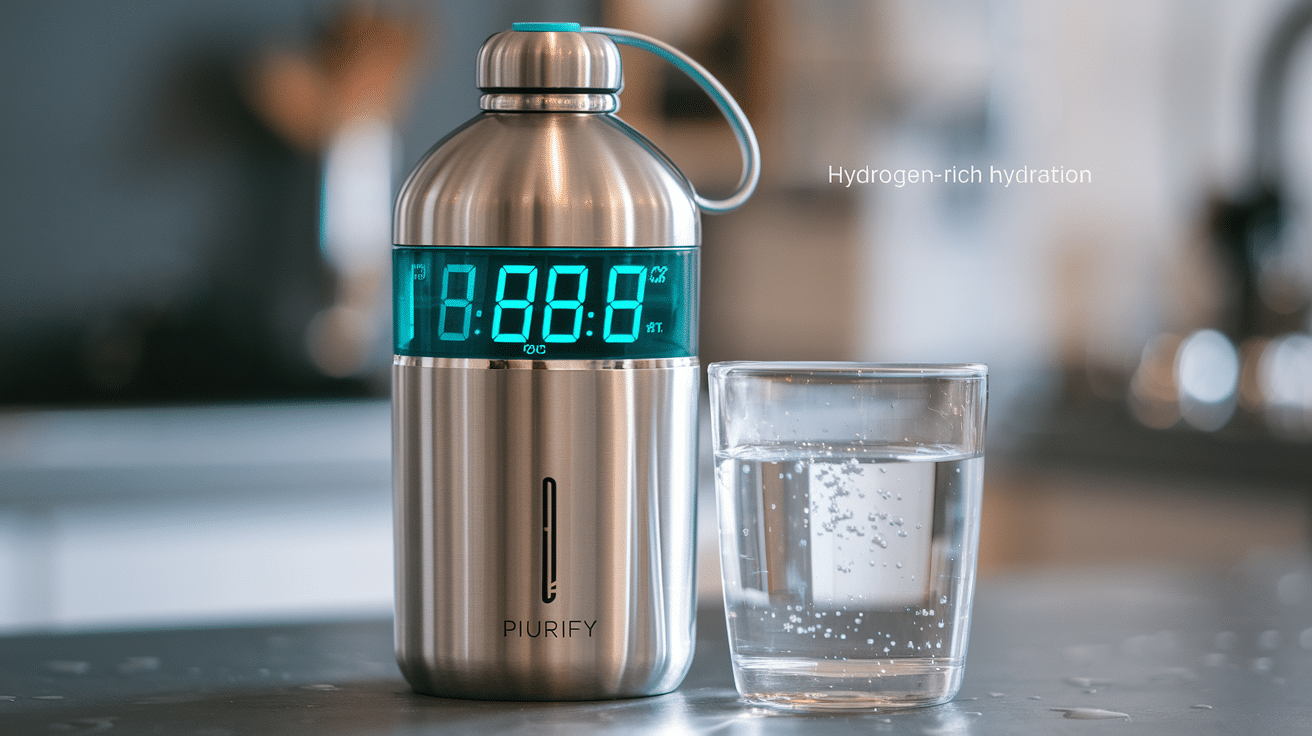
Two independent laboratories have put the Piurify Hydrogenator on a bench and published what came out of it. That is rare in this category, where most bottles ship with a headline ppb number and nothing behind it. This Piurify hydrogen water bottle review works from those two reports rather than from the spec sheet: what the bottle actually dissolves on each cycle, how much hydrogen that puts in a single serving, and the handful of places where the marketing has run ahead of the measurements. It is one of the models we cover in our roundup of the best hydrogen water bottles.
waterbottleinfo.com is an Amazon Associate. If you buy through a link on this page we may earn a commission, at no extra cost to you. It does not change what we write.
- The Short Version
- Overview of the Piurify Hydrogenator Bottle
- Technology Behind Hydrogen Water Benefits
- How Long the Hydrogen Actually Lasts
- Health Benefits and Usage Recommendations
- Design and Usability Assessment
- Comparing Value and Customer Satisfaction
- Where It Falls Short
- Who Should Buy It, and Who Should Not
- The Verdict: What This Piurify Hydrogen Water Bottle Review Comes Down To
- Piurify Hydrogen Water Bottle FAQs
- What is hydrogen water exactly?
- How safe is hydrogen water to drink?
- Does the Piurify Hydrogenator bottle have a filter to replace?
- Does hydrogen water change the pH of the water?
- How quickly should I drink hydrogen water after preparation?
- How much hydrogen water should I drink daily?
- Does the Piurify actually reach the ppb it advertises?
- Is there a downside to drinking hydrogen water?
- Can hydrogen water replace vitamins and minerals?
- What water type is best for a hydrogen water bottle?
- How do I maintain my hydrogen water bottle?
The Short Version
On its ten-minute cycle the Piurify Hydrogenator dissolves roughly 3.85 mg/L of hydrogen into a 280 ml bottle, which works out at about 1.08 mg of H₂ per serving. That is the number worth carrying into any comparison, and it is comfortably above the 0.8 mg daily figure H2HUBB uses as its own standard. Buy it if you want a hydrogen bottle whose output has been measured by someone other than the company selling it. Skip it if you need volume, if the nasal cannula was the reason you were interested, or if you were planning to trust the number on the screen.
Overview of the Piurify Hydrogenator Bottle

PIURIFY Hydrogenator (10 oz)
A 280 ml (9.5 fl oz) portable hydrogen generator using SPE/PEM electrolysis. Two independent laboratories have published measurements: H2HUBB recorded 3.85 mg/L on the ten-minute cycle, and H2 Analytics certified 4,090 ppb on the same cycle, which is roughly 1.08 mg of dissolved hydrogen per bottle. Piurify claims a lifetime warranty, though the same listing also states 10+ years. Downsides: a small serving, an on-screen ppb figure that is prediction software rather than a sensor, and a nasal cannula H2HUBB advises against using.
- Certified Output: 4,090 PPB on the 10-minute cycle (H2 Analytics)
- Independent Check: 3.85 mg/L on the 10-minute cycle (H2HUBB)
- Cycles: 5 or 10 minutes; higher maker figures need stacked cycles
- Venting: SPE/PEM cell vents ozone and chlorine out of the water
- Body: food-grade polycarbonate, 10 oz (280 ml)
- Output measured and published by two independent laboratories
- Certified 4,090 ppb on the built-in ten-minute cycle
- Roughly 1.08 mg of dissolved hydrogen per 280 ml serving
- Works with any water type, including distilled
- No detectable chlorine or ozone in H2HUBB testing
- Warranty terms longer than the category standard
- 280 ml (9.5 fl oz) per serving is small
- On-screen ppb figure is prediction software, not a sensor
- Nasal cannula: H2HUBB advises against inhalation from a water bottle
- Warranty stated two different ways on the same listing
- Needs recharging every 7 to 10 cycles
Technical Specifications
The Piurify Hydrogenator is a compact, portable hydrogen water generator, and one of the models in our best hydrogen water bottle under $100 roundup. The working volume is 280 ml (9.5 fl oz), which is what H2HUBB recorded when it tested the bottle; Piurify markets the same model as a 10 oz bottle. The body is food-grade polycarbonate. Piurify says it chose PC over glass because SPE/PEM electrolysis builds pressure inside a sealed bottle and glass can crack. If you are new to the category, start with hydrogen water bottles explained.
| Specification | Piurify Hydrogenator (10 oz, black) |
|---|---|
| Working volume | 280 ml (9.5 fl oz), marketed as 10 oz |
| Body material | Food-grade polycarbonate (manufacturer) |
| Cell | Proton exchange membrane between two platinum electrodes |
| Cycles | 5 minutes and 10 minutes |
| Battery | 3.7 V, 1800 mAh, 6.66 Wh, USB-C |
| Cycles per charge | Roughly 7 to 10 (manufacturer) |
| Display | OLED showing countdown, battery and an estimated ppb figure |
| Size and weight | 2.3 in wide, 9 in tall, about 13 oz empty |
| In the box | Bottle, USB-C cable, nasal cannula, manual |
| Warranty | See the warranty section below; the listing states it two different ways |
What It Actually Produces
Two laboratories have published measurements of this bottle, using different methods. Both are worth reading, and they do not agree exactly, which is itself useful information.
| Cycle | H2HUBB, 24 Oct 2024 (H2Blue titration) | H2 Analytics, report H2AR-240821-1 (gas chromatography) | H₂ in one 280 ml bottle |
|---|---|---|---|
| 5 minutes | 2.80 mg/L average, SD 0.02 | 2,550 ppb certified | about 0.80 mg |
| 10 minutes | 3.85 mg/L average, 4.03 mg/L peak, SD 0.16 | 4,090 ppb certified | about 1.08 mg |
| Two 10-minute cycles, cap closed | not tested | 5,810 ppb certified | not published |
| Three 10-minute cycles, cap closed | not tested | 6,300 ppb certified | not published |
The gap between the two is worth understanding rather than ignoring. H2HUBB measures by reagent titration and converts to standard temperature and pressure; H2 Analytics measures by static headspace gas chromatography. Different instruments, different days, different bottles off the line. Either way, the ten-minute cycle is the one to use, and H2HUBB recommends exactly that.
It is also worth knowing how the claim has moved. When H2HUBB tested the bottle in October 2024, Piurify was claiming 1.6 to 3.0 mg/L, and the report records that claim as confirmed; the bottle beat its own marketing. The listing today leads with 6,300 ppb, but that figure comes from running three ten-minute cycles back to back with the cap closed, not from one cycle. If you are comparing headline numbers between brands, you are usually not comparing like with like.
The physical reason any of this works is worth a sentence. At sea level, water saturates with hydrogen at about 1.57 mg/L. This bottle passes that because the cap seals and electrolysis raises the pressure inside, so more gas stays dissolved than open water could hold. The cap carries an internal pressure relief valve to stop that going too far.
Price Point and Warranty
The Piurify sits in the upper middle of the portable hydrogen market. It is not the cheapest bottle on the shelf and it is nowhere near the most expensive; Piurify’s own store has historically listed it well above what it sells for through retailers, so check the live price before deciding it is out of range. If you want to see where cheaper options land, we cover those in our 3 Best Hydrogen Water Bottle Under $50 in 2026 guide.
Technology Behind Hydrogen Water Benefits
How SPE/PEM Technology Generates Hydrogen-Enriched Water
The Piurify Hydrogenator uses solid polymer electrolyte and proton exchange membrane electrolysis, usually shortened to SPE/PEM. H2 Analytics describes the cell as a proton exchange membrane sandwiched between two platinum electrodes. That construction is the reason the bottle works with any drinking water you put in it, distilled included, regardless of mineral content or conductivity.
When you press the button, current passes through the water. Hydrogen forms at the cathode and dissolves into the water above the membrane, while oxygen and the other anode-side gases are kept separate and leave through a pin hole in the base. That separation is the point of the design: you drink the hydrogen and not the rest.
Compared with the alternatives, this matters. Alkaline ionisers change the water chemistry as well as adding hydrogen; hydrogen tablets add magnesium and leave residue. A PEM cell adds hydrogen and nothing else.
Two Operation Modes: The Five-Minute and Ten-Minute Cycles
Press the power button once for the five-minute cycle, twice for the ten-minute cycle. The difference between them is larger than the timing suggests.
- Five-minute cycle. H2HUBB measured 2.80 mg/L, which is about 0.80 mg of hydrogen in a full bottle. Fine for topping up during the day.
- Ten-minute cycle. H2HUBB measured 3.85 mg/L on average and 4.03 mg/L at peak, or about 1.08 mg per bottle. H2 Analytics certified 4,090 ppb on the same cycle. This is the setting H2HUBB recommends, and the one worth waiting for.
What the On-Screen ppb Number Actually Is
The OLED panel shows a countdown and a battery level, and both are genuinely useful. The ppb figure next to them is not a measurement. H2HUBB is explicit about this: the readout is generated by prediction software rather than a dissolved-hydrogen sensor, its tests found the software “inaccurately estimates dissolved hydrogen levels” across different cycle lengths and water volumes, and it recommends that consumers not rely on the display and reference independent test results instead. A true hydrogen probe is expensive enough that no consumer bottle carries one. Read the screen as a timer, not as a reading.
Removal of Harmful Byproducts Through Built-In Drain Vent
The base carries a pin hole that vents the anode-side gases produced during electrolysis, so they never reach the water you drink. H2HUBB tested for the two contaminants that matter here and found no detectable chlorine and no detectable ozone in the finished water. That is a stronger statement than the marketing makes, and it is measured rather than claimed.
It also means the bottle does not need cleaning between cycles for that reason, though it does need descaling occasionally. What the vent does not do is filter your water. It handles what electrolysis creates; it does nothing about what was in the tap to begin with.
How Long the Hydrogen Actually Lasts
Piurify claims the bottle holds its hydrogen for up to six hours after a cycle. This is the part of the specification we can least verify, and it is worth being straight about why: neither H2HUBB nor H2 Analytics published a hold-time test for this bottle. Both measured concentration immediately after the cycle finished. There is no independent retention figure for the Piurify in the public record, so the six hours is the manufacturer’s number and should be read as one.
What can be said from the physics is more useful than a number anyway. The bottle only exceeds the 1.57 mg/L sea-level ceiling because the cap is sealed and the pressure is up. The moment you open it, that headroom is gone and the dissolved hydrogen starts leaving solution. Retention claims for sealed bottles are not directly comparable to what you get after your first sip. In practice: run the ten-minute cycle, open it when you are ready to drink, and finish it rather than carrying it around opened all afternoon. If a hold-time figure is what decides your purchase, treat every brand’s number in this category with the same caution, because almost none of them are independently tested.
Health Benefits and Usage Recommendations
What the Research Actually Supports
Molecular hydrogen behaves as a selective antioxidant. Rather than mopping up every reactive species indiscriminately, it reacts preferentially with the hydroxyl radical, which is the mechanism most of the published work is built on. That selectivity is also why it does not appear to disrupt the reactive species the body uses for signalling.
The honest position on the evidence is that there is a lot of it and it is early. The field has produced somewhere between 1,200 and 2,000 papers, but only around 80 to 100 human clinical trials, most with small samples and no standardised dose (see Molecular Hydrogen Therapy: A Review on Clinical Studies and Outcomes, Molecules, 2023). Reviewers consistently report real signals across inflammation, recovery and metabolic markers while calling for larger trials. That is a reasonable basis for interest. It is not a basis for treating hydrogen water as a treatment.
It is worth saying what hydrogen water does not do, because the category is full of claims that do not survive contact with the chemistry. Electrolysis adds hydrogen gas and nothing else, so it adds no minerals. It does not flush toxins, it does not meaningfully change your body’s pH, which is tightly regulated regardless of what you drink, and it does not break water molecules apart to make them easier to absorb.
Reported Benefits, and How Much Weight to Give Them
Owner reviews of the Piurify cluster on the same handful of effects: people report better skin, steadier energy, and easier recovery after training. Those reports are real, they are also uncontrolled, and the placebo response in wellness products is substantial. Hold them loosely.
The outcomes that show up most consistently in the clinical literature, as distinct from owner reports, are:
- Markers of oxidative stress and inflammation, the most repeatedly studied endpoints
- Recovery and perceived fatigue after exercise, where several small trials report an effect
- Blood lipid measures, where more than one meta-analysis has now found a consistent signal
- Subjective energy and sleep quality, reported often but measured poorly
None of that makes hydrogen water a medicine, and the trials that exist are small enough that any individual result could go either way.
This article is information, not medical advice. Hydrogen water is not a treatment for any condition. If you are pregnant, on medication with a narrow therapeutic window, or managing a health condition, talk to a clinician before adding it to your routine.
How Much to Drink, and Why the Dose Matters More Than the ppb
Dose is the useful frame here, and it is the one the marketing never uses. H2HUBB sets its own standard at 0.8 mg of hydrogen per litre and 0.8 mg per day, slightly above the IHSA minimum of 0.5 mg. A single 280 ml bottle on the ten-minute cycle delivers about 1.08 mg, so one full bottle on the long cycle already clears that bar.
- Five-minute cycle: about 0.80 mg per bottle. Meets the daily standard exactly, with nothing spare.
- Ten-minute cycle: about 1.08 mg per bottle. This is the one to use if you are only making one bottle a day.
Drink it soon after the cycle finishes. The concentration is highest the moment the cap comes off and falls from there, so a bottle you made and left open on a desk for three hours is not the bottle the laboratories measured.
Design and Usability Assessment
Portability Advantages: Compact Size, Fits in Cup Holders
The Piurify is small. It is 2.3 inches across and 9 inches tall, and weighs about 13 ounces empty, so it drops into a standard cup holder and disappears into a bag. There is no carrying strap and no loop, which is the one design omission owners mention most.
The trade-off is the 280 ml serving. That is a small glass of water, not a bottle in the sense most people mean, and if you were expecting to fill it once and drink from it all morning you will be disappointed. It is better understood as a hydrogen dose you make three times a day than as a water bottle you carry.
Design, Display and Everyday Feel
The bottle is sold in black, turquoise and silver; the unit this review is based on is the black one. The finish is plain and modern, the base holds the electronics and the screen, and it reads as a piece of equipment rather than a gadget. It is the kind of object you can put on a desk in an office without explaining it.
The base holds the electronics and the OLED panel. The screen shows a countdown and a battery level clearly enough to read at arm’s length, and the housing is plain enough that it does not look out of place on a desk. Treat the ppb figure it also displays as decoration rather than instrumentation, for the reason set out above.
First Use, Cleaning and Long-Term Ownership
Two things matter on first use. Wet the membrane and let the bottle stand for a few minutes before the first cycle, and charge it fully. A dry PEM on a first run is the most common reason a new bottle appears to underperform.
After that, upkeep is simple. Never put the electronic base in water. Leave a little water in the bottle between uses so the membrane stays moist, keep the cap sealed, and descale the base periodically with a vinegar and water solution when mineral deposits build up. Distilled or purified water will keep the cell cleaner for longer, though the PEM does not need minerals to work.
The bottle is leakproof in normal use, and most owners report it as such. It is not universally so: Trustpilot reviews for Piurify include units that leaked during use, units that stopped working, and units that would not hold a charge. The volume of those reports is not high against 534 reviews, but they are there, and they are the reason the warranty terms below matter.
Comparing Value and Customer Satisfaction
How It Compares on Price and Output
Measured against the rest of the category, the Piurify’s case is not that it produces the most hydrogen. It is that you can find out how much it produces. Its competitive position rests on:
- A certified 4,090 ppb on the built-in ten-minute cycle, with the report published
- Two independent laboratories having tested it, using different methods
- A proton exchange membrane cell that works with any water type
- Two cycle lengths rather than one fixed programme
- Warranty terms longer than the one-year cover most of this category ships with
Against the obvious alternatives: the Echo Go+ is the direct rival at the same 10 oz size and generally quotes lower output per cycle, which we set out in our Piurify vs Echo Go+ comparison. PUREPEBRIX and the IonBottles ATOM both claim higher ceilings, and PUREPEBRIX publishes third-party testing to back its number, so if raw concentration is what you are optimising for they deserve a look. Several cheaper bottles advertise 8,000 ppb and above with no published certificate at all; those numbers should be treated as marketing until someone measures them.
One thing to note when comparing: a headline figure produced by stacking three cycles is not the same as a figure from one. Check which one a brand is quoting before you rank them.
What Owners Actually Report
Owner feedback on Piurify is mostly positive, and the themes are consistent across Trustpilot and retail reviews. What comes up repeatedly on the positive side:
- Build quality, and the sense that the object is well made
- Customer support that answers, and replaces units when something goes wrong
- Simple operation, with an auto shut-off that means you cannot get it wrong
- No taste or smell difference from ordinary water
- Size and portability
The complaints are just as consistent, and they are worth reading before buying. They cluster into three groups: hardware that failed, meaning units that stopped working, leaked in use, or would not hold a charge; delivery delays; and buyers who ran the bottle daily for weeks and felt no difference at all. That last group is the one to take most seriously, because it is the honest counterweight to the owner reports in the section above.
We are not publishing a star rating here. Ratings on this product vary by retailer and by colourway and go stale the week after they are written, and a single number would hide exactly the split described above.
The Warranty, and What It Is Worth
The warranty is the messiest part of this product to write about honestly, because Piurify’s own listing states it two different ways. The bullet points say lifetime warranty. The title of the same listing says 10+ years. H2HUBB’s report records a lifetime warranty alongside a 60-day money-back guarantee, and Piurify’s own site adds that cover requires product registration.
So: treat the lifetime claim as the manufacturer’s claim rather than as a settled fact, and read the terms on the listing you are actually buying from. Whichever of the two turns out to be operative, both are longer than the one-year cover that is standard in this category, which is a genuine point in the Piurify’s favour. Do the registration when the bottle arrives, because that is the step that decides whether you have any of it.
Where It Falls Short
- 280 ml per serving. The most common complaint by a distance, and a fair one.
- Most of the hydrogen never dissolves. H2HUBB calculated that only about 24% of the theoretical maximum dissolves on the five-minute cycle and about 17% on the ten-minute one. The rest leaves as gas. This is normal for the category, but it is worth knowing that a longer cycle is not a proportionally bigger dose.
- The screen’s ppb figure is not a measurement. Covered above, and it is the specification most likely to mislead a new owner.
- The nasal cannula. The bottle ships with one, and the listing promotes inhalation. H2HUBB, the laboratory whose approval Piurify advertises, advises against it: by its calculation a water bottle delivers roughly 0.033% hydrogen through a cannula, around 40 times below the concentration used in the inhalation research, and it describes such attachments as largely a marketing gimmick. Buy this for the water, not the cannula.
- Warranty ambiguity. Two different terms on one listing, and registration required.
- Hardware failures do happen. Not at high volume, but leaks and charging faults appear in owner reviews often enough to mention.
Who Should Buy It, and Who Should Not
Buy it if you want a portable hydrogen bottle whose output has actually been measured and published by someone other than the manufacturer, you will use the ten-minute cycle, and a 280 ml serving fits how you drink. On the evidence available, it is one of the better-documented bottles in the category, and documentation is scarce here.
Look elsewhere if you want volume, in which case a larger flask or a pitcher makes more sense; if you are optimising purely for concentration, where PUREPEBRIX publishes higher certified numbers; if you wanted the cannula for inhalation; or if you need a warranty whose terms you can read unambiguously before you buy.
The Verdict: What This Piurify Hydrogen Water Bottle Review Comes Down To
On the ten-minute cycle this bottle puts roughly 1.08 mg of dissolved hydrogen into 280 ml of water, measured by H2HUBB and corroborated at a similar level by H2 Analytics. That is a real dose, above the standard either body sets, from a device you can carry. Set against that: a small serving, a screen whose headline number is software rather than a sensor, an accessory the certifying laboratory recommends against using, and a warranty stated two ways on one page.
What earns the Piurify its place is not the biggest number on the shelf. It is that the numbers can be checked. In a category where most bottles print a figure on the box and publish nothing, two laboratories have tested this one and put their reports in public. If you want hydrogen water and you want to know what you are actually drinking, that is the strongest argument going, and it is the reason this bottle is worth the money it costs.
Piurify Hydrogen Water Bottle FAQs
What is hydrogen water exactly?
Hydrogen water is ordinary water (H₂O) carrying dissolved hydrogen gas (H₂). That gas is separate from the hydrogen already bound to oxygen in the water molecule. It is the unbound, dissolved H₂ that the research is about, and it is what an electrolysis bottle adds.
How safe is hydrogen water to drink?
Hydrogen water is well tolerated in the trials published so far, and no serious adverse effects have been reported. Hydrogen gas has a long history of medical use, including in deep-sea diving mixtures to prevent decompression sickness, and your gut bacteria already produce it during digestion.
Does the Piurify Hydrogenator bottle have a filter to replace?
No. The bottle is an electrolyser, not a filter. There is no cartridge and nothing to replace on a schedule. Piurify’s pitcher is the product with a replaceable filter; the bottle is a different device. What the bottle does need is the membrane kept moist and the base descaled with a vinegar and water solution when mineral deposits build up.
Does hydrogen water change the pH of the water?
Not in this bottle. H2HUBB recorded the change in pH during its testing of the Piurify Hydrogenator and reported that it did not increase. That is what you would expect from a proton exchange membrane design, which keeps the anode side separate rather than making the water alkaline the way an ioniser does. Dissolved hydrogen is a gas in the water, not a change to its chemistry.
How quickly should I drink hydrogen water after preparation?
Soon. Concentration is at its highest the moment the cycle ends and the cap is still sealed, and dissolved hydrogen starts leaving solution once the bottle is opened. Piurify claims up to six hours of retention, but no independent laboratory has published a hold-time test for this bottle, so treat that as the manufacturer’s figure.
How much hydrogen water should I drink daily?
Dose is the number that matters, not volume. H2HUBB sets its own standard at 0.8 mg of hydrogen per day, slightly above the IHSA minimum of 0.5 mg per serving. One 280 ml bottle on the ten-minute cycle delivers roughly 1.08 mg, so a single full bottle on the long cycle already clears that bar. General hydration advice of two to three litres of fluid a day is a separate question and is not what this device is for.
Does the Piurify actually reach the ppb it advertises?
On the ten-minute cycle, broadly yes, though the two laboratories that tested it do not agree exactly. H2 Analytics certified 4,090 ppb by gas chromatography in report H2AR-240821-1. H2HUBB measured 3.85 mg/L on average by H2Blue titration, which is 3,850 ppb, with a peak of 4.03 mg/L. The 6,300 ppb figure on the listing is not a single cycle: it comes from running three ten-minute cycles back to back with the cap closed.
Is there a downside to drinking hydrogen water?
The main downside is expectation. Hydrogen water is well tolerated, but the evidence base is roughly 80 to 100 human clinical trials, most of them small, with no standardised dose, so it is not a treatment for anything and it may do nothing noticeable for you. There is also a cost and habit downside: a device like this only helps if you actually use it daily. If you are pregnant, on medication with a narrow therapeutic window, or managing a health condition, speak to a clinician first.
Can hydrogen water replace vitamins and minerals?
No. Electrolysis adds hydrogen gas and nothing else, so hydrogen water contributes no minerals and no calories. It sits alongside a balanced diet rather than substituting for any part of it.
What water type is best for a hydrogen water bottle?
Any drinking water works in this one. H2 Analytics notes that because the cell uses a proton exchange membrane between platinum electrodes, it functions regardless of mineral content or conductivity, distilled water included. Purified or distilled water will keep the cell cleaner for longer and reduce descaling, which is the practical reason to prefer it.
How do I maintain my hydrogen water bottle?
Keep the membrane moist by leaving a little water in the bottle between uses, keep the cap sealed, never submerge the electronic base, and descale the base periodically with a vinegar and water solution to clear mineral buildup.
