

- Quick picks
- Why you can trust this guide
- How we picked these pitchers
- The 10 best hydrogen water pitchers compared
- 1. PIURIFY 3-in-1 Hydrogen Water Pitcher: Best Overall
- 2. Dr.Water HydroPitcher 68 oz: Best Large Capacity
- 3. PUREPEBRIX Desktop Pitcher: Highest Claimed Output
- 4. ALTHY Dual-Chamber Pitcher: Highest Rated
- 5. Dr. O Solutions Glass Pitcher: The Only Glass Option
- 6. KOZNOVA Hydrogen Water Filter Pitcher: Filtration Plus Hydrogen
- 7. LXYRQ 2L Hydrogen Kettle: Best Capacity Per Dollar
- 8. Tengertang 2L Glass Maker: Longest Track Record
- 9. GOSOIT 1.5L Pitcher: Best Auto-Cycle Program
- 10. XhigwyomhX 2L Glass Pitcher: Lowest Price for 2 Litres
- Hydrogen water pitcher vs bottle
- How hydrogen water pitchers work
- What the research actually shows about hydrogen water
- How to choose a hydrogen water pitcher
- Looking after your pitcher
- Hydrogen water pitcher myths vs facts
- Frequently asked questions
- Are hydrogen water pitchers worth it?
- Which brand of hydrogen water pitcher is best?
- Is there a downside to drinking hydrogen water?
- What brand of hydrogen water does Joe Rogan use?
- Can you use tap water in a hydrogen water pitcher?
- How long does hydrogen stay in the water?
- Is there a Consumer Reports rating for hydrogen water pitchers?
- Do hydrogen water pitchers filter the water as well?
- What is the difference between a hydrogen water pitcher and a water ionizer?
- How do I know if my hydrogen water pitcher is actually working?
- Do hydrogen water pitchers make alkaline water too?
- How long does a hydrogen water pitcher last?
- The bottom line
As an Amazon Associate we earn from qualifying purchases, at no additional cost to you.
Quick picks
| Category | Product Name | Get Your Choice |
|---|---|---|
| Best Overall | PIURIFY 3-in-1 Hydrogen Water Pitcher | |
| Best Large Capacity | Dr.Water HydroPitcher 68 oz | |
| Highest Rated | ALTHY Dual-Chamber Pitcher | |
| Best Budget Pick | LXYRQ 2L Hydrogen Kettle |
If you want one pitcher and no further research, buy the PIURIFY. It has more owner reviews behind it than any other hydrogen pitcher sold on Amazon, and it does three things rather than one: it strips chlorine through a calcium-sulfite filter, conditions the water through a magnetic vortex, then electrolyses it. It is also the most expensive thing on this list.
If you need volume more than polish, the Dr.Water HydroPitcher makes a full two litres a cycle for meaningfully less, and it has no filter cartridge to buy again. If you are still working out whether hydrogen water is for you at all, the LXYRQ kettle does the same two litres for the lowest price on this list, and you can stop there without having spent much.
One thing worth saying before the list. The research on hydrogen water is early and thin, and no pitcher here has had its output verified by anyone independent. Every PPB number on this page is the manufacturer’s own. That does not make them worthless, but it does mean you should buy on capacity, build quality and track record rather than on whose number is biggest.
Those are the picks. If you would rather filter than read, the analyser below compares any two of the ten on the criteria that actually differ, sizes a pitcher against your household, and shows what happens to the hydrogen across a day of pouring.
Compare 10 hydrogen water pitchers
Every figure here comes from the manufacturer listing, read directly. Nothing on this page has been measured in a lab, and the tool says so wherever a brand publishes no number at all.
A
B
How they score, side by side
Scores are the same editorial ratings used in the article: output plausibility, capacity, build, filtration and how much genuine owner feedback sits behind the star rating. They are judgements from published specifications, not test results.
Roughly what happens to the hydrogen
This is an illustration, not a measurement. Hydrogen leaves water continuously once a cycle ends, faster from plastic than glass and faster warm than cold. The curve here uses the retention figure the manufacturer publishes where there is one, and a conservative default where there is not. It exists to show the shape of the trade you make with a pitcher, not to predict your glass.
Why you can trust this guide
This guide is written and maintained by Mahmudul, owner of WaterBottleInfo.com. Two things are worth being straight about up front, because they change how you should read everything below.
First, I have not measured the hydrogen output of these pitchers. There is no lab here and no reagent titration on these particular units, so every PPB figure on this page is labelled as the manufacturer’s claim, because that is exactly what it is. Where a figure is physically implausible, I say so rather than repeat it. Specifications come from each manufacturer’s own listing read directly, availability was checked against a United States delivery address, and the owner-feedback numbers are the counts Amazon actually shows.
Second, hydrogen water is a wellness drink and not a medical treatment. Where research exists I have cited it and described its limits honestly. Where a manufacturer has made a health claim its own listing cannot support, I have said that too, including for products that appear high on this list.
How we picked these pitchers
We started from every hydrogen water pitcher currently listed and purchasable on Amazon in the United States, then cut anything that was really a personal bottle rather than a multi-serving jug. Plenty of roundups skip that distinction, which is how you end up reading about a 250 ml bottle in an article titled best pitcher.
What survived was ranked on things you can actually check: capacity, the published hydrogen rating, body material, whether there is a filtration stage at all, how much owner feedback exists behind the star rating, and whether the brand sells the unit itself or leaves it to a reseller. Specifications come from each manufacturer’s own listing, read directly rather than copied out of other roundups. Availability was confirmed against a United States delivery address, because Amazon hides both stock and price when it decides you are somewhere else.
We have not measured the hydrogen output of these pitchers in a lab, and we are not going to pretend otherwise. Where a brand publishes a PPB figure, we report it as that brand’s claim. Where a brand publishes nothing, we say so, and there are three on this list where that is the case.
Each pitcher below also carries a Detailed Rating table. Those scores are editorial judgements built only from things that can be checked: the published output figure and whether it is physically plausible, capacity, body material, whether there is a filtration stage at all, and how much genuine owner feedback sits behind the star rating. They are not test results, and no score here reflects anything having been measured in a lab.
The 10 best hydrogen water pitchers compared
| # | Pitcher | Best for | Our rating | Rated PPB | Capacity | Material | Filter | Price tier | Get it |
|---|---|---|---|---|---|---|---|---|---|
| 1 | PIURIFY 3-in-1 Hydrogen Water Pitcher | Best Overall | 4.5 / 5 | 700-1300 | 50 oz / 1.5 L | Tritan | Calcium sulfite | Premium | Buy on AmazonRead full review |
| 2 | Dr.Water HydroPitcher 68 oz | Best Large Capacity | 4.2 / 5 | about 1500 | 68 oz / 2 L | BPA-free plastic | Beads in base | Mid | Buy on AmazonRead full review |
| 3 | PUREPEBRIX Desktop Pitcher | Highest Claimed Output | 3.8 / 5 | up to 3000 | 72 oz / 2.1 L | BPA-free plastic | None | Premium | Buy on AmazonRead full review |
| 4 | ALTHY Dual-Chamber Pitcher | Highest Rated | 4.4 / 5 | 1300+ | 54 oz / 1.6 L | Food-grade | Calcium sulfite | Premium | Buy on AmazonRead full review |
| 5 | Dr. O Solutions Glass Pitcher | The Only Glass Option | 2.9 / 5 | not published | 1 L | Glass | None | Mid | Buy on AmazonRead full review |
| 6 | KOZNOVA Hydrogen Water Filter Pitcher | Filtration Plus Hydrogen | 3.9 / 5 | up to 1300 | 3.6 L | BPA-free plastic | Multi-stage + UV | Mid | Buy on AmazonRead full review |
| 7 | LXYRQ 2L Hydrogen Kettle | Best Under 100 Dollars | 3.8 / 5 | up to 2000 | 2 L | Food-grade | None | Budget | Buy on AmazonRead full review |
| 8 | Tengertang 2L Glass Maker | Longest Track Record | 3.6 / 5 | not published | 2 L | Borosilicate glass | None | Budget | Buy on AmazonRead full review |
| 9 | GOSOIT 1.5L Pitcher | Best Auto-Cycle Program | 3.4 / 5 | not published | 1.5 L | Food-grade | None | Budget | Buy on AmazonRead full review |
| 10 | XhigwyomhX 2L Glass Pitcher | Lowest Price for 2 Litres | 3.3 / 5 | up to 1500 | 2 L | Borosilicate glass | None | Budget | Buy on AmazonRead full review |
1. PIURIFY 3-in-1 Hydrogen Water Pitcher: Best Overall
This is the one to buy if you want to stop researching. Nothing else in the category has anywhere near its owner history, and the three-stage design is the only one here that treats tap water as a problem to solve rather than a liquid to electrolyse. What you are not buying is the highest hydrogen figure on this page. PIURIFY rates it at 700 to 1300 PPB, and three cheaper pitchers claim more. A track record is worth more than a number nobody has verified.
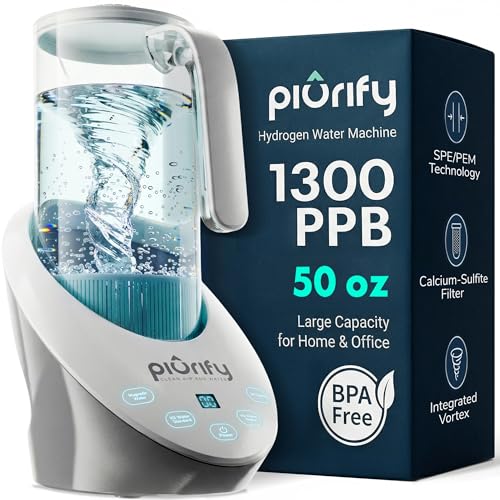
PIURIFY makes the most established hydrogen pitcher on Amazon, with a review history several times deeper than anything else in the category. It runs three stages rather than one: a magnetic vortex pre-cycle, a calcium-sulfite filter that strips chlorine, then SPE/PEM electrolysis on either an 8-minute or a 13-minute setting. PIURIFY rates the output at 700 to 1300 PPB and says hydrogen holds for around eight hours.
- Three-Stage System: Magnetic vortex pre-cycle, calcium-sulfite chlorine filter, then SPE/PEM electrolysis
- Two Hydrogen Cycles: 8 minutes for a rated 700 to 900 PPB, 13 minutes for a rated 1300 PPB
- 50 oz Capacity: Roughly 1.5 litres of BPA-free Tritan, shatter-resistant, fits most fridge doors
- Hydrogen Retention: PIURIFY rates holding time at about 8 hours after a cycle finishes
- Calcium-Sulfite Filter: Quick-swap cartridge aimed at chlorine, with replacements sold separately
- Touch Panel and Self-Clean: Tap to pick a cycle, with a built-in cleaning mode
- Track Record: 4.4 stars from roughly 690 buyers, the deepest feedback in this category
- Sold Direct: Shipped and sold by PIURIFY rather than a third-party reseller
- Deepest owner-review history of any hydrogen pitcher on Amazon
- Filters and conditions the water instead of only electrolysing it
- Two cycle lengths for everyday use or a stronger dose
- Shatter-resistant Tritan survives a knock better than glass
- Sold directly by the brand, so warranty claims go to one place
- Long hydrogen retention makes it practical to pour through the day
- Rated at 700 to 1300 PPB, below what several rivals claim
- Filter cartridges are an ongoing cost
- The most expensive pitcher in this roundup
- Tritan plastic rather than glass
Three stages, not just electrolysis
Nearly every pitcher in this category does one thing: it runs a current through the water. The PIURIFY runs three steps in sequence, and that is the real argument for it. A magnetic vortex cycle aerates and swirls the water first, a calcium-sulfite cartridge strips chlorine out on the way through, and only then does the SPE/PEM stack electrolyse it.
The order matters. Chlorine and the byproducts of electrolysis are the two things people complain about in the taste of hydrogen water, and this is the only pitcher here that addresses both before you pour a glass. PIURIFY also claims the vortex step helps the hydrogen stay in solution roughly three times longer, which is a manufacturer claim rather than a measured one.
Hydrogen output and the two cycles
There are two programmes. The 8-minute cycle is rated at 700 to 900 PPB and is the one for ordinary daily drinking. The 13-minute cycle is rated at 1,300 PPB. PIURIFY states hydrogen is retained for up to eight hours after a run, which for a pitcher is the number that actually matters, because a jug gets poured over a morning rather than drunk in one go.
Be clear-eyed about where that sits. 1,300 PPB is a mid-range figure on this page, and three cheaper pitchers claim more. It is also comfortably below the roughly 1,600 PPB saturation ceiling, which makes it one of the more plausible claims here rather than one of the boldest.
Capacity, build and daily use
Fifty ounces is about 1.5 litres, which covers one or two people for a day without a second run. The body is BPA-free Tritan rather than glass, so it is shatter-resistant and light enough to lift full, and it is narrow enough to sit in most fridge doors, which is where a pitcher realistically lives.
Operation is a touch panel: pick a cycle and walk away. There is a built-in cleaning mode, and the filter cartridge is designed to swap without tools. None of that is exotic, but it is all present, which is more than several pricier units on this page manage.
Running costs and who you buy from
The calcium-sulfite cartridge is a consumable. PIURIFY sells replacements in three-packs, and those carry their own strong owner history, which at least tells you the supply is real and people are actually reordering them. Budget for it: this is one of the pitchers here with an ongoing cost.
It also ships and sells directly from PIURIFY rather than through a third-party reseller. In a category full of brands that appear and vanish inside a year, having one accountable party for a warranty claim is worth more than it sounds.
Buy it if you want the pitcher with the deepest owner history in the category by a wide margin, and you would rather have filtration and conditioning built in than chase the biggest number on a box. Skip it if you are buying on hydrogen concentration alone, in which case cheaper pitchers here claim more, or you want glass rather than Tritan.
Detailed Rating
| Criteria | Rating |
|---|---|
| Hydrogen Output | 3.5 / 5 |
| Capacity and Practicality | 4.5 / 5 |
| Build Quality | 4.5 / 5 |
| Filtration | 5.0 / 5 |
| Owner Feedback Depth | 5.0 / 5 |
| Overall | 4.5 / 5 |
2. Dr.Water HydroPitcher 68 oz: Best Large Capacity
Two litres a cycle, no cartridge to replace, and enough owner feedback behind the rating to trust it. The calcium-sulfite beads sit in the base rather than in a filter you buy again every three months, which quietly makes this the cheapest pitcher here to run. The catch is that it tells you nothing about what it produced. No display, no readout. If you want to know your water actually hit 1500 PPB, you will need a reagent kit.

The HydroPitcher holds 68 ounces, a full two litres, which covers a household for most of a day without a second run. Two presets do the work: one tap for a five-minute cycle, two taps for ten minutes, which Dr.Water rates at roughly 1500 PPB. Calcium-sulfite beads sit in the base to take out chlorine, so there is no cartridge to buy again later.
- Two-Litre Capacity: 68 ounces per run, the practical size for a household rather than one person
- Two Preset Cycles: One tap for 5 minutes, two taps for 10 minutes at a rated 1500 PPB
- Built-In Chlorine Filter: Calcium-sulfite beads sit in the base, with no cartridge to replace
- SPE/PEM Electrolysis: Separates hydrogen from oxygen during generation
- LED Cycle Confirmation: Lights show which programme is running
- 12-Month Warranty: Covered for a year, with the brand handling support directly
- Owner Feedback: 4.1 stars across roughly 179 buyers
- Two litres per cycle, more than every pitcher here except the KOZNOVA
- No filter cartridges to buy on an ongoing basis
- Simple one-tap and two-tap operation with nothing to configure
- Enough review depth for the rating to mean something
- Priced well below the premium tier
- No hydrogen display, so confirming output needs a separate tester
- Lowest star rating among the well-reviewed models here
- Plastic body rather than glass
- The 1500 PPB figure is the manufacturer's and is not independently verified
Two litres, two cycles, one tap
This is the capacity pick. Sixty-eight ounces is a full two litres, enough that a household is not queuing behind the machine. Operation is deliberately blunt: one tap runs a five-minute cycle, two taps run ten minutes, and LEDs tell you which one is going.
Dr.Water rates the ten-minute programme at roughly 1,500 PPB. That is right at the practical saturation ceiling for water at room temperature, which makes it one of the more believable claims on this page even though nobody independent has checked it.
The filter you never have to buy again
Most pitchers with a filtration stage use a replaceable cartridge. This one puts calcium-sulfite beads in the base instead, doing the same chlorine-stripping job with nothing to reorder. Over two years that quietly makes it the cheapest pitcher here to live with.
It is worth being precise about what that stage does and does not do. It targets chlorine before electrolysis so the water tastes clean and the byproducts are reduced. It is not a water purifier and it makes no claim about lead, PFAS or microplastics.
What it will not tell you
There is no display and no readout. You get LEDs confirming which cycle is running and nothing else, so the 1,500 PPB figure is something you take on trust unless you buy an H2Blue reagent kit and check it yourself.
The other honest mark against it is the rating. At 4.1 stars it is the lowest average of the well-reviewed pitchers here, though it sits on 179 ratings, which is real depth. Read a few of the critical ones before you commit.
Buy it if you want the most water per cycle without paying premium prices, and you would rather have no consumables at all than a slightly better filter. Skip it if you want to see what the machine actually produced, or you want a glass body.
Detailed Rating
| Criteria | Rating |
|---|---|
| Hydrogen Output | 4.0 / 5 |
| Capacity and Practicality | 5.0 / 5 |
| Build Quality | 3.5 / 5 |
| Filtration | 3.5 / 5 |
| Owner Feedback Depth | 4.5 / 5 |
| Overall | 4.2 / 5 |
3. PUREPEBRIX Desktop Pitcher: Highest Claimed Output
The biggest number on this page, and the only large pitcher that runs off a battery. If your kitchen has nowhere convenient to plug something in, that matters more than it sounds. Treat the 3000 PPB claim carefully though. It is roughly twice what the best-documented pitchers here rate, it carries no third-party certification, and there are only about seven ratings behind the listing. Buy it for the cordless 72-ounce body, not for the headline.

PUREPEBRIX puts the biggest number on the box in this category, claiming up to 3000 PPB from dual iridium-platinum electrodes. The 72-ounce body is the largest here that still runs cordless, on a 9000 mAh battery, so it can sit on a desk or move to the fridge without a cable. You choose a 10-minute quick cycle or a 20-minute deep one, and a 3-minute backwash cleans it.
- Highest Claimed Output: PUREPEBRIX states up to 3000 PPB, the highest figure in this roundup
- Dual Iridium-Platinum Electrodes: Premium membrane pairing for the electrolysis stage
- 72 oz Capacity: Just over two litres per run
- Cordless 9000 mAh Battery: Runs unplugged, with an 8-hour first charge recommended
- Two Cycle Depths: A 10-minute quick mode or a 20-minute deep cycle
- Auto-Backwash Clean: 3-minute self-cleaning programme
- Byproduct Separation: The SPE/PEM system vents ozone and chlorine rather than dissolving them
- 12-Month Warranty: Backed for a year with 24/7 support
- Highest claimed hydrogen concentration of any pitcher here
- Cordless operation, which is unusual at this capacity
- Largest capacity in the mainstream tier
- Self-cleaning cycle removes the main maintenance chore
- Sold directly by PUREPEBRIX
- Only around seven ratings so far, so the reliability picture is thin
- The 3000 PPB claim carries no third-party certification
- A 20-minute deep cycle is the longest wait in this roundup
- Stock has been intermittent
The biggest number here, and how to read it
PUREPEBRIX claims up to 3,000 PPB from dual iridium-platinum electrodes, which is the highest figure on this page. It is worth pausing on that. Water saturates with hydrogen at roughly 1,600 PPB at room temperature and normal pressure, so a 3,000 PPB reading can only exist at the instant of generation under pressure, not in the glass you drink.
That does not make the pitcher bad. It makes the number marketing. Judge this one on the hardware instead, which is genuinely well specified, and treat the headline as the least useful thing on its listing.
Cordless, at seventy-two ounces
This is the only large pitcher here that runs off a battery. A 9,000 mAh cell means it can sit on a desk, move to the fridge, or go on a table without a cable following it around, which at just over two litres of capacity is genuinely unusual.
PUREPEBRIX recommends a full eight-hour charge before first use. Worth knowing before you unbox it expecting to make water the same afternoon.
Cycles, cleaning and the review problem
Two programmes: ten minutes for a quick run, twenty for a deep one. Twenty minutes is the longest wait on this page. There is also a three-minute automatic backwash cycle, which handles the one maintenance job most people skip.
The real caveat is the evidence base. This listing carries only about seven ratings. That is not enough to know anything about how it holds up over a year, and it is the main reason it sits third here rather than first despite the specification.
Buy it if you need large capacity without being tethered to an outlet, and the self-cleaning cycle appeals. Skip it if you want a purchase backed by a real body of owner feedback, or a twenty-minute cycle is more waiting than you will tolerate.
Detailed Rating
| Criteria | Rating |
|---|---|
| Hydrogen Output | 4.0 / 5 |
| Capacity and Practicality | 5.0 / 5 |
| Build Quality | 4.0 / 5 |
| Filtration | 2.0 / 5 |
| Owner Feedback Depth | 2.0 / 5 |
| Overall | 3.8 / 5 |
4. ALTHY Dual-Chamber Pitcher: Highest Rated
The best-rated pitcher in the category, and the build backs it up: two chambers, a titanium-platinum electrode, a magnetic vortex stage and a genuinely replaceable filter cartridge. It also tells you when it has finished, which sounds trivial until you have walked away from a silent machine three times. Two things to accept. It holds 1.6 litres rather than two, and the cartridge is a running cost of roughly one every three months.

ALTHY holds the best star rating in this category, and the build explains some of it. There is a dual-chamber SPE/PEM design, a titanium-platinum electrode, and a magnetic vortex stage that ALTHY says balances pH and helps hydrogen stay in the water longer. It makes 54 ounces in about ten minutes at a rated 1300 PPB or more, through a replaceable calcium-sulfite cartridge.
- Best Rating Here: 4.8 stars, the highest of any pitcher in this roundup
- Dual-Chamber Electrolysis: Separate chambers for the SPE/PEM process
- Magnetic Vortex Stage: ALTHY says it balances pH, releases VOCs and extends hydrogen retention
- 54 oz in 10 Minutes: About 1.6 litres per cycle at a rated 1300 PPB or higher
- Replaceable Cartridge: Calcium-sulfite filter aimed at ozone, hydrogen peroxide and chlorine
- Titanium-Platinum Electrode: Chosen for service life over cheaper coatings
- Separate Body Design: Lifts apart so the cartridge swaps without tools
- Seven-Colour LED and Chime: Visual display plus an audible end-of-cycle alert
- Highest-rated pitcher in the category
- Dual-chamber design with a genuine filtration stage
- Cartridge replacement is designed to be easy
- Audible finish alert, so you are not watching a timer
- Handles pure, mineral and direct drinking water between 5 and 38C
- The cartridge needs replacing roughly every three months
- Ships in four to five days rather than on a fast delivery window
- 1.6 litres is smaller than the two-litre models here
- Only around two dozen ratings so far
Dual-chamber electrolysis and a real electrode
ALTHY splits the process across two chambers rather than running everything in one, and uses a titanium-platinum electrode chosen for service life rather than cost. In a category where the electrode coating is the part that eventually kills the machine, that is a specification worth paying for.
It makes 54 ounces, about 1.6 litres, in roughly ten minutes, at a rated 1,300 PPB or better. Smaller than the two-litre pitchers, but the output claim is plausible rather than inflated.
The vortex stage, and what ALTHY claims for it
There is a magnetic water vortex step, which ALTHY says balances pH, releases volatile compounds and helps the hydrogen stay in the water longer. Those are the manufacturer’s claims and none is independently verified, but the same vortex idea appears on the PIURIFY at a considerably higher price.
The pre-installed calcium-sulfite cartridge is aimed at ozone, hydrogen peroxide and chlorine. That is a more specific and more honest description of a filter’s job than most listings in this category bother with.
Cartridge, cleaning and the small stuff
The cartridge wants replacing about every three months, and ALTHY recommends running the cleaning mode after every ten electrolysis cycles. Both are running costs in time or money and both are stated up front, which is more than most.
The body separates for cartridge changes, the display is a seven-colour LED, and it chimes when a cycle ends. That last detail sounds trivial until you have walked back to a silent machine three times wondering whether it finished.
Buy it if you want the best-reviewed pitcher in the category with a genuine filtration stage, and 1.6 litres is enough. Skip it if you need a full two litres, you want fast delivery, or a quarterly cartridge is a cost you would rather avoid.
Detailed Rating
| Criteria | Rating |
|---|---|
| Hydrogen Output | 4.0 / 5 |
| Capacity and Practicality | 3.5 / 5 |
| Build Quality | 4.5 / 5 |
| Filtration | 4.5 / 5 |
| Owner Feedback Depth | 4.0 / 5 |
| Overall | 4.4 / 5 |
5. Dr. O Solutions Glass Pitcher: The Only Glass Option
The only pitcher here with a glass body, which is the whole reason to consider it. If the point of treating your water is to keep things out of it, running it through warm plastic every day is a fair thing to object to. Everything else about this listing asks for trust: no published PPB figure anywhere, no ratings yet, one litre, and no filtration stage. It is the right choice for a specific preference, not the safe choice.

This is the only pitcher in the roundup with a genuine glass body, which matters if you would rather your water never touched plastic. Dr. O Solutions rates a full cycle at ten minutes for one litre, operated by a single button. The listing is new, carries no ratings yet, and publishes no hydrogen concentration figure at all, so it asks for more trust than anything else here.
- Glass Construction: The only true glass pitcher in this roundup, so no plastic touches the water
- 1000 mL Capacity: Enough for several servings, sized for one or two people
- 10-Minute Cycle: One full generation run per fill
- One-Touch Operation: Fill it, press once, pour
- Countertop Design: Built to stay out on the counter rather than be stored away
- No plastic in contact with the water at any stage
- Clean design that suits a visible countertop spot
- Simple single-button operation with nothing to configure
- Mid-range price despite the glass body
- No published hydrogen concentration figure anywhere on the listing
- No customer ratings yet, so nothing is known about reliability
- Smallest capacity here at one litre
- Glass is heavier and will break if dropped
- No filtration stage, so chlorine in tap water stays in
Glass, and why anyone would pay for it
This is the only pitcher on the page with a genuine glass body. If your reason for treating water is to keep things out of it, running it through warm plastic twice a day is a reasonable thing to object to, and glass also holds hydrogen marginally better than plastic does.
It is a litre, one-touch, and rated at a ten-minute cycle. As a piece of kitchen equipment it is the most pleasant thing here to have sitting on a counter.
What the listing does not say
Quite a lot, and this is the problem. There is no published hydrogen concentration figure anywhere on it. Not a claimed PPB, not a range, nothing. Every other pitcher on this page at least tells you what it is aiming for, even if the number is optimistic.
There are also no customer ratings yet, so there is no owner evidence about reliability, and no filtration stage, which means chlorine in your tap water stays in your glass. This is a purchase made on a preference for glass, not on demonstrated performance.
Buy it if you specifically want glass and nothing else on this page will do. Skip it if you want to know what you are getting before you buy it. On current information, almost everyone should skip it.
Detailed Rating
| Criteria | Rating |
|---|---|
| Hydrogen Output | 2.5 / 5 |
| Capacity and Practicality | 2.5 / 5 |
| Build Quality | 4.5 / 5 |
| Filtration | 1.0 / 5 |
| Owner Feedback Depth | 1.0 / 5 |
| Overall | 2.9 / 5 |
6. KOZNOVA Hydrogen Water Filter Pitcher: Filtration Plus Hydrogen
The only unit here that treats your tap water as the actual problem. Multi-stage filtration and a UV lamp run alongside the electrolysis, in a 3.6-litre body that dwarfs everything else on this page, and it does it cordless. Read the spec sheet with your eyes open though. The headline filtration claim carries no NSF or IAPMO certification, the bullets underneath name a different set of contaminants, and two of them are copied word for word from another brand listing.

KOZNOVA is the only unit here that treats filtration as seriously as hydrogen. It pairs multi-stage filtration and a UV lamp with SPE/PEM electrolysis rated at 1300 PPB, in a 3.6-litre body that is the largest in this roundup, running cordless on a 9000 mAh battery. One caveat worth knowing: parts of its listing copy are reproduced word for word from another brand, so read the spec sheet carefully.
- Largest Capacity Here: 3.6 litres, well beyond the two-litre pitchers
- Filtration Plus Hydrogen: Multi-layer filtration running alongside the electrolysis stage
- UV Lamp: An ultraviolet stage aimed at bacteria, viruses and mould
- Dual Iridium-Platinum Electrodes: Rated by KOZNOVA at up to 1300 PPB hydrogen output
- Cordless 9000 mAh Battery: Runs away from an outlet, on a desk or in the fridge
- Contaminant Claims: KOZNOVA lists fluoride, chlorine, lead, dirt and heavy metals
- Byproduct Separation: The SPE/PEM design vents ozone and chlorine
- The only pitcher here that filters and disinfects as well as hydrogenates
- Far and away the largest capacity in this roundup
- Cordless, so placement is not decided by an outlet
- Highest star rating on the listing, though from few buyers
- The headline claim of removing 99% of lead, microplastics, PFAS and chlorine carries no NSF or IAPMO certification, and the bullets underneath list a different set of contaminants
- Several bullet points are copied word for word from another brand's listing, which undercuts confidence in the spec sheet
- Only around seventeen ratings so far
- UV lamps and filters both need eventual replacement, and the listing never says how often
Filtration, ultraviolet and hydrogen in one body
This is the only unit on the page that treats your tap water as the actual problem rather than something to run a current through. It stacks multi-layer filtration and a UV lamp alongside the SPE/PEM electrolysis, with the ultraviolet stage aimed at bacteria, viruses and mould rather than at dissolved chemistry.
KOZNOVA rates the hydrogen output at up to 1,300 PPB from dual iridium-platinum electrodes, which is a sane figure sitting below the saturation ceiling. It runs cordless on a 9,000 mAh battery, which at this capacity is genuinely useful.
Three point six litres is a lot of water
This holds nearly twice what the two-litre pitchers do, and close to two and a half times the PIURIFY. For a family that gets through water steadily, one run can cover most of a day.
That size cuts both ways, and it is worth thinking about honestly. Hydrogen starts leaving the moment a cycle ends, so a very large jug means the last glass is meaningfully weaker than the first. Buy this for household volume, not because you expect every pour to be at peak.
Read the spec sheet with your eyes open
The headline claim is that it removes 99% of lead, microplastics, PFAS and chlorine. There is no NSF or IAPMO certification anywhere on the listing to support that, and the feature bullets underneath name a different set of contaminants again, listing fluoride, chlorine, lead, dirt and heavy metals. When a listing cannot keep its own claims consistent across two paragraphs, treat the specific percentages as marketing.
There is a further reason for caution. Two of its bullet points are reproduced word for word from the PUREPEBRIX listing, including the phrase about exceeding any portable hydrogen water bottle on the market. That is a white-label listing wearing a brand name, which does not make the hardware bad but does mean the spec sheet is not a primary source.
Buy it if you want filtration and disinfection in the same device as hydrogen generation, and you have a household that will get through 3.6 litres. Skip it if you are buying it for the certified filtration claims, because they are not certified.
Detailed Rating
| Criteria | Rating |
|---|---|
| Hydrogen Output | 3.5 / 5 |
| Capacity and Practicality | 5.0 / 5 |
| Build Quality | 3.5 / 5 |
| Filtration | 4.5 / 5 |
| Owner Feedback Depth | 2.5 / 5 |
| Overall | 3.9 / 5 |
7. LXYRQ 2L Hydrogen Kettle: Best Capacity Per Dollar
Two litres at the lowest price on this page is the best capacity per dollar here, and ninety-odd ratings is enough history to be more than a gamble. It claims 2000 PPB, which would put it above pitchers costing twice as much. Worth noting, worth not believing without a reagent test. There is no filtration stage, so whatever is in your tap water is still in your glass. A good first pitcher, not a last one.

If you want two litres per run at the lowest price on this list, this is the pick. LXYRQ pairs SPE/PEM electrolysis with a DuPont membrane and rates a single cycle at up to 2000 PPB, a higher figure than pitchers costing twice as much, though nothing in this category is third-party verified. The sealed lid and food-grade body are plain rather than polished, and that is the trade.
- Two Litres For Less: The cheapest way here to make a full jug in one cycle
- Rated 2000 PPB: LXYRQ claims up to 2000 PPB from a single run
- DuPont Membrane: A named membrane supplier in the SPE/PEM stage
- Sealed Lid: Closure designed to hold hydrogen in once the cycle ends
- Food-Grade Body: Standard food-contact construction throughout
- Owner Feedback: 4.0 stars across roughly 91 buyers
- Best capacity per dollar in the roundup
- Claimed output beats several pitchers at twice the price
- Enough review history to be more than a guess
- Straightforward operation with nothing to learn
- No filtration stage, so chlorine in tap water stays in
- The 2000 PPB claim is unverified and sits oddly against pricier rivals
- Sold under a generic brand name with little history behind it
- Plain, functional design
Two litres at the lowest price that still has a history
This is the best capacity per dollar on the page. Two litres per cycle for double figures, with roughly ninety ratings behind it, which is enough of an owner base to be a considered risk rather than a gamble.
It is a plain object. Food-grade body, a sealed lid designed to hold hydrogen in once the cycle ends, no display, no app, no ceremony. For a first hydrogen pitcher that is arguably the right amount of machine.
The 2,000 PPB claim
LXYRQ rates a single cycle at up to 2,000 PPB and names DuPont as the membrane supplier, which is a more specific claim than most budget listings bother to make.
Two thousand PPB is above the roughly 1,600 PPB saturation ceiling, so treat it the same way you should treat PUREPEBRIX’s 3,000: a figure achievable at the instant of generation, not in your glass. If it genuinely lands anywhere near 1,500 in practice it is doing everything you need at this price.
What you give up
There is no filtration stage at all. Whatever is in your tap water is still in your glass, chlorine included, and chlorine is the single most common complaint about the taste of hydrogen water.
The brand is also a generic seller name with little history behind it, shipped by a third party. If a warranty claim matters to you, that is a real difference from buying the PIURIFY or the ALTHY from their own storefronts.
Buy it if you want to find out whether hydrogen water is for you without spending much, and you want a proper household-sized jug while you do it. Skip it if your tap water is heavily chlorinated, or you want a brand that will still exist when something breaks.
Detailed Rating
| Criteria | Rating |
|---|---|
| Hydrogen Output | 4.0 / 5 |
| Capacity and Practicality | 5.0 / 5 |
| Build Quality | 3.0 / 5 |
| Filtration | 1.0 / 5 |
| Owner Feedback Depth | 4.0 / 5 |
| Overall | 3.8 / 5 |
8. Tengertang 2L Glass Maker: Longest Track Record
This listing has been on Amazon longer than anything else here, which in a category where brands appear and vanish inside a year is worth real money. Borosilicate glass, one touch, cleans itself, ninety-three ratings. What it will not tell you is how much hydrogen it makes, because there is no figure anywhere on the listing. If you want glass and a track record and you can live with not knowing, this is the value pick.

This two-litre countertop maker has been on Amazon longer than anything else in the roundup, which counts for something in a category where listings appear and vanish inside a year. The body is borosilicate glass rather than plastic, it runs on one touch, and it cleans itself automatically. The one thing it will not tell you is how much hydrogen it actually produces.
- Borosilicate Glass Body: 2000 mL glass construction rather than plastic
- Two-Litre Tank: Sized for a household rather than a single serving
- One-Touch Operation: A single control starts a generation cycle
- Automatic Cleaning Mode: Self-cleaning programme between uses
- SPE/PEM Electrolysis: Standard membrane electrolysis for the hydrogen stage
- Longest Track Record: The oldest listing in this roundup, with 93 ratings behind it
- Glass body at a budget price
- The longest continuous sales history of any pitcher here
- Automatic cleaning removes the main maintenance chore
- Nearly a hundred ratings, so the 4.0 average carries weight
- No hydrogen concentration figure published anywhere on the listing
- Glass is heavy and will break if dropped
- Sold by a merchant trading under a different name from the brand
- No filtration stage
The longest track record on the page
This listing has been selling on Amazon longer than anything else here, and it carries ninety-three ratings at a 4.0 average. In a category where brands appear, sell for eight months and vanish, longevity is a specification in its own right.
It is a two-litre countertop unit with one-touch operation and an automatic cleaning mode, which removes the maintenance job most owners quietly stop doing after a month.
Borosilicate glass at a budget price
The 2,000 ml body is borosilicate glass rather than plastic. That means no plastic in contact with the water, no taste transfer, and marginally better hydrogen retention, at a price where almost everything else is plastic.
The trade is the obvious one. Two litres of glass is heavy when full and it will break if it goes off a counter, so think about where it is going to live before you buy it.
The missing number
There is no hydrogen concentration figure published anywhere on this listing. Not a claim, not a range. Every competitor at least tells you what it is aiming for.
That is a genuine gap, and it is the reason this sits eighth rather than higher. What you are actually buying here is a glass two-litre body with a long sales history and an unknown output, which is a reasonable trade at this price but you should know that is the trade.
Buy it if you want glass and two litres for a budget price and you are comfortable not knowing the output figure. Skip it if the PPB number matters to you, or you would rather not handle two litres of glass daily.
Detailed Rating
| Criteria | Rating |
|---|---|
| Hydrogen Output | 2.5 / 5 |
| Capacity and Practicality | 5.0 / 5 |
| Build Quality | 4.0 / 5 |
| Filtration | 1.0 / 5 |
| Owner Feedback Depth | 4.0 / 5 |
| Overall | 3.6 / 5 |
9. GOSOIT 1.5L Pitcher: Best Auto-Cycle Program
The only pitcher here that will run six cycles back to back on its own. Sixty-nine minutes, unattended, for anyone who wants the most saturation the hardware can manage rather than a quick pass. That is a genuinely different feature, not a spec-sheet difference. GOSOIT is a brand we have looked at elsewhere on the site. As with several units at this price, no PPB figure is published, so the benefit of that long programme is unmeasured.

GOSOIT does something none of the others do. A double tap starts an automatic programme that runs six nine-minute cycles back to back, 69 minutes in total, for anyone who wants the strongest dose the unit can manage rather than a quick one. It holds 1.5 litres in a food-grade plastic body with a titanium-platinum electrode, and GOSOIT is a brand we already cover elsewhere on the site.
- Six-Cycle Auto Program: A double tap runs 6 cycles across 69 minutes for maximum saturation
- Single-Cycle Mode: One tap for a standard nine-minute run
- 1.5-Litre Capacity: Sits between the one-litre and two-litre tiers
- Titanium-Platinum Electrode: Chosen for service life over cheaper coatings
- SPE/PEM Technology: Membrane electrolysis for the hydrogen stage
- Food-Grade Plastic: Will not shatter if it slips off a counter
- Owner Feedback: 4.5 stars, the second-highest rating in this roundup
- The only pitcher here with a stacked multi-cycle programme
- Strong star rating for the price
- Will not break if it gets knocked off a counter
- A brand with other products we have looked at
- No hydrogen concentration figure published on the listing
- The full 69-minute programme is a long wait
- Plastic rather than glass
- Around thirty ratings, so the average could still move
The six-cycle programme nothing else here has
A single tap runs one nine-minute cycle. A double tap starts an automatic programme that runs six cycles back to back, sixty-nine minutes in total, unattended. Nothing else on this page does that.
The logic is sound: hydrogen concentration builds with repeated passes, so if you want the most saturation the hardware can manage and you are not standing over it, you set it going and come back. It is a genuine functional difference rather than a spec-sheet one.
Build and everyday use
Fifteen hundred millilitres of food-grade plastic, with a titanium-platinum electrode chosen for service life. Plastic here is a deliberate choice rather than a corner cut, because a jug that gets carried between a fridge and a table is a jug that eventually gets dropped.
At 4.5 stars it holds the second-highest rating on this page, and GOSOIT is a brand covered elsewhere on this site, so there is a track record to look at beyond a single listing.
What is not published
No hydrogen concentration figure appears anywhere on the listing. That is a particular shame here, because the six-cycle programme is explicitly about producing more hydrogen and there is no number attached to show how much more.
Sixty-nine minutes is also a long time to wait if you want a glass now. This is a pitcher you set running in the morning, not one you use on demand.
Buy it if you want maximum saturation from a mid-priced pitcher and you plan ahead rather than drinking on demand. Skip it if you want water quickly, or you want to see a concentration figure before buying.
Detailed Rating
| Criteria | Rating |
|---|---|
| Hydrogen Output | 3.0 / 5 |
| Capacity and Practicality | 3.5 / 5 |
| Build Quality | 3.5 / 5 |
| Filtration | 1.0 / 5 |
| Owner Feedback Depth | 3.5 / 5 |
| Overall | 3.4 / 5 |
10. XhigwyomhX 2L Glass Pitcher: Lowest Price for 2 Litres
Two litres, a glass body and a digital touch panel for less than anything else here. On hardware alone it is a lot for the money. The listing is another matter. It claims the water will reset your metabolism, prevent bad cholesterol and slow ageing, none of which hydrogen water research supports. Buy the machine, ignore the copy, and treat the 1500 PPB figure as a marketing number until something measures it.

This is the cheapest way here to get two litres and a glass body in the same machine. It uses platinum-coated titanium plates with a PEM proton membrane, rated at up to 1500 PPB, and adds a digital touch panel that pricier models skip. The listing's health claims run well past what hydrogen water research supports, so read the marketing and the hardware separately.
- Cheapest Two-Litre Option: The lowest price in this roundup for a full jug per cycle
- Borosilicate Glass Body: High-borosilicate glass, fully transparent
- Rated 1500 PPB: The manufacturer's figure for a single cycle
- Platinum-Coated Titanium Plates: Paired with a proton exchange membrane
- Digital Touch Panel: LED display with touch-sensitive controls
- Alkaline Output: The listing describes hydrogen-infused alkaline water
- Lowest price of any two-litre pitcher here
- Glass body at a price where plastic is the norm
- Digital touch controls, which is unusual this cheap
- Nano-grade titanium-platinum plate coating
- The listing makes health claims about resetting metabolism, preventing bad cholesterol and slowing ageing that hydrogen water research does not support
- Sold under a random-string brand name with no history behind it
- The 1500 PPB figure is unverified
- Glass is breakable and there is no filtration stage
The cheapest two litres in glass
On hardware alone this is a lot for the money. Two litres of high-borosilicate glass, platinum-coated titanium plates with a proton exchange membrane, a rated 1,500 PPB, and a digital touch panel with an LED display that several pitchers costing twice as much do not bother with.
If you were shopping on a specification sheet with the brand names covered up, this would look like one of the better values on the page.
Then you read the listing
It claims that regular use will reset your metabolism, help prevent bad cholesterol and slow the ageing process. None of that is supported by hydrogen water research, and the last two are the kind of claim no water device should be making at all.
This matters beyond taste. A seller willing to write that about health outcomes is a seller whose 1,500 PPB figure you have no particular reason to trust either. The hardware may well be fine. The copy is not evidence of anything.
Who it is actually for
There are twenty-seven ratings at a 4.0 average, which is thin but not nothing, and the brand name is a random string with no history behind it, so treat this as a commodity purchase rather than a relationship with a manufacturer.
Buy the machine, ignore the marketing, and if the output figure matters to you, spend a little on a reagent kit and find out for yourself.
Buy it if you want two litres in a glass body for the lowest price on the page and you can read past the marketing. Skip it if you want a brand you can hold accountable, or listing claims like these put you off, which is a fair reaction.
Detailed Rating
| Criteria | Rating |
|---|---|
| Hydrogen Output | 3.5 / 5 |
| Capacity and Practicality | 5.0 / 5 |
| Build Quality | 4.0 / 5 |
| Filtration | 1.0 / 5 |
| Owner Feedback Depth | 3.5 / 5 |
| Overall | 3.3 / 5 |
Hydrogen water pitcher vs bottle
This is the question the pitcher category actually turns on, and almost nobody answers it. A bottle makes 250 to 500 ml and you drink it immediately, so every mouthful is at close to peak concentration. A pitcher makes anywhere from 1.5 to 3.6 litres, which is the whole point of buying one, but that water then sits. Hydrogen is the smallest molecule there is and it leaves solution continuously, faster through plastic than through glass or metal, faster warm than cold.
So the honest framing is not that one is better. A pitcher suits a household where several people drink through the morning, or one person who wants water waiting in the fridge rather than a device to operate every time they are thirsty. A bottle suits someone who wants one strong glass, at the gym or at a desk, and does not mind waiting five to ten minutes for it. If you want both the volume and the peak concentration, what you actually want is a pitcher you run twice a day rather than once, which is worth factoring into how long a cycle you are willing to wait through.
If you are still deciding between the two formats, the full what is a hydrogen water bottle answer covers the portable side in more depth, and more on how to choose hydrogen water bottle walks through the specifications that matter on either format. There is also a direct head to head on two of the better known portables in how echo go+ vs echo flask stack up.
How hydrogen water pitchers work
Every pitcher on this list works the same way underneath: electrolysis across a solid polymer electrolyte, written on the box as SPE and PEM. A current runs through a membrane stack, water splits, and hydrogen dissolves into the water you are going to drink while oxygen and other byproducts are vented off separately. That separation is the whole reason the membrane matters, and the reason these cost more than a jug with two electrodes in it. Cheap electrolysis pushes ozone and chlorine byproducts straight back into the water, which is exactly the taste people complain about in reviews.
The electrodes are usually titanium coated in platinum or iridium. That coating is what wears out, and it is why a pitcher is not really a repairable object. What you can replace, on the units that have one, is the filter cartridge. It is normally calcium sulfite, and its job is to take chlorine out before electrolysis rather than to purify the water in any broader sense. Three of the pitchers on this list have no filtration stage at all.
What PPB means, and the ceiling nobody mentions
PPB is parts per billion of dissolved hydrogen. 1,000 PPB is one milligram per litre, which you will also see written as 1 ppm. The figures on these listings run from about 900 to 3,000, and some bottle brands advertise 6,000.
Here is the part the marketing leaves out. At room temperature and normal atmospheric pressure, water saturates with hydrogen at roughly 1.6 milligrams per litre, which is about 1,600 PPB. Past that point hydrogen does not stay in the water at all; it comes back out as gas. So any claim much beyond 1,600 PPB is either a reading taken at the instant of generation under pressure, or it is a number someone chose. When you see 3,000 or 6,000 on a box, that is what you are looking at.
It is also why you can be fairly relaxed about the gap between a pitcher rated at 1,300 and one rated at 2,000. Both land in the same practical range by the time the water is in your glass, and neither number has been checked by anyone independent. If you genuinely want to know what your pitcher produces, an H2Blue titration reagent kit costs very little and gives you a real reading in about a minute. It is the only way any of these claims can be confirmed at home.
What the research actually shows about hydrogen water
This is where most roundups on this topic stop being useful, so here is the honest position.
The National Cancer Institute lists hydrogen-rich water in its drug dictionary as a nutritional supplement with potential preventive, antioxidant, anti-inflammatory and radiation protective activities. That entry gets quoted constantly by people selling these devices, and it is worth reading carefully, because it describes a proposed mechanism rather than a finding that any of it works. The operative word is potential.
MD Anderson Cancer Center puts it more plainly. Its clinical dietitian Snigdha Poudyal says there is limited evidence that hydrogen water has more long-term benefits and effectiveness compared to regular water, and that the studies which do exist are small and early. The same piece makes the safety point, which is genuinely reassuring: hydrogen water is considered generally safe and is not known to cause significant risks or side effects. It also notes, drily, that you do not need it to get hydrogen into your diet.
The published literature is larger than the sceptics allow and much weaker than the vendors imply. There are a couple of thousand papers and something in the order of eighty human trials, with genuine signals in areas like blood lipid markers and exercise recovery. Reviewers of that literature keep flagging the same three limitations: small samples, protocols that differ from one study to the next, and no standard dose. That is a fair description of an early field, not a settled one.
What that means for a buying decision is simple enough. Buy a hydrogen water pitcher because you want to drink more water and you like the idea, or because you want to try something with a plausible mechanism and a good safety record. Do not buy one expecting a documented health outcome, and be sceptical of any page that promises you one, including the product listings linked from this one.
How to choose a hydrogen water pitcher
Capacity first, because it is the one thing you cannot change your mind about later. A litre suits one person. Two litres covers a couple or a small household. The 3.6-litre KOZNOVA is a lot of water to get through before the hydrogen fades, so bigger is not automatically better here, for the reason set out in the pitcher versus bottle section above.
Material is the next real decision. Borosilicate glass holds hydrogen better than plastic, tastes of nothing and will break if you knock it off the counter. Tritan and food-grade plastics are lighter, survive the drop, and let a little more hydrogen through over time. If you read anywhere that glass loses hydrogen faster than plastic, that is backwards.
Then running costs, which roundups routinely ignore. A pitcher with a replaceable calcium-sulfite cartridge, like the PIURIFY or the ALTHY, needs a new one roughly every three months. One with the beads built into the base, like the Dr.Water, does not. Over a couple of years that difference is real money, and it is invisible at the moment you buy. Warranties across this category are short, typically twelve months, and support quality varies enormously, so buying from the brand’s own storefront rather than a third-party reseller counts for more here than in most categories.
For a broader walkthrough of the specifications that apply whichever format you land on, see our complete hydrogen water bottle guide. And if what you actually want is a countertop machine rather than a pitcher, those are covered separately in our best hydrogen water machine picks.
Looking after your pitcher
Use filtered or purified water. Do not use distilled water: it has almost nothing dissolved in it, and SPE and PEM cells need ions to carry current, so output drops. Most of these manufacturers specify purified, filtered, mineral or ordinary drinking water, and ALTHY gives a working temperature range of 5 to 38 degrees Celsius.
Keep hot liquids, tea, juice, sugary drinks and anything carbonated out of it. They damage the membrane stack, and that is not a repairable fault.
Wash by hand with warm water and a mild detergent, never in a dishwasher. Pay attention to the electrolysis chamber, and use the self-clean cycle if the unit has one. ALTHY suggests running theirs after every ten cycles. Deep clean roughly once a week with an equal mix of white vinegar and water, then rinse thoroughly and let everything dry before reassembling.
Replace the filter cartridge on whatever schedule the manufacturer gives, usually about every three months. You do not replace the electrodes. On these units they are bonded into the membrane stack and are not a user-serviceable part, whatever a generic maintenance guide tells you. When the coating eventually degrades, the pitcher has reached the end of its life.
Hydrogen water pitcher myths vs facts
This is a category built on bold promises, so it helps to separate what the evidence supports from what simply gets repeated in listings. Here are the claims that come up most often on pitcher pages, with a straight answer for each.
Myth: a bigger PPB number means a better pitcher.
Fact: only up to a point, and that point is lower than the marketing suggests. Water saturates with hydrogen at roughly 1,600 PPB at room temperature and normal pressure, so anything advertised well beyond that is measured at the instant of generation under pressure, not in your glass. Consistent output from a decent membrane matters far more than the headline figure.
Myth: a hydrogen pitcher filters your water.
Fact: most do not. Six of the ten pitchers on this page have no filtration stage at all. Of those that do, the calcium-sulfite cartridges in the PIURIFY and the ALTHY exist to strip chlorine before electrolysis, not to purify water in any broad sense. Only the KOZNOVA attempts real filtration, and its contaminant claims carry no NSF or IAPMO certification.
Myth: hydrogen water is the same as alkaline or ionised water.
Fact: they are different things. Alkaline water is about a raised pH. Hydrogen water is about dissolved molecular hydrogen gas, and it usually sits close to neutral pH. Some pitchers here advertise both, but the part any research concerns itself with is the dissolved hydrogen, not the pH.
Myth: a pitcher of hydrogen water keeps its hydrogen all day.
Fact: it does not, and this is the single most important thing to understand before buying one. Hydrogen begins leaving the water the moment a cycle ends. A sealed cold jug holds it longer than an open warm one, and glass holds it better than plastic, but the last glass from a two-litre pitcher is always weaker than the first.
Myth: visible bubbles prove it is working.
Fact: they prove a gas is being produced, not which gas or how much of it dissolved. Proper SPE/PEM units separate hydrogen from ozone and chlorine byproducts and vent the rest. The only way to know what your pitcher actually put into the water is an H2Blue titration reagent kit, which costs very little.
Myth: hydrogen water treats or prevents disease.
Fact: it does not, and no pitcher should be sold as though it does. The research is early, the trials are small, and the honest summary is the one in the research section above. One product on this very list claims its water will reset your metabolism and slow ageing. It will not.
Frequently asked questions
Are hydrogen water pitchers worth it?
That depends on what you expect from one. As a way to drink more water, with a plausible mechanism and a good safety record behind it, yes. As a treatment for anything, no. MD Anderson says there is limited evidence that hydrogen water offers more long-term benefit than regular water, and the published trials remain small and inconsistent. Buy one because you want it, not because you have been promised an outcome.
Which brand of hydrogen water pitcher is best?
PIURIFY has the strongest position in the pitcher category, with more owner reviews than any other hydrogen pitcher on Amazon and a three-stage design that filters and conditions the water rather than only electrolysing it. Dr.Water is the better buy if capacity matters more to you than refinement, and ALTHY holds the highest star rating in the category.
Is there a downside to drinking hydrogen water?
Not a safety one, on current evidence. MD Anderson describes hydrogen water as generally safe and not known to cause significant risks or side effects. The real downsides are practical. These pitchers are not cheap, several need a new filter cartridge roughly every three months, and the hydrogen fades from the water within hours of a cycle finishing.
What brand of hydrogen water does Joe Rogan use?
Rogan has discussed hydrogen water on his podcast and is generally associated with tablet and bottle formats rather than pitchers. We are not going to name a brand on the strength of podcast chatter, and no pitcher manufacturer on this page has a verified endorsement from him. Treat any listing that implies one as marketing.
Can you use tap water in a hydrogen water pitcher?
Yes, and filtered tap water is what most of these manufacturers actually specify. What you should not use is distilled water. It has almost no dissolved ions, and SPE and PEM cells need ions to carry current, so output drops. If your tap water is heavily chlorinated, a pitcher with a calcium-sulfite stage will deal with that before electrolysis.
How long does hydrogen stay in the water?
It begins leaving the moment a cycle ends and keeps going. A sealed, cold pitcher holds it far longer than an open one on a warm counter, and glass or metal holds it better than plastic. In practice the first glass after a cycle is the strongest and one poured hours later is noticeably weaker. That is the main trade you accept in choosing a pitcher over a bottle.
Is there a Consumer Reports rating for hydrogen water pitchers?
No. Consumer Reports does not currently rate hydrogen water pitchers, and no independent testing body publishes concentration measurements for this category. That is why every PPB figure you see, on this page and on every other, is the manufacturer’s own claim. An H2Blue titration kit is the only practical way to check one at home.
Do hydrogen water pitchers filter the water as well?
Some do and most do not. Six of the ten pitchers on this page have no filtration stage at all. The calcium-sulfite cartridges in the PIURIFY and the ALTHY are there to strip chlorine before electrolysis, not to purify water in any broad sense. Only the KOZNOVA pairs multi-stage filtration and a UV lamp with hydrogen generation, and even there the filtration claims carry no NSF or IAPMO certification.
What is the difference between a hydrogen water pitcher and a water ionizer?
An ionizer is a plumbed-in or countertop appliance that splits water into alkaline and acidic streams, and its selling point is pH. A hydrogen pitcher dissolves molecular hydrogen into water and leaves the pH roughly where it started. The technologies are related but the goals are different. If what you actually want is dissolved hydrogen, a pitcher does it for a fraction of what an ionizer costs.
How do I know if my hydrogen water pitcher is actually working?
Visible bubbles and a working indicator light tell you something is happening, not how much hydrogen dissolved. The only real check is an H2Blue titration reagent kit. You add drops to a sample until the colour changes, and the drop count gives you a concentration. It costs very little, and it is the only way to verify any figure on this page, including the ones we have reported as manufacturer claims.
Do hydrogen water pitchers make alkaline water too?
Several listings here advertise both, and one describes its output as hydrogen-infused alkaline water. Treat the pH as a side effect rather than the point. Electrolysis can shift pH slightly, but a hydrogen pitcher is not an ionizer, and the research that exists concerns dissolved hydrogen rather than alkalinity.
How long does a hydrogen water pitcher last?
The part that wears out is the electrode coating on the membrane stack, and on every pitcher here it is not user-replaceable. Manufacturers do not publish a lifespan figure for these units, and warranties across the category are typically twelve months, which tells you something about what they are willing to stand behind. Replacing the filter on schedule and keeping hot and sugary liquids out of it are the two things genuinely in your control.
The bottom line
If you take one thing from this page, take this: choose on capacity and build quality, not on the PPB figure, because nobody independent has verified a single one of them.
The PIURIFY is the pitcher to buy if you want to decide once and stop thinking about it. The Dr.Water HydroPitcher is the better value at two litres and costs less to live with, because there is no cartridge to keep buying. The ALTHY is the one to pick if you want the best-reviewed unit in the category and can accept a slightly smaller jug and a quarterly filter. If price is the binding constraint, the LXYRQ gives you a full two litres for the lowest price here with enough owner history behind it to be a reasonable risk.
And if you have read this far and are not convinced by the evidence, that is a perfectly defensible place to end up. A hydrogen water pitcher is a pleasant way to drink more water. On what has actually been published so far, that may be most of what it is.
