

- What the Aqua Vital is and how it works
- How much hydrogen does it actually produce?
- Claimed health benefits, and what the evidence shows
- Using it day to day
- Where it falls short
- One name, three different products
- What owners and reviewers actually report
- The verdict: is the Aqua Vital worth buying?
- Aqua Vital hydrogen water bottle FAQ
Disclosure: we earn a commission if you buy through links on this page, at no extra cost to you.

Aqua Vital Hydrogen Water Bottle
The Aqua Vital uses SPE/PEM electrolysis to add hydrogen to plain water in a 3-minute cycle. It has a 16 oz (470 ml) borosilicate glass body on a brushed-steel base and a USB-rechargeable 1,000 mAh battery rated for about 10 cycles. The maker publishes no output figure, and owner reviews are mixed on reliability.
- Cycle: 3 minutes, beeps when ready
- Body: borosilicate glass, 470 ml (16 oz)
- Battery: 1,000 mAh, about 10 cycles (maker)
- Base: brushed steel with a silicone pad
- Opening: wide mouth for filling and cleaning
- Fast 3-minute hydrogen generation
- 16 oz / 470 ml means fewer refills
- Borosilicate glass keeps the taste clean
- USB charging, no filters to replace
- Easy one-button operation
- Auto shut-off ends each cycle
- Requires regular charging
- Glass construction needs careful handling
- Higher upfront cost than regular bottles
- No published hydrogen concentration figure
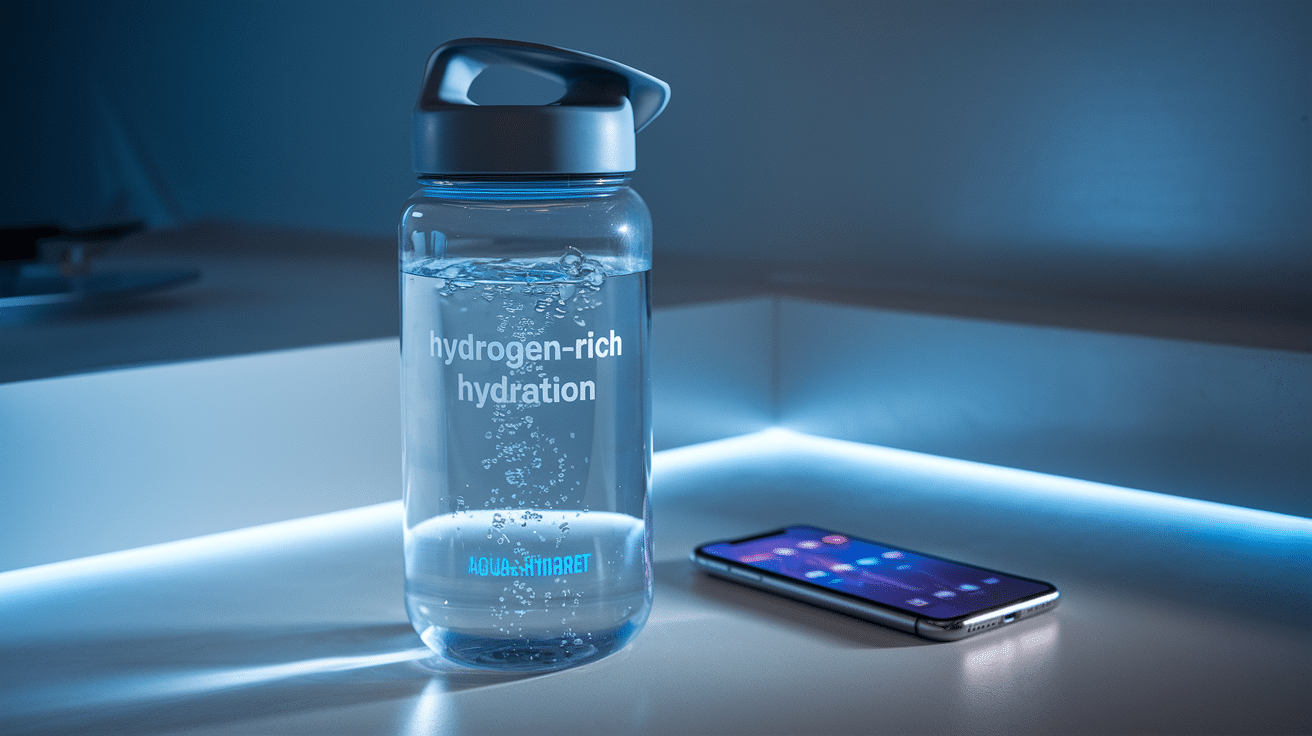
The Aqua Vital is a 16 oz (470 ml) borosilicate glass bottle with an electrolysis unit built into the base. You fill it, press one button, and about three minutes later it has infused the water with molecular hydrogen. The pitch is antioxidant support, faster recovery and better hydration.
Hydrogen water is a genuine area of research. It is also a category full of numbers nobody has checked. This Aqua Vital hydrogen water bottle review checks them: what the bottle actually is, what it measurably produces, and which claims cannot be sourced at all. Some of what follows contradicts the marketing.
What the Aqua Vital is and how it works
The specification, checked against the listing
The Aqua Vital uses solid polymer electrolyte (SPE) and proton exchange membrane (PEM) electrolysis to generate hydrogen inside the bottle. The listing and the manufacturer feature list agree on these figures: 16 oz (470 ml) capacity, a borosilicate glass body, a 1,000 mAh battery rated for roughly ten cycles per charge, USB-C charging, auto shut-off, and a single fixed three-minute cycle. It measures about 8.1 by 2.6 inches, so it fits a cup holder. If you are shopping the cheaper end of the category, our roundup of the best hydrogen water bottle under $50 covers that tier.
Two figures that circulate widely are worth flagging as unverified. No manufacturer source states an operating temperature range for this bottle, and none names the supplier of the membrane. Where a number cannot be traced to the manufacturer or to an independent test, this review says so rather than repeating it. For background on how these devices work in general, see our hydrogen water bottle resource.
How the electrolysis works
When you press the button, the base runs a current through the water. Electrolysis splits water molecules into hydrogen and oxygen, and the proton exchange membrane separates the two gas streams so that hydrogen dissolves into the water you drink while oxygen vents away. That separation is the point of SPE and PEM designs: cheaper electrode bottles without a membrane can also generate chlorine and ozone by-products in tap water.
In practice you add water, press once, and wait roughly three minutes. There is only one cycle length. Bottles that offer longer cycles generally reach higher concentrations, and the Aqua Vital does not offer that option.
Where it sits on price
The Aqua Vital sits in the middle of the portable hydrogen bottle range rather than at the budget end. It costs noticeably more than a plain insulated bottle and well under a countertop ionizer, and a one-year warranty is sold separately as a paid add-on rather than included. Prices move, so check the current figure on the listing before deciding. For the tier above this one, see the best hydrogen water bottle under $100.
How much hydrogen does it actually produce?
This is the specification that matters most in this category, and it is the one the Aqua Vital does not publish. The listing and the marketing describe hydrogen-rich water, antioxidants and energy without ever stating a dissolved hydrogen concentration. There is no manufacturer figure to quote.
One independent reviewer who bought the glass model and measured it with a hydrogen meter reported roughly 315 ppb after a full three-minute cycle. That is a single reading by one tester rather than a laboratory result, so treat it as indicative rather than definitive. It is well below what bottles in this category typically advertise, and it is the only measured number we could find for this specific product.
Some context helps you judge any figure you see. Dissolved hydrogen is quoted in parts per billion (ppb), parts per million (ppm) or milligrams per liter, and 1 ppm equals 1,000 ppb equals about 1 mg/L. At 25 degrees Celsius and normal atmospheric pressure, water saturates at roughly 1.6 mg/L, or about 1,600 ppb, according to the Molecular Hydrogen Institute. Any unpressurized bottle claiming a sustained concentration above that ceiling is either quoting an instantaneous peak before the gas escapes, or overstating what it does.
This is also why bubbles are a poor guide. A vigorous cloud of bubbles shows the unit is running, not that much hydrogen has dissolved. Most of what you can see is gas leaving the water rather than staying in it, and concentration falls quickly once the bottle is opened. Drink it promptly, and do not read bubble volume as a dose.
Claimed health benefits, and what the evidence shows
Molecular hydrogen is small and uncharged, so it diffuses across cell membranes easily, and the proposed mechanism is that it reduces oxidative stress by neutralizing reactive oxygen species. The research is real and it is also early. A 2024 systematic review in the International Journal of Molecular Sciences, Hydrogen Water: Extra Healthy or a Hoax?, found encouraging but limited results across the literature. Most trials are small, short, and use different concentrations and delivery methods, which makes them hard to compare and easy to over-read.
Antioxidant effects and free radicals
The antioxidant case is the best supported of the three. A 2025 review of hydrogen-rich water in oxidative stress related conditions reports measurable reductions in oxidative stress markers across several human studies, alongside anti-inflammatory effects. One frequently cited trial found improved quality of life in liver cancer patients undergoing radiotherapy who drank hydrogen-rich water during treatment. These are specific clinical contexts, not general wellness findings.
Exercise recovery and endurance
Several small trials have reported reduced exercise-induced fatigue, lower muscle damage markers and modest endurance gains. The trials are short and typically involve a few dozen participants, so the effect size is not settled. If you are buying for training, treat this as plausible and unproven rather than established.
Metabolic and liver markers
Studies in people with type 2 diabetes and with non-alcoholic fatty liver disease have reported improvements in cholesterol, glucose and liver function markers. The same caveats apply: small samples, short durations, few placebo-controlled designs and limited objective biomarkers. Nothing here supports treating hydrogen water as a therapy, and it is not a regulated therapeutic product.
Using it day to day
Operation and portability
Operation is genuinely simple: one button, one cycle, an alert when it finishes. There is nothing to learn and no app. The glass body and food-grade materials keep the taste clean, and at 8.1 by 2.6 inches it travels well in a bag or a cup holder. There are no filters to replace, so the running cost after purchase is effectively nothing beyond charging it.
Watching the bubbles
The clear body lets you watch the reaction during a cycle, which is the detail most owners mention first. It is satisfying, and it does make people drink more often simply because the bottle is interesting. It is worth repeating that this is an engagement benefit rather than evidence of output: bubble volume is not a measure of dissolved hydrogen.
Battery life and USB-C charging
The 1,000 mAh battery is rated for around ten three-minute cycles per charge, and it charges over USB-C from a laptop, power bank or wall adapter. For most people that is several days of normal use between charges. Auto shut-off ends each cycle without you watching it.
Where it falls short
Inconsistent hydrogen output
The most common complaint about bottles in this class, including this one, is that output varies between cycles. Because the Aqua Vital displays no concentration reading and the manufacturer publishes no figure, you have no way to tell a good cycle from a poor one. Hydrogen also escapes quickly once the bottle is opened, so a drink left standing is weaker than one taken immediately.
The evidence is still developing
Expert opinion remains genuinely divided. The mechanism is plausible and the early results are interesting, but the trials that exist are small and short, and reviewers consistently call for larger and better-designed studies before firm claims are made. Treat the health case as promising rather than proven.
One claim repeated across this category deserves a direct correction. Hydrogen water does not rebalance your acid-base chemistry. The body holds that within a narrow range regardless of what you drink, and no beverage meaningfully shifts it.
Maintenance, descaling and suitable water
The unit works best with purified or distilled water. Hot or carbonated liquids can damage the electrolysis system, so use neither. Leave a little water in the bottle between uses to keep the proton exchange membrane moist, which extends its life. Descaling matters too: mineral deposits build up on the electrolyser base and reduce output, and a vinegar and water solution is the usual remedy. Do not submerge the generator base, which houses the electronics. Skipping this maintenance is one of the more likely reasons a unit produces less over time.
Glass is a real trade-off
Borosilicate glass gives a clean taste and lets you see the cycle, and it is also the reason this is a poor travel bottle. It can crack from a drop or a knock against a counter, which matters more for a device you are meant to carry to the gym. If you are hard on your kit, this is the specification that should put you off.
One name, three different products
This is the most useful thing we can tell you before you buy, and almost nobody covering this product mentions it. The name Aqua Vital is attached to more than one thing. There is the glass hydrogen bottle sold through Amazon, which is what this review covers. There is a separate direct-to-consumer Aqua Vital store, and there is also an Aqua Vital water filter, which is a different category of product entirely.
The distinction matters because the customer experience differs sharply. The direct-to-consumer operation holds a rating of about 1.5 out of 5 across roughly 33 reviews on Trustpilot, where the recurring complaints are orders shipping from China despite a US address on the site, a 15 percent restocking fee applied to refunds, and unexpected subscription charges. Buying the same-named bottle through a major retailer instead means that retailer handles your return under its own policy. Whichever route you choose, read the return terms on the listing you are actually buying from, because they are not the same.
What owners and reviewers actually report
Feedback on this bottle is mixed rather than enthusiastic. The recurring positives are the simplicity of one-button operation, the taste from the glass body, and the novelty of watching a cycle run. The recurring negatives are output that seems to vary between cycles, instructions that owners find vague, and durability worries about carrying glass around.
Among reviewers who bought and measured the product rather than describing it, the verdict is harsher. The one independent review we found that actually measured output with a meter concluded against buying it, on the grounds that the reading was low and the design is a rebadged generic. That is one reviewer rather than a consensus, but it is the only measured assessment available, and it points the same way as the missing manufacturer specification.
The verdict: is the Aqua Vital worth buying?
If you want to try hydrogen water without spending much, this is a workable entry point. It is easy to use, the glass body tastes clean, there are no filters to buy, and the three-minute cycle fits into a normal morning. As a cheap experiment in a category you are curious about, it does the job.
What you are not getting is a verified dose. The manufacturer publishes no hydrogen concentration for this bottle, the one independent meter reading we could find came in far below what this category typically advertises, and there is no display to tell you what any given cycle produced. Add a glass body that does not travel well, and the case for paying mid-range money weakens.
So: worth it as an inexpensive way to find out whether you notice anything, and not worth it if you are buying a specific hydrogen dose. If output figures matter to you, spend more on a bottle that publishes third-party measurements, or wait until this one does.
Who it suits
People curious about hydrogen water who want a low-cost way in. People who value a clean-tasting glass bottle and simple one-button operation. People who will use it at home or at a desk, where a glass body is not a liability, and who are comfortable that the benefits are plausible rather than proven.
Who should skip it
Anyone who wants a verified concentration figure, because this product does not provide one. Anyone rough on their gear or packing for travel, because the body is glass. Anyone expecting a clinical effect, because the evidence does not support that. And anyone who would be disappointed by a wellness purchase that might do nothing noticeable at all.
Aqua Vital hydrogen water bottle FAQ
Do hydrogen water bottles really work?
They do generate hydrogen, and the mechanism is real. Whether you feel a benefit is a separate question. Electrolysis genuinely dissolves molecular hydrogen into the water, and studies have measured reductions in oxidative stress markers. The trials are small and short, so the health case is promising rather than proven. Output also varies a lot between models, and a bottle that publishes no concentration figure gives you no way to check what you are getting.
Is there a downside to drinking hydrogen water?
Molecular hydrogen is generally well tolerated at the levels these devices produce, and no established toxicity has been reported in the published trials. The realistic downsides are financial and practical rather than medical: the bottles cost more than plain ones, most publish no verified output, and the benefits may be small or absent for you. Hydrogen water is not a regulated therapeutic product and should not replace medical treatment.
How much hydrogen does the Aqua Vital produce?
The manufacturer does not publish a figure, which is itself worth knowing. One independent reviewer measured roughly 315 ppb with a hydrogen meter after a full three-minute cycle, which is a single reading rather than a lab result. For context, water saturates at about 1,600 ppb at room temperature and normal pressure, so any unpressurized bottle claiming a sustained figure above that is quoting a peak or overstating. Visible bubbles are not a measure of concentration.
How do I clean and descale the Aqua Vital?
Use purified or distilled water, and never hot or carbonated liquids, which can damage the electrolysis system. Leave a little water in the bottle between uses so the proton exchange membrane stays moist. Descale the electrolyser base regularly with a vinegar and water solution to clear mineral buildup, which otherwise reduces output over time. Do not submerge the generator base, because the electronics sit inside it.
Is the Aqua Vital hydrogen water bottle worth buying?
As a low-cost way to try the category, yes. As a way to get a known hydrogen dose, no. You get simple one-button operation, a clean-tasting glass body and no filter costs. You do not get a published concentration, a display, or a body that survives travel well. If a verified output figure matters to you, buy something that publishes third-party measurements instead.
