

This Level Up Way hydrogen water bottle review covers a 250 ml generator that claims up to 5,000 ppb of dissolved hydrogen, runs a six- or twelve-minute electrolysis cycle from a single button, and ships with a breathing adapter in the box. It costs roughly $120 to $150 depending on where you buy it, which puts it at the top end of the portable market and well above other portable hydrogen water bottles. For 250 ml of water at a time, that is a fair question to ask.
We have not owned this unit. What follows is built from LevelUpWay’s published specifications, from the independent laboratories that test these devices, and from owner reports across retailers. Where the manufacturer makes a claim nobody has verified, we say so rather than repeat it.
Disclosure: this page contains affiliate links. As an Amazon Associate we earn from qualifying purchases, at no additional cost to you.
- Level Up Way Hydrogen Water Bottle Review: The Short Verdict
- What the LevelUpWay Bottle Is Made Of
- How the LevelUpWay Generates Hydrogen
- Does the 5,000 ppb Claim Hold Up?
- User Experience and Operation
- Performance and Taste
- Health Benefits and Research
- Is the LevelUpWay Worth the Money?
- Where It Falls Short
- Customer Experiences
- Conclusion
- FAQ
- What is molecular hydrogen (H₂)?
- What type of water should I use with my Level Up Way hydrogen water bottle?
- How do I properly clean my hydrogen water bottle?
- Can I overcharge my hydrogen water bottle?
- How do I generate hydrogen-rich water with my bottle?
- How should I store my hydrogen water bottle when not in use?
Level Up Way Hydrogen Water Bottle Review: The Short Verdict
Buy it if you want hydrogen water at a desk or in a bag and the breathing adapter is the part that appeals. It is the only bottle in LevelUpWay’s range that includes one, and it is the main reason to pay this much instead of less.
Skip it if you want to know how much hydrogen you are actually drinking. LevelUpWay publishes a third-party laboratory figure for exactly one product in its range, and this is not that product. Skip it too if 250 ml, about 8.5 fl oz, is not enough water for the way you drink: that is roughly one glass per cycle.
The manufacturer does not publish warranty terms for this model, and it does not state what the bottle body is made of. Both are unusual at this price, and both count against it.
| Capacity | 250 ml, about 8.5 fl oz, per cycle |
| Hydrogen output | Up to 5,000 ppb — manufacturer claim |
| Independent measurement | None published for this model |
| Cycle options | 6 minutes or 12 minutes, one-button start |
| Readout | Digital display |
| Technology | Dual-chamber SPE/PEM electrolysis |
| Breathing adapter | Included |
| Water compatibility | Up to 1100 ppm total dissolved solids |
| Weight | About 1 lb (0.45 kg) |
| Power | Rechargeable lithium-ion, cordless in use |
| Body material | Food-grade; the manufacturer does not say which material |
| Warranty | Not published for this model |
| Typical price | Roughly $120 to $150 |
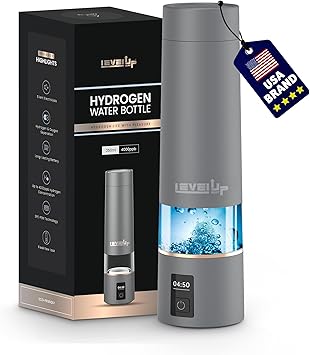
LevelUpWay Hydrogen Water Bottle
The Level Up Way hydrogen water bottle is a 250 ml (about 8.5 fl oz) generator built around SPE/PEM electrolysis. The manufacturer says it reaches up to 5,000 ppb of dissolved hydrogen and reduces chlorine; no independent laboratory has published a measurement for this model. One button starts a six- or twelve-minute cycle and a digital display shows the status. A hydrogen breathing adapter is included. It is cordless, weighs about a pound, and works with tap water up to 1100 ppm TDS.
- Maker Output: up to 5,000 PPB (no third-party report)
- Cycles: 6 or 12 minutes, one-touch, with a digital display
- Body: stainless steel, per the listing, 250 ml
- Extras: hydrogen breathing adapter included
- Brand: says it's based in the USA
- Manufacturer claims up to 5,000 ppb hydrogen
- Breathing adapter included in the box
- Six- or twelve-minute cycle, one-button start
- Digital display shows the cycle status
- Cordless and light, around 1 lb
- Works with tap water up to 1100 ppm TDS
- Only 250 ml per cycle, about 8.5 fl oz
- No independently published hydrogen measurement for this model
- Manufacturer publishes no warranty terms for this model
- Owner reports of battery and leak problems
- Needs regular charging and periodic descaling
What the LevelUpWay Bottle Is Made Of
Hydrogen bottles are largely one idea in different housings, and the housing is where LevelUpWay’s range diverges most, which is exactly where a review has to be careful. If you want the broader picture we have written up the science behind hydrogen water bottles separately. What follows is about this one unit.
Size, Weight and What It Is Made From
The bottle holds 250 ml, about 8.5 fl oz. That is roughly a glass of water per cycle, and it is the single biggest practical constraint on the product. It weighs about a pound, which is heavy for its volume, because most of that pound is the base unit, the electrode assembly and the battery rather than the water.
LevelUpWay describes the body as food-grade and leak-resistant. It does not say what the body is actually made of. Other bottles in the same range are specified: the 13-ounce and 300 ml models are borosilicate glass, and the 4,000 ppb model is food-grade Tritan. For this one the material is simply not published, and we are not going to guess at it. If the material matters to you, ask the seller before you buy.
The Dual-Chamber Design
Electrolysis produces hydrogen at one electrode and oxygen at the other. In a single-chamber bottle both end up in the same water. LevelUpWay says this model separates them, so hydrogen dissolves into the water you drink while oxygen, and any ozone or chlorine by-product, vents away from the drinking chamber. That separation is the main argument for a proton exchange membrane design over a cheap electrolysis puck. It is a claim about the architecture, not about the output.
How the LevelUpWay Generates Hydrogen
SPE/PEM Electrolysis and the 5,000 ppb Claim
SPE stands for solid polymer electrolyte and PEM for proton exchange membrane. A platinum-coated titanium electrode sits on each side of a thin polymer membrane. Current splits water at the lower electrode; hydrogen ions cross the membrane and recombine at the upper one as molecular hydrogen, H₂, which dissolves into the water above. Oxygen, and any ozone produced along the way, stays on the far side and vents out.
LevelUpWay’s listing for this model claims up to 5,000 parts per billion of dissolved hydrogen. Treat that as what it is: the manufacturer’s own headline figure for its newest and most expensive bottle. It is not a measurement anyone outside the company has published.
The Included Breathing Adapter
This is the feature that separates this model from the cheaper ones, and it is most of the reason the price sits where it does. The bottle ships with an adapter that lets you inhale the hydrogen the unit generates rather than drink it. LevelUpWay claims ten minutes of inhalation is equivalent to drinking two litres of hydrogen-rich water.
We have found no independent verification of that equivalence, and hydrogen inhalation research is a smaller and thinner literature than the drinking-water research described further down this page. If the adapter is why you are buying, buy it for the option it gives you, not for the equivalence figure.
Effective Chlorine Reduction for Pure Drinking Water
The manufacturer says the same cycle reduces chlorine in tap water. That is plausible chemistry, since electrolysis will act on free chlorine, but no figure is published for how much it removes and we have not seen it independently measured on this device.
Does the 5,000 ppb Claim Hold Up?
This is the question the category deserves and almost no review of it asks. Here is what can actually be established.
H2HUBB, one of the two laboratories that test these devices, is explicit that the ppb or ppm figure shown on a bottle’s own display does not reliably represent the concentration actually in the water. It advises buyers to rely on independent test results from H2HUBB or H2 Analytics, or to measure for themselves with an H2Blue reagent titration, rather than on the number the device reports.
LevelUpWay does publish a third-party laboratory figure: 3,310 ppb, tested by H2 Analytics. That figure belongs to its borosilicate glass model, which sells for well under half the price of this one. There is no equivalent figure for the 5,000 ppb model.
Where hands-on measurement of a LevelUpWay bottle has been published at all, it has come in below the headline. A reviewer measuring the 4,000 ppb model reported roughly 1,600 to 2,500 ppb depending on cycle length. That is the pattern across this category, where independent results routinely land under marketing claims.
So: nobody has published an independent measurement of this model. That is not a claim that it underperforms. It means the 5,000 ppb figure is unverified, and if the number matters to you, an H2Blue kit costs a fraction of the bottle and will tell you what you are actually getting.
User Experience and Operation
One-Button Operation and the Six or Twelve Minute Cycle
One button starts a cycle. That is the whole interface. The model offers two lengths, a six-minute quick cycle and a twelve-minute extended one, and a digital display shows which is running. Fill it, seat the lid squarely, press once.
Charging and Battery Life
The unit runs cordless on a rechargeable lithium-ion cell. LevelUpWay does not publish a cycles-per-charge figure or a battery capacity for this model, and we are not going to borrow the number quoted for its 4,000 ppb bottle, which is a different product. Charging is also the most common complaint in owner reports, covered below.
Water, Cleaning and Descaling
Use spring water or filtered water. Electrolysis needs some mineral content for conductivity, so distilled or heavily purified water performs poorly: there is very little in it to carry current. At the other end, the manufacturer states the unit supports water up to 1100 ppm total dissolved solids, which covers most tap supplies.
Hard water leaves limescale on the electrode plates, and scale is what kills output over time. Descale periodically with diluted white vinegar, run and discard a cycle afterwards, and keep the base unit and its contacts dry between uses. Do not overfill. Overfilling, along with a lid seated at an angle, is what most reported leaks trace back to.
Hydrogen also does not stay put. It comes out of solution quickly once the cycle ends and the bottle is opened, so drink it soon after it is made rather than carrying it around all morning.
Performance and Taste
What the Water Actually Tastes Like
Hydrogen is odourless and tasteless, so the water should not taste different, and for many people it does not. Owner reports that do describe a difference tend to describe texture rather than flavour: a smoother mouthfeel, occasionally read as a faint sweetness. Source water quality, temperature and what you last ate all move that perception more than the hydrogen does.
Formation of Bubbles Indicating Hydrogen Generation
You will see fine bubbles during a cycle. They confirm the unit is electrolysing, which is worth knowing, but they are not a measure of anything. Visible bubbles are gas that has come out of solution. The hydrogen that matters is the part still dissolved, and you cannot see that.
Health Benefits and Research
Potential Antioxidant Properties and Reduced Oxidative Stress
Molecular hydrogen is described in the literature as a selective antioxidant. Rather than mopping up everything, it acts preferentially on the hydroxyl radical, and it shows anti-inflammatory activity in several models. The 2024 systematic review in International Journal of Molecular Sciences, titled fairly enough Hydrogen Water: Extra Healthy or a Hoax?, collects what human trials have actually found and is the honest place to start.
Reported Improvements in Hydration and Energy Levels
The best-known clinical result is narrow and specific. In a randomised, placebo-controlled trial of 49 patients receiving radiotherapy for liver tumours, six weeks of hydrogen-rich water was associated with lower reactive oxygen metabolites in the blood and better quality-of-life scores than placebo water. That is a real finding in a specific clinical population under medical supervision. It is not a claim about what a bottle will do for a healthy person’s afternoon energy, and it should not be read as one.
Current Research on Metabolic Health and Athletic Performance
Meta-analyses published between 2023 and 2026 report associations between hydrogen-rich water and improvements in blood lipid profiles, including total cholesterol, LDL, HDL and triglycerides, in people with metabolic disorders. Work on exercise recovery and endurance, on liver conditions such as hepatitis B and non-alcoholic fatty liver disease, and on mood exists but is earlier and thinner.
The reviews themselves name the limits: small samples, short follow-up, heavy reliance on self-reported outcomes and almost no long-term data. Researchers consistently call for larger, pre-registered trials before any of this is treated as settled.
The health effects described above are based on early and emerging research. Hydrogen water is not a medicine and is not intended to diagnose, treat, cure, or prevent any disease. Always consult a qualified healthcare professional for medical advice, especially if you have an existing health condition.
Is the LevelUpWay Worth the Money?
Where It Sits on Price
Roughly $120 to $150 depending on retailer and promotion. That is the upper end of the portable hydrogen market, enough that our roundup of hydrogen water bottles under $100 and the cheaper end at hydrogen water bottles under $50 are both worth reading before you commit. Check the current price yourself; this category discounts often and the figure moves.
Warranty and Customer Support Quality
LevelUpWay publishes a one-year warranty and a thirty-day money-back window for its borosilicate glass model. It publishes neither for this one; the listing says warranty terms vary. At this price that is a real gap, and it is worth asking the seller directly before ordering.
Support is the thing owners praise most consistently. Reports across retailers describe replacements arranged, troubleshooting followed through and named staff who stayed with a problem, including for buyers outside the United States. That does not offset an unpublished warranty, but it is not nothing.
How It Compares With LevelUpWay’s Other Models
LevelUpWay sells at least seven hydrogen generators and they are easy to confuse. The 13-ounce borosilicate glass model is the only one with a published third-party laboratory result, 3,310 ppb from H2 Analytics, and it is also the cheapest of them. A 300 ml glass model is rated 3,000 ppb. A 250 ml Tritan model claims 4,000 ppb on a five-minute cycle. This one claims 5,000 ppb and is the only one that includes the breathing adapter. If you want a number you can check, the glass model is the one with the number.
There is also a 25-ounce stainless steel bottle with a filter in the same catalogue. It generates no hydrogen at all. If you are comparing listings, check that first; the names sit close enough together to catch people out.
Where It Falls Short
- 250 ml is one glass per cycle. Drink hydrogen water through the day and you will be running cycles through the day.
- No independent measurement of the 5,000 ppb claim exists for this model.
- No published warranty terms and no published body material, both unusual at this price.
- Owner reports include units failing at one to three months, batteries not holding charge, and leaks.
- Hydrogen dissipates quickly, so this is a drink-it-now device rather than a fill-and-carry bottle.
- The evidence behind the health claims that sell this whole category is still preliminary.
Customer Experiences
Long-Term Reliability Reported by Owners
Owner reports split. Some units are still working after a year of daily use with nothing more than periodic descaling; one reviewer who used a LevelUpWay bottle for close to a year reported it still fully operational and easy to maintain. Others fail inside one to three months, most often the battery: it stops holding charge, or charging becomes intermittent. Both experiences turn up often enough that neither can honestly be called typical.
Mixed Feedback on the Build and the Charging System
Leaks come up regularly. Most reports trace them to overfilling or a lid seated at an angle, and several owners say the bottle stopped leaking once they corrected both. Some report leaks anyway. The charging connection is the other recurring theme, and it is the one that tends to end in a replacement rather than a change of technique.
Customer Service Responsiveness to Issues
This is where the brand does well. Buyers describe prompt replies, replacements arranged without argument and follow-up afterwards, including for overseas orders. Given that warranty terms for this model are not published anywhere, that responsiveness is doing more work than it should have to.
Conclusion
The LevelUpWay is a competent portable hydrogen generator with one genuine differentiator, the breathing adapter, and one genuine gap: nobody outside the company has measured what it produces. At roughly $120 to $150 you are paying a premium for the adapter and for the 5,000 ppb headline, and only one of those two is something you can verify.
If the adapter appeals and 250 ml a cycle suits the way you drink, it is a reasonable buy at the low end of its price range. If what you want is confidence in the hydrogen figure, buy LevelUpWay’s cheaper glass model, which has a third-party laboratory result attached, or buy an H2Blue kit and find out for yourself. Either costs less than the difference.
FAQ
What is molecular hydrogen (H₂)?
Molecular hydrogen, also called hydrogen molecule, is formed when two hydrogen atoms bond covalently. This substance has existed on Earth for a long time and is the technology behind hydrogen-infused water. In Japanese terminology, “hydrogen water” simply refers to water that has been infused with molecular hydrogen.
What type of water should I use with my Level Up Way hydrogen water bottle?
For optimal performance and to prevent damage to the sensitive components, it’s recommended to use only spring water or filtered water with your hydrogen water bottle.
How do I properly clean my hydrogen water bottle?
Regular cleaning is essential for maintaining efficient operation. Use a diluted white vinegar solution to prevent plaque buildup on the electrolyzer elements. This helps ensure your bottle continues to generate hydrogen-rich water effectively.
Can I overcharge my hydrogen water bottle?
No, you should avoid overcharging the device. Only use the provided charger that comes with your Level Up Way hydrogen water bottle to prevent potential damage to the battery and electronic components.
How do I generate hydrogen-rich water with my bottle?
The process is straightforward: first ensure all parts are secure, then fill the bottle to the specified level (not exceeding the recommended amount), and activate the electrolysis function. The bottle’s user-friendly design makes this process simple.
How should I store my hydrogen water bottle when not in use?
Keep the bottle dry when not in use, especially the electronic components. Proper storage will help extend the lifespan of your hydrogen water generator and maintain its performance over time.
