As an Amazon Associate we earn from qualifying purchases. Buying through a link here costs you nothing extra. We were not given these bottles and CamelBak does not pay us.
- Our Top CamelBak Picks at a Glance
- About CamelBak & Design Differences
- Top CamelBak Water Bottles Reviewed
- How CamelBak Bottles Perform in Daily Use
- How to Choose Your CamelBak
- CamelBak vs. The Competition
- The Bottom Line on CamelBak Bottles
- How We Chose These Bottles
- Frequently Asked Questions (FAQ)
- What are the common problems with CamelBak Podium bottles?
- Are water bladders worth investing in instead of multiple bottles?
- Is it safe to put boiling water into CamelBak BPA-free water bottles?
- Why would my CamelBak water bottle start leaking for no apparent reason?
- What are the pros and cons of CamelBak style hydration systems for running?
- Which bottle cage works best with a 24oz CamelBak Podium?
Our Top CamelBak Picks at a Glance
Choosing a CamelBak water bottle comes down to four models, and each is built for a different job. If you only read one section, read this one.
- Best overall: the CamelBak Chute Mag in insulated stainless steel. The only one here CamelBak publishes both a hot and a cold figure for, and the only one that is dishwasher safe end to end.
- Best for cycling: the CamelBak Podium Chill. Squeezes, seals itself, locks out for transport, and weighs 99 g empty.
- Best for the backcountry: the CamelBak Eddy+ Filtered by LifeStraw. The filter lives in the straw, so the bottle is the filter.
- Best steel bike bottle: the CamelBak Podium Steel. Cage-shaped vacuum insulation, if you can give up the squeeze.
|
Best Overall

|
Best for Cycling

|
Best for the Backcountry

|
Best Steel Bike Bottle

|
|
Key Features & Benefits:
|
Key Features & Benefits:
|
Key Features & Benefits:
|
Key Features & Benefits:
|
|
Pros:
|
Pros:
|
Pros:
|
Pros:
|
|
Cons:
|
Cons:
|
Cons:
|
Cons:
|
- Double-wall vacuum-insulated stainless steel with a powder-coat finish
- CamelBak rates this 32 oz size at 32 hours cold and 12 hours hot
- Magnetic cap stows out of your face while you drink, then seals shut
- Sweat-resistant exterior, so it does not leave a ring on a desk
- Bottle and cap are both dishwasher safe
- Carry loop molded into the lid
- CamelBak lists it at 493 g empty
- The only bottle here CamelBak publishes both a hot and a cold figure for
- The magnetic cap solves the lid-in-the-face problem with no extra strap
- Dishwasher safe end to end, which the Podium bottles are not
- Opening is wide enough to get a bottle brush inside
- Heaviest of the four, and you notice it in a pack
- Built for everyday and travel use, not for a bike cage
- Powder coat scuffs where it lands on rock
- CamelBak calls the cap leak-resistant, not leak-proof
- Easy-squeeze polypropylene body shaped for standard bike cages
- Double-wall construction; CamelBak states it keeps water cold twice as long
- High-flow self-sealing Jet Valve
- Positive lockout dial for leak-proof transport
- CamelBak lists it at 99 g empty
- CamelBak publishes the material as 65% PP copolymer, 15% SEBS, 5% HDPE, 5% silicone
- Squeeze delivery gets water in without breaking your rhythm on a bike
- The lockout dial means it can go in a bag without soaking it
- Lightest of the four by a wide margin
- Cage fit is the entire design brief, and it shows
- CamelBak says to hand wash it, so it is not a dishwasher bottle
- The bite valve is where mold starts if you skip the deep clean
- Double-walled, not vacuum-insulated, so it trails the steel models
- 21 oz runs down quickly on a long ride
- Two-stage LifeStraw filtration built into the straw
- Hollow fiber membrane removes 99.999999% of bacteria, 99.999% of parasites and 99.999% of microplastics
- Ion exchange stage reduces lead, chlorine, odor and taste
- CamelBak states the hollow fiber stage treats up to 4,000 liters and the ion exchange stage up to 100 liters
- Tritan Renew body, made with up to 50% certified recycled content (ISCC mass balance)
- Integrated carry handle
- Scoop and drink, with no separate filter to pack
- Both filter capacities are published, which is rare in this category
- Uses the same flip-bite-sip valve as the standard Eddy+
- The lightest way to carry filtration and a bottle as one object
- Flow is slower than an unfiltered bottle; that is the filter doing its job
- Two consumables to replace, on different schedules
- The bite valve needs the same deep clean as every CamelBak straw lid
- Not insulated, so it is a warm-water bottle by the afternoon
- Vacuum-insulated stainless steel in a bike-cage profile
- High-flow cap you lift and sip from rather than squeeze
- Integrated lockout for transport
- Cage fit tuned to stop rattle on rough ground
- 0.65 liters, just under 22 oz
- Cage-shaped insulation, which the plastic Podium cannot offer
- No squeezing means no accidental spray from a full bottle
- Steel body shrugs off drops that would scar a painted bottle
- You cannot squeeze it, which is a real adjustment from a plastic Podium
- Heavier than the plastic Podium on every ride
- Sold in a narrower range of sizes than the plastic line
- Sits well above the plastic Podium in CamelBak's range
A CamelBak water bottle is the one most people reach for when a plain bottle has let them down — leaked in a gym bag, tasted of plastic, or cracked on the trail. There is an overwhelming number of insulated water bottles on the market (we have 36 insulated water bottles compared in one guide), and CamelBak is one of the few brands that publishes enough about its own bottles to check.
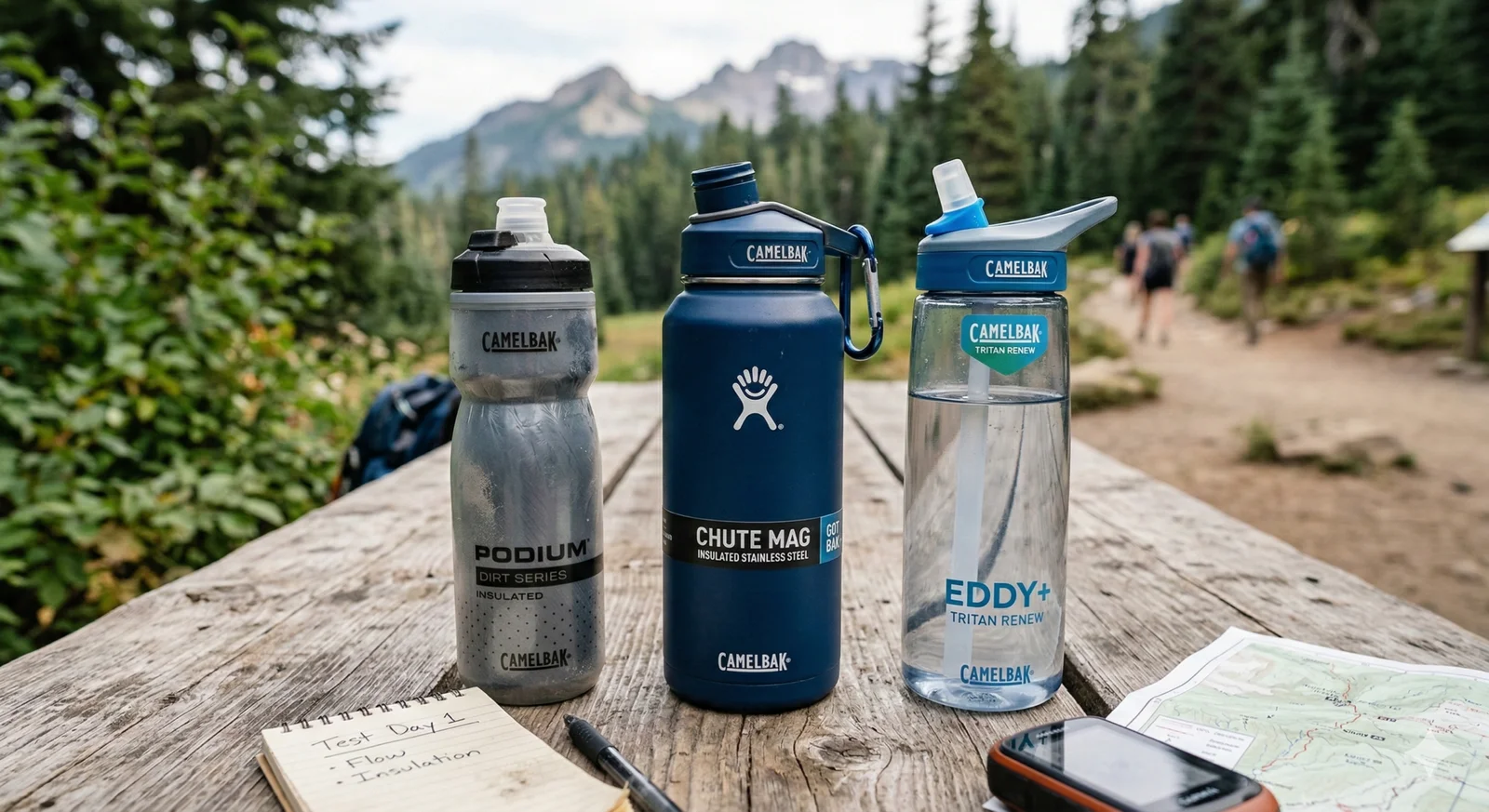
This guide covers the four CamelBak bottles worth considering in 2026: the Chute Mag, the Podium Chill, the Eddy+ Filtered by LifeStraw and the Podium Steel. Every performance figure quoted here comes from CamelBak’s own specifications or from a named third party, and each one says where it came from.
Whether you are a cyclist looking for a reliable cage fit, a hiker needing a rugged purification vessel, or just looking for continuous hydration at your office desk without the spills, this guide breaks down the clear winners for 2026.
About CamelBak & Design Differences
What makes CamelBak the best choice for outdoor hydration?
The brand’s reputation was built entirely around the concept of effortless, hands-free hydration. CamelBak dates itself to 1989 and describes itself as the brand that invented the hands-free hydration category. The story usually told is of an emergency medical technician rigging an IV bag into a tube sock for a long summer bike race; CamelBak’s own history page does not spell that out, so treat the detail as folklore and the 1989 date as the company’s own claim. That focus on getting water into you quickly is still the thread running through every bottle it makes, and it is worth reading our main insulated water bottle guide alongside this one if you are weighing CamelBak against the wider market.
Modern CamelBak bottles stand out because of their materials. Their hard-sided models are predominantly crafted from Eastman Tritan Renew, a copolyester that Eastman says is made with up to 50% certified recycled content, certified by ISCC on a mass-balance basis. It is BPA-free, phthalate-free and shatter-resistant. Unlike cheap, generic plastics that retain a lingering taste or degrade under UV light, CamelBak’s material choice ensures long-term outdoor viability. For extreme temperatures, they also offer double-wall vacuum-insulated stainless steel models designed specifically for maximum ice retention.
CamelBak Podium vs a Regular Water Bottle
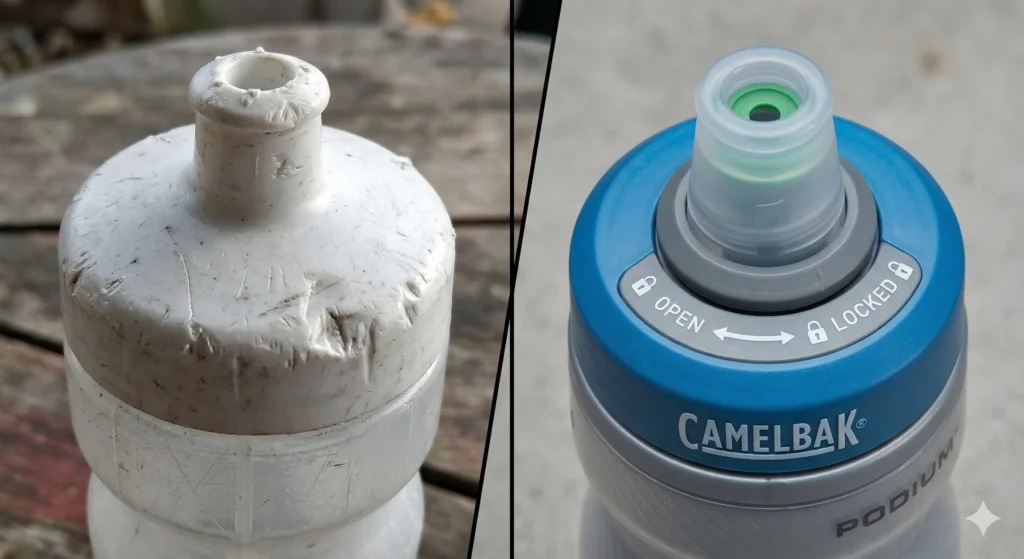
For decades, traditional sports and cycling water bottles relied on a basic push-pull top. You had to pry it open with your teeth, squeeze the rigid plastic body, and manually slam the cap shut on your chin to prevent leaks. It was functional, but highly prone to spilling and breaking over time.
The CamelBak Podium series entirely redefined this mechanism. Instead of a pull-top, the Podium utilizes a high-flow self-sealing Jet Valve made from silicone. When you squeeze the flexible body of the bottle, the valve opens to deliver a rapid, targeted burst of water. The moment you release pressure, it instantly seals itself back shut. There is no fumbling with your teeth, and zero splashing while riding over rough terrain.
Furthermore, unlike a standard bottle, the Podium features a twist “lockout” dial at the base of the cap. Turning this dial completely shuts off water flow, providing a genuinely leak-proof transport mode when you throw the bottle horizontally into a backpack.
Top CamelBak Water Bottles Reviewed
CamelBak Chute Mag (Best Overall Bottle)
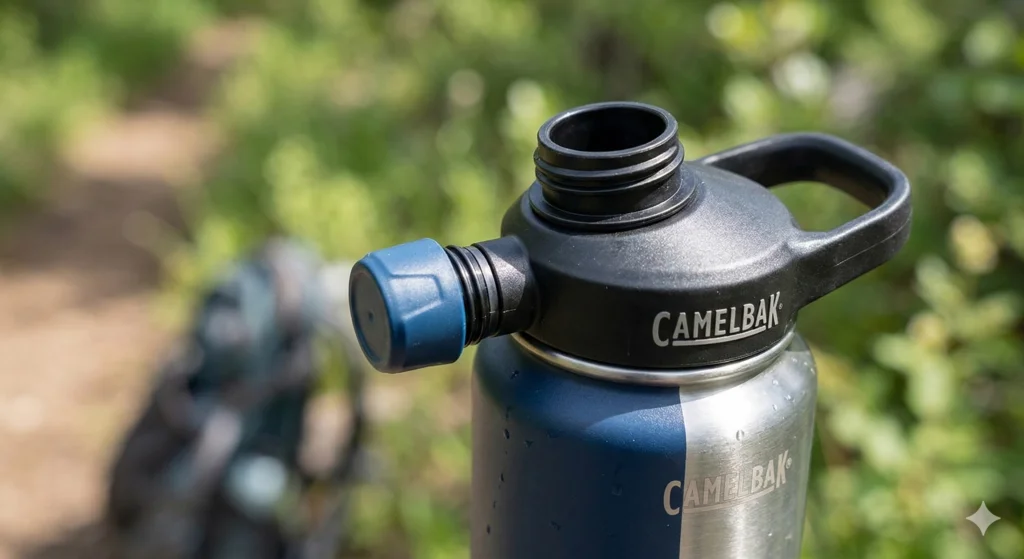
For daily, rugged use, the CamelBak Chute Mag stands out as the most versatile option in the lineup. Its defining feature is a high-flow angled spout designed to deliver water rapidly without the mess of a wide-mouth opening. The feature people keep mentioning is the magnetic top: the cap parks on the side of the bottle while you drink instead of swinging back into your nose.
The Chute Mag comes in two bodies. One is lightweight, shatter-resistant Tritan Renew plastic, made with up to 50% certified recycled content, which resists odors and stains. The other is double-wall vacuum-insulated stainless steel. CamelBak rates the insulated 32 oz version at 32 hours cold and 12 hours hot, and describes the exterior as sweat-proof so it will not leave a ring on a desk. Those figures come from CamelBak, not from us. If you want one bottle for the office, the gym and the trail, this is the one. CamelBak calls the cap leak-resistant rather than leak-proof, which is the honest description: it survives a bag, not a tumble down a hillside.
- Double-wall vacuum-insulated stainless steel with a powder-coat finish
- CamelBak rates this 32 oz size at 32 hours cold and 12 hours hot
- Magnetic cap stows out of your face while you drink, then seals shut
- Sweat-resistant exterior, so it does not leave a ring on a desk
- Bottle and cap are both dishwasher safe
- Carry loop molded into the lid
- CamelBak lists it at 493 g empty
- The only bottle here CamelBak publishes both a hot and a cold figure for
- The magnetic cap solves the lid-in-the-face problem with no extra strap
- Dishwasher safe end to end, which the Podium bottles are not
- Opening is wide enough to get a bottle brush inside
- Heaviest of the four, and you notice it in a pack
- Built for everyday and travel use, not for a bike cage
- Powder coat scuffs where it lands on rock
- CamelBak calls the cap leak-resistant, not leak-proof
CamelBak Podium Chill & Ice Series
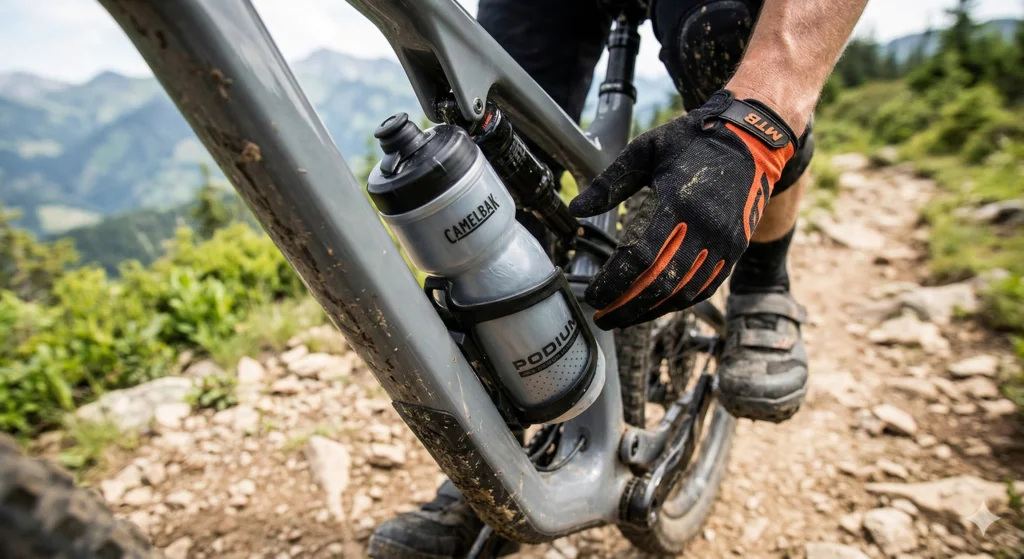
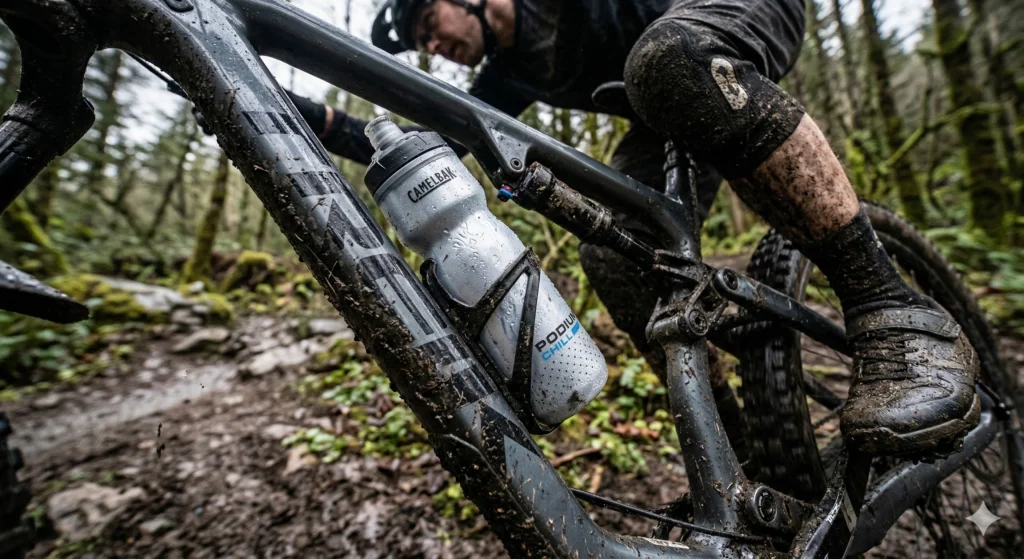
If you are a cyclist, standard water bottles simply do not cut it. The Podium Chill and Podium Ice series are explicitly engineered to fit securely into standard bicycle bottle cages without rattling. Unlike hard-sided bottles, the Podium series uses an easy-to-squeeze polypropylene body that allows you to force a high-flow stream of water into your mouth with minimal effort.
The lid is the part that matters. The self-sealing Jet Valve gives a high flow rate while keeping splatter down to almost nothing over rough ground. For insulation, the Podium Chill uses a double-walled construction designed to keep water cold twice as long as regular sport bottles. If you frequently ride in blistering heat, stepping up to the Podium Ice provides even greater thermal protection. Just remember to engage the positive lockout dial on the cap before tossing it into a gym bag to prevent accidental squeezing and leaking.
- Easy-squeeze polypropylene body shaped for standard bike cages
- Double-wall construction; CamelBak states it keeps water cold twice as long
- High-flow self-sealing Jet Valve
- Positive lockout dial for leak-proof transport
- CamelBak lists it at 99 g empty
- CamelBak publishes the material as 65% PP copolymer, 15% SEBS, 5% HDPE, 5% silicone
- Squeeze delivery gets water in without breaking your rhythm on a bike
- The lockout dial means it can go in a bag without soaking it
- Lightest of the four by a wide margin
- Cage fit is the entire design brief, and it shows
- CamelBak says to hand wash it, so it is not a dishwasher bottle
- The bite valve is where mold starts if you skip the deep clean
- Double-walled, not vacuum-insulated, so it trails the steel models
- 21 oz runs down quickly on a long ride
CamelBak Eddy+ Bottle Filtered by LifeStraw
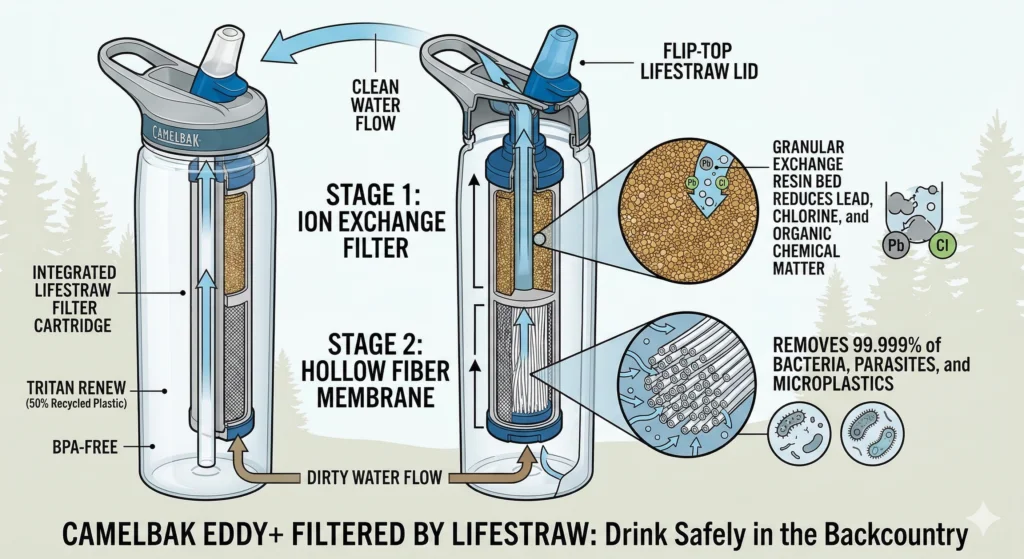
For hikers, backpackers, and travelers venturing off the grid, carrying a separate water filter and drinking vessel can be cumbersome. The Eddy+ Filtered by LifeStraw solves this by integrating a two-stage filtration system directly into the straw.
It removes a whole item from your pack. Water is drawn first through a hollow fiber membrane, which LifeStraw states removes 99.999999% of bacteria, 99.999% of parasites and 99.999% of microplastics. It then passes an ion exchange stage that reduces lead, chlorine, odor and taste. CamelBak states the hollow fiber stage treats up to 4,000 liters and the ion exchange stage up to 100 liters, so the two are replaced on different schedules. You simply scoop water from a stream, flip up the classic Eddy+ silicone bite valve, and sip safely. While the flow rate is naturally slower due to the heavy-duty filtration process, the peace of mind it provides in remote locations makes it an invaluable piece of survival and hiking gear.
The bite valve is the same flip-and-sip design CamelBak uses across the Eddy+ line, so if you get on with it here you will get on with the unfiltered versions too — and with the wider category of insulated bottles with a straw lid.
- Two-stage LifeStraw filtration built into the straw
- Hollow fiber membrane removes 99.999999% of bacteria, 99.999% of parasites and 99.999% of microplastics
- Ion exchange stage reduces lead, chlorine, odor and taste
- CamelBak states the hollow fiber stage treats up to 4,000 liters and the ion exchange stage up to 100 liters
- Tritan Renew body, made with up to 50% certified recycled content (ISCC mass balance)
- Integrated carry handle
- Scoop and drink, with no separate filter to pack
- Both filter capacities are published, which is rare in this category
- Uses the same flip-bite-sip valve as the standard Eddy+
- The lightest way to carry filtration and a bottle as one object
- Flow is slower than an unfiltered bottle; that is the filter doing its job
- Two consumables to replace, on different schedules
- The bite valve needs the same deep clean as every CamelBak straw lid
- Not insulated, so it is a warm-water bottle by the afternoon
CamelBak Podium Steel
The Podium Steel is the model people mean when they search for a CamelBak podium insulated steel water bottle, and it is the least understood bottle in the range. It takes the cage-shaped Podium profile and builds it in vacuum-insulated stainless steel rather than squeezable plastic.
That one change alters how you drink from it. A plastic Podium is squeezed, and the Jet Valve meters the jet. The Steel cannot be squeezed, so CamelBak fits a high-flow cap you lift and sip from instead. You still get the lockout for transport and the same rattle-free cage fit, and CamelBak lists the 22 oz version at 0.65 liters. If you ride somewhere genuinely hot and want insulation that still drops into a bike cage, this is the CamelBak for it. If you have ridden with a squeeze bottle for years, expect the first week to feel wrong. It also sits well above the plastic Podium in CamelBak’s range, and it is heavier on every ride.
- Vacuum-insulated stainless steel in a bike-cage profile
- High-flow cap you lift and sip from rather than squeeze
- Integrated lockout for transport
- Cage fit tuned to stop rattle on rough ground
- 0.65 liters, just under 22 oz
- Cage-shaped insulation, which the plastic Podium cannot offer
- No squeezing means no accidental spray from a full bottle
- Steel body shrugs off drops that would scar a painted bottle
- You cannot squeeze it, which is a real adjustment from a plastic Podium
- Heavier than the plastic Podium on every ride
- Sold in a narrower range of sizes than the plastic line
- Sits well above the plastic Podium in CamelBak's range
Which Podium Is Which?
CamelBak sells five bottles with Podium in the name and the differences are not obvious from the listings. This is the part that trips people up:
| Model | Body | Insulated | How you drink |
|---|---|---|---|
| Podium | Polypropylene, single wall | No | Squeeze |
| Podium Chill | Polypropylene, double wall | Yes | Squeeze |
| Podium Ice | Polypropylene, extra insulation | Yes, the most of the plastic line | Squeeze |
| Podium Steel | Vacuum-insulated stainless steel | Yes | Lift and sip — it does not squeeze |
| Podium Dirt Series | As the Chill, plus a mud cap | Yes | Squeeze |
If you are shopping for a cage bottle specifically, our roundup of the insulated bicycle water bottle picks puts these against the rest of the market.
How CamelBak Bottles Perform in Daily Use
What’s good about CamelBak bottles?
CamelBak’s greatest strength is ergonomics and flow rate. Whether you are squeezing a Podium bottle on a bike or using the magnetic stowed cap on the Chute Mag, you never feel like you are fighting the bottle to get water out.
Durability is the other strength, and it comes from the materials rather than from anything we can claim to have proved. Eastman states that Tritan is shatter-resistant, and 18/8 stainless steel dents rather than breaks. Behind both sits CamelBak’s Got Your Bak Lifetime Guarantee, which covers manufacturing defects in materials and workmanship for the lifetime of the product.
What’s not so good?
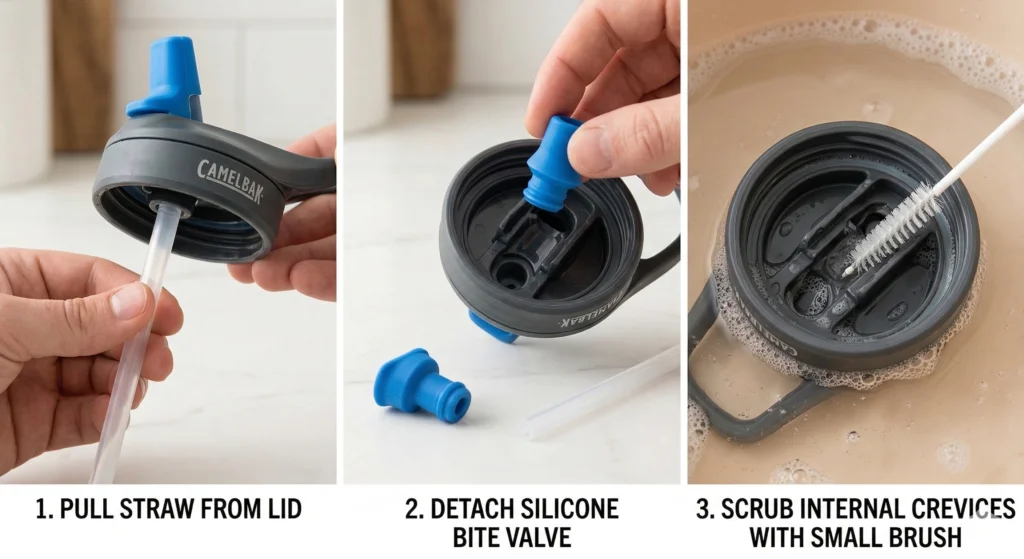
The single biggest complaint among CamelBak owners is the cleaning routine their bite valves need, and it is the one thing most likely to make somebody regret the purchase.
Because the Eddy+ and Podium lids use intricate silicone valves to prevent leaks, moisture gets trapped in the small crevices. Here is the part most buyers never read: CamelBak’s own care guidance says its sports bottles, such as Podium and Podium Chill, should be hand washed in hot soapy water with a bottle brush — they are not dishwasher bottles at all. The insulated Chute Mag is the exception; CamelBak says that bottle and its cap are dishwasher safe, top rack. Whichever you own, rinsing alone will eventually grow mold in the mouthpiece. CamelBak asks you to periodically pull the bite valve and straw entirely out of the cap for a deep clean, soaking them in warm, soapy water and scrubbing the interior. It is undeniably a tedious chore compared to washing a simple wide-mouth bottle.
Material Quality & Insulation
When purchasing a CamelBak, you are generally choosing between two highly capable materials: Tritan Renew plastic or double-wall vacuum-insulated stainless steel.
The plastic models are ideal for ultralight backpacking or the gym, as they will not weigh you down. If temperature control is the priority, the insulated stainless steel models are the ones to look at. CamelBak rates the 32 oz insulated Chute Mag at 32 hours cold and 12 hours hot, with a sweat-proof powder-coated exterior. For the plastic Podium Chill, CamelBak makes a narrower claim: double-wall construction that keeps water cold twice as long as a single-wall bottle. Both are the manufacturer’s figures.
How to Choose Your CamelBak
Four decisions cover it. Get these right and the model almost picks itself.
- Capacity. A 21 oz Podium is a one-hour ride. The 22 oz Podium Steel is the same ride with cold water at the end of it. A 32 oz Chute Mag is a desk or a day pack, not a bike cage. If the bottle has to live in a car cup holder, check the base diameter before anything else — the 32 oz steel bottles are the ones that do not fit.
- Material. Tritan Renew is lighter and cheaper and will not hold temperature for long. Vacuum-insulated steel holds temperature and costs more, and you carry the difference. There is no third answer.
- Lid. A bite valve is the fastest way to drink and the slowest to clean. A magnetic spout is a good middle. A high-flow cap is the simplest thing CamelBak makes.
- Cleaning. Be honest about this one. If you will not take a lid apart every couple of weeks, do not buy a bite-valve bottle. Our guide to how to deep-clean an insulated bottle covers the routine in full.
On price, CamelBak sits in the middle of the premium bracket: the plastic Podium bottles are the cheapest thing it makes, the insulated steel models cost several times as much, and the filtered Eddy+ sits between them because you are also buying two filters. That ordering has held for years even as the numbers move.
CamelBak vs. The Competition
Who makes the best product: CamelBak, Nalgene, or Klean Kanteen?
Set CamelBak against the other big names and the “best” bottle depends on how much lid you are willing to clean against how fast you want to drink.
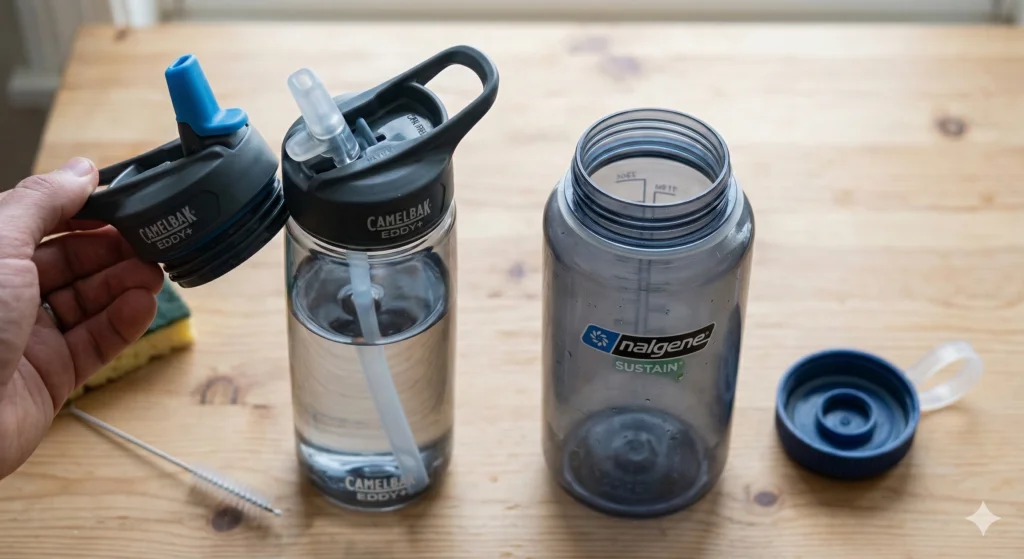
Nalgene’s whole appeal is that there is almost nothing to break. Like CamelBak’s hard-sided bottles, modern Nalgenes are crafted from highly durable Eastman Tritan Renew plastic, making them shatter-proof and lightweight. Nalgene’s wide mouth has no valve to trap moisture, which makes it far easier to clean and much less mold-prone than a CamelBak bite valve. The trade-off is that Nalgene lacks the spill-proof, one-handed drinking experience that makes CamelBak the superior choice for driving or walking.
On the other hand, Klean Kanteen competes aggressively in the metal bottle category. As a certified B Corporation dedicated to eliminating single-use plastics, Klean Kanteen’s stainless steel vessels are incredibly rugged and feature eco-friendly powder coatings. While Klean Kanteen wins on environmental pedigree and minimalist design, CamelBak’s sports-focused ergonomics—particularly the squeezable Podium for cycling and the magnetic Chute Mag cap—still offer a much better experience for high-intensity active users.
CamelBak vs. Yeti, Hydro Flask and Ello
For pure temperature retention, Yeti holds the edge. Yeti’s popular Rambler series is constructed from thick, 18/8 kitchen-grade puncture-resistant stainless steel. Neither company publishes a figure in a form that allows a like-for-like comparison, so treat multi-day ice-retention claims with care whoever makes them — how the YETI Rambler compares goes through what Yeti does and does not state. What is not in doubt is the weight penalty. Yeti bottles are notoriously heavy and bulky, making them ideal for basecamp or a truck cab, but terrible for cycling, running, or ultralight backpacking where CamelBak shines.
Hydro Flask is the rival CamelBak is most often cross-shopped against, and it is the more direct comparison than Yeti. Its wide-mouth bottles use the same 18/8 stainless steel and double-wall vacuum construction, and Hydro Flask publishes retention figures for them, which is more than many rivals do. Where CamelBak pulls ahead is the drinking mechanism: Hydro Flask sells you a lid, while CamelBak designs the whole bottle around getting water into you one-handed. Where Hydro Flask pulls ahead is cleaning, because a wide mouth has no valve in it.
If your use case is the office or the yoga studio, Ello is worth a look. Ello specializes in stylish, everyday hydration, frequently utilizing odor-free glass wrapped in protective silicone sleeves or sleek stainless steel. Glass provides the absolute purest water taste, completely avoiding the faint rubbery flavor sometimes reported with new CamelBak silicone bite valves. Ello’s lids are also famously easy to clean. For ruggedness on a mountain trail, though, CamelBak’s shatter-resistant Tritan and vacuum-insulated steel are the better outdoor choice.
The Bottom Line on CamelBak Bottles
Best Uses & Investment
When you purchase a premium water bottle, you want assurance that it will survive rigorous daily use. CamelBak’s Got Your Bak Lifetime Guarantee covers reservoirs, backpacks, bottles, coolers, drinkware and accessories against manufacturing defects in materials and workmanship for the lifetime of the product. A defective seal or a lid that arrived cracked will be repaired or replaced, at CamelBak’s discretion. Read the limits too: CamelBak states the guarantee does not cover normal wear and tear, accidental loss, improper care or cleaning, or non-standard use, and it does not offer refunds. It is a good warranty, not an unconditional one.
Furthermore, CamelBak’s push toward sustainability means that their modern hard-sided plastic bottles are constructed from Tritan Renew, which Eastman says is made with up to 50% certified recycled content on a mass-balance basis. This ensures they are both shatter-resistant and completely safe for commercial dishwashers, greatly extending the bottle’s usable lifespan compared to cheap, single-use plastics.
Matching the right model to your lifestyle is critical to maximizing this investment:
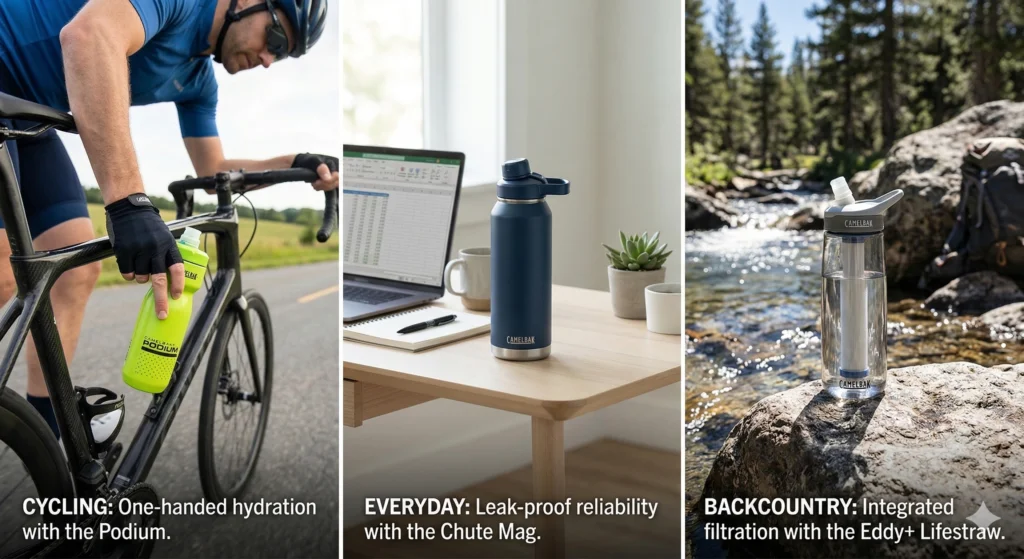
- For Cyclists: The CamelBak Podium Chill is hard to beat. Its self-sealing Jet Valve and easy-squeeze body make it the safest and most efficient choice for drinking while riding.
- For Everyday Office & Gym Use: The CamelBak Chute Mag in insulated stainless steel provides excellent temperature retention and has a magnetic cap that stays out of your face while you drink.
- For Hiking & Travel: The CamelBak Eddy+ Filtered by LifeStraw filters bacteria, parasites and microplastics out of backcountry water through the straw itself, so there is nothing extra to pack.
My Final Verdict on CamelBak Bottles
CamelBak is still the default in this category for one reason: its designs put getting water into you quickly ahead of looking minimal on a desk. The Eddy+ and Podium models need a dedicated, sometimes tedious cleaning routine to keep mold out of the silicone bite valves. For an active rider or hiker the one-handed, high-flow drinking is worth that. For somebody who wants to rinse a bottle and move on, it is not.
If you are tired of struggling with screw-off lids while driving or splashing water on yourself while running, upgrading to a CamelBak is a highly logical choice. If you want one bottle that handles the office, the gym and the trail without much fuss, buy the CamelBak Chute Mag. And if you already know you will not take a lid apart every fortnight, buy a wide-mouth bottle from somebody else instead — that is a better outcome than a moldy Podium in six months.
How We Chose These Bottles
Most pages in this category open by telling you how many bottles somebody tested. This one will not, because we have not lab-tested these bottles and we are not going to claim otherwise.
What is here instead: every performance number on this page comes from CamelBak’s own published specifications or from the component maker — Eastman for Tritan Renew, LifeStraw for the filter figures — and each is attributed where it appears. Where a claim could not be sourced, it was removed rather than softened. Where CamelBak’s own documentation contradicts a common belief, as it does on hand-washing the Podium, we say so and link to the page that says it. Where two sources disagree, we report the disagreement instead of picking the tidier number.
Selection came from what CamelBak actually sells in 2026, which models cover genuinely different use cases, and what owners consistently report going wrong. That last part is why the cleaning section is the longest on the page.
Frequently Asked Questions (FAQ)
What are the common problems with CamelBak Podium bottles?
The most universally reported issue with the Podium series is keeping the self-sealing Jet Valve clean. Because the silicone valve contains tiny interior crevices, sugary sports drinks and electrolyte powders leave a sticky residue, and if that is not cleaned out it turns into mold. Rinsing is not enough. CamelBak asks you to take the valve components apart and scrub them, and its care guidance says the Podium and Podium Chill should be hand washed rather than run through the dishwasher.
Are water bladders worth investing in instead of multiple bottles?
If you are logging high mileage on a hiking trail or a mountain bike, a dedicated hydration reservoir is usually worth it. A bladder centralizes the water weight against your back, which keeps your center of gravity better than heavy bottles sloshing around the sides of a pack. The drinking tube also encourages small, continuous sips without stopping to unpack your gear. The trade is cleaning: a long narrow tube needs a dedicated brush.
Is it safe to put boiling water into CamelBak BPA-free water bottles?
No. Tritan is a copolyester, and like any plastic it deforms above a certain temperature, so boiling water can distort the body and compromise the lid seal. CamelBak markets its plastic bottles for cold and warm drinks rather than boiling ones, and sells its insulated stainless steel models for hot drinks. We could not load CamelBak own bottles FAQ page to quote its exact wording, so treat this as the material property rather than a direct quotation. For coffee or tea on the trail, use a double-wall vacuum-insulated steel bottle.
Why would my CamelBak water bottle start leaking for no apparent reason?
If a previously watertight bottle suddenly leaks from the mouthpiece, it is almost always environmental pressure. Rapid changes in altitude or temperature, such as driving up a mountain pass, taking a flight, or leaving the bottle in a hot car, make the air inside the bottle expand. That pressure forces water up the internal straw and out through the bite valve. Crack the main lid a quarter-turn first to equalize the pressure, and only then flip the mouthpiece open.
What are the pros and cons of CamelBak style hydration systems for running?
The biggest advantage of a CamelBak running vest or soft flask is streamlined, hands-free hydration that does not disrupt your gait, so you never break stride to drink. The drawbacks are the sloshing sound of water bouncing against your back as the reservoir empties, and the cleaning: the long, narrow drinking tubes need dedicated tube brushes to keep bacteria from growing between runs.
Which bottle cage works best with a 24oz CamelBak Podium?
The CamelBak Podium 24oz bottle is tall. On a full-suspension mountain bike or a smaller road frame, pulling it straight up out of a standard cage often means the bottle catches the top tube. A side-load cage such as the Specialized Zee Cage II solves it by letting the bottle slide out horizontally, which makes the taller Podium far easier to reach while riding.