
Choosing a hydrogen water bottle comes down to three questions: how much hydrogen it actually dissolves, whether anyone independent has measured that number, and whether it still works after a year of daily use. Everything else is packaging. If you would rather skip the reasoning and go straight to what we recommend, start with the best hydrogen water bottle roundup.
Not all hydrogen water bottles deliver the same results. The difference between a $30 bottle and a premium $150 model often comes down to hydrogen concentration levels, build quality, and long-term reliability. Some cheaper options may not produce the advertised hydrogen levels, while others lack proper customer support when things go wrong.
What follows is how to read a concentration claim, which materials survive being carried around all day, what capacity you actually get and why it is so small, and how to tell a real warranty from a decorative one. Price gets its own section, because the cheap end of this market is where most of the bad advice lives.
The interactive tool just below does the same job faster: answer four questions and it narrows the field for you.
How to Choose a
Hydrogen Water Bottle
6 interactive sections covering every decision factor — from concentration science to budget tiers. Find the right bottle without reading the whole article.
🎯 Personalized Bottle Finder
Answer 4 quick questions and get a personalized recommendation matched to your goal, budget, and lifestyle.
Loading…
PPB ↔ PPM Converter
Live Concentration Meter
Insufficient for therapeutic benefit. Common in cheap or tablet-based products. Avoid as a primary bottle.
Meets the expert-recommended baseline (0.6–1.0 PPM). You'll get some benefit — acceptable for budget picks above $70.
The research sweet spot. Most quality bottles in the $80–$150 range hit this. Consistent daily benefits are achievable here.
Above research-optimal range. Premium bottles with SPE/PEM tech reach this. Excellent for athletic recovery and therapeutic use.
Top-tier output from certified lab-tested devices. Peak output under ideal conditions — compare independently verified numbers only.
H₂ Retention: How Fast It Escapes
Molecular hydrogen is the smallest molecule in the universe — it dissipates quickly. Knowing retention times helps you get the most from each cycle.
Tritan Plastic vs Glass
Tritan Plastic
✓ RecommendedBorosilicate Glass
Feature Importance Ratings
Every feature has a different impact on your actual experience. Here's how to prioritize when comparing bottles:
Capacity Visual Guide
Hydrogen water bottles are smaller than regular water bottles by design — the electrolysis chamber limits size. Here's what to expect:
Price Tier Breakdown
Under $70
⚠ Verify First- ✗ Often uses no SPE/PEM tech — ozone risk in water
- ✗ PPB claims rarely verified by independent labs
- ✗ No warranty or < 30-day return only
- ✗ Electrode plates corrode faster, releasing metals
- → If forced to buy in this range, demand detailed specs and return policy
$70 – $150
✓ Sweet Spot- ✓ Real SPE/PEM electrolysis technology
- ✓ 800–2,500 PPB achievable concentration
- ✓ Minimum 1-year warranty (often 2-year)
- ✓ BPA-free Tritan or borosilicate glass
- → Best range for most daily users seeking real results
$150 – $300
⭐ Premium- ✓ 2,000–8,000+ PPB lab-certified output
- ✓ Lifetime warranties common
- ✓ IHSA / H2 Analytics third-party verified
- ✓ Advanced UI (OLED displays, app integration)
- → Worthwhile for therapeutic use or serious athletes
Cost Per Day Analysis
Once purchased, hydrogen water bottles cost remarkably little to run — primarily electricity for USB charging:
Top Brand Profiles
These brands have established reputations in the US hydrogen water market based on customer reviews, warranty policies, and technology transparency.
Piurify
A+Echo Water (Synergy Science)
AIonBottles
ALevelUpWay
B+EVOLV
B+Olansi
BWarranty Tier Guide
Gold standard. Indicates manufacturer confidence in durability and technology. Typically offered by Piurify, IonBottles, and a few premium brands. This level of coverage often signals better internal components and quality control.
Acceptable and common at the $80–$200 price range. A 2-year warranty is a positive signal. Look for what's covered — does it include the electrolysis module and battery, or just the bottle body?
Borderline acceptable only if return policy is generous and responsive. This suggests the manufacturer isn't confident the product will outlast 90 days of use without issues.
Major red flag. Sellers who offer no warranty are frequently associated with overpriced, underperforming bottles. These products often use inferior components and lack real quality control. Walk away.
Red Flags to Avoid
Frequently Asked Questions
Quick Decision Summary
✓ BPA-free materials (verify certification)
✓ Minimum 600 PPB output (aim for 1,000+)
✓ At least 1-year warranty
✓ Diameter ≤3 inches
✓ USB-C charging
✗ No published concentration figure
✗ No mention of SPE/PEM tech
✗ Unverified PPB claims
✗ No customer service contact
✗ Uses carbonated water compatible
→ Aim for 2–4 cycles per day
→ Use lightly filtered water (50–300 TDS)
→ Clean monthly with citric acid
→ Run 3–4 break-in cycles before use
→ Store sealed at room temperature
- How to Choose a Hydrogen Water Bottle: the Features That Actually Matter
- Understanding Hydrogen Concentration Standards
- Material and Build Quality Assessment
- Size and Capacity Considerations
- Warranty and Customer Support Evaluation
- Budget and Value Assessment
- Top Brand Recommendations and Features
- FAQ
- What is the difference between hydrogen water and regular water?
- How much hydrogen concentration should I look for in a hydrogen water bottle?
- How long does hydrogen water stay potent after generation?
- Are glass or plastic hydrogen water bottles better?
- How often should I clean my hydrogen water bottle?
- Can I use tap water in my hydrogen water bottle?
- What's the typical lifespan of a hydrogen water bottle?
- Do hydrogen water bottles really work or is it just marketing hype?
- Conclusion
How to Choose a Hydrogen Water Bottle: the Features That Actually Matter
Five things separate a bottle worth owning from one that merely glows blue: measured hydrogen output, the material it is built from, whether it fits your bag and your cup holder, how the manufacturer behaves when something breaks, and what you paid. Each one gets a section below. For the wider picture of how these bottles work and who they suit, see the hydrogen water bottle hub.
Hydrogen Generation Efficiency and Concentration Levels
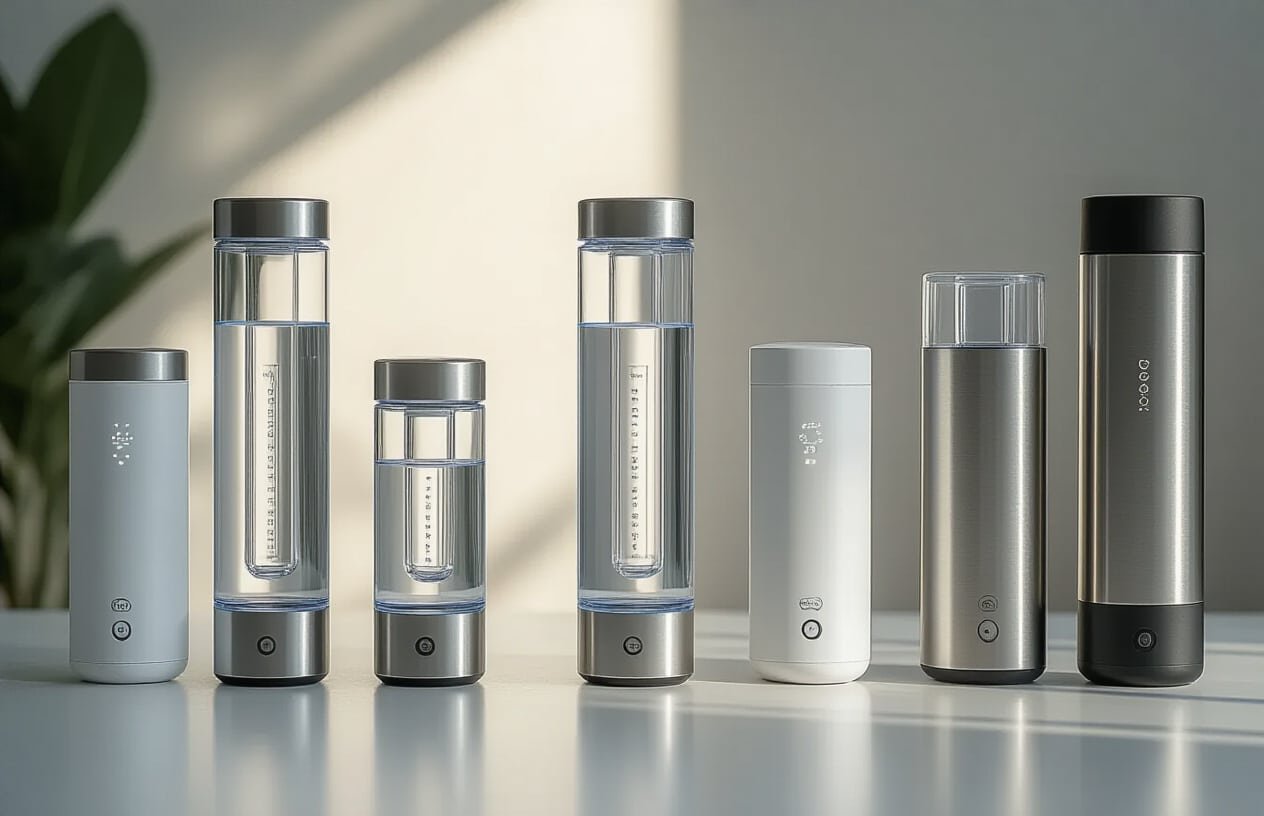
The number that matters most is how much hydrogen the bottle actually dissolves. It is quoted in parts per million (ppm) or parts per billion (ppb), and occasionally in milligrams per litre (mg/L), which for water means the same thing as ppm. So 1.0 ppm, 1000 ppb and 1.0 mg/L all describe the same glass of water.
Most bottles land between 300 and 3000 ppb per cycle, and a few reach 4000 ppb. Treat 600 ppb (0.6 ppm) as your floor. Below that you are mostly drinking slightly fizzy water.
Two technologies produce that hydrogen, and the difference shows up in the glass. Cheap bottles use plain electrolysis, which splits the water at both electrodes and sends chlorine and ozone into your drink along with the hydrogen. Better bottles use an SPE/PEM membrane (solid polymer electrolyte with a proton exchange membrane), which keeps the two gases apart and vents the oxygen out of the base. If a product listing never mentions SPE or PEM, assume there is not one in there.
Material Quality and Safety Standards
Tritan is the usual choice: tough, light and BPA-free. It survives being dropped, which matters more than it sounds once the bottle starts living in a gym bag.
Borosilicate glass tastes cleaner and adds nothing to the water, but it breaks. If the bottle travels with you, Tritan is the safer bet.
Portability and Design Considerations
Keep it under 3 inches across and it will fit a car cup holder. Wider than that and it stops fitting, which is one of the most common complaints in owner reviews.
Most weigh 10 to 15 ounces empty, which is light enough to stop noticing.
Battery Life and Charging Capabilities
Battery life is quoted in cycles, not hours. Ten to fifteen cycles per charge is normal, and USB-C charging is worth holding out for, because a bottle with a proprietary cable becomes useless the day you lose it.
Understanding Hydrogen Concentration Standards
Minimum PPB Requirements for Health Benefits
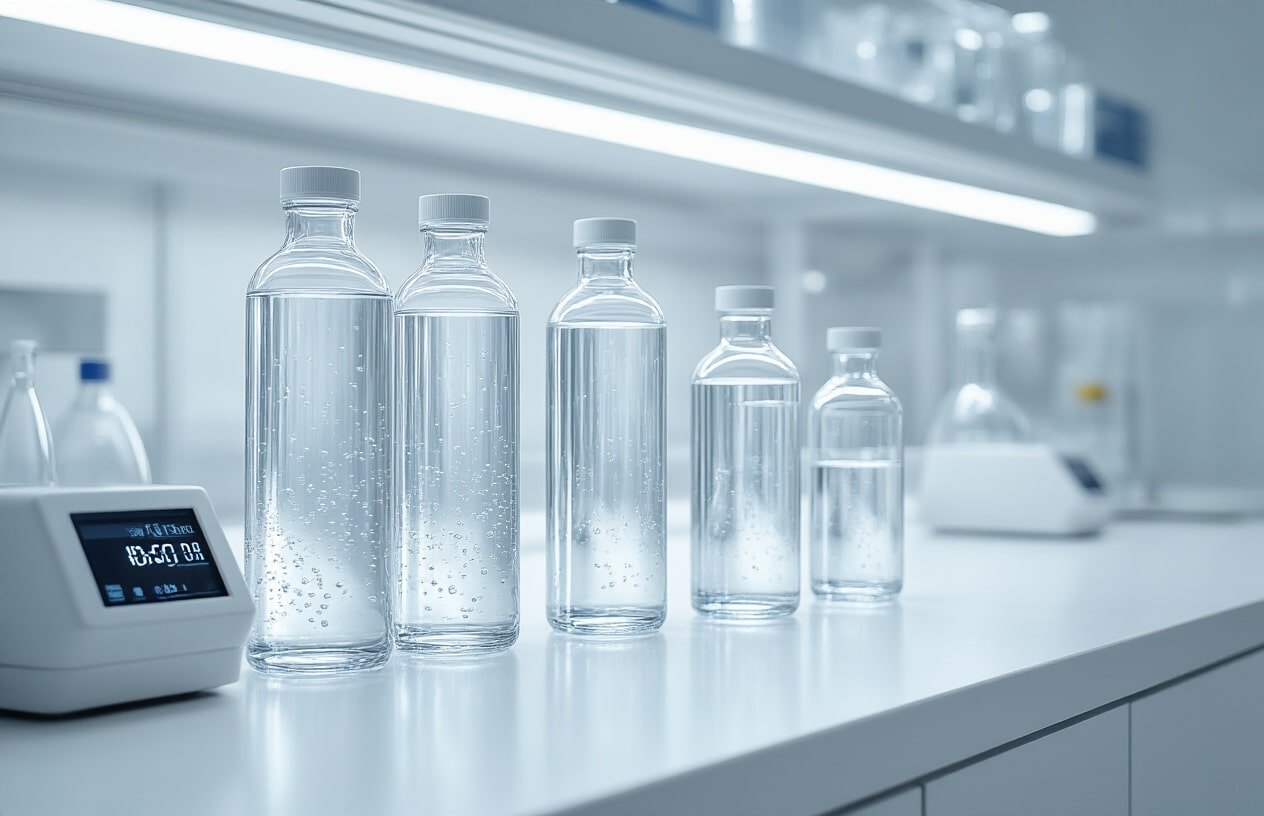
600 ppb (0.6 ppm) is the figure cited most often in the research literature as a useful baseline, and a number of studies work at roughly double that, around 1200 ppb. Neither is a regulated standard. Treat any brand that presents one as though it were an official threshold with a little suspicion.
More is not automatically better. Past roughly 1.6 ppm the water is saturated and the surplus hydrogen just leaves. That is also why a cap with a one-way pressure valve holds its concentration noticeably longer than an open spout.
How to Verify Advertised Concentration Claims
Advertised numbers are marketing until somebody measures them, and there are two practical ways to do that. H2 Blue is a methylene-blue titration reagent: you add drops until the blue stops vanishing, and each drop stands for roughly 0.1 ppm. It is what most reviewers use and the only inexpensive method that measures dissolved hydrogen directly. An ORP meter is the other option, but it reads oxidation-reduction potential rather than hydrogen, so it confirms the water changed without telling you by how much.
So in owner reviews, look for anyone quoting an H2 Blue drop count rather than an impression. Two or three independent measurements tell you more than a hundred five-star ratings. Be sceptical of hydrogen test strips, which are unreliable enough that most experienced reviewers have given up on them.
Optimal PPM Levels for Daily Consumption
For daily drinking, 1 to 2 ppm is the range most often recommended. It is high enough to be worth the trouble and low enough that nothing is wasted.
Consistency matters more than a headline figure. A bottle that reliably reaches 1.0 ppm on every cycle is worth more than one that advertises 3.0 ppm and hits it once, on the bench, when new.
Important Disclaimer: The benefits described here are based on early and emerging research. Hydrogen water is not a medicine and is not intended to diagnose, treat, cure, or prevent any disease. Always consult a qualified healthcare professional for medical advice, especially if you have an existing health condition.
Material and Build Quality Assessment
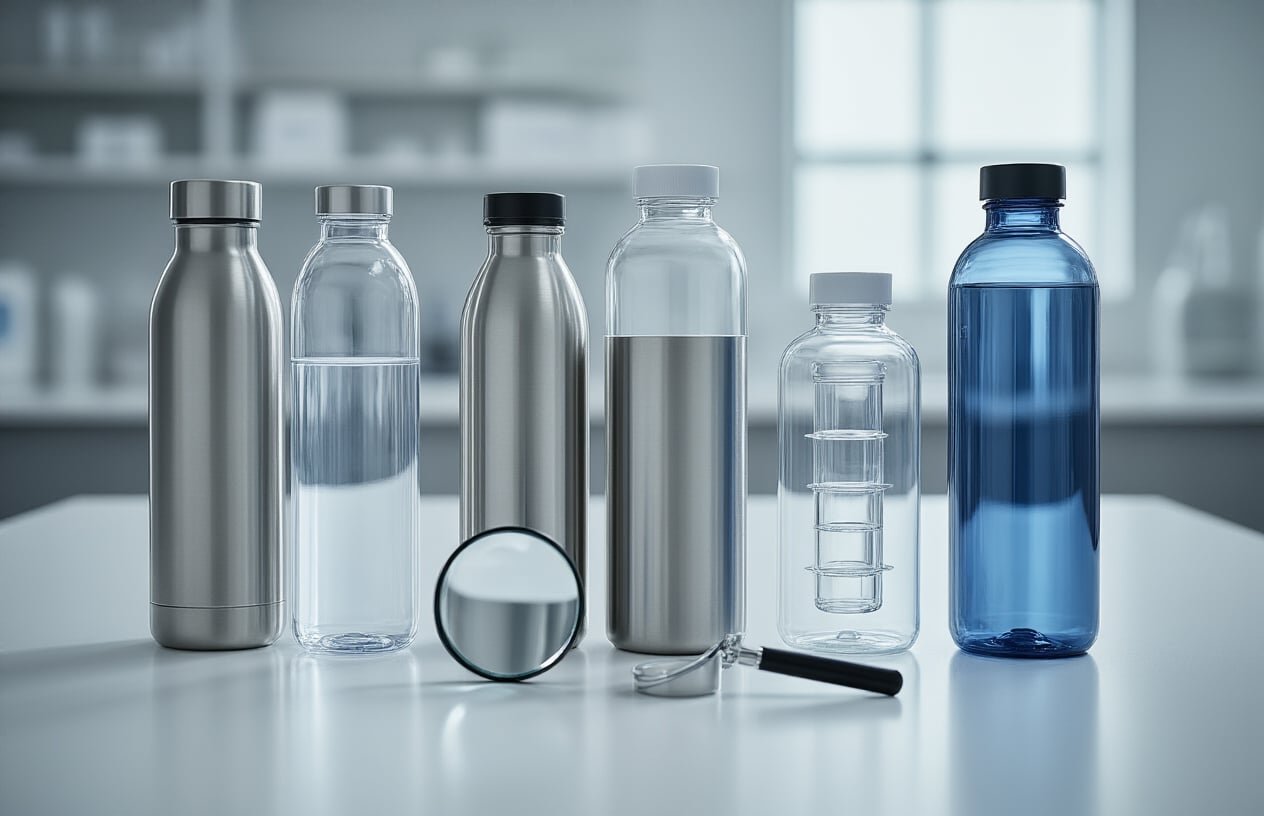
Tritan vs Glass Construction Benefits
Most bottles use Tritan, a BPA-free copolyester that has become the default for anything meant to be carried around. It is the industry standard for a dull reason: it does not shatter.
Glass feels cleaner and adds nothing to the taste, which is why it appeals to people who care about flavour. It comes with one significant limitation: it breaks easily, so it is a poor match for an active life. That fragility rules it out for most people who genuinely carry a bottle around.
| Material | Benefits | Drawbacks |
|---|---|---|
| Tritan Plastic | Durable, lightweight, break-resistant | May retain odors over time |
| Glass | Pure taste, no flavor interference | Fragile, heavy, break-prone |
BPA-Free and Chemical Safety Requirements
Chemical safety is not negotiable. The bottle should be BPA-free, and it matters more here than in an ordinary flask: electrolysis plus a long contact time between water and plastic is exactly the condition under which leaching gets worse.
Most of the industry has moved to BPA-free materials, but the claim is worth checking rather than assuming.
Durability for Active Lifestyle Use
Tritan is the right choice if the bottle moves with you. Commuting, training or travelling, it has to survive handling, temperature swings and the occasional drop without damaging the electrode stack inside.
Active users should prioritize bottles that can endure:
- Regular transport and handling
- Temperature fluctuations
- Impact resistance during activities
- Long-term structural integrity
That is why most people end up with Tritan.
Size and Capacity Considerations
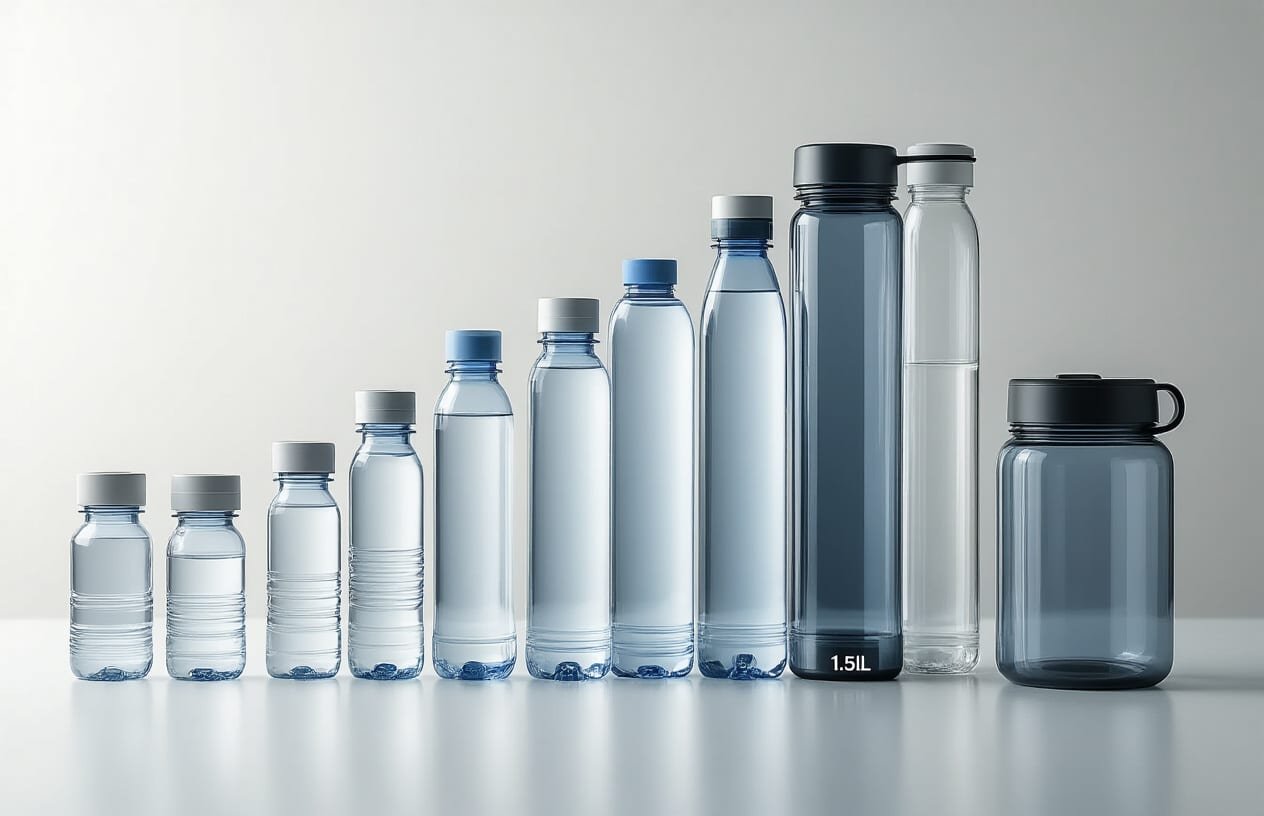
Standard Capacity Limitations and Why They Exist
These bottles hold between 8 and 14 ounces, which catches most first-time buyers out. That is roughly a third of an ordinary flask, and the limit is mostly economic.
A bigger chamber needs a bigger electrode stack and a bigger battery, and the price climbs faster than the volume does. Nobody has solved that yet, so plan on refilling rather than shopping for a large one.
Portability Requirements for Daily Use
The specification that decides whether you keep using it is diameter. Three inches or less fits a car cup holder and a backpack side pocket.
A wide bottle can hit every concentration figure printed on the box and still end up in a cupboard, because it will not travel. Three inches became the industry benchmark for that reason alone.
Weight and Dimension Guidelines
Empty weight runs 10 to 15 ounces, light enough to carry all day without thinking about it.
Filled, that is still under two pounds, which is the practical reason the small capacity is tolerable at all.
Warranty and Customer Support Evaluation

Importance of Warranty Coverage
A warranty tells you how much the manufacturer trusts its own build. That is most of its value: the length of the cover is a claim about the failure rate, made by the only people who actually know it.
Lifetime cover is the best you will see and it is rare. One or two years is normal and perfectly reasonable. Anything shorter than a year is a signal.
Warranty length tracks build quality closely enough to use as a proxy when you cannot inspect the bottle yourself.
Red Flags When No Warranty is Offered
No warranty at all is a red flag, and it rarely travels alone. It tends to arrive with a vague concentration claim, no named manufacturer, and a listing that has been live for three weeks.
A seller who will not stand behind the product for twelve months is telling you something, either about how long they expect it to last or about how long they expect to be trading.
Either way, the risk moves to you.
Customer Support Quality Indicators
Support quality matters just as much, and it is easier to check than build quality because it shows up in reviews straight away. Piurify has the strongest reputation on this front, and we go through it in detail in our Piurify hydrogen water bottle reviews.
What you want is someone who answers within a couple of days and processes a warranty claim without asking for the original packaging.
The failure mode is well documented in one-star reviews: a bottle that stops generating after four months and a support address that never replies.
Budget and Value Assessment
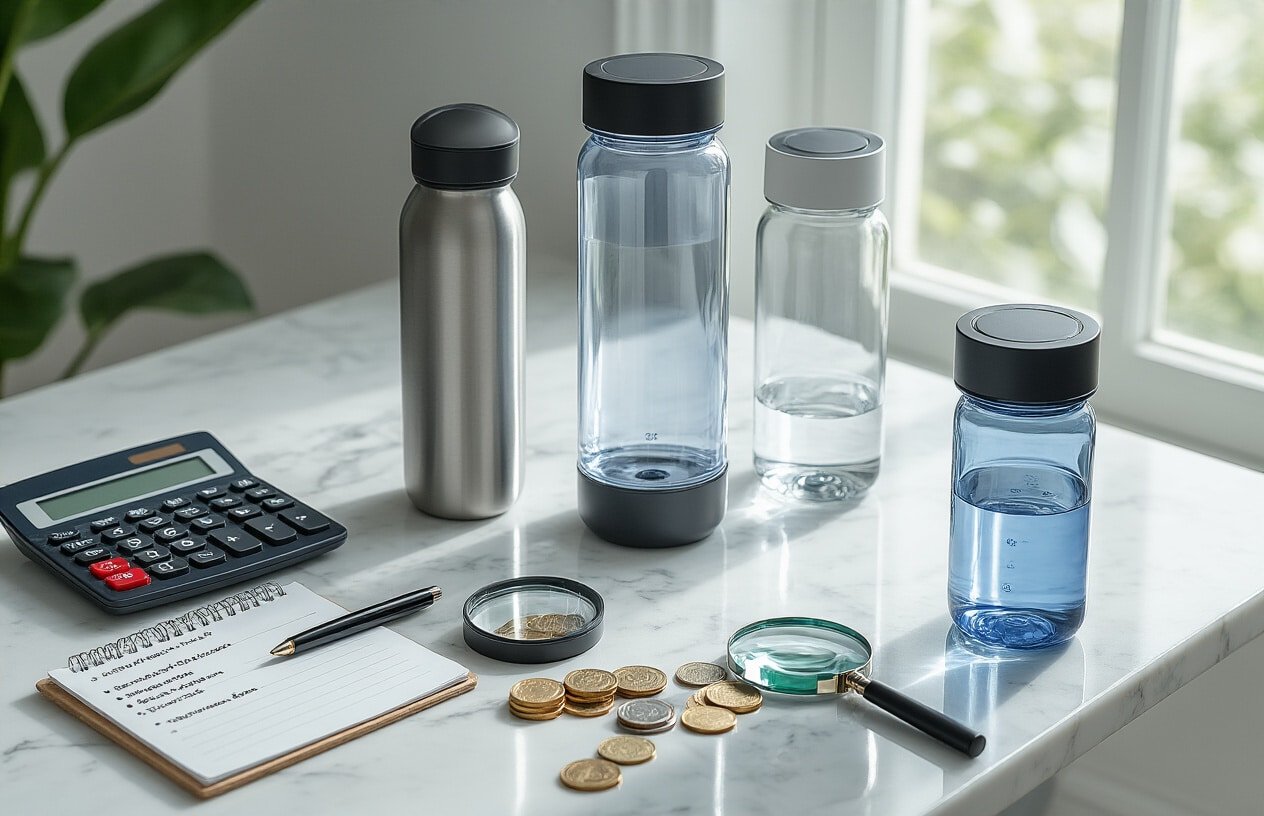
Price Range Guidelines for Quality Products
Price does correlate with performance here, but loosely, and the correlation is strongest at the bottom of the range. Most reliable bottles sit between $70 and $200. Above that you are mostly paying for design and brand rather than for hydrogen.
What the extra money actually buys is an SPE/PEM stack instead of bare electrolysis, a battery that still holds a charge in year two, and a warranty somebody will honour.
What to Check Before Buying Under $70
Cheap bottles are not automatically bad. Unverified ones are. Below roughly $70 the failure mode is nearly always the same: the listing quotes no concentration figure at all, or quotes one nobody has ever reproduced. So the rule to apply is not a price floor but an evidence floor. A bottle under $70 that publishes a real ppb number, and that owners confirm with H2 Blue, is worth considering. Three of them clear that bar in our roundup of the best hydrogen water bottle under $50.
What tends to go wrong at the bottom of the market is predictable enough to list: output that starts low and falls further within months, plastic that is not quite what the listing claims, and bare electrolysis with no membrane, which is the one that puts chlorine and ozone in the water along with the hydrogen.
Cost vs Benefit Analysis
Work out the cost per day rather than staring at the sticker price. A $150 bottle that lasts three years costs about fourteen cents a day.
Better materials last longer and do not taint the water. Consistent output means you get the dose you paid for on every cycle, not just the first one.
The warranty usually improves with price as well, which compounds the difference over a few years.
Set against store-bought hydrogen water at around $3 a can, almost any bottle that works pays for itself within a few months. That is the honest argument for spending more, rather than the price tag on its own.
Top Brand Recommendations and Features
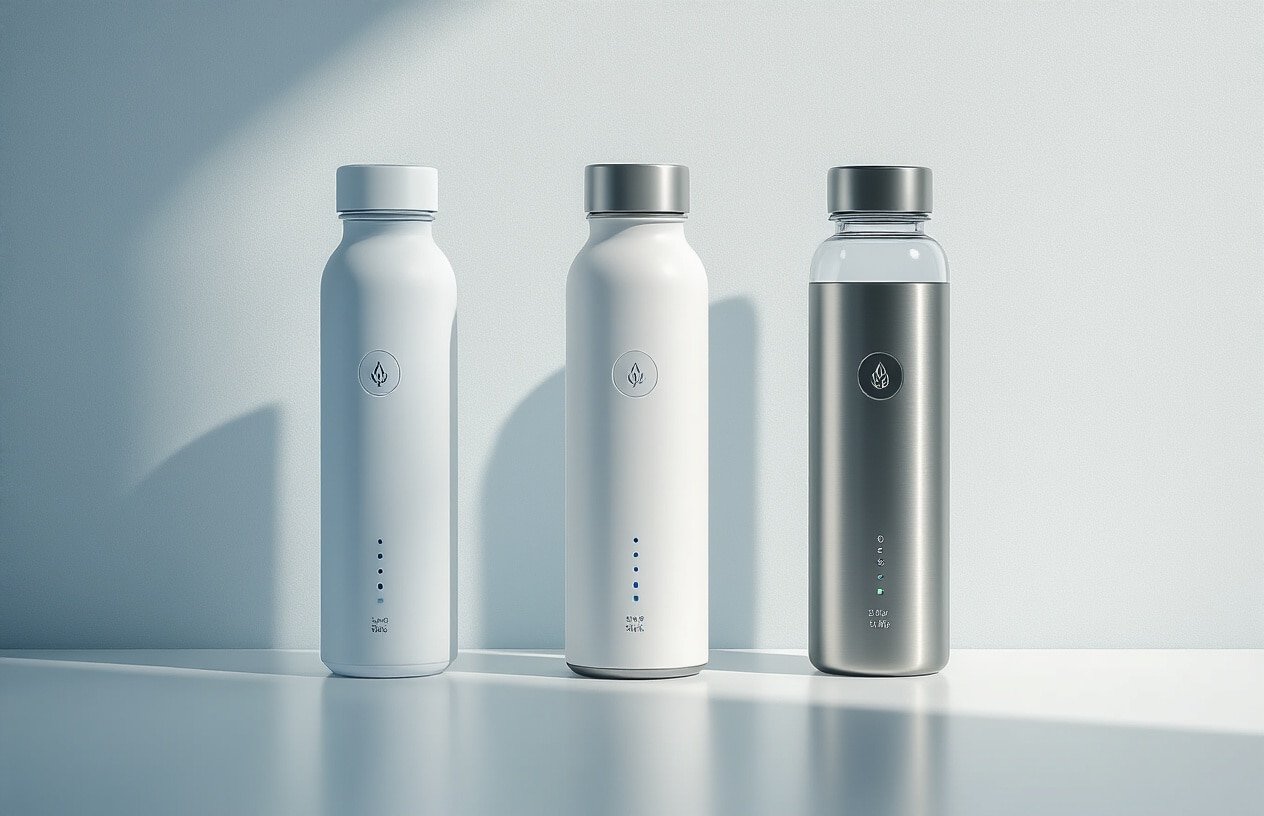
Leading Manufacturers and Their Strengths
A handful of manufacturers come up again and again once you start reading owner reviews. Piurify is American, has the best support record in the category, and its Hydrogenator is the model most often recommended by people who actually own one.
StoneStream, Echo, AquaHealth, IonBottles and Olansi make up most of the rest of the field. Echo is the one readers ask about most often, so we took it apart separately in our Echo Go Plus Review.
US-Based Testing and Certification Benefits
The certification worth looking for is independent lab testing by H2 Analytics USA, which operates as an official testing laboratory for the International Hydrogen Standards Association (IHSA). A small number of models carry it. Most do not, and the ones that do tend to say so on the box.
The whole point of independent testing is that the lab has no stake in the answer. One concentration figure signed off by someone who does not sell the bottle is worth several signed off by someone who does.
Customer Review Analysis and Real-World Performance
Lab certification tells you what a bottle can do. Owner reviews tell you what it actually does after six months in a rucksack. Plenty of buyers run their own H2 Blue tests and post the drop counts, which adds up to a rough public dataset nobody planned.
Those numbers fall short of the marketing often enough that reading them first, rather than after the parcel arrives, is the single most useful habit in this category.
FAQ
What is the difference between hydrogen water and regular water?
Hydrogen water contains dissolved molecular hydrogen (H2) gas, while regular water is simply H2O. The key difference lies in the additional hydrogen molecules that act as antioxidants in your body. When you drink hydrogen water from a hydrogen water bottle, you’re consuming water enriched with therapeutic levels of molecular hydrogen, typically measured in parts per million (ppm). Regular tap or bottled water contains virtually no dissolved hydrogen gas.
How much hydrogen concentration should I look for in a hydrogen water bottle?
The hydrogen concentration ppm is crucial for effectiveness. Look for bottles that produce between 0.5 to 1.5 ppm of dissolved hydrogen. Most best hydrogen water bottle models achieve concentrations around 1.0-1.2 ppm, which research suggests is the therapeutic range. Anything below 0.5 ppm may not provide significant benefits, while concentrations above 1.6 ppm don’t necessarily offer additional advantages and may indicate oversaturation.
How long does hydrogen water stay potent after generation?
Molecular hydrogen is a small molecule that escapes quickly from water. After generating hydrogen water in your portable hydrogen water bottle, the concentration begins decreasing immediately. Drink your hydrogen water within 30 minutes for maximum potency. If stored in a sealed container, hydrogen water maintains about 50% of its concentration after 6 hours and becomes essentially regular water after 24 hours.
Are glass or plastic hydrogen water bottles better?
Glass does not affect taste and does not age, but it is heavier and it breaks. BPA-free plastic is lighter and far more practical for daily carrying. Either way the material matters less than the electrolysis system inside, which is where the real difference in output comes from.
How often should I clean my hydrogen water bottle?
Clean your hydrogen rich water bottle after every 5-10 uses or weekly, whichever comes first. Use warm water and mild soap for the bottle body, and follow manufacturer instructions for cleaning the electrolysis plates. Some models have self-cleaning modes that run citric acid solutions through the system. Regular cleaning prevents mineral buildup and maintains optimal hydrogen production levels.
Can I use tap water in my hydrogen water bottle?
Most molecular hydrogen water bottle models work with tap water, but filtered water produces better results. Hard water with high mineral content can reduce efficiency and require more frequent cleaning. Distilled water isn’t recommended as it lacks the minerals needed for proper electrolysis. If your tap water is heavily chlorinated or has a strong taste, use filtered water for the best hydrogen production and taste.
What’s the typical lifespan of a hydrogen water bottle?
Quality hydrogen water bottles typically last 2-3 years with regular use. The electrolysis plates are usually the first components to degrade, but many manufacturers design them to handle 1000+ cycles. Battery life varies by model, with most providing 10-15 uses per charge. When researching hydrogen water bottle reviews, pay attention to long-term user experiences and warranty coverage.
Do hydrogen water bottles really work or is it just marketing hype?
The honest answer is that the research is genuinely large and genuinely early. There is real evidence that dissolved H2 behaves as a selective antioxidant, and there are hundreds of published studies, but most human trials so far are small, short, and not always placebo-controlled. You can read the primary sources through the clinical trials indexed on PubMed and judge for yourself. What that means for a purchase is narrow but useful: a bottle cannot promise you an outcome, only a dose. Buy the one that delivers a verified dose, and treat anything stronger as marketing.
Conclusion
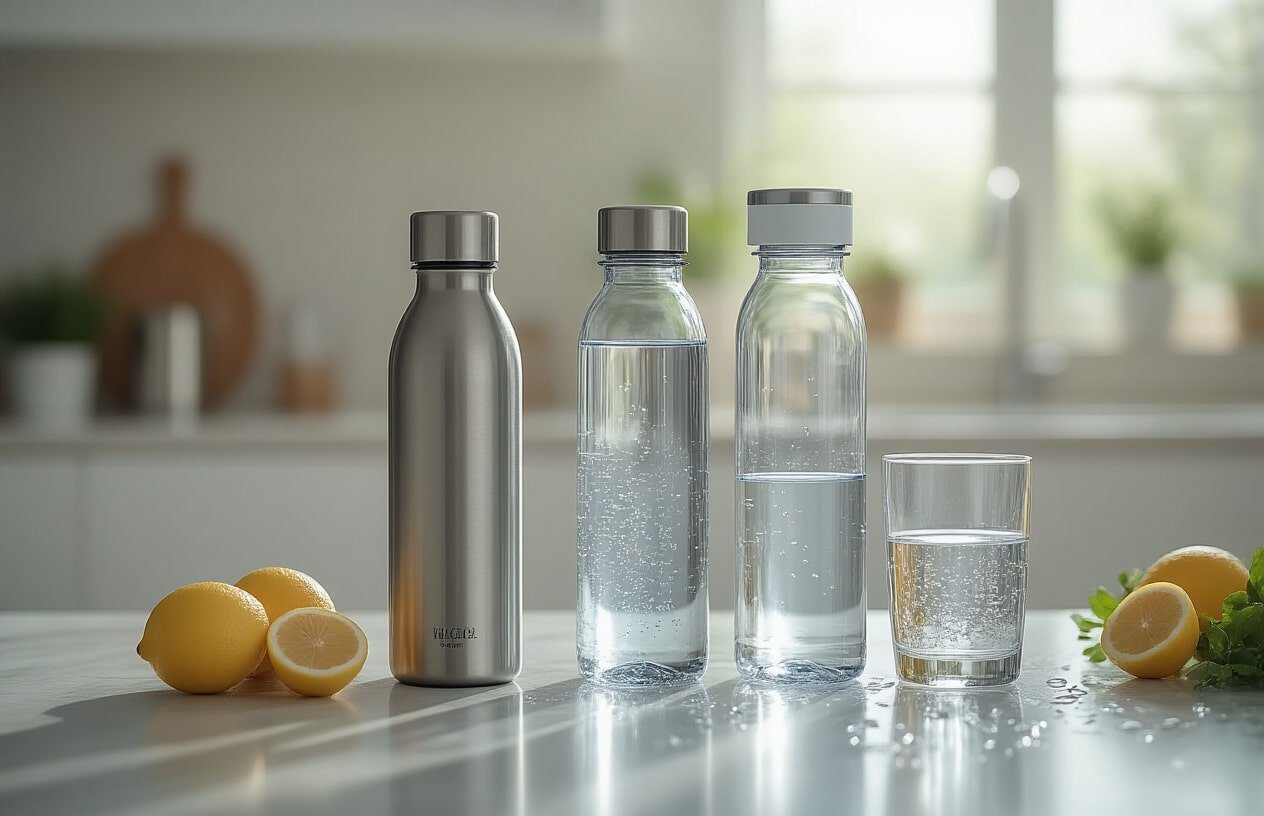
So, in order: find the concentration figure and check who measured it, aim for at least 600 ppb, prefer an SPE or PEM stack over bare electrolysis, keep it under 3 inches across so it fits a cup holder, and read the warranty before you read the reviews.
Price on its own is a weak signal. What matters is whether anybody independent has verified the output, and whether the manufacturer will still be answering email when something fails. If you would rather have a starting point than a checklist, the tool near the top of this page narrows the field to a single profile in about a minute.
The short version, by situation:
- You want the most hydrogen per cycle. Look for a published ppb figure with independent lab testing behind it, and expect to pay $150 or more.
- You will carry it every day. Diameter under 3 inches, Tritan rather than glass. Concentration comes second.
- You are trying hydrogen water out and do not want to spend much. Make a published ppb number a hard requirement, then check owner reviews for an H2 Blue drop count before you buy.
- Taste matters most to you. Borosilicate glass, and accept that you will break it eventually.
Whichever of those you are, the one specification that should never be missing is a concentration figure measured by somebody other than the seller.