

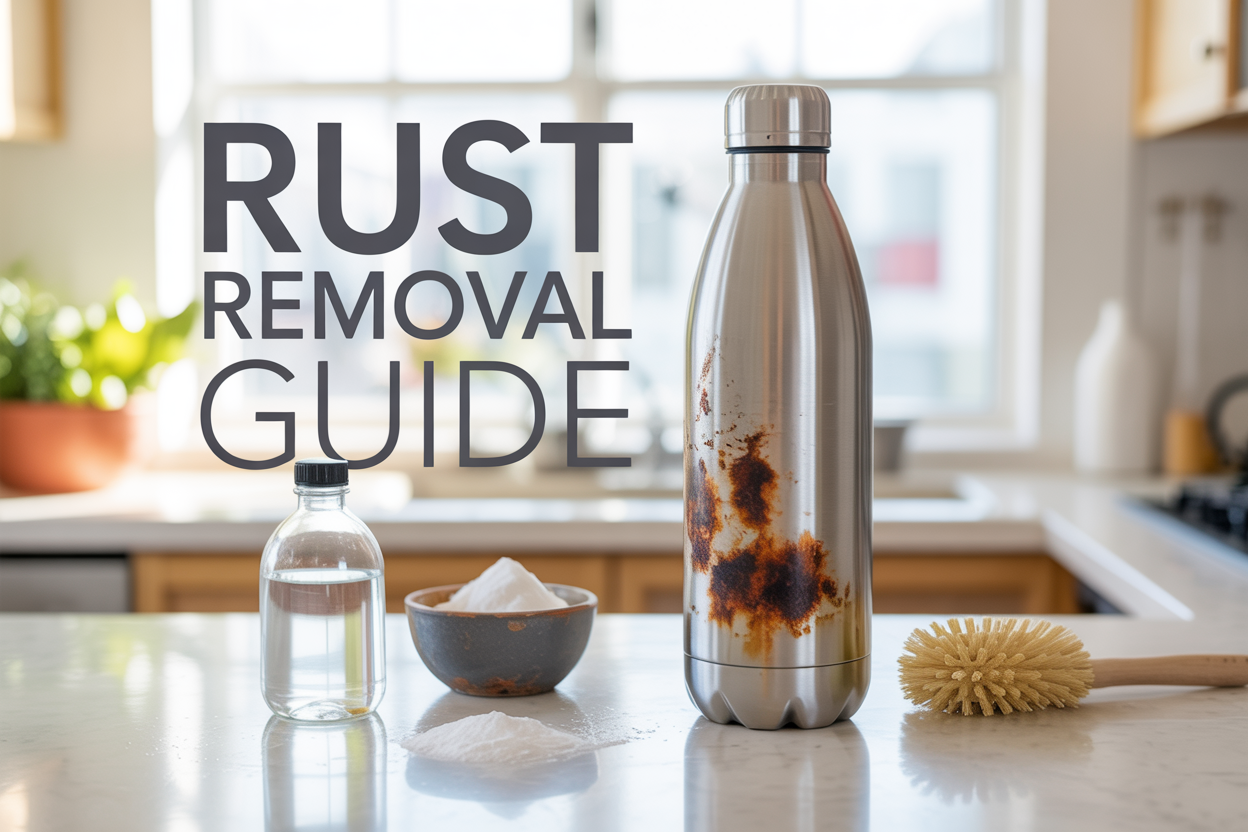
Most of the orange-brown marking people find inside a steel bottle is not rust at all. So before you work out how to remove rust from insulated water bottle interiors, spend thirty seconds deciding which of four different problems you actually have, because three of them wipe off and one of them means the bottle is on its way out. If you decide the bottle is past saving, our best insulated stainless steel water bottle is the place to start.
This guide covers how to tell real corrosion from staining and scale, which cleaners lift iron and which only look like they do, the two things people reach for that make rust worse, and the point at which cleaning stops being worth it.
- First, work out what you are actually looking at
- Why a stainless steel bottle rusts in the first place
- How to remove rust from an insulated water bottle
- What not to use, and why it makes rust worse
- Where rust actually starts on a bottle
- When to stop cleaning and replace the bottle
- How to keep it from coming back
- FAQs
- Why is there rust in the bottom of my water bottle?
- Do stainless steel water bottles rust?
- Can I use bleach to remove rust from a water bottle?
- Is it safe to drink from a rusty water bottle?
- What is the difference between rust stains and actual rust?
- Does vinegar remove rust from a water bottle?
- How often should I deep clean my insulated water bottle?
- Can rust spread to other parts of the bottle?
- Will rust affect my bottle insulation?
- What household items work best for rust removal?
First, work out what you are actually looking at
Four different things show up on the inside of a steel bottle and they look more alike than they are. Only one of them is the steel corroding.
| What you see | What it is | How it feels | Serious? |
|---|---|---|---|
| Orange-brown specks or patches, often near the base or a seam | Rust, iron oxide. The steel itself is corroding | Rough or gritty, sometimes pitted | Yes |
| An even brown film after coffee or tea | Tannin staining | Smooth | No, cosmetic |
| Chalky white or grey crust | Mineral scale from hard water | Slightly rough but pale, never orange | No, cosmetic |
| An oily rainbow sheen | Rainbowing, a chromium oxide layer thickened by heat | Smooth | No, harmless |
The quickest test needs nothing but a clean finger. Run it around the inside of the dry bottle. Smooth means a deposit sitting on the surface, and it will come off. Rough, gritty or pitted means the surface itself has been eaten into, and that is the one worth taking seriously.
Why a stainless steel bottle rusts in the first place
Stainless steel is not rust-proof. It is self-repairing. The chromium in the alloy reacts with oxygen to form a passive chromium oxide film only a few nanometers thick, and that passive layer is the only thing standing between water and the iron underneath. Scratch it and it rebuilds itself, as long as oxygen can reach it.
Rust appears when something keeps stripping that film faster than it can re-form. Four things do it. Chlorides: salt, sports drinks, chlorinated tap water and bleach. Physical damage: deep scratches, and dents, which is why it is worth dented metal water bottle repair before the finish breaks. Water trapped with no air: a damp bottle sealed shut starves the film of the oxygen it needs to heal. And iron arriving from outside, which is the one almost nobody expects.
Grade matters too. Most food-grade bottles are 18/8 steel, stamped 304, meaning 18 percent chromium and 8 percent nickel. Klean Kanteen states plainly that its bottles are 18/8 (#304) stainless steel. The step up, 316, adds molybdenum and resists chlorides better. Cheaper alloys below 304 give up sooner, which is covered in our guide to water bottle insulation and how the construction differs between bottles.
How to remove rust from an insulated water bottle
The methods below are ordered by what actually lifts iron oxide, not by how often they get recommended. The chemistry is the reason: citric and oxalic acids bind to iron and carry it away, while acetic acid, the acid in vinegar, is weak and binds iron poorly. That single fact explains why the most popular suggestion is also the weakest one for this job.
Start with a baking soda paste
Mix three parts baking soda to one part water into a thick paste. Spread it on the marks, leave it 30 minutes, then work it with a nylon brush or a bottle brush and rinse until the water runs clear. Baking soda is a mild abrasive, soft enough that it will not scratch steel, and it is what Klean Kanteen recommends as its own everyday cleaner. On light marking this is often the whole job.
Lemon juice and salt for marks that stay
Make a paste of lemon juice and table salt and spread it over the rust. The citric acid does the chemical work and the salt gives it some grip. Leave it 30 minutes, scrub gently, then rinse the bottle out completely and dry it. That last step is not optional: salt is a chloride, and chloride left sitting on steel is one of the things that started the problem.
Oxalic acid cleansers, with one condition
The powdered cleansers sold for stainless sinks and cookware usually work on oxalic acid, which binds iron the way citric acid does and does it harder. They will shift rust that the kitchen methods leave behind. The condition is food contact: these are not all rated for surfaces you drink from. Read the label, and if it says nothing about food contact, do not use it on a bottle. Keep the contact time short and rinse far longer than feels necessary.
Where vinegar actually helps
Vinegar earns its reputation on staining and discoloration rather than on rust. For a brown coffee film or hard water scale, half a cup of white vinegar left in the bottle for an hour, then rinsed, usually clears it. Klean Kanteen suggests diluted vinegar overnight for smells and flavors that linger.
Do not mix vinegar and baking soda in the bottle. They cancel each other out. The acid and the base react into sodium acetate, water and carbon dioxide, and the fizzing everyone takes as a sign of cleaning power is the two ingredients destroying each other. What you are left with is salty water, weaker than either one alone. Use one, rinse, then use the other if you need to.
What not to use, and why it makes rust worse
Three popular shortcuts attack the chromium oxide film directly, and all three leave the bottle more likely to rust than before.
Steel wool and wire brushes. Ordinary steel wool is carbon steel. Dragging it across stainless leaves microscopic carbon steel particles embedded in the surface, and those particles rust. The orange specks that appear a week later are theirs, not the bottle’s. If a metal tool is unavoidable, it has to be stainless steel itself.
Sandpaper. It removes the rust and the protective film together, and leaves a field of scratches for the next rust spot to start in. There is no grit fine enough to make this a good idea inside something you drink from.
Bleach and chlorine cleaners. Hydro Flask tells owners plainly to avoid dishwashing cleansers with bleach or chlorine, and the reason is the chloride attack described above. There is also a direct safety problem: bleach reacts with acids to release chlorine gas. The CDC states that household chlorine bleach can release chlorine gas if it is mixed with certain other cleaning products, and its advice is blunt, do not mix household cleaners. Exposure burns the eyes, nose and throat and makes breathing difficult. On a page that recommends vinegar and lemon juice this matters: if you have used bleach, rinse the bottle out completely with plain water before anything acidic goes near it.
Where rust actually starts on a bottle
Rust is not evenly distributed, and knowing where to look saves scrubbing the wrong places. The base is the usual offender, because that is where the last of the water sits when a bottle is stood upright to dry. The welded seam near the bottom comes next, since welding thins the protective film. Then the threads at the mouth, which stay wet longest, and the groove under the gasket, which almost never gets dried at all.
The base can simply be soaked. The threads and the gasket groove cannot, because a soak does not reach them. Use a cotton swab dipped in the lemon paste for those, which puts the acid exactly where the rust is and nowhere else.
When to stop cleaning and replace the bottle
Cleaning works while the chromium oxide film can still re-form. Past a certain point it cannot, and more scrubbing only removes more steel. Replace the bottle if any of these is true: the rust comes back within about a week of a careful clean; the surface is pitted rather than stained and you can feel the roughness; there is a hole, a weep or a seam that has opened; a metallic taste survives cleaning; or it has stopped holding temperature, which means the vacuum between the walls has failed and is not repairable. For what ordinary wear looks like before that point, see how long a water bottle lifespan usually runs.
On the health question, the honest answer is narrower than most pages give. The EPA treats iron in drinking water as a secondary standard, set at 0.3 mg/L, and it describes secondary standards as non-mandatory water quality standards that it does not enforce. The effects it lists for iron are rusty color, sediment, metallic taste and orange staining rather than toxicity. So the usual problem with a rusting bottle is taste and a container that is falling apart. The part worth acting on is the pitting, because a pitted surface holds residue a brush cannot reach. If you are unsure, replace it.
How to keep it from coming back
Dry it before it goes away
A bottle put away damp is the single most common reason rust starts, because sealed wet steel has no oxygen reaching it and the film cannot rebuild. Shake the water out, then leave the bottle, the lid and the gasket apart until all three are dry to the touch. That takes a few hours, not twenty minutes. Upside down on a drying rack is faster than standing it up, which just pools water in the base.
Rinse after anything that is not water
Coffee, tea, sports drinks and juice leave sugars and acids against the steel, and sports drinks bring chlorides with them. Rinse within a few hours rather than at the end of the day. If a smell has already settled in, how to remove coffee smell from thermos covers the stronger treatments.
Hand washing, and when the dishwasher is fine
Warm water, dish soap and a soft bottle brush handle routine care, and most bottles never need more. Work from the bottom up and give the threads attention, since that is where residue collects. Our full guide to insulated water bottle cleaning goes through the routine step by step, and how often should water bottles be washed sets out a sensible schedule.
The dishwasher is fine for many bottles if the maker says so. Hydro Flask states that its bottles and tumblers are dishwasher safe as long as they do not have the trademark symbol next to the logo, with straws, caps and lids separated and placed on the top rack. Klean Kanteen says the same of its kanteens, cups, tumblers and caps, with the bamboo cap excepted. Two rules hold either way: top rack, and no detergent containing bleach or chlorine. Wash gaskets and silicone parts by hand.
Put the gasket back the right way
Get this wrong and the bottle leaks. Most gaskets have a smooth side that faces the liquid and a ribbed side that seats against the thread. Check the gasket for cracks and permanent flattening while it is out, and replace it rather than the bottle if it has gone hard.
FAQs
Why is there rust in the bottom of my water bottle?
The base is where water collects when a bottle is left standing upright to dry, so it stays wet longest and is usually the first place to corrode. The welded seam just above it is the second, because welding thins the chromium oxide film that protects the steel. Drying the bottle upside down fixes most of it.
Do stainless steel water bottles rust?
Yes, under the right conditions. Stainless steel resists rust because chromium forms a thin protective oxide film, not because it cannot corrode. Chlorides, deep scratches, trapped moisture and carbon steel particles from the wrong cleaning tool all break that film down, and once it cannot re-form the iron underneath is exposed.
Can I use bleach to remove rust from a water bottle?
No. Bleach attacks the protective layer and leaves the bottle more prone to rust afterwards, which is why Hydro Flask tells owners to avoid cleansers containing bleach or chlorine. There is also a serious safety reason: the CDC warns that household chlorine bleach can release chlorine gas if it is mixed with certain other cleaning products, and advises plainly not to mix household cleaners. Since rust removal usually involves an acid such as vinegar or lemon juice, bleach has no place anywhere near it.
Is it safe to drink from a rusty water bottle?
The EPA handles iron in drinking water as a secondary standard at 0.3 mg/L, describing secondary standards as non-mandatory and not enforced by the agency, and the effects it lists are rusty color, sediment, metallic taste and staining rather than toxicity. So the usual consequence is that the water tastes of metal. The thing worth acting on is pitting, because a pitted surface traps residue a brush cannot reach. If you are unsure, replace the bottle.
What is the difference between rust stains and actual rust?
Rust is the steel itself corroding, and it feels rough or pitted under a finger. A stain is a deposit sitting on top of a surface that is still smooth, whether that is brown tannin from coffee, pale mineral scale from hard water, or an iridescent sheen from heat. Stains come off with a baking soda paste. Corrosion does not, and no amount of scrubbing restores steel that has been eaten into.
Does vinegar remove rust from a water bottle?
Not very well. Vinegar is acetic acid, which is weak and binds iron poorly, so it is the wrong tool for corrosion even though it is the most recommended one. It is genuinely good at coffee staining, discoloration and mineral scale. For rust, citric acid from lemon juice or an oxalic acid cleanser does the job properly.
How often should I deep clean my insulated water bottle?
Rinse after every use and wash with soap and a brush daily if you drink anything other than water. Klean Kanteen advises cleaning the cap at least weekly, and daily when the bottle holds something other than water. A longer soak is worth doing whenever staining or a smell appears rather than on a fixed calendar.
Can rust spread to other parts of the bottle?
Corrosion keeps going at the spot where it started and works deeper rather than spreading across the surface like a stain. What does spread is the cause: carbon steel particles from a wire brush, or salt left in the bottle, will start new spots wherever they settle. Dealing with a rust spot early keeps it to one pit instead of several.
Will rust affect my bottle insulation?
Surface rust does not. The vacuum that does the insulating sits between two walls, and marking on the inner surface does not reach it. Deep corrosion is different: if it perforates the inner wall the vacuum is lost. Watch how long the bottle holds temperature. If it stops keeping drinks hot or cold for as long as it used to, the seal has failed and that cannot be repaired.
What household items work best for rust removal?
Baking soda as a gentle abrasive paste, and lemon juice for the acid, ideally together with a little salt for grip. Cream of tartar, which is a mild acid, works on light marks. Keep white vinegar for staining and scale rather than rust, and keep bleach, steel wool and sandpaper away from the bottle entirely.
