

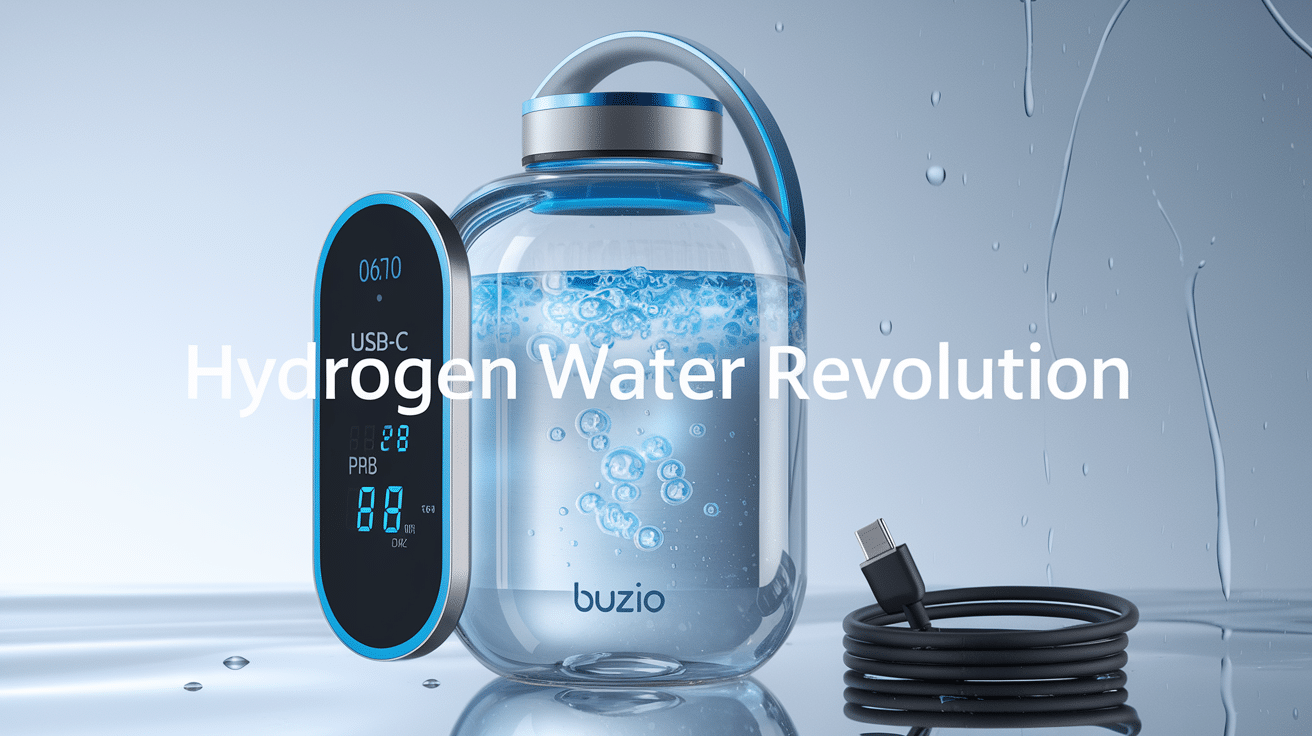
This Buzio Hydrogen Water Bottle review starts from an awkward fact: it is one of the cheaper ways into a category where the marketing runs a long way ahead of the evidence. It uses Gen5 SPE/PEM electrolysis with a DuPont membrane, reports a hydrogen reading on a small OLED screen, and usually sells somewhere around the $80–$110 mark, though prices in this category move constantly. If you are weighing it against the other best portable hydrogen water bottles, the questions below are the ones that decide it.
The useful question is not whether it makes hydrogen water. It does. The question is whether the number on the screen means what the marketing implies, and whether a 10 oz bottle you have to keep upright and recharge fits the way you actually drink water. This review is built from BUZIO’s published specifications, the peer-reviewed research on molecular hydrogen, and what the independent hydrogen-testing bodies do and do not verify. Where a claim cannot be checked, it is flagged rather than repeated.
Disclosure: this review contains affiliate links. If you buy through one of them we may earn a commission, at no extra cost to you.
Bottom line on this Buzio Hydrogen Water Bottle review: it is a capable, affordable SPE/PEM bottle whose headline hydrogen figure is BUZIO’s own number rather than an independent lab’s. It suits someone who wants portable hydrogen water and a display that shows what is happening. It will not suit someone who wants a lab-certified concentration, or more than a large glass of water at a time.
- BUZIO Hydrogen Water Bottle Features and Specifications
- Design and Usability Benefits
- Potential Health and Performance Benefits
- Real-World Experience and Limitations
- Buzio Hydrogen Water Bottle Review: The Verdict
- FAQ
- How do I clean and maintain my BUZIO Hydrogen Water Bottle?
- What is the warranty policy for BUZIO products?
- Is the BUZIO hydrogen bottle insulated?
- Can I put anything other than water in it?
- What is the hydrogen concentration capability of the BUZIO Hydrogen Water Bottle?
- How do I monitor the hydrogen concentration?
- How is the BUZIO Hydrogen Water Bottle powered?
- How soon should I drink the water after a cycle?
- Does hydrogen water taste different?

BUZIO Hydrogen Water Bottle
The BUZIO Hydrogen Water Bottle uses SPE/PEM electrolysis with a DuPont proton exchange membrane. BUZIO states up to 4,000 PPB in about 10 minutes, or 1,600 PPB in 5, and the bottle vents ozone and chlorine byproducts at its base. It has an OLED display for hydrogen level, battery, and timer, and it charges over USB-C. BUZIO says H2 Analytics certified it, but no report has been published, so read the figure as the maker’s.
- Maker Output: 4,000 PPB at 10 min, 1,600 PPB at 5 min
- Certificate: H2 Analytics certification claimed; report not published
- Membrane: DuPont PEM with a drain vent at the base
- Display: OLED shows PPB estimate, timer, and battery
- Battery: 1,800 mAh, USB-C, about 8 ten-minute cycles
- BUZIO-stated 4,000 PPB in 10 minutes
- Quick 5–10 minute generation time
- Easy-to-read OLED display with real-time monitoring
- DuPont SPE/PEM membrane with byproduct venting
- Long-lasting battery with convenient USB-C charging
- Lightweight and portable design
- Must be kept upright during operation
- 10-ounce capacity may be small for some users
- Requires regular charging for continued use
BUZIO Hydrogen Water Bottle Features and Specifications
The BUZIO is built around one idea: a proton exchange membrane that keeps hydrogen in the water you drink and pushes the unwanted byproducts out of the bottle. Most of what follows is a consequence of that. For the wider context on how these devices work across the category, our hydrogen water bottle buying guide is the place to start.
Gen5 PureSplit Technology
The bottle uses BUZIO’s Gen5 PureSplit system, which is a DuPont proton exchange membrane doing the separation. Current splits water at the electrodes, and the membrane lets protons across to form dissolved molecular hydrogen on the drinking side, while oxygen, ozone and chlorine compounds stay on the other side and get vented. That separation is the entire point of SPE/PEM, and it is what cheaper membrane-less designs skip: they run current straight through the water you are about to drink and leave those byproducts in it.
One thing worth clearing up, because the marketing in this category muddles it constantly: hydrogen water is not alkaline water. An SPE/PEM bottle like this one dissolves molecular hydrogen into the water and leaves the pH close to neutral, roughly 6.8 to 7.5. Alkaline ionizers do the opposite, raising pH without adding much dissolved hydrogen. The research interest is in the dissolved hydrogen, so that is the figure worth reading. Because only protons cross the membrane, the bottle also works with ordinary drinking water, whether tap water, filtered or bottled, and does not need the mineral content older ionizers relied on.
BUZIO does not publish an electrode specification for this model. That is a real gap rather than a nitpick: electrode quality determines whether output holds up over months, and it is one of the few things you cannot infer from marketing copy.
Hydrogen Concentration: What BUZIO Actually Claims
BUZIO publishes two cycle figures for this bottle: up to 1,600 PPB after five minutes, and up to 3,000 PPB after ten. Higher numbers, 3,800 and 4,000 PPB, circulate in retail listings for the same model. That is common in this category and worth treating with caution, so the manufacturer’s own published figures are used throughout this review.
If you are cross-shopping, note that PPB and PPM measure the same thing at different scales, so convert before you compare: 1,000 PPB is 1 PPM. Most human research on molecular hydrogen has used water in the 1,000 to 3,000 PPB range, which means BUZIO’s stated ten-minute cycle already sits inside the range those studies used. That is a more useful way to read the number than assuming a bigger figure is automatically better, and it is worth keeping in mind when comparing top hydrogen water bottles under 100.
Is the Hydrogen Output Independently Verified?
Short answer: not publicly, as far as we can establish. Hydrogen bottles are increasingly tested against IHSA standards by laboratories such as H2 Analytics, which uses gas chromatography, and H2HUBB, with some brands also publishing SGS results for PFAS and heavy metals. Brands holding those certificates tend to publish them prominently, because in this category they are a genuine differentiator. We could not find a published third-party certificate for this BUZIO model.
That is not evidence the bottle underperforms, and it should not be read as one. It means the PPB figure is a manufacturer claim rather than a verified measurement. The distinction matters because the gap between claimed and measured output in this category can be wide: independent testing has found bottles advertised at 8,100 PPB measuring closer to 2,750. If a lab-verified number is what you are buying, this is the point to look at a certified model instead.
The Drain Vent: What It Removes and Why It Matters
The drain vent is the safety feature. Electrolysis does not only produce hydrogen; it also generates ozone and chlorine compounds at the anode. A vent at the base expels those byproducts instead of leaving them in what you drink, and it does so without any input from you. This is the practical reason the membrane matters: a bottle without one produces the same byproducts and has nowhere to put them.
OLED Display Functionality and User Interface
The BUZIO has an OLED display. Some cheap hydrogen water bottles have a display too, but BUZIO’s shows more. Its screen reports:
- Current hydrogen concentration levels
- Countdown timer during the hydrogen generation process
- Battery level indicator
- Operational status
There is one button and a screen. That is the whole interface, which is the right call for a device you use half-awake in the morning.
Design and Usability Benefits
The technology only matters if the bottle is pleasant to carry and use. Here is how it holds up as an object.
Lightweight, BPA-free Construction
The body is BPA-free food-grade plastic rather than glass or steel, which keeps the weight down and makes it more forgiving if you drop it. Capacity is about 10 oz, roughly 300 ml. That is the single most important practical fact about this bottle and the easiest one to miss: this is a hydrogen generator you drink from in one or two goes, not a day’s water supply. Most people end up carrying it alongside a normal bottle rather than instead of one.
Portability and Battery Life
The battery is 1800 mAh. BUZIO states it runs up to 15 five-minute cycles or 8 ten-minute cycles per charge, which for most people means about a week of daily use before it needs the cable again. Whether that is enough depends on how often you run the longer cycle.
USB-C Charging Capabilities
Charging is over USB-C, so it takes the same cable as most phones and laptops. That sounds minor until you are packing for a trip and do not have to hunt for a proprietary charger. BUZIO does not publish a charge time for this model.
Non-slip, Durable Design
The exterior is textured so it does not slide off a gym bench or a wet counter. There is not much more to say about it, which is rather the point: it is a sensible finish on a device you handle with wet hands.
| Specification | BUZIO published figure |
|---|---|
| Hydrogen concentration | Up to 1,600 PPB (5 min) / 3,000 PPB (10 min) |
| Capacity | About 10 oz (approx. 300 ml) |
| Electrolysis | Gen5 SPE/PEM with DuPont proton exchange membrane |
| Byproduct handling | Base vent for ozone and chlorine compounds |
| Battery | 1800 mAh; up to 15 x 5-min or 8 x 10-min cycles |
| Charging | USB-C |
| Display | OLED: concentration, timer, battery |
| Body material | BPA-free food-grade plastic |
| Electrode material | Not published |
| Charge time | Not published |
| Independent lab certificate | None found |
Potential Health and Performance Benefits
The reason anyone buys one of these is the claimed health effect, so it is worth looking at what the research actually shows and how far it goes. The honest summary: molecular hydrogen is a real area of study with peer-reviewed trials behind it, but most of those trials are small, several are open-label, and almost none of them tested a consumer bottle. Nothing below is a treatment claim for this product or any other. If you have a medical condition, that is a conversation for your doctor rather than a water bottle review.
Enhanced Hydration and Recovery
This is the best supported claim in the category, and it is still a modest one. A study of resistance-trained participants found that eight days of hydrogen-rich water intake was associated with improved muscular endurance and faster fatigue recovery during training (study). Protocols usually have people drink it 10 to 30 minutes before exercise. Two caveats are worth carrying: the concentrations used in research are often higher than a consumer bottle delivers, and effects were measured across days of consistent intake rather than after a single session.
Reduced Oxidative Stress and Inflammation
Two studies get cited constantly here, and both need their caveats stated alongside them. In a randomised, double-blind trial, healthy adults drinking 1.5 litres of hydrogen-rich water daily for four weeks showed no overall difference in biological antioxidant potential against the control group. The increase appeared only in the subgroup aged 30 and over (Scientific Reports, 2020). That is a subgroup finding, and it is routinely reported as though it were the headline result. Separately, an open-label pilot study of 20 people with rheumatoid arthritis reported that 47.4 per cent achieved remission by the end of the protocol (Medical Gas Research, 2012). It had no control group, a very small sample, and the authors themselves called for a placebo-controlled follow-up. It also used water at 4 to 5 ppm, which is well above what this bottle produces.
Improved Athletic Performance
The endurance findings above are the strongest part of this picture, and they are where the evidence stops being thin. Claims that hydrogen water lowers cholesterol or glucose come from small metabolic studies in specific patient groups and should not be read across to healthy adults drinking 10 oz a day. Treat improved athletic performance as plausible and lightly supported rather than established.
Skin Health Improvements
There is one controlled study worth knowing about, with a detail that usually gets dropped: it tested hydrogen-water bathing, not drinking. Over eight weeks, 24.4 per cent of 41 patients bathing in hydrogen-rich water achieved at least a 75 per cent improvement in psoriasis severity, against 2.9 per cent of 34 controls (Scientific Reports, 2018). That is a genuine result. It also says nothing about what drinking 10 oz of hydrogen water does for your skin, and this bottle is not a bath.
Real-World Experience and Limitations
Specifications only take you so far. These are the things that decide whether you keep using it after the first month.
What It Is Like to Live With
You can see it working, which matters more than it should. Bubbles form, the screen counts down, and ten minutes later you have a drink. That visible feedback loop is a large part of why people stick with these bottles, and it is worth being honest that some of the appeal is the ritual rather than the chemistry. The flip side is that it is a device with a charging habit attached, and a bottle you have to plan around is a bottle some people quietly stop using by week three.
How Quickly the Hydrogen Escapes
This is the fact the marketing never leads with. Hydrogen is the smallest molecule there is, and it does not stay dissolved for long. As soon as a cycle ends the concentration starts falling, faster if the bottle is open or shaken. A PPB figure describes the water at the moment the cycle finishes, not what reaches you forty minutes later at your desk. In practice that means generating it and drinking it promptly, which is the single habit that most affects whether you get what you paid for. It also means BUZIO’s stated 3,000 PPB after ten minutes is not the same thing as drinking 3,000 PPB.
Everyday Handling and Upkeep
There is very little to learn. Fill it, press the button, wait. The bottle has to stay upright while it runs, which sounds trivial until you want to put it in a bag mid-cycle. Cleaning matters more than people expect: the membrane and electrode assembly are the parts that degrade, and residue shortens their life, so plain water only and regular rinsing is the sensible discipline.
Is It Worth the Price?
At its usual street price the BUZIO sits at the affordable end of a category that runs well into the hundreds. Prices move constantly here, so check the live listing rather than trusting a figure written into any article, this one included. What you are paying for is the membrane and the venting, which is what separates a real SPE/PEM bottle from a cheap electrolysis cup. What you are not paying for is a verified concentration, because no published third-party certificate exists for this model. Whether that trade is worth it depends entirely on which of those two things you thought you were buying.
Who Should Buy It, and Who Should Not
It is a reasonable buy if you want a portable SPE/PEM bottle with a display that tells you what is happening, you are content treating the PPB number as a manufacturer claim, and a small capacity fits how you actually drink. It is the wrong buy if you want a lab-certified concentration, if you want one vessel to cover a whole day of hydration, or if you know you will not keep it charged and clean. If certification is the thing you care about, compare the models that publish their certificates.
Buzio Hydrogen Water Bottle Review: The Verdict
So, is it worth it? If you want a portable SPE/PEM bottle with a readable display, and you are comfortable that the hydrogen figure is BUZIO’s own number rather than a laboratory’s, this is one of the more sensible cheap entries in the category. The membrane and the vent are real engineering rather than marketing, and they are what separate it from the electrolysis cups that leave ozone in the water.
If you want a verified concentration, or a bottle that holds more than a large glass, or something you can fill and forget, buy something else. The technology here is real. The certainty around it is not, and confident packaging does not change that. Read the PPB figure as a claim, drink it promptly, and keep your expectations proportionate to what the research actually shows.
FAQ
How do I clean and maintain my BUZIO Hydrogen Water Bottle?
Daily cleaning is recommended using antibacterial soap and a bottle brush. For deep cleaning and odor removal, you can use hydrogen peroxide or distilled vinegar. While parts of the bottle are dishwasher safe, hand washing is preferred to maintain the bottle’s integrity and functionality.
What is the warranty policy for BUZIO products?
BUZIO publishes a 12-month warranty on this model while promoting a longer-term guarantee elsewhere in its marketing, so the terms are not entirely consistent. Confirm the current warranty at the point of purchase rather than relying on a figure quoted in any article.
Is the BUZIO hydrogen bottle insulated?
No. This model is a hydrogen generator in a lightweight BPA-free plastic body, so it does not hold temperature at all. BUZIO also sells vacuum-insulated stainless steel bottles, but those are a separate product line and should not be confused with this one.
Can I put anything other than water in it?
No, use plain drinking water only. The electrolysis assembly is designed for water, and juice, coffee or flavoured drinks leave residue on the membrane and electrodes, which shortens their life and reduces output. Tap, filtered and bottled water all work fine.
What is the hydrogen concentration capability of the BUZIO Hydrogen Water Bottle?
BUZIO states up to 1,600 PPB after a five-minute cycle and up to 3,000 PPB after ten minutes. Higher figures circulate in some retail listings. No published third-party laboratory certificate for this model could be found, so the number is best read as a manufacturer claim.
How do I monitor the hydrogen concentration?
The bottle comes with an OLED display that allows you to monitor both the hydrogen concentration and operational status of the device.
How is the BUZIO Hydrogen Water Bottle powered?
It’s battery-powered with USB-C charging capabilities, making it convenient for on-the-go use.
How soon should I drink the water after a cycle?
As soon as is practical. Dissolved hydrogen starts escaping the moment the cycle ends, and faster still if the bottle is open or shaken, so the concentration you actually drink is lower than the figure quoted for the end of the cycle.
Does hydrogen water taste different?
No. Dissolved molecular hydrogen is odourless and tasteless, so hydrogen water tastes like whatever water you put in. If a bottle produces a chlorine or ozone smell, that points to a byproduct venting problem rather than to the hydrogen itself.
