
- Quick Picks: Our Top 4 Reusable Water Bottles
- How We Chose These 19
- Best Reusable Water Bottles at a Glance
- The 19 Best Reusable Water Bottles: Full Reviews
- Other Bottles We Considered
- The Retention Numbers Nobody Can Actually Compare
- The Lid Is the Part That Fails
- What the Warranties Don't Cover
- Hydro Flask vs Owala vs YETI: Head to Head
- Best Reusable Water Bottle by Use
- Materials: Steel vs Glass vs Tritan vs Filtered
- What to Look for When Buying
- Is a Reusable Bottle Actually Greener?
- Care and Cleaning
- Frequently Asked Questions
- The Bottom Line
- Sources
- About the Author
Affiliate disclosure: this guide contains affiliate links. As an Amazon Associate I earn from qualifying purchases, at no additional cost to you. Commission has never decided a ranking here. The bottle at number four is one of the cheapest on the page, and the bottle I criticize most heavily is one of the most popular.
Quick Picks: Our Top 4 Reusable Water Bottles
These are the four highest-scoring picks of the nineteen, in rank order. Scores are our own editorial ratings out of 100, using the criteria set out below — and the full ranking continues in the comparison table.
| Rank | Our Pick | Best For | Score | Get Your Choice |
|---|---|---|---|---|
| #1 | Hydro Flask Wide Mouth 32 oz | Best Overall | 92 | |
| #2 | Owala FreeSip | Best Lid / Everyday | 88 | |
| #3 | YETI Rambler 26 oz | Most Durable | 86 | |
| #4 | LifeStraw Go Series | Best Filtered | 86 |
Don’t want to read all nineteen reviews? Use the interactive tool below to compare any two bottles side by side on lid, insulation, build, cleaning, everyday usability and value.
Ice, not temperature
"Hours iced" and "hours cold" are different tests. A bottle can still have a sliver of ice at 40 hours while the water has been merely cool since hour 12. Brands pick whichever measure flatters them.
Starting conditions
Fill level, ice mass, water temperature at the start and ambient room temperature all move the result by hours. None of these brands publish theirs, so two "24 hour" bottles may not have faced the same test.
Opening the bottle
Lab figures assume a sealed bottle. Every time you open it you dump the cold air and start again, which is why a bottle you actually drink from all day never matches its own spec sheet.
Silence is a data point
Four of these 19 publish no retention figure at all. That is not necessarily bad — the toughest bottle here is one of them — but it does mean you are buying on reputation rather than a stated promise.
Straw lids
Best to drink from one-handed, worst to clean. A straw needs its own thin brush, and the joint where the straw meets the lid is where residue collects. Buy a straw bottle only if you will actually own a straw brush.
Chug and spout caps
Fewer parts, faster flow, far easier to clean. The trade is that you usually need two hands and you cannot sip while walking without tipping your head back.
Screw caps
The simplest and most reliable seal on this list, and the easiest to clean because there is almost nothing to clean. The cost is convenience — no one-handed sipping at all.
Bite valves
Excellent for children because they are spill-proof even when open. They are also silicone, which perishes, so treat the valve as a consumable and check that replacements are cheap and available.
Pull the gasket weekly
Almost every odor complaint traces to a silicone seal left damp inside a closed lid. Take it out, rinse it, and let the two halves dry apart. This one habit prevents most of the problems people blame the bottle for.
Dry it open
Air-dry with the lid off and store it uncapped. A sealed damp bottle is the single fastest way to grow a smell you then cannot shift.
Check what is actually dishwasher-safe
"Dishwasher safe" often means the lid only, or the top rack only. Several bottles here are fully dishwasher safe and several are not, and the difference is worth checking before you buy rather than after.
Deep-clean without bleach
Baking-soda paste or a diluted white-vinegar soak clears most staining and odor. Bleach can pit stainless steel, and it is rarely necessary.
| # | Bottle | Best for | Material | Capacity | Insulated | Lid | Dishwasher | Clean | Overall | Get it |
|---|
Almost every guide to the best reusable water bottles ranks the bottle. After a few years of buying, using and quietly retiring them, I think that’s the wrong object to look at.
Look at what the scores in this guide actually do. Build strength barely moves across the group. The steel is a solved problem, and has been for a decade. Then look at the cleaning column, and it falls off a cliff. One of the most loved bottles here posts one of the highest build scores on the page and the lowest cleaning score by a clear margin. Same bottle. The difference is entirely the lid.
That matches what happens in real kitchens. Bottles do not usually die. They get abandoned, because the straw grew something, because the gasket smells and you can’t work out why, because the lid has nine surfaces and the dishwasher only reaches four of them. The body outlives the relationship by years.
So this guide ranks nineteen bottles on the six things that decide whether one survives contact with your actual life, with the lid weighted like it matters. Along the way it does three things that usually get skipped: it explains why the cold-retention figures you’re comparing are not comparable, it shows you which warranties quietly exclude the damage you’ll definitely get, and it tells you which filtered bottles filter the thing you’re worried about.
How this guide was put together: I haven’t run a laboratory. What I have done is read every specification these twenty bottles actually publish, set those claims against each other, read every warranty in full, and work through thousands of verified-buyer reports for the faults that repeat. Where a number comes from a brand, I say so. Where a brand publishes nothing at all (and four of these do), I say that too, because silence is its own kind of answer.
How We Chose These 19
Every bottle here had to clear three hurdles, and I want to be precise about what each one means, because “tested” is doing a lot of unexamined work in this category.
1. What the brand publishes, read properly. I went to each manufacturer’s own pages and support documents rather than a retail listing, because listings paraphrase and support pages don’t. That’s how I found that Hydro Flask’s Wide Mouth comes in three sizes rather than the five commonly listed, that Klean Kanteen quotes seventy-five hours iced, and that Simple Modern warns in writing against hot liquids in a bottle plenty of people use for coffee.
2. Verified-buyer reports, read in bulk and against the grain. Averages hide everything interesting. A bottle can carry a high overall average and still have a large minority of one-star reviews all complaining about the same part. I read for the repeated specifics: the gasket, the ring on the chug cap, the straw that lasted four years — not the sentiment.
3. The warranty, read in full rather than skimmed. Every brand here publishes one, and the useful part is always the exclusions. That is where you learn that the damage a bottle will actually take, dents and scratches and a chipped powder coat, is usually the damage the warranty refuses. The table further down sets those exclusions side by side.
What I did not do: I did not run my own thermal protocol, and you should be suspicious of small sites that claim they did. I haven’t measured hours of ice retention under controlled conditions, so I don’t quote a figure as if I had. Where you see a retention number in this guide it belongs to the brand or to a named lab, and it’s labeled that way every time.
The six criteria each bottle is scored on: lid and drinkability, insulation performance, build and durability, ease of cleaning, everyday usability and value for price. The Overall score is an editorial judgement rather than an average of the six. A bottle can score one out of five for insulation because it has none, and still be an outstanding pick for what it is for.
Best Reusable Water Bottles at a Glance
Side by side first, for the shortlist. The sortable table underneath carries the full specification for all nineteen.
The two columns to read across are Cleaning and Retention. Cleaning is where the spread is widest and where regret comes from. Retention is where the numbers look comparable and are not — see the section below for why.
| # | Bottle | Best For | Material | Capacity | Lid | Dishwasher | Retention (published) | Get It |
|---|---|---|---|---|---|---|---|---|
| 1 | Hydro Flask Wide Mouth | Best Overall | 18/8 stainless | 20 / 32 / 40 oz | Swappable Flex | Yes | 24 h cold / 12 h hot | |
| 2 | Owala FreeSip | Best Lid / Everyday | Triple-layer stainless | 24 / 32 / 40 oz | FreeSip two-way, locking | Lid only | 24 h cold | |
| 3 | YETI Rambler 26 oz | Most Durable | Thick-gauge 18/8 | 12–46 oz | Chug Cap | Yes | Not published | |
| 4 | LifeStraw Go Series | Best Filtered | Insulated stainless + filter | 18 / 24 / 34 oz | Filter straw lid | Lid only | Insulated, hours not published | |
| 5 | Hydro Flask Lightweight Trail | Best for Hiking | 18/8, thinner wall | 21–40 oz | Honeycomb Flex Cap | Yes | 24 h cold / 12 h hot | |
| 6 | Owala FreeSip Sway | Best for Cup Holders | 18/8 stainless | 30 oz | FreeSip 2-in-1 | Lid only | 24 h cold | |
| 7 | Nalgene Sustain | Best Value / Best Plastic | Tritan Renew, 50% recycled | 16 / 32 oz | Wide screw cap | Yes | None — single wall | |
| 8 | Klean Kanteen TKWide | Best Steel Build | Food-grade 18/8 | 12–64 oz | Twist Cap, steel straw | Yes | 75 h iced (brand claim) | |
| 9 | Stanley Quencher H2.0 | Best Tumbler | 90% recycled stainless | 14 / 20 / 30 / 40 / 64 oz | FlowState 3-position | Yes | None published | |
| 10 | Takeya Actives | Best Spout Lid | 18/8 stainless | 14–64 oz | Insulated spout | Lid only | 24 h cold | |
| 11 | Coldest Water Bottle | Best Cold Retention | 18/8 stainless | Several sizes | Insulated straw | Lid only | 36 h cold / 13 h hot | |
| 12 | BrüMate Rise | Best Metal Straw | Stainless steel | 25 oz | Covered metal straw | Lid & straw | 24 h cold | |
| 13 | Takeya Originals | Best Budget Insulated | 18/8 stainless | 18–64 oz | Leakproof spout | Lid only | 24 h cold | |
| 14 | CamelBak Chute Mag | Best Lightweight Plastic | Tritan | 32 oz | Magnetic chute cap | Yes | None — single wall | |
| 15 | Ello Syndicate Glass | Best Glass | Glass + silicone sleeve | 20 oz | One-touch flip | Yes | None — single wall | |
| 16 | purifyou Glass | Best Glass Value | Borosilicate glass | 12 / 22 / 32 / 40 oz | Stainless screw lid | Yes | None — single wall | |
| 17 | WaterH BOOST Smart | Best Smart Bottle | Triple-wall stainless | 32 oz | Smart lid, light ring | Lid only | 24 h hot or cold | |
| 18 | Brita Filtering Bottle | Best Everyday Filter | Stainless steel | 20 / 32 oz | Filter straw lid | Lid only | Not published | |
| 19 | YETI Yonder | Lightest | BPA-free plastic | 1 L / 34 oz | Tether Cap | Yes | None — single wall |
Three entries in that retention column say Not published, and one of them is the toughest bottle on the page. That isn’t an oversight on my part — it’s the finding. More on it below.
The 19 Best Reusable Water Bottles: Full Reviews
Each review below follows the same shape, so you can skim to the part you care about: what it’s, how the lid behaves, what it does with temperature, what it’s made of, how it lives day to day, where it falls short, and who should actually buy it. Scores are out of five against the six criteria above.
1. Hydro Flask Wide Mouth 32 oz — Best Overall

Hydro Flask Wide Mouth 32 oz
The Hydro Flask Wide Mouth is a double-wall vacuum-insulated stainless steel bottle built around the brand’s proprietary TempShield insulation system, which keeps cold drinks cold for up to 24 hours and hot drinks hot for up to 12. Made from 18/8 pro-grade stainless steel with a 63 mm wide opening that accepts full-size ice cubes, the bottle is built around an interchangeable lid ecosystem — Flex Cap, Flex Straw Cap, and Flex Chug Cap — so a single bottle adapts to hiking, commuting, the office, or the gym. Available in 20, 24, 32, and 40 oz, finished in the Color Last powder coat, and backed by a limited lifetime warranty, it remains the most balanced premium insulated bottle on the market.
- TempShield double-wall vacuum insulation keeps drinks cold up to 24 hours and hot up to 12 hours
- 18/8 pro-grade stainless steel body resists rust, odor, and flavor transfer
- 63 mm wide mouth accepts full-size ice cubes and standard backcountry water filters
- Three interchangeable Flex lids (Cap, Straw, Chug) all fit the same Wide Mouth body
- Color Last powder coat resists chipping and is rated dishwasher safe
- Slim diameter profile fits most car cup holders in the 20 and 24 oz sizes
- Leakproof when the cap is closed; Flex Straw Cap locks with a folding carry loop
- Available in 20, 24, 32, and 40 oz with a wide color range
- BPA-free and phthalate-free construction
- Backed by a limited lifetime warranty
- Excellent real-world cold retention across full workdays and long drives
- Best-in-class lid ecosystem with single-hand operation on the Straw and Chug caps
- Lighter than thicker-walled competitors at the same capacity
- Wide range of sizes and colors
- Bottle and most lids are dishwasher safe
- Proven multi-year durability in everyday use
- Steel walls are thinner than the YETI Rambler and more prone to denting on hard drops
- Flex Straw Cap is not rated for hot liquids — needs the Flex Cap or Chug for coffee
- Sits at the upper end of the price band among mainstream insulated bottles
The short version: The bottle that gets recommended by everyone, and annoyingly it deserves it. It publishes real numbers instead of vague promises — three sizes, twenty-four hours cold and twelve hot, and a warranty that states what it covers — and the swappable lid system means one body can be three different bottles depending on the week you’re having.
What it is
A double-wall vacuum-insulated bottle in 18/8 pro-grade stainless steel with a 63 mm wide mouth. Worth correcting a widespread error here: the Wide Mouth line comes in 20, 32 and 40 oz only. I checked every size Hydro Flask hosts a page for, and 16 oz and 64 oz Wide Mouths don’t exist in the current lineup, whatever the listings elsewhere tell you.
The lid
This is the real argument for the bottle. The same body accepts a Flex Cap, a Flex Straw Cap and a Flex Chug Cap, so you can switch from a sealed commuter lid to a straw for the desk without buying another bottle. In independent leak testing it retained all its liquid across twenty-four hours, straw included. The external threads are a small, underrated blessing, because they wipe clean in one pass instead of harboring residue in a recess.
Insulation & performance
TempShield double-wall vacuum insulation, rated by Hydro Flask at 24 hours cold and 12 hours hot. I checked that figure on the 20, 32 and 40 oz pages and it’s identical across all three, which is more consistency than most brands manage. Not for the stove, the microwave or the freezer.
Materials & safety
18/8 stainless throughout, BPA and phthalate free, with a powder-coat exterior. It carries a limited lifetime warranty against manufacturer defects. But read that carefully if you are buying on looks, because the policy states in plain terms that it does not cover ordinary wear and tear, “including dents, scratches, powder coat chips from the flask being dropped or damaged”.
In everyday use
This is the bottle that keeps turning up in unusually long ownership reports. Owners describe running the same one for six years and more through drops, dings and hot cars, and five-year reports are common. That is the thing that separates it from bottles that merely look good on day one.
Where it falls short
Two consistent criticisms, and both are lid-related. The gaskets are not as durable as the bottle and are not easy to source or replace, which is a strange oversight on a bottle sold as buy-it-for-life. And the plastic straw imparts a faint plastic note to the water that steel-straw bottles do not. It also dents more readily than a YETI, because the walls are thinner. And it is expensive.
Who should buy it
Almost anyone who wants one bottle to do everything and does not want to think about it again. If you want the toughest possible body, go to the YETI below. If you want a lid that never needs a brush, go to a chug or screw cap.
Our Scores
Criteria | Score (out of 100) |
|---|---|
Lid & drinkability | 92 |
Insulation performance | 92 |
Build & durability | 86 |
Ease of cleaning | 90 |
Everyday usability | 94 |
Value for price | 78 |
Overall | 92 |
2. Owala FreeSip — Best Lid, and the Hardest to Clean
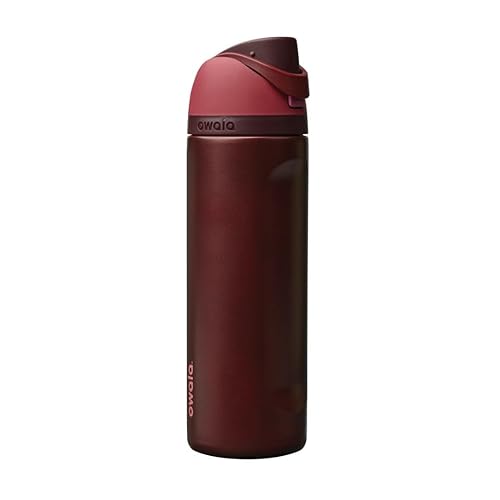
Owala FreeSip 24 oz
The Owala FreeSip is a triple-wall vacuum-insulated stainless steel bottle built around the patented FreeSip lid, which gives you two drinking modes in one cap — a built-in straw for upright sipping and a wider opening behind it for tilting and chugging. A push-button cover protects the mouthpiece from desk dust and gym-bag grime, and the folding carry loop locks down over the button to keep the lid sealed in a bag. Available in 19, 24, 32, and 40 oz, the FreeSip has become one of the most popular daily-drive bottles on the market thanks to its drinkability and overall hygiene design.
- Patented FreeSip dual-sip lid combines a built-in straw and a swig opening
- Triple-wall vacuum insulation keeps drinks cold for up to 24 hours
- Push-button mechanism opens and closes the lid with one hand
- Protective cover keeps the mouthpiece clean when not in use
- Folding carry loop locks down to prevent accidental lid opening
- 18/8 stainless steel construction, BPA-free
- Available in 19, 24, 32, and 40 oz with a deep color range
- Slim profile in smaller sizes works in most car cup holders
- Limited lifetime warranty
- Lid is top-rack dishwasher safe
- Genuinely the easiest insulated bottle to drink from while moving
- Hygienic mouthpiece cover is a standout feature for office and gym use
- Strong cold retention performance across a full day
- One-hand operation works whether you’re driving, walking, or working out
- Competitive pricing versus other premium brands
- Stainless cup is hand-wash only (lid is top-rack dishwasher safe)
- Not rated for hot drinks because of pressure buildup risk
- Thinner walls than the YETI — more prone to dents from hard drops
- Lid mechanism and straw need attentive cleaning to prevent buildup
The short version: The best-designed lid on this page attached to the most annoying lid to clean on this page. Both of those things are true at once, and the tension between them is the single clearest illustration of this guide’s argument.
What it is
A triple-layered vacuum-insulated stainless bottle in 24, 32 and 40 oz, built around Owala’s patented FreeSip spout, a push-button lid that locks shut, and a carry loop. There is also a BPA-free Tritan version if you want the lid without the steel.
The lid
Genuinely clever. Sip upright through the built-in straw, or tip the bottle back and swig through a separate wider opening. Two drinking modes without swapping anything. A push-button cover locks it closed so it will not pop open in a bag, and Owala states the lid is leak-proof when locked. This is the highest lid score I have given on this page.
Insulation & performance
Triple-layer vacuum insulation rated by Owala at 24 hours cold. It is a cold-only bottle, not rated for hot drinks, and not for carbonated ones.
Materials & safety
Stainless steel with BPA-free plastic and silicone lid components, backed by a limited lifetime warranty.
In everyday use
On build it is superb. It takes the highest build score on this page, and owners report only minor dents and scratches after years of genuinely hard use. If it were judged on the body alone it would be at the top of this list.
Where it falls short
The cleaning, and it carries the lowest cleaning score on this page. The intricate threads and the spout need handwashing, and flavor lingers in the recesses of the lid where a brush will not reach. Owala’s own care instructions ask you to hand wash the cup. The recurring one-star complaint on this bottle is about the lid rather than the body, and an aftermarket full of replacement gaskets and lids tells the same story.
Who should buy it
People who will drink more because the lid is a pleasure, and who will wash the lid by hand. If you know you’re the sort of person who puts everything in the dishwasher and hopes, buy the Ello Cooper further down — every part of that one is dishwasher safe.
Our Scores
Criteria | Score (out of 100) |
|---|---|
Lid & drinkability | 96 |
Insulation performance | 86 |
Build & durability | 94 |
Ease of cleaning | 56 |
Everyday usability | 92 |
Value for price | 86 |
Overall | 88 |
3. YETI Rambler 26 oz — Most Durable, and the One That Publishes Nothing
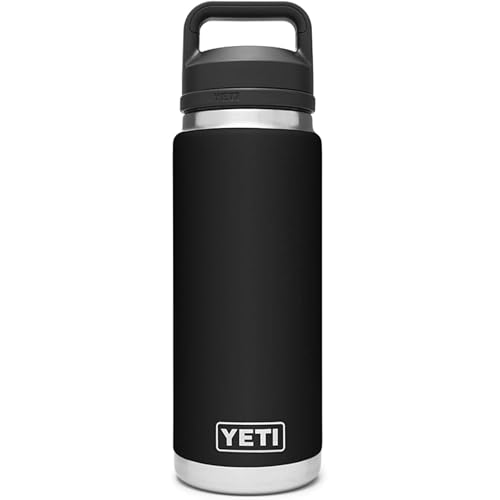
YETI Rambler 26 oz
The YETI Rambler 26 oz is built from kitchen-grade 18/8 stainless steel with double-wall vacuum insulation and noticeably thicker walls than most competitors, which is why it consistently survives drops and impacts that dent other bottles. The Chug Cap pairs a threaded base ring with a hinged flip spout that locks closed when the carry handle is folded down — one of the most reliable leak-prevention designs on the market. YETI’s Duracoat finish is among the few powder coats rated for repeated dishwasher cycling without degradation, and the included Chug Cap is fully dishwasher safe. Available in multiple sizes including 12, 18, 26, 36, and 46 oz with a 5-year warranty.
- Double-wall vacuum insulation rated to keep drinks cold and hot for 24+ hours
- Thick-gauge kitchen-grade 18/8 stainless steel for genuine drop resistance
- Duracoat color finish that holds up to repeated dishwasher cycles
- Chug Cap with locking carry handle that physically blocks the spout when folded
- Fully dishwasher safe — both the body and the included Chug Cap
- Compatible with a full line of optional YETI lids (Straw Cap, MagSlider, etc.)
- Wide range of sizes from 12 oz to 46 oz to suit different daily needs
- Large color range including standard and seasonal options
- BPA-free interior
- Backed by a 5-year YETI warranty
- Thick-gauge 18/8 steel built for drop resistance
- Best dishwasher experience of any premium insulated bottle
- Lid design is genuinely leak-resistant when the handle is locked down
- Excellent cold and hot retention for typical daily use
- Strong color and size selection
- Noticeably heavier than Hydro Flask or Stanley at the same capacity
- Two-motion lid (lift handle, then flip spout) is slower than one-hand straw lids
- Premium pricing positions it above most mainstream alternatives
The short version: The bottle you buy when you’re tired of replacing bottles. It earned the only perfect build score on this page, and it’s also the clearest example of a brand asking you to trust reputation instead of a number.
What it is
A double-wall vacuum-insulated bottle in extra-thick kitchen-grade 18/8 stainless, sold from 12 to 46 oz, with YETI’s Chug Cap. The heavier gauge is the entire point: it is engineered to shrug off drops that dent thinner bottles.
The lid
The Chug Cap is a narrow spout behind a screw-down cover, so you can drink without dousing yourself and still get a fast pour. YETI states the Chug Cap is leakproof, and owner reports back that up. Both body and cap are fully dishwasher safe, which is still uncommon at this level, and the clear lid means you can see whether it’s actually clean rather than assuming.
Insulation & performance
And here is the thing nobody says out loud. YETI publishes no retention figure at all. Not for this bottle, not for the Rambler line. Its own material compares the Rambler favourably to a plastic cup rather than committing to a number of hours. The insulation is unquestionably good. But if you’re building a spreadsheet, you can’t put YETI in it, and I have marked the insulation score down for that reason rather than for performance.
Materials & safety
Thick-gauge 18/8 stainless with a DuraCoat exterior, BPA-free interior, and a five-year limited warranty against defects in material and workmanship, original owner only. Five years is shorter than the lifetime cover several cheaper bottles here offer, which counts for something.
In everyday use
The long-term ownership reports are the best on this page. Owners describe keeping the same bottle for five years and taking it down the Grand Canyon more than once. That is the sort of record that makes the price argument for itself.
Where it falls short
Weight, and it is not close. At 624 g empty this is the heaviest mainstream bottle here, roughly three and a half times a Nalgene before you add water. It does not fit standard cup holders. And it’s expensive for a bottle that won’t tell you how long it keeps ice.
Who should buy it
Anyone hard on gear, anyone who has already dented two bottles, anyone who wants to buy once. If you carry it all day on foot, the Hydro Flask Lightweight further down does the same job for a quarter less weight.
Our Scores
Criteria | Score (out of 100) |
|---|---|
Lid & drinkability | 88 |
Insulation performance | 80 |
Build & durability | 100 |
Ease of cleaning | 92 |
Everyday usability | 76 |
Value for price | 74 |
Overall | 86 |
4. LifeStraw Go Series — Best Filtered, and the Only One That Filters the Right Thing

LifeStraw Go Series
The LifeStraw Go Stainless combines a double-wall vacuum-insulated 18/8 stainless steel bottle with LifeStraw’s two-stage filtration system — a 0.2-micron membrane microfilter that physically captures bacteria, parasites, and microplastics, plus an activated carbon filter that reduces chlorine, organic compounds, and bad taste from tap water. Membrane filter life runs up to 1,000 gallons; the carbon filter is replaced about every 25 gallons. Designed for hikers, travelers, and anyone using uncertain tap or trail water, the bottle solves contamination and temperature problems in a single package.
- 2-stage filtration: 0.2-micron membrane microfilter + activated carbon
- LifeStraw rates the membrane at 99.999999% of bacteria and 99.999% of parasites and microplastics
- Activated carbon reduces chlorine and organic taste compounds
- Membrane filter lifespan up to 1,000 gallons; carbon filter replaced every 25 gallons
- Double-wall vacuum-insulated 18/8 stainless steel body
- Leakproof carry lid with built-in straw access through filter
- BPA-free construction
- Compact 24 oz capacity that fits most pack pockets
- Replaceable filters (no need to replace the entire bottle)
- LifeStraw brand reliability and trail-proven filtration
- One bottle solves both contamination safety and temperature
- Lighter than carrying a separate filter and insulated bottle
- Long-life primary filter (rated up to 1,000 gallons)
- Reliable performance even in turbid or murky water
- Trusted name in field water purification
- Does NOT remove viruses — only bacteria, parasites, microplastics
- Drinking through the filter requires more suction than a normal straw
- Hand wash only
- Insulation is good but not 24-hour-class like premium pure-bottle options
The short version: Most “filtered” bottles improve the taste of water you already trust. This one is built for water you don’t. That distinction is the entire reason it is here rather than a household-brand filter bottle, and almost nobody explains it.
What it is
A double-wall insulated stainless bottle in 18, 24 and 34 oz with a two-stage filter built into the straw lid.
The lid
A filter straw lid — you sip and the water passes through the filter on the way. That is more effort per mouthful than an open spout, and the lid is bulkier than a plain straw cap. It is the price of the function.
Insulation & performance
Double-wall insulated stainless, though LifeStraw does not publish an hours figure, one of three bottles here that stays quiet on the number. Insulation is a secondary feature on this bottle and should be treated as one.
Materials & safety
This is where it earns its place. A membrane microfilter of roughly 0.2 microns plus an activated carbon stage removes 99.999999% of bacteria, 99.999% of parasites and 99.999% of microplastics, along with sand, dirt and cloudiness. The membrane lasts up to 1,000 gallons; the carbon filter about two months. It is independently lab-tested to WHO, US EPA and NSF standards: three named benchmarks, which is three more than most filtered bottles can point to.
In everyday use
The point of it’s that you stop thinking about the source. Airport fountains, a campsite tap, an unfamiliar rental. You fill and drink. There is also a give-back element: LifeStraw funds a year of safe water for a child for every bottle sold, which is a real program rather than a slogan.
Where it falls short
Two filters mean two replacement schedules and an ongoing cost. The lid is the most complex here after the Owala and needs proper cleaning. And you’re paying for filtration whether or not you ever need it. If you only ever fill from your own tap, this is money spent on reassurance.
Who should buy it
Travellers, hikers, campers, and anyone who genuinely does not trust the tap where they are going. If what you actually want is for your own tap water to taste less of chlorine, a simple carbon filter bottle does that for less — just be clear that’s a different job.
Our Scores
Criteria | Score (out of 100) |
|---|---|
Lid & drinkability | 80 |
Insulation performance | 84 |
Build & durability | 86 |
Ease of cleaning | 76 |
Everyday usability | 88 |
Value for price | 84 |
Overall | 86 |
5. Hydro Flask Lightweight Trail Series 32 oz — Best for Hiking
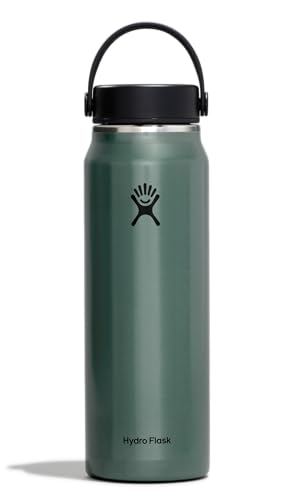
Hydro Flask Lightweight Trail Series 32 oz
The Hydro Flask Lightweight Trail Series 32 oz is the brand's pack-friendly bottle, engineered to shave about 25% of the weight off a standard Wide Mouth while keeping the same TempShield vacuum insulation. Built from 18/8 pro-grade stainless steel with thinner walls and a Honeycomb-insulated lightweight Flex Cap — featuring a flexible perforated strap and aluminum pivots — it keeps cold drinks cold for up to 24 hours and hot drinks hot for up to 12, all in a noticeably lighter package. Because it uses the standard Wide Mouth thread, every Hydro Flask Flex lid (Cap, Straw, Chug) fits, and it's backed by Hydro Flask's limited lifetime warranty. For hikers and backpackers counting every ounce who still want genuine cold retention and proven reliability, it's the clear pick.
- TempShield double-wall vacuum insulation keeps drinks cold up to 24 hours and hot up to 12 hours
- Approximately 25% lighter than the standard 32 oz Wide Mouth
- 18/8 pro-grade stainless steel resists rust, odor, and flavor transfer
- Honeycomb-insulated lightweight wide-mouth Flex Cap with aluminum pivots
- Compatible with all standard Hydro Flask Wide Mouth lids (Cap, Straw, Chug)
- Wide mouth accepts full-size ice cubes and backcountry filters
- BPA-free construction
- Backed by a Hydro Flask limited lifetime warranty
- Significantly lighter for hiking and backpacking
- Genuine 24-hour cold retention from proven TempShield insulation
- Accepts the full Hydro Flask Wide Mouth lid ecosystem
- Hydro Flask build quality and limited lifetime warranty
- Wide mouth is easy to fill, ice, and clean
- Thinner walls dent more easily than the standard Wide Mouth
- Costs more than budget insulated bottles
- Stock lightweight Flex Cap is a loop cap, not a straw lid
The short version: The same insulation as the standard Hydro Flask with a quarter of the weight removed, and one of the bottles ranked for hiking weight. If you carry a bottle on your back rather than to a desk, that’s the only spec that matters.
What it is
A Trail Series Wide Mouth in 18/8 stainless, sold from 21 to 40 oz, built specifically to cut mass. Hydro Flask states it is 25% lighter than the equivalent standard 32 oz.
The lid
A Honeycomb insulated wide-mouth cap, which uses a perforated flexible strap and aluminum pivots instead of solid plastic, weight shaved from the parts nobody normally thinks about. It stays leakproof, and it still takes the same wide-mouth Flex lids as the rest of the range.
Insulation & performance
Unchanged from the standard line, at 24 hours cold and 12 hours hot. That is the impressive part: the weight came out of the walls and the cap without costing retention.
Materials & safety
18/8 pro-grade stainless with thinner walls, BPA-free, and the same limited lifetime warranty as the rest of the Hydro Flask range, with the same exclusion for dents, scratches and powder-coat chips.
In everyday use
A quarter less weight is more noticeable than it sounds after a few hours of walking, and it’s the difference between a bottle you carry and a bottle you leave in the car. The wide mouth still takes full-size ice and standard inline filters.
Where it falls short
Thinner walls mean less dent resistance, and the standard Hydro Flask already loses that contest to YETI. This one is a step further in the wrong direction for abuse tolerance. It is also priced at the premium end for a bottle whose selling point is having less material in it.
Who should buy it
Hikers, backpackers, commuters who walk a long way, anyone weighing what goes in the bag. If the bottle mostly sits on a desk, buy the standard Wide Mouth and keep the money.
Our Scores
Criteria | Score (out of 100) |
|---|---|
Lid & drinkability | 90 |
Insulation performance | 92 |
Build & durability | 78 |
Ease of cleaning | 90 |
Everyday usability | 92 |
Value for price | 74 |
Overall | 86 |
6. Owala FreeSip Sway 30 oz — Best for Cup Holders
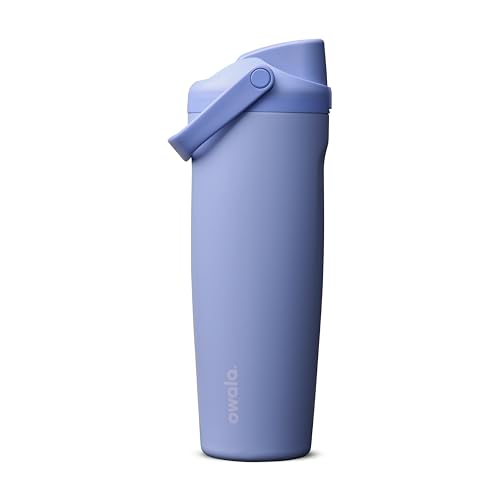
Owala FreeSip Sway 30 oz
- Two drinking styles from one spout
- Lid locks, so it survives a bag
- Fits a cup holder, unlike the original FreeSip
- 24 hours cold published by the maker
- Wide mouth takes real ice cubes
- The cup must be washed by hand
- Spout crevices a brush cannot reach
- No hot-drink rating at all
- Heavier than a plain screw-cap bottle
- 30 oz insulated stainless steel body
- Patented 2-in-1 FreeSip spout: straw or swig
- Push-button lid that locks closed
- Triple-layer insulation, 24 hours cold published
- Wide opening that takes full-size ice
- Narrow base built for car cup holders
- BPA, lead and phthalate free
- Lid is dishwasher safe
- Cup is hand wash only
- Not rated for hot liquids
The short version: The Sway is Owala answering the one complaint people actually had about the FreeSip, which was the shape. It is taller and narrower, it drops into a car cup holder without a fight, and it carries the same two-in-one spout. Everything good about the FreeSip is here. So is the cleaning problem.
What it is
A 30 oz triple-layer vacuum-insulated stainless bottle built around the patented FreeSip spout, a push-button lid that locks, and a bucket handle. The base is deliberately narrow, which is the whole reason this version exists.
The lid
The same clever two-in-one spout as the standard FreeSip. Sip upright through the built-in straw, or tilt the bottle and swig through the wider opening, with no parts to swap. A push-button cover locks it shut so it will not open in a bag. Owala states it is leak-proof when locked.
Insulation and performance
Owala publishes 24 hours cold from triple-layer insulation. There is no published figure for hot, and the care instructions rule hot liquids out entirely, so treat this as a cold-only bottle and do not put coffee in it.
Materials and safety
Stainless steel body, BPA free, and specifically stated free of lead and phthalates — which is worth noting, because lead in the sealed base is a question people now ask and most brands simply do not answer in writing.
Where it falls short
The cleaning, exactly as on the standard FreeSip. The cup is hand wash only and the spout has recesses a brush will not reach. It scores 56 here, the joint-lowest cleaning score on the page. Buy it knowing you are signing up to wash a lid by hand.
Who should buy it
Anyone who wanted a FreeSip but drives. If the bottle lives in a car cup holder, this is the version to get. If you will not hand wash a lid, buy a chug cap instead.
Our Scores
Criteria | Score (out of 100) |
|---|---|
Lid & drinkability | 96 |
Insulation performance | 86 |
Build & durability | 94 |
Ease of cleaning | 56 |
Everyday usability | 94 |
Value for price | 84 |
Overall | 86 |
7. Nalgene Sustain 32 oz — Best Value, and the Most Verifiable Bottle Here

Nalgene Sustain 32 oz
The Nalgene Sustain 32oz is the retro-colorful pick and the value champ of the list: the iconic wide-mouth shape, now made from Tritan Renew — a material derived from 50% recycled plastic waste. It comes in clear plus a rainbow of bright translucent colors and Landscape print series, is BPA-free, dishwasher safe, and made in the USA. There's no insulation — it's single-wall — but it's nearly indestructible, the wide mouth takes full-size ice, and the attached loop cap won't get lost. It's the pick for a cheerful, sustainable, throw-it-in-your-bag classic.
- Iconic wide-mouth retro shape; 32oz (also 16oz)
- Made from Tritan Renew — derived from 50% recycled plastic waste; BPA-free
- Leakproof attached loop-top cap (won't get lost)
- Wide mouth accepts full-size ice cubes and standard filters
- Dishwasher safe; made in the USA
- Single-wall (not insulated); marked measurement graduations on the side
- Huge range of bright translucent colors + Landscape print series
- Cheapest pick, with a real sustainability story (50% recycled material)
- Near-indestructible retro classic
- Huge bright / translucent color range
- Wide mouth for ice, cleaning, and fitting filters
- Made in the USA with an attached, loseproof cap
- Single-wall — no insulation, won't keep drinks cold
- Plastic, not the premium metal/glass of other picks
- Wide-mouth pour can be splashy without a straw lid
The short version: The cheapest bottle on this list, the lightest by a wide margin, and the only one whose entire specification I could independently verify line by line. It keeps nothing cold. It also may outlive everything else here.
What it is
The classic single-wall wide-mouth Nalgene, now molded from Tritan Renew at 50% certified recycled content, a conversion Nalgene completed across its lifestyle bottle line in January 2023 — with the attached loop-top cap, in 16 and 32 oz.
The lid
A wide screw cap on a tether. There is nothing to go wrong and nothing to brush out, which is precisely the appeal. The trade-off is real though: a 63 mm opening is a lot of water arriving at once, and drinking from it while walking is a poor idea.
Insulation & performance
None. It is a single wall of plastic. Ice melts, and in warm weather the outside will sweat. I have scored it one out of five for insulation because that’s honest, not because it’s a flaw. You’re buying this bottle for weight and indestructibility, and it isn’t pretending otherwise.
Materials & safety
BPA and BPS free, dishwasher safe, and made in the USA. It weighs 6.25 oz (177 g) empty, a figure I can state with unusual confidence because Nalgene publishes it and an independent lab measured exactly the same number. Nalgene’s lifetime guarantee covers functional damage (cracks, breaks, broken components) but explicitly excludes cosmetic damage including scratches, nicks and worn prints.
In everyday use
Close to indestructible, which is how it has survived in essentially the same form for decades. The molded measurement graduations double as a rough intake tracker, the wide mouth is the easiest here to fill, ice and scrub, and it takes inline filters for the trail.
Where it falls short
Beyond the obvious lack of insulation, the one specific criticism from testing is that dirt and residue collect in the lid and the exterior threads and need deliberate attention. The loop-top design creates crevices the body does not have. It also does not fit most cup holders.
Who should buy it
Anyone who wants a bottle to stop being a decision. Hikers counting grams, students, anyone who has lost expensive bottles before. If you need cold water in the afternoon, you need one of the insulated picks instead — this one can’t do it at any price.
Our Scores
Criteria | Score (out of 100) |
|---|---|
Lid & drinkability | 76 |
Insulation performance | 20 |
Build & durability | 88 |
Ease of cleaning | 80 |
Everyday usability | 84 |
Value for price | 100 |
Overall | 84 |
8. Klean Kanteen TKWide — Best Steel Build, With One Real Caveat

Klean Kanteen TKWide 32 oz
The Klean Kanteen TKWide is a vacuum-insulated wide-mouth bottle made from 90 percent post-consumer recycled 18/8 stainless steel, paired with the company’s Climate Lock double-wall insulation and a TK Closure internal-thread system that recesses the cap inside the neck to reduce thermal bridging. The TKWide accepts multiple cap options — Loop Cap, Café Cap, and Twist Cap (some with a stainless steel straw that avoids the plastic taste of standard straws). Klean Kanteen is one of the few water bottle brands with B Corp certification, and the bottle is backed by a strong lifetime warranty.
- 90% post-consumer recycled 18/8 stainless steel construction
- Climate Lock double-wall vacuum insulation; Klean Kanteen rates it for days of ice
- TK Closure internal-thread system reduces thermal weak points at the neck
- Stainless steel straw option avoids plastic taste over time
- Multiple swappable lids (Loop Cap, Café Cap, Twist Cap with straw)
- Klean Coat chip-resistant powder finish
- Available in 12, 16, 20, 32, and 64 oz capacities
- B Corp certified company with family-owned heritage
- BPA-free
- Lifetime warranty
- One of the best long-duration cold retention performers in this category
- The only insulated bottle in this lineup with a stainless steel straw option
- Internal-thread design is a measurable thermal-engineering advantage
- Strongest sustainability credentials in the lineup (B Corp + recycled steel)
- Multiple lid choices to match different use cases
- Café Cap version is not leakproof when inverted — choose the Loop or Twist Cap for bag carry
- Hand wash recommended; not optimized for repeated dishwasher cycles
- Silicone straw mouthpiece can impart a faint flavor for the first week of use
The short version: The biggest insulation claim on this page, an excellent body, an interchangeable cap system that makes it four bottles in one, and a leak problem that two completely independent sources describe in the same terms. All of that has to sit in one review.
What it is
A food-grade 18/8 stainless bottle from 12 to 64 oz with Klean Kanteen’s TK Closure internal thread and a smooth rounded lip, finished in their chip-resistant Klean Coat powder coat.
The lid
The strongest cap ecosystem here. The same body takes the Twist Cap (with a built-in reusable steel straw and swivel loop), a Chug Cap, a Café Cap and a Loop Cap, so one purchase covers a straw bottle, a fast-pour bottle and a coffee tumbler. That flexibility is real and rare.
Insulation & performance
Klean Kanteen’s Climate Lock double-wall vacuum insulation is rated to keep contents iced up to 75 hours, comfortably the highest published figure on this page. Treat it as a claim rather than a result, though: the most specific owner report I found for the same bottle says “ice lasts 20+ hrs”. Twenty-plus hours is a full day and a night and perfectly good. It is not seventy-five.
Materials & safety
Food-grade 18/8 stainless, dishwasher safe, with a Lifetime Limited Warranty.
In everyday use
The body is superb. Owners describe dropping it repeatedly with barely a mark, and one reports the steel straw still going after four years with only a small tear in the silicone tip. The wide mouth makes it one of the easier bottles here to actually scrub.
Where it falls short
The leaking, and I want to be specific because it is the reason this does not sit higher. The TKWide is reliable upright and much less so on its side, which is the position a bottle spends most of its life in inside a bag. Owner reports on Klean Kanteen’s own site repeat that complaint often enough to be a pattern rather than an outlier. Owners of the Chug Cap variant also report the metal ring working loose over time until the cap becomes hard to remove. The steel straw is awkward to clean, and the silicone mouthpiece can carry an industrial flavor when new.
Who should buy it
People who want one body and several lids, who value a chip-resistant finish, and who will carry it upright in a hand or a bottle pocket rather than lying flat in a bag with a laptop. If bag-safety is the whole point for you, buy the Owala or the YETI.
Our Scores
Criteria | Score (out of 100) |
|---|---|
Lid & drinkability | 78 |
Insulation performance | 94 |
Build & durability | 94 |
Ease of cleaning | 78 |
Everyday usability | 84 |
Value for price | 80 |
Overall | 84 |
9. Stanley Quencher H2.0 30 oz — Best Tumbler

Stanley Quencher H2.0 Tumbler 30 oz
- The handle makes 30 oz easy to carry all day
- Three lid positions cover most drinking habits
- Narrow base clears tight cup holders
- Recycled steel and a lifetime warranty
- Dishwasher safe, lid included
- Spill-resistant, not leakproof — never pack it sideways
- Stanley publishes no retention hours
- Too tall for some bags
- The straw opening still lets a splash out
- 30 oz double-wall vacuum insulated tumbler
- FlowState rotating lid with three positions
- Reusable straw held in place by the lid seal
- Ergonomic comfort-grip handle
- 90 percent recycled stainless steel
- Narrow base fits nearly any cup holder
- Also sold in 14, 20, 40 and 64 oz
- BPA free
- Tumbler and lid are dishwasher safe
- Lifetime warranty through authorized resellers
The short version: A tumbler, not a bottle, and the difference decides whether it suits you. It is built to sit on a desk or in a car and be sipped all day. It is not built to go in a bag on its side, and no amount of marketing changes that.
What it is
A 30 oz double-wall vacuum-insulated tumbler with a handle, a reusable straw and the FlowState lid. Also sold in 14, 20, 40 and 64 oz. Every size except the 64 has a narrow base sized for a car cup holder.
The lid
The FlowState lid rotates between three positions: a straw opening, a wider drink opening, and a full cover. Stanley describes the closed position as resisting leaks rather than preventing them, and that wording is deliberate. Treat it as spill-resistant and it will not let you down.
Insulation and performance
Double-wall vacuum insulation that holds cold and hot for hours. Stanley publishes no retention figure at all — not for cold, not for hot. It is one of three bottles here that tell you nothing, and the score reflects that silence rather than any measured failure.
Materials and safety
Built from 90 percent recycled stainless steel and BPA free. Tumbler and lid are both dishwasher safe, which is genuinely uncommon for a straw lid at any price.
Where it falls short
It is not leakproof, it publishes no numbers, and it is tall enough to be awkward in a bag. The straw opening will let a splash out if the tumbler tips. None of that matters on a desk, and all of it matters in a rucksack.
Who should buy it
Desk workers, drivers and anyone who drinks more when a straw is already there. Not for a bag, not for a hike, and not if you need a stated retention number.
Our Scores
Criteria | Score (out of 100) |
|---|---|
Lid & drinkability | 78 |
Insulation performance | 84 |
Build & durability | 90 |
Ease of cleaning | 88 |
Everyday usability | 92 |
Value for price | 76 |
Overall | 84 |
10. Takeya Actives 24 oz — Best Spout Lid

Takeya Actives 24 oz
The Takeya Actives is the bottle Verywell Fit put at the top of its stainless steel list, and the appeal is how little it asks of you. The insulated spout lid flips open under a protective cap, so the part your mouth touches stays out of the gym floor and the car footwell, and the whole lid goes in the dishwasher. Takeya rates the double-wall vacuum body for 24 hours cold. The 24 oz version is the one that fits cup holders comfortably; the powder-coat finish gives it grip when your hands are wet, which is more useful than it sounds.
- Double-wall vacuum insulated 18/8 stainless steel body
- Insulated spout lid rated by Takeya for 24 hours cold
- Protective flip cap keeps the mouthpiece clean between uses
- Leakproof seal when the spout is closed
- Lid is dishwasher safe, unlike many insulated bottles
- Powder-coat exterior for grip with wet hands
- Tapered base fits most car cup holders at 24 oz
- Carry handle molded into the lid
- Available from 14 oz up to 64 oz
- Wide range of solid and two-tone colorways
- One of the few insulated bottles with a fully dishwasher-safe lid
- Spout is quick to drink from without being a firehose
- Protective cap is a genuine hygiene advantage for gym use
- Light for its capacity, so it is easy to carry all day
- Priced below the premium brands without feeling cheap
- Spout pours faster than a straw, which takes adjusting to
- Powder coat chips if you drop it on concrete
- No straw option on this lid if that is how you prefer to drink
- The 32 oz and larger sizes stop fitting cup holders
The short version: The spout lid is the reason to buy this one. It gives you a fast, controlled pour without the face-full you get from a wide chug cap, and Takeya prices it well below the premium brands doing the same job.
What it is
A 24 oz double-wall vacuum-insulated stainless bottle with an insulated spout lid and a carry handle built into the cap. The Actives line runs from 14 oz up to 64 oz, so the lid carries across sizes.
The lid
A protected spout behind a screw-down cover. You drink through a narrow opening rather than a wide mouth, which is easier while moving and much easier in a car. The handle is part of the lid, so there is nothing extra to lose.
Insulation and performance
Takeya publishes 24 hours cold. That is the same figure Hydro Flask and Owala quote, and as the retention section below explains, all three are measured under conditions nobody discloses — so read it as a claim of the same order, not a verified equal.
Materials and safety
18/8 stainless steel, BPA free, powder-coated exterior. The steel is thinner than Klean Kanteen or YETI use, which is a real part of how the price is achieved.
Where it falls short
The spout has recesses that take time to clean properly, and the plastic against the lips divides people. Thinner walls dent more easily than the premium bottles here. It scores 72 on cleaning for those reasons.
Who should buy it
Anyone who wants a controlled pour on the move without paying premium prices, and who accepts a lid that needs attention in the sink.
Our Scores
Criteria | Score (out of 100) |
|---|---|
Lid & drinkability | 80 |
Insulation performance | 88 |
Build & durability | 84 |
Ease of cleaning | 72 |
Everyday usability | 86 |
Value for price | 88 |
Overall | 84 |
11. Coldest Water Bottle with Straw Lid — Best Cold Retention

Coldest Water Bottle with Straw Lid
- The highest published cold figure here
- Insulating the straw lid is genuinely unusual
- No condensation on the outside
- Wide mouth makes it easy to clean
- Fits a cup holder
- The published figures are the maker's, unverified
- Bulkier than most 24-hour bottles
- Straw assembly is another part to clean
- Priced above the obvious alternatives
- 18/8 stainless steel, double-wall vacuum
- Insulated straw lid rather than only an insulated body
- 36 hours cold published by the maker
- 13 hours hot published by the maker
- Exterior designed not to sweat
- Maker states 100 percent leakproof
- Wide mouth for cleaning and whole ice
- Fits most cup holders
- Sold in several sizes and colors
- Straw and lid come apart for washing
The short version: Coldest publishes the most aggressive retention numbers in this guide, and it is the only bottle here that insulates the straw lid itself rather than just the body. That second part is the engineering that makes the first part plausible.
What it is
An 18/8 stainless bottle with true double-wall vacuum insulation and a fully insulated straw lid, sold in several sizes and a wide color range. The exterior is built not to sweat, which matters if the bottle lives on a wooden desk.
The lid
A straw lid with the insulation carried through the cap rather than stopping at the shoulder. On most straw bottles the straw is a thermal hole straight into the contents. Here it is not, and that is the single reason the published figure is as high as it is.
Insulation and performance
Coldest publishes 36 hours cold and 13 hours hot — the highest cold figure on this page by a clear margin. As with every number in this guide, that is the maker’s claim under conditions it does not disclose. I have scored it high because the design supports the claim, not because I have verified it.
Materials and safety
18/8 stainless steel, double-wall vacuum construction, BPA free. The wide mouth takes whole ice cubes and makes the inside reachable with a brush.
Where it falls short
It is bulky, it costs more than the obvious alternatives, and the straw assembly is another set of parts to take apart and dry. If you want the retention without the maintenance, a chug cap gets you most of the way for less.
Who should buy it
Anyone whose actual complaint is that their water goes warm by mid-afternoon. This is the bottle built specifically for that problem.
Our Scores
Criteria | Score (out of 100) |
|---|---|
Lid & drinkability | 84 |
Insulation performance | 96 |
Build & durability | 88 |
Ease of cleaning | 76 |
Everyday usability | 78 |
Value for price | 68 |
Overall | 82 |
12. BrüMate Rise 25 oz — Best Metal Straw

BrüMate Rise 25 oz
- A metal straw, which almost nothing else offers
- Converts between straw and chug in seconds
- Silicone sleeve absorbs everyday knocks
- Lifetime guarantee
- Cup-holder friendly
- Straw and cover are two more parts to wash
- 25 oz is small for an all-day fill
- Sleeve traps water if you leave it on
- Only the lids and straws are guaranteed dishwasher safe
- 25 oz insulated stainless steel body
- ColdKey stainless steel straw, not plastic
- Removable SoftSip silicone straw cover
- Pull the straw to convert to a chug bottle
- BevGuard insulation, 24 hours cold published
- Removable protective silicone sleeve
- Sized to fit most cup holders
- Lids and straws are top-rack dishwasher safe
- Lifetime guarantee
- Sold in a range of colors
The short version: The Rise answers an objection nothing else here takes seriously — people who do not want to drink through plastic. Inside the silicone cover is a stainless steel straw, and pulling it out turns the bottle into a chug bottle in one movement.
What it is
A 25 oz insulated stainless bottle with a removable silicone sleeve, a covered SoftSip straw and the ColdKey stainless straw inside it. The base is sized for cup holders.
The lid
A leakproof lid with a fully covered silicone straw that lifts out for cleaning. Remove the metal straw and you have a chug bottle. That conversion is the piece of design worth paying for — most bottles force the choice at purchase.
Insulation and performance
BrüMate publishes 24 hours cold from its BevGuard insulation. No hot figure is quoted, which is consistent with a straw bottle.
Materials and safety
Stainless steel body and stainless straw, so the only plastic touching the water is the removable silicone mouthpiece. The silicone sleeve takes the everyday knocks that chip a powder coat.
Where it falls short
Straw plus cover plus sleeve is three more parts to wash and dry, and a sleeve left on a wet bottle traps water underneath. At 25 oz it is modest if you fill once and expect it to last the day. BrüMate guarantees only the lids and straws as top-rack dishwasher safe.
Who should buy it
Anyone who wants a straw but not a plastic one, and anyone who switches between sipping and chugging depending on the day.
Our Scores
Criteria | Score (out of 100) |
|---|---|
Lid & drinkability | 88 |
Insulation performance | 86 |
Build & durability | 86 |
Ease of cleaning | 74 |
Everyday usability | 84 |
Value for price | 78 |
Overall | 82 |
13. Takeya Originals 40 oz — Best Budget Insulated

Takeya Originals 40 oz
The Takeya Originals is a double-wall vacuum-insulated stainless steel bottle from a brand with 60 years of Japanese drinkware heritage, paired with an integrated flip-spout lid that includes a hinge-lock to hold the spout open while drinking. Cold retention is rated at 24 hours and hot at 12. Available in 18, 24, 32, and 40 oz, with the 18 and 24 oz sizes fitting most car cup holders. The spout-lid design is more functional than a bare screw cap at a similar budget price, making the Originals a popular value pick.
- 18/8 food-grade stainless steel with double-wall vacuum insulation
- 24-hour cold and 12-hour hot retention from the manufacturer
- Built-in flip-spout lid with hinge lock to hold the cap open while drinking
- 18 and 24 oz sizes fit standard car cup holders
- Available in 18, 24, 32, and 40 oz capacities
- BPA-free
- Powder-coat exterior with a wide color range
- Heritage Japanese design (Takeya has been making drinkware since 1962)
- Limited lifetime warranty
- Reasonable mid-budget price tier
- Better lid experience than budget bottles with bare screw caps
- Better cold retention than the RTIC at the 24-hour mark
- Smaller sizes are cup-holder friendly
- Strong brand heritage and long warranty
- A genuinely underrated everyday option
- Body is hand-wash only — not rated for dishwasher cycling
- Carry handle on the spout lid is thinner than the Hydro Flask or YETI handles
- O-ring lid gasket may need occasional replacement with daily use
The short version: Proper insulated performance and a lifetime warranty at a price well under the premium brands, with a lid that is easy to drink from and fiddly to clean.
What it is
A double-wall vacuum-insulated 18/8 stainless bottle sold from 18 to 64 oz, with Takeya’s leakproof spout lid and a carry loop.
The lid
A sip-friendly spout that screws down to a tight seal, in plastic and silicone. The useful part is that the same lid fits across Takeya’s Actives, Originals, Pickleball and Tritan bottles, so replacements and upgrades are easy to find years later.
Insulation & performance
Rated at 24 hours cold with a sweat-proof exterior, so it will not ring a desk or damp a bag.
Materials & safety
18/8 stainless, BPA-free. Takeya’s limited lifetime warranty repairs or replaces defective bottles, but like Hydro Flask and Nalgene it explicitly excludes normal wear including dents, scratches and color fade.
In everyday use
At 40 oz this is a fill-once-and-forget bottle, and the spout means you can drink while walking without the faceful a wide mouth delivers.
Where it falls short
The lid again. Takeya’s spout lid has several recesses that take real time and effort to clean, and owners consistently report disliking the feel of the plastic spout against the lips and finding the flow slower than a chug cap. The steel is also thinner than the premium bottles here, which is part of how the price is achieved.
Who should buy it
Anyone who wants big insulated capacity without premium pricing and does not need a straw. If the lid feel matters to you, handle one first.
Our Scores
Criteria | Score (out of 100) |
|---|---|
Lid & drinkability | 80 |
Insulation performance | 86 |
Build & durability | 78 |
Ease of cleaning | 70 |
Everyday usability | 84 |
Value for price | 92 |
Overall | 82 |
14. CamelBak Chute Mag 32 oz — Best Lightweight Plastic

CamelBak Chute Mag 32 oz
- The magnetic cap genuinely stays out of the way
- Light for 32 oz
- Resists the smell old plastic bottles get
- Bottle and cap both dishwasher safe
- One-handed operation
- No insulation at all
- Tritan scratches over time
- Wide body does not suit every cup holder
- Cap mechanism is one more thing to fail
- 32 oz Tritan body, lightweight rather than insulated
- Magnetic cap stows itself while you drink
- Seals tightly when closed
- One-handed drinking
- Odor and stain resistant material
- Integrated carry handle
- Bottle and cap are both dishwasher safe
- BPA free
- No insulation
- Backed by CamelBak's warranty
The short version: One small problem, solved properly. The cap is magnetic, so when you open it the cap swings back and sticks to the bottle instead of into your face or against your hand. Drink one-handed, let go, done.
What it is
A 32 oz Tritan bottle with a magnetic leak-resistant cap and an integrated carry handle. Uninsulated, and much lighter than any steel bottle of the same capacity.
The lid
A narrow chute you drink from, behind a cap that stows magnetically against the bottle while open and seals when closed. It is the most elegant cap solution on this page, and it costs nothing in complexity — there is no gasket maze to clean.
Insulation and performance
None. This is a single-wall plastic bottle, so water tracks the air around it and ice does not last. That is the trade for the weight, and it is the right trade for a gym bag.
Materials and safety
Tritan copolyester, BPA free, and specifically resistant to the odors and stains that make old plastic bottles unpleasant. Bottle and cap are both dishwasher safe.
Where it falls short
No insulation, Tritan scratches where steel dents, and the body is wide enough that it will not suit every cup holder. The magnetic cap is one more mechanism that can eventually fail, though there is nothing here to clog.
Who should buy it
Gym, commute and desk use where weight matters more than temperature, and anyone who is tired of a cap dangling on a tether.
Our Scores
Criteria | Score (out of 100) |
|---|---|
Lid & drinkability | 90 |
Insulation performance | 20 |
Build & durability | 78 |
Ease of cleaning | 86 |
Everyday usability | 86 |
Value for price | 84 |
Overall | 80 |
15. Ello Syndicate 20 oz Glass — Best Glass

Ello Syndicate 20 oz Glass
The Ello Syndicate is a 20 oz borosilicate glass bottle with a protective silicone sleeve and one-touch flip lid for easy one-handed use. It’s BPA-free, dishwasher-safe, and fits standard cup holders. While durable and stylish, the flip lid can leak under vigorous movement. Best for office or home use, offering clean-tasting water with convenient portability.
- Pure Glass Construction: Borosilicate glass for fresh, odor-free taste
- One-Touch Flip Lid: Leak-proof, easy-access drinking
- Protective Silicone Sleeve: Non-slip grip guards against chips and cracks
- Built-in Carry Loop: Easy transport for gym, office, school, or travel
- Dishwasher Safe Design: Top-rack safe; silicone sleeve stays on
- BPA-Free Materials: Safe, chemical-free hydration
- 20oz Capacity: Ideal size for all-day hydration
- Glass provides a pure, clean taste.
- The silicone sleeve protects against drops.
- The flip lid prevents messy leaks.
- Dishwasher safe makes cleaning very easy.
- A built-in loop makes carrying simple.
- It does not keep drinks cold for long term.
- The glass makes it somewhat heavy.
- Debris gets stuck under the sleeve.
- The narrow mouth blocks large ice.
- The flip lid can stick sometimes.
The short version: If you’ve ever finished a coffee, rinsed the bottle, filled it with water and tasted yesterday, glass is the answer to that problem and this is the affordable way in.
What it is
A 20 oz glass bottle with a one-touch flip lid, wrapped in an FDA food-grade silicone sleeve with a no-slip grip and a carry loop. You drink directly from glass, so there’s no flavor transfer at all, not from the previous drink, not from the bottle itself.
The lid
A one-touch flip top, which is the right choice for a desk bottle: open one-handed, closed in a second, nothing to unscrew while you’re typing. It isn’t a lid I would trust upside down in a rucksack.
Insulation & performance
None, and glass conducts heat readily, so a cold drink warms faster here than in any steel bottle on this page. On a desk with air conditioning that matters very little. In a car in July it matters a great deal.
Materials & safety
Glass and food-grade silicone, dishwasher safe. Glass is the most chemically inert material in this guide. Nothing leaches into it, nothing is absorbed by it, and it does not hold odor the way plastic can.
In everyday use
The silicone sleeve is the entire reason a glass bottle is practical rather than precious. It grips, it muffles the clunk on a hard desk, and it absorbs the knocks that would otherwise end the bottle. Being able to see exactly how clean the inside is turns out to be quietly reassuring after a few weeks with an opaque steel bottle.
Where it falls short
It is glass, and the honest context matters. Glass is the weakest material in this guide on both leaking and breakage, and a silicone sleeve does not change the physics of a hard drop onto tile. This one is heavier than its capacity suggests, and it is not a gym bottle.
Who should buy it
Desk and home users who care most about taste, and anyone who alternates between coffee, tea and water in the same bottle. If it is going in a bag with hard objects, buy steel.
Our Scores
Criteria | Score (out of 100) |
|---|---|
Lid & drinkability | 80 |
Insulation performance | 20 |
Build & durability | 68 |
Ease of cleaning | 92 |
Everyday usability | 72 |
Value for price | 88 |
Overall | 78 |
16. purifyou Borosilicate Glass 22 oz — Best Glass Value

purifyou Borosilicate Glass Water Bottle 22 oz
- No taste transfer, ever
- Borosilicate handles temperature change
- Silicone sleeve absorbs the drops that matter
- Wide mouth is genuinely easy to clean
- Dishwasher safe, unlike most glass bottles
- No insulation at all
- Heavier than steel at the same volume
- Glass is still glass on a hard floor
- Not for carbonated drinks
- Borosilicate glass body, not ordinary glass
- Food-grade silicone protective sleeve
- Stainless steel lid with O-ring handle
- Time and volume markers up the side
- Wide mouth for ice and sliced fruit
- Sold in 12, 22, 32 and 40 oz
- Leak-resistant lid
- Fits most cup holders
- Dishwasher safe
- Not rated for carbonated drinks
The short version: Glass solves the one problem no steel bottle can. Nothing leaches, nothing lingers, and water tastes like water even after a week of coffee in the same vessel. This is the version that does it without asking a premium.
What it is
A borosilicate glass bottle inside a food-grade silicone sleeve, with a stainless lid and an O-ring handle. Sold in 12, 22, 32 and 40 oz, with time and volume markers running up the side.
The lid
A stainless screw lid with a leak-resistant seal and a loop handle. There is no straw and no spout, which on a glass bottle is the right decision — fewer parts means fewer places for the taste advantage to be undone.
Insulation and performance
None at all. Glass cannot be vacuum insulated, so ice melts on its own schedule and a cold drink will not stay cold. If temperature matters to you, this is the wrong material and no amount of sleeve changes it.
Materials and safety
Borosilicate rather than ordinary soda-lime glass, so it tolerates temperature change without cracking. The silicone sleeve does the real work of surviving a knock. It is the most chemically inert option here by a distance.
Where it falls short
Heavier than steel at the same volume, breakable on a hard floor whatever the sleeve does, and explicitly not rated for carbonated drinks. It is not a gym bottle and it is not a hiking bottle.
Who should buy it
Desk and home use, and anyone who alternates coffee, tea and water in one bottle and is tired of tasting yesterday.
Our Scores
Criteria | Score (out of 100) |
|---|---|
Lid & drinkability | 78 |
Insulation performance | 20 |
Build & durability | 70 |
Ease of cleaning | 92 |
Everyday usability | 76 |
Value for price | 84 |
Overall | 78 |
17. WaterH BOOST Smart 32 oz — Best Smart Bottle
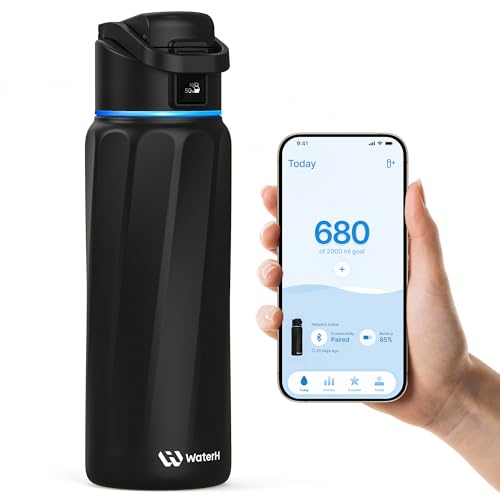
WaterH BOOST Smart 32 oz
The BOOST Smart Water Bottle is the high-tech outlier — an insulated stainless steel bottle with a brain. Its smart lid carries an LED reminder ring and display, and it syncs over Bluetooth to a phone or smartwatch app that estimates your intake and nudges you to drink throughout the day. Underneath the electronics it’s a capable double-wall vacuum bottle that keeps drinks cold (or hot) for around 24 hours and even keeps carbonated drinks fizzy. The rechargeable lid lasts roughly two weeks per charge. For people who genuinely struggle to drink enough water and want reminders and logging, it’s the best hydration-tracking pick on this list.
- Smart lid with an LED reminder ring and display to prompt regular drinking
- Bluetooth sync to a phone/smartwatch app that estimates daily intake
- Double-wall vacuum insulation keeps drinks cold or hot up to around 24 hours
- Rechargeable lid lasts up to about 2 weeks per charge
- Sealed wide-mouth lid keeps carbonated drinks fizzy
- 32 oz stainless steel body; BPA-free
- Hydration tracking based on flow and bottle angle
- Genuine hydration reminders and intake logging
- Good battery life for a smart bottle
- Solid 24-hour insulation as a standalone bottle
- Keeps carbonated drinks fizzy
- Useful for desk, gym, and building a hydration habit
- Tracking accuracy depends on drinking at a consistent angle
- App can be finicky to sync
- LED display washes out in bright sunlight
- Smart features stop when the battery is flat
- Premium price for the technology; occasional lid-sealing complaints
The short version: Smart bottles have earned their bad reputation. One of the big publications put a rival in its “avoid” list this year for a two-day battery and a proprietary charger. This is the one that answers those objections, provided you understand what it’s measuring.
What it is
A 32 oz triple-wall vacuum-insulated stainless bottle with a light ring on the lid, an LED display and phone and smartwatch notifications, all aimed at making you drink more often.
The lid
The electronics live in the cap, which flips 180 degrees to act as a handle. The bottle is leakproof and the mouth is wide enough for ice and fruit. Practically, an electronic lid means the lid can’t go in the dishwasher, and that’s the compromise you accept.
Insulation & performance
Triple-wall vacuum insulation rated at 24 hours hot or cold, which is a normal, credible figure for this construction.
Materials & safety
Stainless steel, BPA-free, with twill grooves down the body for grip.
In everyday use
The battery is the headline. WaterH rates it at up to two weeks per charge, against the two-to-three days that got a competing smart bottle criticized. That’s the difference between a device you keep using and one that lives in a drawer. We compare the category properly in our top smart water bottles guide. The light ring works better than the app for me. A glowing lid in peripheral vision is a nudge; a phone notification is one more thing to dismiss.
Where it falls short
Be clear about the tracking. WaterH states the intake calculation uses flow and bottle angle with an accuracy tolerance of roughly 15%. That is honest of them and it is also a lot. This is a nudge, not a measurement, and if you want real numbers you’ll be disappointed. At 32 oz it’s too wide for most cup holders, it’s the most expensive way here to hold a liter of water, and it’s the only bottle on this list you’ve to remember to charge.
Who should buy it
People who genuinely forget to drink and know a visual prompt helps. If you would ignore the reminder, you’re buying an ordinary insulated bottle at a considerable premium.
Our Scores
Criteria | Score (out of 100) |
|---|---|
Lid & drinkability | 80 |
Insulation performance | 88 |
Build & durability | 80 |
Ease of cleaning | 72 |
Everyday usability | 74 |
Value for price | 70 |
Overall | 78 |
18. Brita Stainless Steel Filtering Bottle — Best Everyday Filter
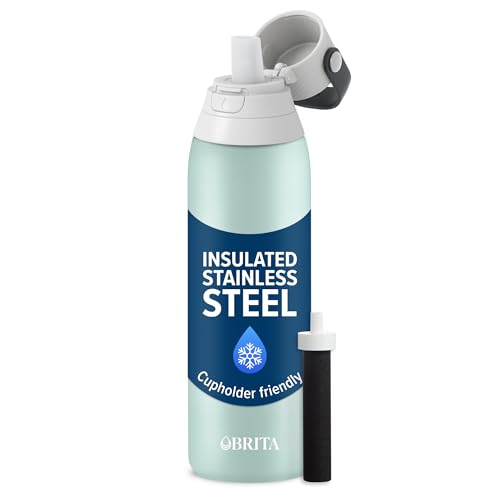
Brita Stainless Steel Filter Bottle
This is the only bottle on the list that treats the water rather than just holding it. A carbon filter sits in the straw, so tap water is filtered on the way up rather than in a jug beforehand, which is the point if you are trying to stop buying bottled water at work or on the road. Brita rates each filter for roughly two months of normal use. The body is insulated stainless steel, so it behaves like a normal bottle the rest of the time. You are trading some capacity and a recurring filter cost for tap water that tastes better.
- Carbon filter built into the straw filters as you drink
- Brita rates each filter for around two months of typical use
- Insulated stainless steel body, BPA-free
- Reduces chlorine taste and odor from tap water
- Straw lid with a push-button opening and carry loop
- Filter replacements are widely stocked and inexpensive
- Removes the need to pre-filter in a jug
- Fits standard car cup holders
- Dishwasher safe lid, hand wash the body
- Designed to cut single-use bottle purchases
- Makes unfamiliar tap water drinkable, which no other bottle here does
- Filter sits in the straw, so there is no waiting
- Replacement filters are cheap and easy to find
- Insulated body means it works as a normal bottle too
- Good choice for offices with poor-tasting water
- Ongoing filter cost that none of the other bottles have
- Filter takes up internal space, cutting usable capacity
- Reduces taste and odor, not a purifier for unsafe water
- Plastic straw and filter housing sit in the drinking path
The short version: A filter for taste rather than for safety, and it is important to be clear about which problem you are solving. If your tap water is safe but unpleasant, this fixes it. If you are filling from a stream, it does not.
What it is
An insulated stainless bottle with a replaceable carbon filter in the straw, from the brand most people already associate with jug filters.
The lid
A straw lid with the filter built into the straw itself, so water is filtered as you drink rather than as you fill. The practical consequence is that there is no waiting.
Insulation and performance
Double-wall vacuum insulation in the stainless version. Brita quotes filter life in bottles-replaced rather than hours of retention, which tells you where the brand thinks the value is.
Materials and safety
Stainless body, BPA free, with an activated carbon filter. Carbon reduces chlorine taste and odor. It does not remove bacteria, protozoa or viruses. That distinction is the whole reason the LifeStraw sits five places above it.
Where it falls short
Filters are a running cost, the straw assembly needs regular cleaning, and the filtration is the mildest here. It is a taste upgrade, not a safety device.
Who should buy it
Anyone whose tap water is safe but tastes of chlorine, and who will actually replace a filter on schedule.
Our Scores
Criteria | Score (out of 100) |
|---|---|
Lid & drinkability | 76 |
Insulation performance | 82 |
Build & durability | 80 |
Ease of cleaning | 74 |
Everyday usability | 80 |
Value for price | 82 |
Overall | 76 |
19. YETI Yonder 34 oz — Lightest

YETI Yonder 34 oz
- Light enough to stop mattering in a pack
- The cap cannot be left behind
- Leakproof rather than leak-resistant
- Clips on without an accessory
- Dishwasher safe
- No insulation at all
- Plastic scratches where steel dents
- Costs more than plastic bottles that match it
- Wide body is not cup-holder friendly
- 1 liter / 34 oz capacity
- BPA-free plastic body, not steel
- Tether Cap stays attached to the bottle
- Maker states 100 percent leakproof
- Clips to a strap or carabiner
- Substantially lighter than a steel bottle
- Dishwasher safe
- No insulation of any kind
- Also sold in other sizes
- Backed by YETI's warranty
The short version: The bottle YETI makes for people who do not want to carry YETI weight. It holds a liter, it weighs a fraction of a Rambler, and the cap cannot be lost. What you give up is every degree of temperature control.
What it is
A 1 liter / 34 oz BPA-free plastic bottle with the Tether Cap permanently attached. It clips to a strap or a carabiner and is dishwasher safe.
The lid
The Tether Cap stays attached to the bottle, so the component everyone eventually loses cannot be left on a table. YETI states it is fully leakproof rather than leak-resistant, which is unusually firm wording for a plastic bottle.
Insulation and performance
None. This is single-wall plastic. Water tracks the ambient temperature and ice does not survive a warm afternoon. The insulation score of 20 is not a failure — it is the specification.
Materials and safety
BPA-free plastic, dishwasher safe, and backed by YETI warranty support. Plastic scratches where steel dents, which is cosmetic rather than structural.
Where it falls short
It costs considerably more than plastic bottles that do the same job, it keeps nothing cold, and the body is too wide for most cup holders. You are paying for the cap design and the warranty.
Who should buy it
Hikers and anyone packing by weight, where every gram is argued over and temperature is not part of the argument.
Our Scores
Criteria | Score (out of 100) |
|---|---|
Lid & drinkability | 88 |
Insulation performance | 20 |
Build & durability | 76 |
Ease of cleaning | 88 |
Everyday usability | 84 |
Value for price | 70 |
Overall | 74 |
Other Bottles We Considered
Nineteen bottles is a long list, and the ones that did not make it are as useful as the ones that did. These were read, compared and left out, with the reason in each case.
Left out on the strength of the product
- Purist Mover. A glass-lined interior is the only real answer to flavor transfer in a steel bottle, and on paper it belongs here. In practice the model that gets recommended is not the one reliably stocked, and the listings that are available come and go. A bottle you cannot buy is not a recommendation.
- Nomader and other collapsible bottles. A collapsible bottle solves a genuine problem — pack size on the way home — but the silicone ones hold flavor, the folding seams are the first thing to fail, and none of them insulate. If pack space is the constraint, the YETI Yonder at nineteen does the lightweight job without folding.
- LARQ PureVis and UV self-cleaning bottles. UV-C does sanitise the inside of a bottle between fills, and it is the only category here that addresses the smell problem at source. It also adds a battery, a charging cable and a failure mode to something that otherwise has none. Worth considering if you never wash a bottle properly; skip it if you do.
- Lifefactory, Corkcicle and Iron Flask. All competent. None does anything the bottles above do not do, and each is beaten on its own ground by something already on this list.
- Memobottle and other flat bottles. A flat profile genuinely fits a laptop bag better. The trade is a narrow opening that is hard to clean and a shape that suits no cup holder at all.
Moved to a more specific guide
- Bivo Trio. An insulated cycling bottle is a different object from an everyday bottle — it has to be squeezable, bottle-cage shaped and openable with one hand at speed. It belongs in the insulated bike bottle guide rather than here.
- Hydro Flask Kids and CamelBak Eddy+ Kids. A bottle for a child is judged on different things: bite valves, drop survival, whether the lid can be opened by small hands and closed by them again. Both now sit in the kids bottle roundup.
Dropped from a previous version of this guide
- YETI Rambler One Gallon Jug. It is an excellent jug. It is not a water bottle, and including it distorted every capacity comparison on the page.
- Ello Cooper 22 oz. A perfectly good budget straw bottle, but the Owala FreeSip does the same job better and the BrüMate Rise does it with a metal straw. It was the weakest entry once both were added.
The Retention Numbers Nobody Can Actually Compare
Here is a table you’ll see in some form on every roundup in this category, and here is why it’s close to meaningless.
Bottle | What the brand publishes |
|---|---|
Klean Kanteen TKWide | 75 hours iced |
Hydro Flask Wide Mouth | 24 hours cold, 12 hot |
Owala FreeSip | 24 hours cold |
Takeya Originals | 24 hours cold |
Ello Cooper | 24 hours cold |
WaterH BOOST | 24 hours hot or cold |
CamelBak Eddy+ Kids | 10 hours cold |
YETI Rambler | Nothing |
YETI Rambler Jug | Nothing |
LifeStraw Go | Nothing |
Read that top row against the second. Klean Kanteen’s figure is three times Hydro Flask’s. Does that mean a TKWide keeps water cold three times longer than a Hydro Flask? Almost certainly not — because they are not measuring the same thing.
“Iced” and “cold” are different tests. A bottle can still contain a visible sliver of ice at hour forty while the water around it has been merely cool since hour twelve. “Hours iced” is a generous measure. “Hours cold” is a stricter one. Brands choose the one that flatters the product, and nothing obliges them to say which they used.
Nobody publishes their conditions. Fill level, ice mass, starting water temperature and ambient room temperature each move the result by hours. None of these brands publish a protocol. Two bottles both claiming twenty-four hours may have faced tests that differ by half a day.
And every figure assumes you never open it. Each time you unscrew the lid you vent the cold air and start again. A bottle you actually drink from through a working day will never reach its own specification, and that isn’t the bottle’s fault.
The most useful correction I found came from an owner rather than a lab. Klean Kanteen publishes seventy-five hours iced; the most specific verified-buyer report on that same bottle says “ice lasts 20+ hrs”. Twenty-plus hours is good. A full day and a night. It is also a quarter of the headline.
Then there are the three that publish nothing at all, including the bottle with the best build score on this page. That is not a scandal; YETI’s reputation was built without a number. But it does mean that when you compare a YETI against a Hydro Flask on a spec sheet, you’re comparing a claim against a blank — and the blank isn’t the same as a zero.
How to use these figures properly: treat them as a tier, not a ranking. Anything published at twenty-four hours or above is a day-long bottle. Ten hours is a school-day bottle. Nothing published means judge on construction (double wall, vacuum sealed, sweat-free exterior) and on what long-term owners say.
The Lid Is the Part That Fails
Set each bottle’s build score against its cleaning score and a pattern appears immediately.
Bottle | Build | Cleaning |
|---|---|---|
YETI Rambler 26 oz | 100 | 92 |
Owala FreeSip | 94 | 56 |
Klean Kanteen TKWide | 94 | 78 |
Nalgene Sustain 32 oz | 88 | 80 |
Hydro Flask Wide Mouth | 86 | 90 |
Takeya Originals 40 oz | 78 | 70 |
This guide’s own scores, out of 100. Build clusters between 78 and 100. Cleaning runs from 92 all the way down to 56, and the bottle at the bottom of that column is one of the strongest in the build column. The variable is not the steel. It is the lid.
The same story shows up everywhere once you look for it. Hydro Flask’s most persistent criticism is not the body. It is that the gaskets wear out and are hard to replace. Klean Kanteen’s worst owner report is about a cap ring seizing. The Owala’s problem is a lid so intricate that a dishwasher cycle does not reliably clear it. Nobody complains that the steel gave up.
What each lid type actually costs you
- Straw lids drink best and clean worst. You need a thin straw brush and you need to use it. The joint where straw meets lid is where trouble starts. Only buy one if you’ll keep on top of it — or buy one where every part is dishwasher safe.
- Chug caps are the sensible middle. Few parts, quick pour, easy to clean, and you can drink without a faceful. The cost is two hands and no sipping while you walk.
- Screw caps seal best and clean fastest because there is nothing to clean. The cost is all convenience — no one-handed drinking at all.
- Spout lids sit between chug and straw. Watch for recesses around the spout, which is exactly where residue collects.
- Bite valves are excellent for children because they are spill-proof even when open. Treat the valve as a consumable and check replacements are cheap before you buy.
The practical rule I would give anyone: buy the simplest lid you’ll still enjoy drinking from. Every feature added to a lid is a surface you’ll eventually have to clean, and the bottle you keep is the one that doesn’t feel like a chore on a Sunday evening.
What the Warranties Don’t Cover
“Lifetime warranty” is one of the most quietly misleading phrases in this category. Every warranty here covers manufacturing defects. Almost none of them cover the damage you’ll actually get.
Brand | Term | What it excludes |
|---|---|---|
Hydro Flask | Limited lifetime | Dents, scratches, powder-coat chips from drops |
Nalgene | Lifetime guarantee | Cosmetic damage — scratches, nicks, worn prints |
Takeya | Limited lifetime | Dents, scratches, color fade |
YETI | 5 years | Normal wear; original owner only |
Klean Kanteen | Lifetime limited | Normal wear and misuse |
CamelBak | Lifetime (“Got Your Bak”) | Covers defects in materials and workmanship |
Owala | Limited lifetime | Normal wear |
Three of the biggest names on this page, Hydro Flask, Nalgene and Takeya, go out of their way to name cosmetic damage as excluded. So the powder-coat chip from the day you dropped it on the drive, the scuffs down one side from a car door, the faded color after two summers on a dashboard: none of that’s a claim, on any of them.
What a warranty does cover is a bottle that stops insulating, a lid marketed as leakproof that leaks, or a component that breaks in normal use. Those are real, they happen, and they are worth the paperwork. Buy the finish you’ll still like scuffed, because scuffed is where it ends up and no one is replacing it for that.
Also note the outlier: YETI’s five years is the shortest term here, on the most expensive bottles. Several cheaper bottles on this page carry lifetime cover.
Hydro Flask vs Owala vs YETI: Head to Head
These three are the brands every roundup names, and most people are really choosing between them.
Feature | Hydro Flask Wide Mouth | Owala FreeSip | YETI Rambler |
|---|---|---|---|
Published retention | 24 h cold / 12 h hot | 24 h cold | None published |
Lid | Three swappable Flex caps | Two-way spout, locking | Chug cap |
Independent durability | 8.0 | 9.0 | 9.0 |
Independent cleaning | 8.0 | 5.0 | 8.5 |
Dishwasher | Yes | Lid only | Yes, body and cap |
Measured weight | 363 g | ~522 g | 624 g |
Hot drinks | Yes, 12 h | No | Yes |
Warranty | Limited lifetime | Limited lifetime | 5 years |
Choose the Hydro Flask if you want one bottle that does everything, takes hot drinks, and can become a straw bottle or a chug bottle whenever you change your mind. Choose the Owala if the drinking experience is what keeps you hydrated and you’ll hand-wash the lid. Choose the YETI if you’re hard on gear and want the body that won’t care, accepting the weight, the price and the absence of a stated number.
Best Reusable Water Bottle by Use
Pick by the job the bottle actually does. If you are still deciding whether the switch is worth making at all, the reusable water bottle benefits are set out separately, and how much water you should drink a day will tell you what capacity you are really shopping for.
- Desk and commute: Hydro Flask Wide Mouth, or the Ello Cooper if you want a straw you can put in the dishwasher — see how the Ello bottles hold up for the range. If a straw is non-negotiable, see best insulated straw water bottle.
- A child: a bottle sized for smaller hands is a different purchase, and we cover it in the kids bottle roundup.
- The gym: Owala FreeSip for the one-handed lid, YETI Rambler if it gets thrown around.
- Hiking and backpacking: Hydro Flask Lightweight Trail if you want cold water, Nalgene Sustain if you want the lightest possible bottle and don’t care about temperature.
- Travel and unfamiliar taps: LifeStraw Go, and nothing else here comes close for that job.
- Children: CamelBak Eddy+ Kids for ages three to ten.
- Hot drinks: Hydro Flask at twelve hours, or the YETI. Do not use a cold-only straw bottle for coffee — several are explicitly not rated for it because pressure builds behind a sealed lid.
- Groups, sites and long days: YETI Rambler Gallon Jug.
- Pure taste: Ello Syndicate glass, for anyone who alternates coffee and water in one bottle.
Materials: Steel vs Glass vs Tritan vs Filtered
Before the material comparison, two things worth reading separately: what these bottles are actually made of is covered in our guide to materials for reusable water bottles, and the plastics question is handled in full under microplastics in reusable water bottles.
Stainless steel — specifically food-grade 18/8, also sold as 304, is the default for good reason. It is stable in contact with water, holds no odor, survives being dropped, and is the only material here that can be vacuum insulated. It is also the heaviest, and a powder coat will chip. If steel is the only material you will consider, we rank it separately in our top rated stainless steel water bottles guide, and the health questions people ask about it are answered under safest reusable water bottles.
Glass is the most chemically inert option, which is a technical way of saying it tastes of nothing and never will. If you switch between coffee, tea and water in the same bottle, glass is the only material that won’t carry yesterday over. The cost is weight, fragility and no insulation, and glass is the weakest material in this guide on both leaking and breakage. A silicone sleeve is not optional. If temperature is the thing you care about most, the answer to what is the best insulated water bottle is a separate guide.
Tritan is the modern BPA-free plastic, and it earns its place on merit rather than price alone: it is by far the lightest, it is hard to break, and Nalgene’s version is made from 50% certified recycled content. It cannot be insulated, and it will pick up odors over years in a way steel and glass do not.
Filtered bottles: the distinction that actually matters
This is the part of the category most often explained badly, so here it is plainly. There are two completely different things sold as “filtered”.
Activated carbon filters improve taste. They reduce chlorine and particulates, which is why filtered tap water tastes softer. They do nothing to bacteria, parasites or viruses. Most household-brand filter bottles are this type, and their own certifications say so: chlorine taste and odor, and particulates. That is an honest claim, and it is a taste product.
Membrane microfilters remove organisms. A membrane of around 0.2 microns physically blocks bacteria, parasites and microplastics. This is what you need if you’re filling from a source you don’t trust. A bottle doing this properly will name the standards it was tested against (WHO, US EPA, NSF) rather than just saying “filtered”.
Buying the first when you needed the second is the single most consequential mistake in this category. If the bottle can’t tell you its filter’s micron rating or its testing standard, assume it’s a taste filter.
On plastics generally: the FDA’s current position is that BPA is safe at the levels found in food contact, though it amended its regulations in 2012–13 to drop BPA-based materials from baby bottles and sippy cups. BPA-free is now the baseline buyers expect rather than a feature worth advertising, and every bottle on this list meets it.
What to Look for When Buying
Size, and the weight nobody mentions
For most people 24–32 oz covers an office or gym day without constant refilling and still fits a cup holder. Go bigger only if refilling is genuinely inconvenient, because weight climbs fast and it is rarely discussed: the heaviest bottle here is 624 g empty against the lightest at 177 g. That is three and a half times, before any water goes in. Under 20 ounces makes sense for a handbag or a child and not much else.
Cup-holder fit
If the bottle rides in a car, check the base diameter before anything else — a 32 ounce bottle that will not sit in the holder is a 32 ounce bottle that rolls around the footwell. The insulated range is compared on exactly that in the cup-holder fit comparison. Several bottles here, among them the YETI Rambler, the 32 oz smart bottle, the gallon jug, the wide-mouth Nalgene — do not fit a standard cup holder, and a bottle that lives on a passenger seat is a bottle that rolls under the pedals.
Read the dishwasher claim closely
“Dishwasher safe” is doing a lot of work on product pages. Sometimes it means the whole bottle. Often it means the lid only, or the top rack only, and occasionally it means the body but not the lid, which is exactly backwards from what you need. On this page the fully dishwasher-safe bottles are a genuine minority, and check it before you buy rather than after you’ve ruined a finish.
Match the lid to your honest habits
Not to your aspirations. If you’ll not use a straw brush weekly, don’t buy a straw bottle unless every part goes in the dishwasher. If you drink while walking or driving, a wide mouth will soak you. If it goes in a bag with a laptop, buy a lid that locks and take leak reports seriously.
Is a Reusable Bottle Actually Greener?
Mostly yes, but not for the reason the marketing gives, and not immediately. A steel bottle costs far more to manufacture than a single-use plastic one. It only pays that back after it has replaced enough of them, and every estimate of how many depends on assumptions about the energy mix where it was made. The honest version is that the break-even is in the dozens to low hundreds of fills, and that you reach it quickly with a bottle you actually carry.
The greenest bottle is the one you already own
That is the part the category tends not to say. Replacing a working bottle because a new one looks better is the single least green thing you can do here, and it is what most of this market runs on. If you are reading this because your current bottle leaks, smells or has a lid you hate, replacing it is justified. If it works, it works.
Look past the broad eco-friendly claim
“Eco-friendly” on a product page usually means one specific, narrow thing, and it is worth finding out which. Nalgene Sustain is made from material derived from recycled content, and says so with a figure. Stanley states 90 percent recycled stainless. Those are checkable claims. A vague badge without a number usually means the packaging.
The end-of-life picture is less flattering across the board. A vacuum-walled steel bottle with a coating and a plastic collar is awkward to recycle curbside, so many end up in landfill rather than back in the steel stream. Glass and uncoated steel are the easiest to process; a multi-material insulated bottle is the hardest. None of that outweighs displacing single-use plastic, but it is worth knowing before the word “recyclable” does any work on you. For the fuller argument, see the reusable water bottle benefits guide.
Care and Cleaning
- Daily: rinse with hot water and soap, especially after anything with sugar or citrus. Dry with the lid off. The full routine, including deep cleans, is in the best way to clean reusable water bottles.
- Weekly: pull the gasket out of the lid, wash it separately, and let both halves dry apart. This single habit prevents most of the odor problems people blame on the bottle.
- Straws: remove and brush. A thin straw brush costs very little and is the difference between a straw bottle you keep and one you quietly retire.
- Deep clean: baking-soda paste or a diluted white-vinegar soak. Avoid bleach, which can pit stainless steel.
- Store it open. A sealed damp bottle is how smells begin.
- Never microwave a steel bottle, freeze a vacuum-insulated one, or exceed a maker’s stated temperature ceiling.
If you’re buying partly on how a bottle looks, it helps to know which finishes survive that routine and which dull after a season. Our guide to aesthetic water bottle picks covers fifteen picks chosen on finish, colorway and silhouette rather than performance.
Frequently Asked Questions
What is the best reusable water bottle overall?
The Hydro Flask Wide Mouth 32 oz, for most people. It publishes real retention figures rather than vague claims, its lid swaps between straw, chug and flip so one bottle covers several habits, and long-term owner reports run past six years. If you’re hard on gear, the YETI Rambler is tougher. If you want the best value, the Nalgene Sustain costs a fraction and may outlive both.
Which reusable water bottle is best for everyday use?
For most people it is the Hydro Flask Wide Mouth 32 oz, because everyday use is really three jobs at once and the swappable lid lets one bottle do all of them. If your everyday means a car, the Owala FreeSip Sway is the same idea in a shape that fits a cup holder. If it means a desk and a straw, the Stanley Quencher is the tumbler built for exactly that, provided you never put it in a bag on its side.
What is the healthiest type of reusable water bottle?
Glass, on the narrow question of what touches the water — borosilicate glass is chemically inert, so it leaches nothing and carries no flavor between drinks. Food-grade 18/8 stainless steel is the practical answer for most people, since it is stable in contact with water and survives being dropped. Every bottle in this guide is BPA free, and several state in writing that they are free of lead and phthalates too, which is worth looking for because many brands simply do not say. But the honest answer is that material matters less than habit. A non-toxic bottle you never wash properly is worse for you than a plastic one you clean weekly, because the thing that actually grows in a bottle is what lives in the lid. The safest reusable water bottles guide goes through the evidence in full.
How long do reusable water bottles last?
The body and the lid age at completely different rates, and conflating them is why people replace bottles too early. A stainless steel body will normally see out a decade of ordinary use. The long-term reports behind this guide include a Hydro Flask at six-plus years and a YETI at five. The lid is the consumable: gaskets perish, straws split, bite valves harden. Judge replacement by whether spare parts are available and affordable, not by whether the outside looks tired.
How often should you replace a reusable water bottle?
Replace a plastic bottle when it holds odor you can’t shift or shows cracks and deep scratches that trap residue. Replace a steel bottle when the vacuum fails, when the outside starts sweating or contents stop staying cold — or when rust or pitting appears inside. Replace lid components far more often than bottles: a perished gasket or a split straw is a part, not a purchase.
Are stainless steel water bottles safe?
Food-grade 18/8 stainless, also sold as 304, is stable in contact with water, does not hold odors and does not degrade with heat the way some plastics can. It is not literally inert, since acidic drinks in a scratched or pitted bottle can pick up a faint metallic note — but for water it is the most reliable material here. Rust or pitting inside means the bottle has reached the end of its life.
Which material is best — steel, glass or plastic?
Steel for durability and insulation, glass for taste, Tritan for weight and price. There is no overall winner, only a fit: steel is the only one that keeps drinks cold, glass is the only one that never carries flavor over, and Tritan is a third of the weight of the heaviest steel bottle here. Choose the property you’ll notice daily.
How long do insulated bottles really keep water cold?
Less than the label, because the label assumes a sealed bottle you never open. Published figures across this list run from ten hours to seventy-five, and they are not comparable. Some measure hours iced, some hours cold, and none publish their test conditions. In practice a good vacuum-insulated bottle keeps water properly cold through a working day with normal opening. Treat published figures as tiers, not rankings.
Why does my reusable bottle smell?
Nine times in ten it is the lid gasket, not the body. The silicone seal traps moisture against itself inside a closed lid and that is where odor develops. Pull the gasket out, wash it separately and dry the lid in two pieces. Straw lids need the straw removed and brushed as well. If a plastic bottle still smells after all that, the material itself has absorbed it and it is time to replace.
Are reusable water bottles dishwasher safe?
Some are, entirely; many are only partly. On this list the YETI Rambler is dishwasher safe body and cap, the Ello Cooper is dishwasher safe in every part including the straw, and several others rate only the lid or only the top rack. Check the maker’s own wording, because “dishwasher safe” on a listing frequently means one component rather than the bottle.
Do filtered water bottles remove bacteria?
Only the ones built to. Activated carbon filters, the type in most household-brand filter bottles, reduce chlorine and particulates to improve taste and do nothing to biological contamination. Removing bacteria and parasites requires a membrane microfilter of roughly 0.2 microns, and a bottle that does it will name the standards it was tested against. If a filtered bottle can’t tell you its micron rating, treat it as a taste filter.
What size reusable water bottle should I buy?
24–32 oz suits most adults for a working day and still fits a cup holder. Choose 40 oz or more only if refilling is awkward, because empty weight roughly doubles between those tiers. Under 20 oz is for handbags, children and short trips. If in doubt, smaller and refilled is more pleasant to carry than larger and half full.
Can you put hot drinks in a reusable water bottle?
Only in a vacuum-insulated bottle whose lid is rated for it. Single-wall glass and Tritan are not designed for hot liquids. Several insulated bottles are explicitly cold-only, because pressure builds behind a sealed straw lid and can force it open. Check the maker’s ceiling too, because one bottle on this list is capped at 185°F. Never microwave a steel bottle.
Which reusable water bottle fits in a car cup holder?
Look at base diameter rather than capacity, since tapered bottles fit at sizes straight-walled ones do not. On this list the slimmer 22–24 oz bottles generally fit, while the YETI Rambler, the 32 oz smart bottle, the wide-mouth Nalgene and the gallon jug do not. If the bottle lives in a car, treat this as the first filter rather than an afterthought.
Is a more expensive bottle actually better?
Up to a point. Money buys wall thickness, gasket quality, coating durability and longer warranty terms. Beyond the mid range you’re largely paying for brand and colorway. The clearest evidence on this page is that the cheapest bottle in the list earns a perfect five for value and is independently described as close to indestructible — it simply cannot keep anything cold.
The Bottom Line
If you want one bottle and no further thought, buy the Hydro Flask Wide Mouth 32 oz. If you are weighing the YETI instead, our YETI Rambler breakdown goes deeper on that one range, and takeya insulated water bottle review does the same for Takeya. It publishes honest numbers, the lid system means it can change jobs as your habits change, and people are still using theirs six years later.
If you’re hard on your things, the YETI Rambler earned the only perfect build score here and has been down the Grand Canyon three times in one owner’s hands. Accept the weight and the silence on retention. If you want to spend as little as possible, the Nalgene Sustain is the lightest, cheapest and most independently verifiable bottle on the page, and the only thing it cannot do is keep water cold. If you’re filling from taps you don’t trust, the LifeStraw Go is the only pick here tested against WHO, EPA and NSF standards. And if you want a straw without the maintenance penalty, the Ello Cooper is the one whose every part goes in the dishwasher.
The thread running through all nineteen is the one I started with: the bottle is rarely what fails. Pick the lid you’ll still be happy to take apart in a year, and the rest looks after itself. If you want the wider picture, covering materials, safety, cleaning and what to do with a bottle at the end of its life, start with our complete guide to reusable water bottle brands.
Sources
Every figure in this guide comes from one of three places, and each is named where it is used. No retention number here is mine.
- Manufacturer specifications and support documents — Hydro Flask, Owala, YETI, Nalgene, Klean Kanteen, Takeya, Stanley, BrüMate, Coldest, CamelBak, LifeStraw, Brita, purifyou, Ello and WaterH. Read from each brand’s own product and support pages rather than from a retail listing, because listings paraphrase and support pages do not.
- Published warranty terms — taken from each brand’s warranty page, including the exclusions, which is where the useful information is.
- Neutral standards bodies — the US Food and Drug Administration on food-contact materials and BPA, and NSF/ANSI protocols where a filter claims certification against them.
- Verified-buyer reports — read in bulk on each brand’s own site and on retail listings, for the faults that repeat rather than for the average.
Scores are this guide’s own editorial judgement, out of 100, applied consistently across all nineteen bottles using the six criteria set out above. They are not measurements and are not presented as any.
About the Author
This guide was written and is maintained by Mahmudul, owner of WaterBottleInfo.com. No brand supplied a product, sponsored this article or saw it before publication.
I want to be straight about method, because this category is full of claims that sound like measurements. I am not a laboratory. I have not run controlled thermal tests, and where you see a retention figure in this guide it belongs to the manufacturer, labeled as such every time. What I bring is the published specification read properly, the warranty read in full, and thousands of verified-buyer reports read for the faults that repeat. Where a brand’s claim and an owner’s experience disagree, I have said so rather than picking the tidier number.