

As an Amazon Associate we earn from qualifying purchases, at no additional cost to you. Water Bottle Info is reader-supported: we were not given these products and we do not accept payment for a favorable review.
Want glass, the larger capacity and the inhaler? The ionBottles Pro. Buy it from ionBottles directly, because the Amazon listing this page links to now opens a different model.
Want the highest published output? That is the ionBottles Atom, which is what the Pro’s Amazon listing now shows. It is Tritan rather than glass, and it holds less.
Set on an Echo? The Flask is the only portable bottle left in Echo’s catalog. The Go and the Go+ are gone from it.
Just want to try the technology cheaply? The 380 ml glass bottle sold on Amazon under the Echo Go brand name does the job. Go in knowing it is not made by Echo Water.
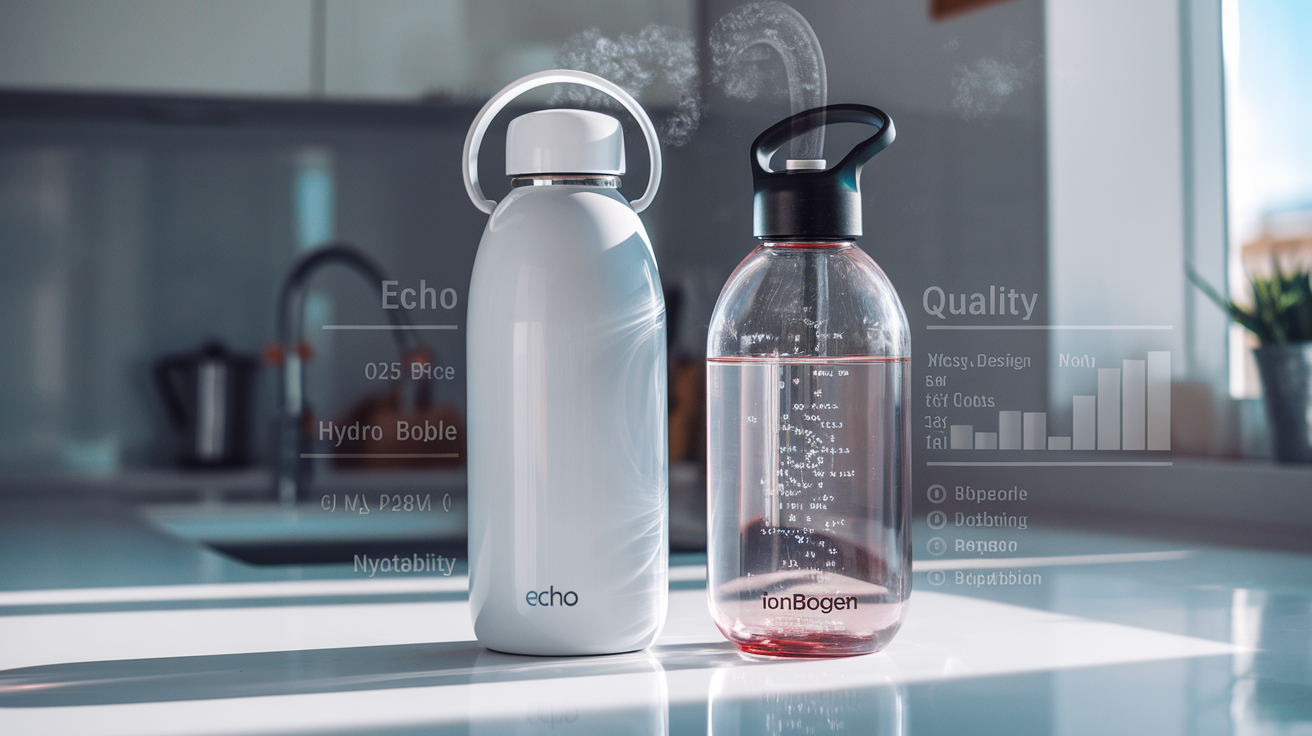
The Echo Go bottle vs ionBottles Pro question has a complication that most comparisons skip: as of today, neither bottle is quite what its listing suggests. Echo has moved on from the Go. The Pro is still made, but its Amazon listing opens a different model. That is worth knowing before you weigh a single specification, so this comparison starts there and then goes through what each maker actually publishes, who checked it, and which numbers nobody has checked at all. If you would rather see the wider field first, we keep a ranked list of the leading hydrogen water bottles.
Both bottles use the same underlying method. A proton exchange membrane separates hydrogen from oxygen so the hydrogen dissolves into your water and the oxygen vents away. The differences that matter are capacity, what the body is made of, how much hydrogen each maker claims, and whether anyone independent has confirmed the claim. That last one turns out to be the most interesting column in the table.
- Side by Side Comparison: Echo Go Bottle vs ionBottles Pro Hydrogen Water Bottle
- What each bottle in this comparison actually is
- The Echo line: what Echo publishes
- The ionBottles Pro: what ionBottles publishes
- The specs side by side, and who verified each one
- What a PPM number actually means
- How to choose between them
- Frequently asked questions
- Is the Echo Go still sold by Echo Water?
- What does the Amazon listing under the Echo Go name actually ship?
- Can I buy the ionBottles Pro on Amazon?
- Does a higher PPM figure mean a better bottle?
- How can I check a hydrogen concentration claim myself?
- Is the ionBottles Pro independently lab tested?
- Which should I buy for travel?
- Is hydrogen water worth it at all?
- The verdict
Side by Side Comparison: Echo Go Bottle vs ionBottles Pro Hydrogen Water Bottle
|
Compact Travel Companion

|
Premium Glass Construction

|
|
Description: A 380 ml borosilicate glass hydrogen water bottle sold under the Echo Go brand name. Amazon lists the manufacturer as LSTKJ, not Echo Water. It uses SPE/PEM electrolysis, and the seller quotes 1.2 PPM on the three minute cycle and 1.8 PPM on the ten minute cycle. USB rechargeable, with automatic shut-off. Drawbacks: the glass body needs careful handling, 380 ml is a small serving, hydrogen dissipates soon after the cycle ends, and it needs purified water plus regular descaling. |
Description: The ionBottles Pro uses SPE/PEM electrolysis to produce up to 3.0 PPM (3,000 PPB) of hydrogen on its ten minute cycle, a figure ionBottles publishes itself. The body is borosilicate glass on a stainless steel base. One button operation, a self-cleaning cycle and a built-in inhaler port. Drawbacks: the glass is fragile, it costs more than plastic rivals, and owners report occasional charging faults. Evidence for the health claims made for hydrogen water is still early. |
|
Key Features & Benefits:
|
Key Features & Benefits:
|
|
Pros:
|
Pros:
|
|
Cons:
|
Cons:
|
A 380 ml borosilicate glass hydrogen water bottle sold under the Echo Go brand name. Amazon lists the manufacturer as LSTKJ, not Echo Water. It uses SPE/PEM electrolysis, and the seller quotes 1.2 PPM on the three minute cycle and 1.8 PPM on the ten minute cycle. USB rechargeable, with automatic shut-off. Drawbacks: the glass body needs careful handling, 380 ml is a small serving, hydrogen dissipates soon after the cycle ends, and it needs purified water plus regular descaling.
- Electrolysis Technology: SPE/PEM system, seller quotes 1.2 to 1.8 PPM
- Dual Timing Options: Three or ten minute cycles with automatic shut-off
- Glass Construction: 380 ml borosilicate glass
- Portable and Lightweight: Fits most cup holders
- USB Rechargeable: Battery powered, USB adapter included
- Water Requirement: Needs filtered or purified water, and is not a filter itself
- Short three minute cycle if you want a quick dose
- Seller quotes 1.2 to 1.8 PPM
- Borosilicate glass rather than plastic
- USB charging
- Automatic shut-off at the end of each cycle
- Small enough to carry
- Limited to 380 ml
- Not for water above 60 C
- Needs charging regularly
- Glass needs careful handling
- Not made by Echo Water, despite the brand name on the listing
The ionBottles Pro uses SPE/PEM electrolysis to produce up to 3.0 PPM (3,000 PPB) of hydrogen on its ten minute cycle, a figure ionBottles publishes itself. The body is borosilicate glass on a stainless steel base. One button operation, a self-cleaning cycle and a built-in inhaler port. Drawbacks: the glass is fragile, it costs more than plastic rivals, and owners report occasional charging faults. Evidence for the health claims made for hydrogen water is still early.
- Hydrogen Output: Up to 3.0 PPM (3,000 PPB), published by ionBottles
- Borosilicate Glass Chamber: 14 oz thermal-shock-resistant glass with a stainless steel base
- Rechargeable Convenience: USB-C charging, 10 or more cycles per charge
- One-Touch Simplicity: Single-button operation
- Self-Cleaning Cycle: Hold the power button to run a cleaning cycle through the electrodes
- LED Status Indicator: Shows operation, battery and cleaning status
- Portable Design: Fits most cup holders and bags
- Built-In Inhalation Port: Breathe residual hydrogen through the included cannula
- Highest published output of the two, at 3.0 PPM (3,000 PPB)
- Rechargeable, so there is nothing to reorder
- Borosilicate glass does not hold flavours or leach
- Self-cleaning cycle reduces scale on the electrodes
- The only bottle here with an inhaler port
- Glass needs careful handling, and there are electronics in the base
- 14 oz is one or two glasses, not a day of water
- Needs charging every few days with regular use
- Costs more than a plastic bottle of similar output
- The Amazon listing now opens a different model, so buy direct
What each bottle in this comparison actually is
This is the part that changes the rest of the page, so it goes first.
The bottle sold on Amazon under the Echo Go brand name is not made by Echo Water. Amazon’s own product details list the manufacturer as LSTKJ, the model as QQB95, the body as glass and the capacity as 380 ml. Echo Water’s own Echo Go is a 9.5 oz polycarbonate bottle. Those are two different products that happen to share a name in a brand field. We have gone through the echo go in full separately if you want the detail.
Echo Water’s own catalog no longer lists the Go or the Go+. Both product URLs now redirect, the Go to the Echo homepage and the Go+ to the Echo Flask. The Flask is the only portable bottle Echo still sells. We are reporting catalog status here, not stock levels, and Echo has not announced anything.
On the ionBottles side, the Pro is still in production and still sold on ionBottles’ own site. Its Amazon listing, however, now resolves to the ionBottles Atom, a 10 oz Tritan bottle with a higher published output. The Pro and the Atom are different bottles and their numbers should never be mixed. If you want a fuller picture of how to pick between formats, start with how to choose a hydrogen water bottle.
The Echo line: what Echo publishes
Echo builds all three of these bottles on solid polymer electrolysis with a proton exchange membrane, in a dual-chamber design that keeps chlorine and ozone out of the water you drink. The models differ mainly in output and capacity.
Echo Go: capacity, cycle time and hydrogen output
Echo publishes up to 1.8 PPM (1,800 PPB) for the original Go, in a 9.5 oz bottle, with a short cycle and a longer one. It is the least powerful of the three and it is the one that has left the catalog. Echo asks for filtered, distilled or reverse osmosis water rather than tap water.
Echo Go+: what the extra output buys
The Go+ is the model most often confused with the Go, including on this page before today. Echo publishes 2.5 PPM at five minutes and up to 4.5 PPM at ten, in a 10 oz bottle. That is roughly double the Go. Its product URL now redirects to the Flask. Our echo go plus in full covers it properly.
Echo Flask: the only one Echo still sells
The Flask is Echo’s current portable bottle, a 12 oz model for which Echo publishes up to 8 PPM. Echo lists a five year warranty and a sixty day return window on it. ionBottles’ competitor page disputes the return figure and says thirty days. We have not been able to reconcile the two, so both are on record here. The echo flask in full goes deeper.
Echo states that all of its products undergo third party testing and that certificates are available, including a PFAS report for the Flask. ionBottles, for its part, describes Echo’s concentration figures as self published. Both positions are on their respective websites and we are not in a position to settle which is the better description.
The ionBottles Pro: what ionBottles publishes
The Pro is a 14 oz borosilicate glass bottle. ionBottles publishes up to 3.0 PPM (3,000 PPB) on the ten minute cycle, with a three minute option for a lighter dose, and quotes ten or more cycles per charge over USB-C. It costs less than the Echo bottles it competes with. Our our ionbottles pro review has the full picture.
Self-cleaning, and what it does
Holding the power button for five seconds runs a cleaning cycle through the electrodes. It reduces the mineral scale that builds up on the plates and gradually cuts output. It does not replace descaling, and ionBottles still recommends periodic cleaning with citric acid and distilled water. Echo’s approach on some models is polarity reversal instead.
The inhaler port
The Pro has a built-in inhaler port and ships with a cannula, which ionBottles describes as a feature no other bottle in its range has. Whether that is worth anything to you depends entirely on whether you intend to use it. It is the clearest single difference between the Pro and every Echo bottle here.
Glass, and the trade-off it brings
Borosilicate glass resists thermal shock, will not leach and does not hold flavours. It also breaks. Owner reviews on the Amazon listing raise breakage and charging problems more often than anything else. Echo’s Go used BPA-free polycarbonate instead, which is shatter-resistant and less pleasant to drink from. There is no right answer here, only a choice about where you will carry it.
The specs side by side, and who verified each one
Every figure below is what the maker publishes. The right-hand column is the part that usually goes unmentioned, and on this pairing it is where the comparison actually turns.
| Specification | ionBottles Pro | Echo Go | Echo Flask | Where the number comes from |
|---|---|---|---|---|
| Hydrogen output | Up to 3.0 PPM (3,000 PPB) | Up to 1.8 PPM | Up to 8 PPM | Each maker’s own product page. See the note below on lab verification |
| Capacity | 14 oz | 9.5 oz | 12 oz | Maker published |
| Body material | Borosilicate glass | BPA-free polycarbonate | Not published on the product page | Maker published |
| Self-cleaning cycle | Yes | Sources disagree | Not published | ionBottles product page. For Echo, a dealer spec table and Echo’s own pages do not agree |
| Inhaler port | Yes, with cannula | No | No | ionBottles product page |
| Warranty | 1 year | 5 years | 5 years | Maker published |
| Returns | 60 day refund | 60 days per Echo, 30 per ionBottles | 60 days per Echo | Disputed between the two makers |
| Independent lab report | None published for the Pro | None found | Echo says certificates exist | See below |
| Still in the maker’s catalog | Yes | No | Yes | The makers’ own catalogs |
The lab verification question, which neither brand answers cleanly
The Pro’s product page carries a badge reading Lab-verified PPM. ionBottles’ own FAQ page then answers the question Why is only the ATOM certified? by saying it prioritized third party lab testing for the Atom, and that its other models use the same technology and components. An earlier answer on the same page says ionBottles products are tested and certified by a laboratory accredited to ISO/IEC 17025. Those two answers do not agree with each other, and we could not find a published lab report for the Pro.
Echo is in a similar position from the other direction. It says its products undergo third party testing and that certificates are available, while a competitor characterizes its figures as self published. Neither brand’s verification story survives a careful read of its own website. We are not saying either is wrong. We are saying that if the published concentration is what is deciding your purchase, you should know that on this pairing it rests on the makers’ word.
What a PPM number actually means
This is the section that makes the numbers above comparable, and it is the reason a higher figure is not automatically a better bottle.
At room temperature and normal atmospheric pressure, water stops dissolving hydrogen at roughly 1.6 PPM. That is a physical ceiling, not a build quality difference. So when a bottle advertises 3.0 PPM, or 5.0, or 8.0, the reading is taken at the moment of generation, while the sealed bottle is very slightly pressurized and the water is carrying extra hydrogen as fine nanobubbles. That state is real and measurable. It also starts unwinding the second you open the lid.
Two things follow. The first is that the gap between a 3 PPM bottle and an 8 PPM bottle at the moment you actually drink is much smaller than the gap between the headline numbers. The second is that how quickly you drink it, and how well the lid seals, matter more than the number on the box. Dissolved hydrogen has a half-life of roughly two hours in an open container, and far less if the water is shaken.
How to check a claim yourself
You do not have to take any of this on trust, ours included. A reagent titration such as H2Blue gives a usable home reading: add drops to a 6 ml sample and count how many lose their color before the sample stays blue, then multiply by 0.1 for a rough figure in PPM. If a bottle claims a high concentration and the sample stays blue after a few drops, the bottle is not doing what the box says. The laboratory reference method is headspace gas chromatography, which is what an accredited lab report would be based on.
One thing to avoid: an ORP meter does not measure hydrogen concentration. It reads oxidation reduction potential, which is affected by pH, dissolved minerals and chlorine. It is widely sold for this purpose and it will not answer the question.
How to choose between them
Start with capacity, not concentration
Both of these bottles are small. The Pro holds 14 oz and the Echo bottles hold less. That is one or two glasses, not a day’s water, so you will refill and re-run the cycle several times. If that sounds tedious, it will be. A larger format suits some people better than any of these.
Then decide what the body should be made of
Glass tastes cleaner and will not leach. It also breaks, and a hydrogen bottle has electronics in the base. If it lives on a desk, take the glass. If it goes in a gym bag, take the plastic. This is a bigger practical difference than any concentration figure on this page.
Treat the headline number as a ceiling, not a dose
Given the saturation limit above, a 3 PPM bottle you drink from immediately can easily deliver more hydrogen than an 8 PPM bottle you brew and leave on the counter. What you want from the number is enough margin that a slightly tired electrode still reaches a useful concentration. Chasing the biggest figure on the box is the wrong optimization.
Check what the link in front of you actually opens
That sounds obvious. It is also how this page went wrong for months. Before you buy, read the product title and the brand on the listing itself, not the link text that brought you there.
Frequently asked questions
Is the Echo Go still sold by Echo Water?
No. Echo’s own product URL for the Go now redirects to its homepage, and the Go and Go+ no longer appear in Echo’s catalog. The Flask is the only portable bottle Echo currently lists. We are describing catalog status, not stock levels, and Echo has made no announcement about either model.
What does the Amazon listing under the Echo Go name actually ship?
Amazon’s own product details give the manufacturer as LSTKJ and the model as QQB95, a 380 ml glass bottle. The words Echo Go appear in the brand field and the listing title. It is not made by Echo Water, and Echo Water’s own Go is a 9.5 oz polycarbonate bottle, so the two should not be treated as the same product.
Can I buy the ionBottles Pro on Amazon?
Not at present. The Pro’s Amazon address now resolves to the ionBottles Atom, a 10 oz Tritan bottle with a higher published output. The Pro itself is still made and still sold on ionBottles’ own site.
Does a higher PPM figure mean a better bottle?
Not on its own. Water stops dissolving hydrogen at around 1.6 PPM at normal pressure, so every figure above that is measured at the instant of generation while the sealed bottle is slightly pressurized. It begins falling as soon as you open the lid. How soon you drink it matters more than the number printed on the box.
How can I check a hydrogen concentration claim myself?
Use a reagent titration such as H2Blue. Add drops to a 6 ml sample, count how many lose their color before the sample stays blue, and multiply by 0.1 for a rough figure in PPM. An ORP meter will not tell you this; it measures oxidation reduction potential, which is affected by pH and dissolved minerals.
Is the ionBottles Pro independently lab tested?
ionBottles’ FAQ says it prioritized third party lab testing for the Atom and that its other models use the same technology and components. A separate answer on the same page says ionBottles products are certified by an ISO/IEC 17025 accredited laboratory. Those answers do not agree, and no lab report for the Pro is published, so we treat the Pro’s figure as a manufacturer claim.
Which should I buy for travel?
The lighter plastic option. Glass and a bag full of gym kit are a poor combination, and a hydrogen bottle carries electronics in its base. Keep the glass bottle for a desk or a kitchen counter.
Is hydrogen water worth it at all?
The honest answer is that the research is early and the marketing is well ahead of it. Most published studies are small. If you are buying, buy on the practical things you can verify, which are capacity, build, seal quality and how quickly you will drink it, rather than on a health claim.
The verdict
Between these two specifically, the ionBottles Pro is the better bottle for most people. It holds more, the glass is nicer to drink from, the self-cleaning cycle is genuinely useful, and the inhaler port is something no Echo bottle offers. Buy it from ionBottles rather than through the Amazon listing, which now opens the Atom.
If you specifically want an Echo, the Flask is the only portable one still in the catalog, and it carries the longer warranty. If what you want is simply to find out whether hydrogen water does anything for you before spending much, the 380 ml glass bottle sold under the Echo Go name will show you, as long as you understand who makes it.
What we cannot tell you is how either bottle performs in a laboratory, because neither maker publishes a report we can read for these models and we have not measured them ourselves. Hydrogen water is not a treatment for anything, the research base is early, and nothing here is medical advice. If you are managing a health condition, talk to a clinician before adding it to your routine.
