

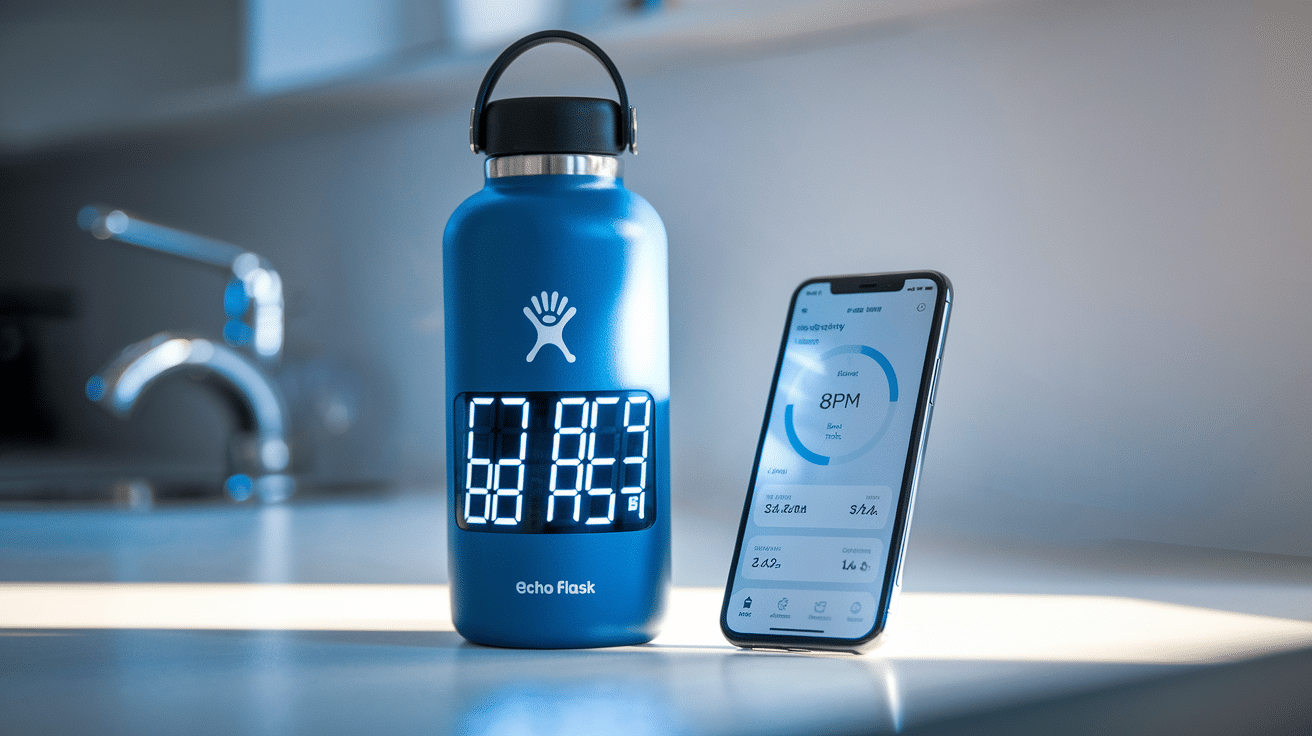
This Echo Flask hydrogen water bottle review opens with the figure that decides the rest of it: an independent laboratory measured 8.25 mg/L of dissolved hydrogen coming out of the bottle, the highest number Echo publishes for anything portable it sells. That output is what the price buys. It is also a 12 oz bottle that needs a twenty-minute cycle to reach it, will not start a cycle on its own, and costs several times what most of the best hydrogen water bottles do. What follows is what the lab actually measured, what the app gets right and wrong, and who is better off spending less.
One caveat first. Molecular hydrogen has a genuine research literature behind it, but most published trials are small, short, and run on narrow populations. Nothing below is a health claim. Where a number appears, it comes from a test report or from Echo, and it is labelled as such.
- Echo Flask Technology and Features
- User Experience and App Integration
- Performance Evaluation
- Health Benefits and User Testimonials
- Value Assessment
- Echo Flask hydrogen water bottle review: pros and cons at a glance
- Echo Flask specifications
- How the Echo Flask compares to the alternatives
- Cleaning, care and known issues
- Conclusion
- FAQ
- How long does hydrogen remain in the water produced by Echo Flask?
- Can I use any type of water with the Echo Flask?
- How many servings of hydrogen water should I drink daily?
- Does the Echo Water App work with all smartphones?
- How soon can I expect to see benefits from using hydrogen water?
- Is the Echo Flask portable enough for travel?
Disclosure: As an Amazon Associate we earn from qualifying purchases. If you buy through a link on this page we may earn a commission, at no extra cost to you. It never changes what we write.

Echo Flask Hydrogen Water Bottle
The Echo Flask uses SPE/PEM electrolysis, and Echo publishes an H2 Analytics report for it: 6.07 mg/L after a 10-minute cycle and 8.25 mg/L after 20. It adds a touch screen and intake tracking in the Echo app. It holds 12 oz (350 ml) and sits at the top of the price range.
- Lab Result: 6.07 mg/L at 10 min, 8.25 mg/L at 20 min (H2 Analytics)
- Tracking: touch screen and intake logging in the Echo app
- Capacity: 12 oz (350 ml)
- Membrane: SPE/PEM with adjustable hydrogen levels
- Body: ABS, polycarbonate, and PPSU, per Echo's listing
- Smart technology integration with real-time tracking
- Published H2 Analytics output report
- Compact and travel-friendly size
- Easy-to-use touch screen interface
- Requires regular charging for electronic components
- Limited 12 oz capacity may require frequent refills
- Higher price point compared to standard water bottles
Echo Flask Technology and Features
Hydrogen Water Generation Capabilities (up to 8 ppm)
The Echo Flask uses Solid Polymer Electrolysis (SPE) across a Proton Exchange Membrane (PEM). Platinum-coated electrode plates split water at the membrane so that hydrogen gas is driven into solution as dissolved hydrogen rather than bubbling off, which is what separates a real hydrogen generator from a bottle that simply fizzes. Echo rates the full 20-minute cycle at up to 8 parts per million (ppm) and says the process produces hydrogen without the byproducts cruder electrolysis can leave behind. The underlying mechanism is covered in our hydrogen water guide. Echo puts the research base at over 1,000 published studies on molecular hydrogen; that is the manufacturer’s count, not an independent tally.
Smart Technology and Touchscreen LCD Interface
The Echo Flask features an intuitive touchscreen LCD display that makes operation simple and convenient. The interface offers both dark and light modes to suit different preferences and lighting conditions. Users can easily customize cycle lengths for hydrogenation through the touchscreen. The display provides real-time notifications about the device’s status and hydrogen generation progress. The smart technology is further enhanced with Bluetooth connectivity, allowing seamless integration with the dedicated Echo Water App for a complete hydration management system. You will not find these smart technologies in cheaper ones like hydrogen water bottles that are under $100, let alone the $50 hydrogen water bottles.
Hydration and Hydrogen Consumption Tracking
One of the Echo Flask’s standout features is its ability to track both hydration goals and hydrogen consumption. Through integration with the Echo Water App, users can monitor their daily water intake and ensure they’re meeting their hydration targets. Echo’s own guidance is about timing rather than volume: drink the water soon after a cycle finishes, while the dissolved hydrogen is still in it. The app also monitors bottle performance, providing insights into usage patterns and efficiency.
12-Ounce Capacity and BPA-Free Construction
The Echo Flask holds 12 oz (0.36 liters). It measures 10 inches tall, 3 inches wide and 2 inches deep, and weighs about 1 pound (455.5 g). The body is polyphenylsulfone (PPSU), which Echo states is third-party verified free of BPA, BPS, PFOS and PFAS. It operates at up to 90 PSI and carries a built-in rechargeable lithium-ion battery charged over USB-C. Echo does not publish a capacity in mAh for that battery, so we are not quoting one. Echo rates a full charge at up to 7 cycles, which it breaks down as roughly five to seven 10-minute cycles or three to four 20-minute ones.
User Experience and App Integration
Building upon the innovative technology in the Echo Flask hydrogen water bottle, the user experience is significantly enhanced through smart app integration. The Echo Water App serves as the control center for your hydration journey.
Bluetooth Connectivity and Real-Time Statistics
The Echo Flask connects seamlessly to your smartphone via Bluetooth. To pair your device, simply set the flask to pairing mode by navigating to settings and selecting “Not Paired.” Then open the app and click Start → Begin Pairing. The connection status is clearly indicated by the Bluetooth icon—white means disconnected, while teal confirms successful pairing. Once connected, you can name your flask for easy identification. Real-time statistics about your hydrogen water consumption are displayed directly in the app, though some users report occasional tracking inconsistencies.
Personalized Hydration Reminders
The Echo Water App excels in interactive hydration management. Users can set personalized hydration targets based on their individual needs and receive timely reminders throughout the day. The app monitors your progress toward daily hydration goals, creating a structured approach to maintaining optimal hydration levels. This feature works in tandem with the Echo Flask’s advanced hydrogen technology to ensure you’re not just drinking water, but benefiting from enhanced hydrogen concentration.
Compatibility with Other Health Applications
One standout feature is the app’s health insights integration capability. The Echo Water App syncs with various fitness and sleep applications, providing a comprehensive wellness overview. This integration allows users to understand the relationship between their hydrogen water consumption and other health metrics. The app also offers educational content about hydrogen’s benefits for cellular health, creating a holistic approach to wellness tracking.
Battery Performance and USB Charging
The Echo Flask includes convenient USB charging functionality, though specific battery life details aren’t extensively covered in user feedback. What users do mention is that recent firmware updates have introduced alerts for battery status and charging requirements. These updates have addressed some minor bugs to enhance the overall user experience, though some connectivity issues between the app and flask persist according to user reviews.
Performance Evaluation
Echo commissioned an outside laboratory to measure what the Flask actually produces, and published the report. Those figures, rather than the number on the box, are the sensible place to start.
Hydrogen Concentration Effectiveness
The report is H2 Analytics H2AR-250116-1, dated 16 January 2025. Testing used distilled water at 24.5 °C ± 1.5 °C and pH 6.52, about 350 ml per fill, analysed by static headspace on an SRI 8610C gas chromatograph. Mean dissolved hydrogen measured 6.07 mg/L after the 10-minute cycle and 8.25 mg/L after the 20-minute cycle — roughly 6,070 and 8,250 ppb, at a delivered dose of 2.17 mg and 2.89 mg respectively. Two things follow. These are third-party numbers from a laboratory Echo paid, which is better evidence than a marketing figure and weaker than a test nobody commissioned. And Echo’s own materials disagree about the short cycle: the product page and the current comparison table both say up to 6 ppm, while the older specifications page still says 5. The measured 6.07 mg/L supports the higher figure, which is why this review uses it.
Cycle Length and Wait Time Considerations
While the Echo Flask delivers excellent hydrogen concentration, users should be aware of the time investment required. The standard 10-minute cycle is suitable for daily use, but achieving maximum concentration requires double that time at 20 minutes. This wait time could be inconvenient for users needing quick hydration on the go. The Echo Go+ model, which shares similar technology, has received some user feedback regarding this wait time as a potential drawback for those with busy schedules.
How long the hydrogen lasts
Dissolved hydrogen does not vanish the moment the cap comes off. Echo explains that the bottle pressurises during generation, which forces more hydrogen gas into solution; unscrewing the cap releases the pressure and the headspace gas, while the dissolved hydrogen stays in the water. Echo recommends drinking it within about two hours of opening. That pressurisation also settles a question worth settling: the Flask is not glass. Echo states plainly that glass is not used because it would crack under the pressure — which matters, because at least one review site describes the Flask as a borosilicate glass bottle. It is PPSU plastic.
Manual Activation Requirements
One notable limitation is the absence of an auto-activation feature. Users must manually initiate each hydrogen infusion cycle, which means the hydrogen levels don’t automatically maintain throughout the day. The bottle operates on a USB-C rechargeable lithium-ion battery that provides up to seven cycles per charge – sufficient for daily use but requiring regular recharging for heavy users.
Durability and Material Quality
The shell is PPSU rather than the polycarbonate used in cheaper bottles, and Echo publishes an SGS water-quality and PFAS test report alongside the H2 Analytics work, plus a Verification of Conformity. The 12 oz capacity is practical for a desk or a gym bag; the Echo Go+ holds 10 oz, which some owners find limiting. Whether the build justifies the price depends mostly on how often you will actually run a cycle.
Health Benefits and User Testimonials
Reported Energy Level Improvements
Energy is the benefit owner reviews return to most often, on Amazon and on Echo’s own listings alike, usually after a few weeks of daily use. The proposed mechanism is that molecular hydrogen reduces oxidative stress, which is associated with fatigue. Both halves of that deserve care: the reports are self-reported and uncontrolled, and the published trials remain small and short. Treat it as what buyers say, not as a demonstrated effect.
Hydration Consistency Advantages
The Echo Flask’s intuitive design and companion app have proven instrumental in improving hydration consistency among users. The app’s hydration tracking features and goal-setting capabilities encourage more regular water consumption. Users report being more motivated to stay hydrated when they can visualize their progress through the app, which integrates with popular health applications for a comprehensive wellness approach. This improved hydration consistency translates to better overall health outcomes as users maintain optimal hydration levels throughout their day.
Overall well-being enhancements
Beyond energy, the theme that recurs most in owner reviews is recovery after exercise, which is also where the research literature is least thin — though those studies stay small. Claims further afield, such as skin appearance or digestion, appear in marketing more than in reviews, and nothing we could source supports them, so this review does not repeat them.
Suitability for Athletes and Busy Professionals
The Echo Flask has found particular favor among athletes and busy professionals seeking performance advantages and efficient hydration solutions. Athletes appreciate the potential recovery benefits, with testimonials suggesting improved post-exercise recuperation and reduced muscle fatigue. Meanwhile, busy professionals value the bottle’s portability and on-demand hydrogen generation, allowing them to maintain optimal hydration despite hectic schedules. The self-cleaning mechanism and minimal maintenance requirements further enhance its appeal for those with limited time.
Value Assessment
Price Comparison with Previous Models
Echo’s portable line has moved in one direction: more hydrogen, more electronics, a higher price. The Echo Go+ holds 10 oz and is rated at 2–3 ppm on a five-minute cycle and up to 4.5 ppm on a ten-minute one. The Flask holds 12 oz and roughly doubles that ceiling. Above it now sits the Echo Forty Tumbler, a 40 oz stainless vessel rated up to 4 ppm on the short cycle and 6 ppm on the long one — more water, lower concentration. Worth knowing if you are reading older comparisons: the Echo Go+ and the Echo Family Pitcher (57 oz, 1.03–1.4 ppm) no longer appear in Echo’s current product comparison table, although the Go+ is still sold through retailers. On price the Flask sits in the upper middle of the range; on concentration it sits at the top of it.
Feature Justifications for Higher Cost
The Echo Flask’s premium pricing is justified by several advanced features:
- Measured output: 8.25 mg/L on the long cycle in Echo’s commissioned lab report — the highest figure Echo publishes for any portable model it sells
- Smart Technology Integration: The Flask’s app connectivity allows health data tracking
- Proton Exchange Membrane: Advanced technology for consistent hydrogen generation
- Published test reports: SGS water-quality and PFAS testing, an H2 Analytics certificate of compliance, and a Verification of Conformity
- Warranty: prorated five-year coverage plus a 60-day return window — note that app and firmware problems are excluded
Against the cheaper bottles in this category — many of them 16 oz, at well under a third of the price — the Flask trades volume for concentration and adds tracking hardware nothing else in Echo’s portable range carries. Whether that is the right trade depends entirely on whether you want hydrogen water or a large bottle.
Long-Term Health Investment Perspective
Viewing the Echo Flask as a health investment rather than merely a water bottle helps contextualize its cost. Compared to premium bottled hydrogen water or other wellness products, this represents potential long-term savings while providing consistent access to hydrogen-enriched water.
Limitations and Potential Drawbacks
Several limitations are worth weighing before you buy:
- Limited Capacity: At 12 oz, the Echo Flask may require frequent refilling for adequate daily hydration
- App and firmware: the Echo Water App sits outside the hardware warranty, and owners report intermittent sync problems
- Price Barrier: The cost may be prohibitive compared to conventional water bottles
- Relative Value: Higher-end Echo Water systems offer additional features at higher price points, potentially offering better value for those with specific needs
Echo Flask hydrogen water bottle review: pros and cons at a glance
Everything below comes from Echo’s published specifications and test reports, or from owner reviews on retail listings. None of it comes from a unit we tested ourselves.
What it does well
- The highest measured hydrogen output of any portable model Echo sells — 8.25 mg/L on the 20-minute cycle in a third-party laboratory report
- Echo publishes the evidence rather than asserting it: hydrogen output, SGS water-quality and PFAS testing, and a certificate of compliance
- Touchscreen LCD with dark and light modes, plus Bluetooth tracking through the Echo Water App
- PPSU body, third-party verified free of BPA, BPS, PFOS and PFAS
- A built-in clean cycle and USB-C charging, rated at up to seven cycles per charge
Where it falls short
- Twenty minutes for the headline concentration and ten for the lower one — this is not a bottle you fill and drink
- 12 oz per fill, so anyone drinking steadily will refill and re-run cycles repeatedly
- No auto-activation: every cycle is started by hand, so hydrogen levels do not maintain themselves through the day
- Several times the price of bottles that still reach a useful concentration
- The warranty is prorated and excludes the app and firmware, which is where owners report the most trouble
- Overfilling past the fill line causes leaks, and small drips from the oxygen port are normal rather than a fault
Echo Flask specifications
| Capacity | 12 oz (0.36 liters) |
| Hydrogen concentration | Up to 6 ppm on the 10-minute cycle, up to 8 ppm on the 20-minute cycle (Echo) |
| Measured output | 6.07 mg/L at 10 minutes, 8.25 mg/L at 20 minutes (H2 Analytics H2AR-250116-1) |
| Technology | SPE with a proton exchange membrane, platinum-coated electrode plates |
| Dimensions | 10 in tall, 3 in wide, 2 in deep |
| Weight | Approx. 1 lb (455.5 g) |
| Material | Polyphenylsulfone (PPSU); verified free of BPA, BPS, PFOS and PFAS |
| Operating pressure | Up to 90 PSI |
| Power | Built-in rechargeable lithium-ion, USB-C; up to 7 cycles per charge |
| Display and app | Touchscreen LCD with dark and light modes; Bluetooth to the Echo Water App |
| Recommended water | Filtered, distilled or reverse osmosis (RO) |
| Warranty | Prorated 5-year coverage, 60-day return window; app and firmware excluded |
How the Echo Flask compares to the alternatives
Concentration is the only axis on which the Flask clearly wins, and it wins on it by a wide margin. If you want the same brand for less, the echo go+ vs echo flask comparison sets out what the smaller bottle gives up, and our echo flask vs echo go head-to-head covers the older model still sold alongside it. Choosing between the two cheaper Echo bottles is its own question, which our echo go vs echo go+ head-to-head answers.
Outside Echo, the obvious rivals are Evolv, Piurify and Ionbottles, all of which undercut the Flask substantially. the echo flask vs evolv comparison is the closest like-for-like on output; the piurify vs echo go+ comparison and the echo go bottle vs ionbottles comparison are worth reading if price matters more than the last two ppm. As a rule: buy the Flask if you drink hydrogen water daily and want the highest concentration you can carry. Buy something cheaper if you are still finding out whether you notice a difference — a lower-priced bottle answers that question just as well.
Cleaning, care and known issues
Echo recommends filtered, distilled or reverse osmosis (RO) water; tap water with a heavy mineral load shortens the life of the membrane. Fill only to the indicated fill line. Overfilling is the most common cause of the leaking owners complain about, and Echo describes small drips from the oxygen port as normal, usually settling after a few uses. The built-in clean cycle handles routine maintenance. The most persistent complaint in owner reviews is not the hardware at all but the app — pairing and sync problems recur, and they sit outside the hardware warranty.
Conclusion
The Flask earns its price on one axis: measured hydrogen output. On the laboratory report Echo commissioned it produces more dissolved hydrogen than anything else portable the company sells, and it is the only model in that range with a touchscreen and app tracking. Against that, it holds 12 oz, needs twenty minutes for the headline figure, and will not start a cycle on its own.
So the recommendation splits. If you already drink hydrogen water daily and care about concentration, the arithmetic works and the Flask is the strongest portable option Echo makes. If you are still finding out whether hydrogen water does anything for you, buy a cheaper bottle first — it answers that question just as well for a fraction of the money, and you can move up later. And whichever you choose, treat the health claims around hydrogen water as unsettled: the research is real, but it is early.
FAQ
How long does hydrogen remain in the water produced by Echo Flask?
The hydrogen produced in your Echo Flask water remains active for a limited time. For optimal benefits, it’s recommended to consume the hydrogen-enriched water shortly after production to experience maximum effectiveness.
Can I use any type of water with the Echo Flask?
For best results, it’s recommended to use distilled or purified water with your Echo Flask. This ensures optimal hydrogen generation and prevents potential issues with the device.
How many servings of hydrogen water should I drink daily?
While hydrogen water can be integrated into your daily hydration routine, it’s not necessary to replace regular water entirely. Many users find that a few servings daily are sufficient for experiencing the potential health benefits.
Does the Echo Water App work with all smartphones?
The Echo Water App is designed to integrate with the Echo Flask, allowing you to select desired hydrogen levels and monitor your device. Check compatibility specifications on the Echo website for your specific smartphone model.
How soon can I expect to see benefits from using hydrogen water?
Consistency in consumption is vital for observing wellness effects. Some users report benefits shortly after starting regular consumption, while others may take longer to notice changes. Individual results may vary.
Is the Echo Flask portable enough for travel?
The Echo Flask is 10 inches tall and weighs about a pound, so it is bigger and heavier than a plain bottle and it needs charging. It holds 12 oz, runs roughly five to seven short cycles per charge and charges over USB-C, which makes it practical for daily travel. One travel note: it pressurises during a cycle, so open it slowly and never fill past the fill line.
