

As an Amazon Associate we earn from qualifying purchases, at no additional cost to you. waterbottleinfo.com is reader-supported: we were not given this product and we do not accept payment for a favourable review.
Short answer. Buy the Echo Flask if you want the highest hydrogen figure Echo publishes and you will actually use the app: it holds 12 oz, and Echo rates it up to 8.25 PPM, though only on its 20-minute cycle. Buy the Echo Go+ if you want a 9.5 oz bottle that fits a cup holder and makes hydrogen water in 5 or 10 minutes. Skip both if you are buying on the health claims alone, because the evidence for hydrogen water is still mixed and owners of both bottles report the same trouble with batteries and seals.
One thing to know before you compare. Echo has replaced the Go+ with the Flask in its own line-up. Echo Water’s store no longer lists the Go+ bottle, only Go+ replacement parts, and its old Go+ product URL now redirects to the Echo Flask page. Treat the Go+ as the outgoing model rather than a current one, and weigh it accordingly.
This comparison is built from Echo Water’s published specifications for both bottles, the manufacturer’s own comparison documentation, and aggregated verified-buyer reports. We have not measured either bottle ourselves. Where Echo’s own documents disagree with each other, we say so rather than choose a figure. Specifications checked September 2026.
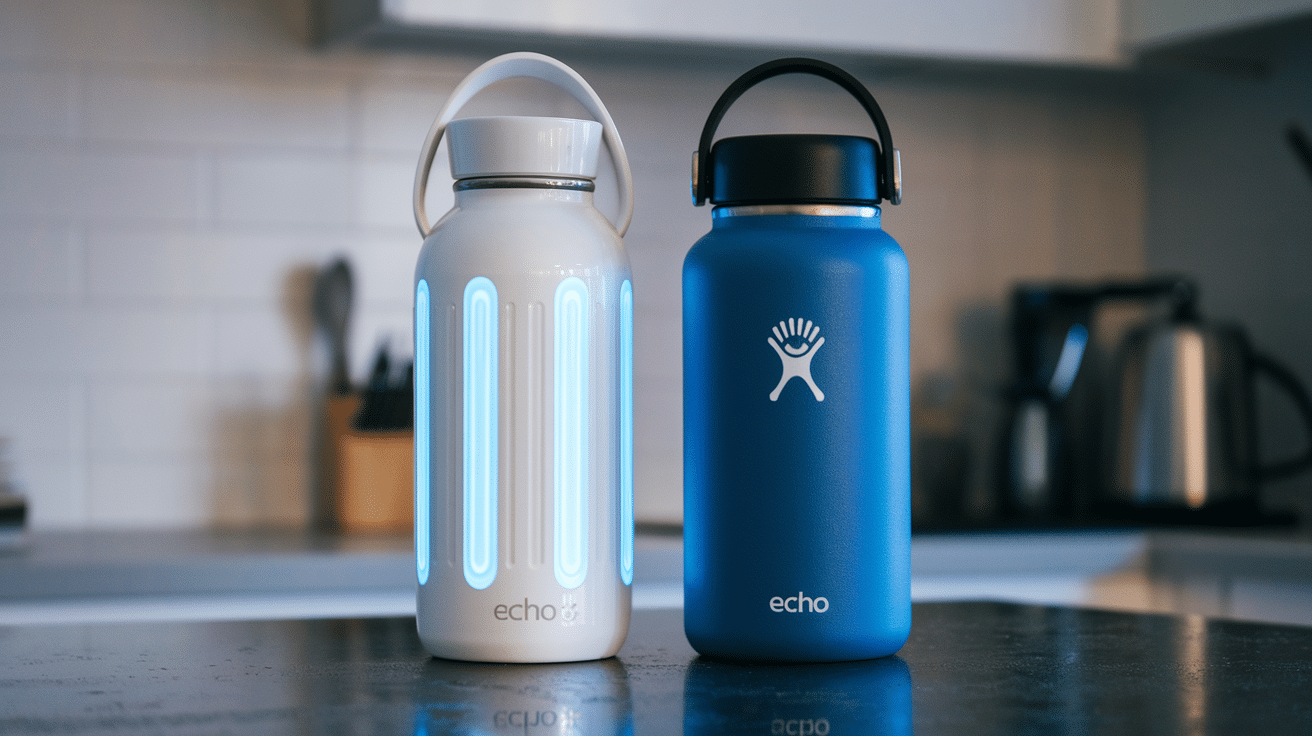
The two bottles answer different questions. The Go+ is the smaller, quicker and cheaper one; the Flask is the bigger, slower and smarter one. Each difference below is set out with the figure Echo publishes for it, followed by what owners actually report. If you are still choosing between brands rather than between these two models, start with which hydrogen water bottle is best.
Product overview: Echo Go+ vs Echo Flask
Side by side comparison
|
Superior Hydrogen Output

|
Premium Tech Integration

|
|
Description: Echo rates the Echo Go+ at up to 4.5 PPM of dissolved hydrogen from a 5- or 10-minute SPE/PEM cycle. It holds 9.5 oz, fits most cup holders, charges over USB-C and runs 5 to 10 cycles per charge. It is a premium price for a single-purpose bottle, and Echo has since replaced it with the Echo Flask in its own line-up. Hydrogen water benefits are not fully established. |
Description: Echo rates the Echo Flask at up to 8.25 PPM on its 20-minute cycle and about 6 PPM on a 10-minute cycle, using SPE/PEM electrolysis. It adds a touchscreen LCD, Bluetooth tracking through the Echo Water app and a PPSU inner bottle. It is the dearer of the two, it arrives dry and needs rehydrating, and owners report mixed battery life. Hydrogen water benefits are not fully established. |
|
Key Features & Benefits:
|
Key Features & Benefits:
|
|
Pros:
|
Pros:
|
|
Cons:
|
Cons:
|
Echo rates the Echo Go+ at up to 4.5 PPM of dissolved hydrogen from a 5- or 10-minute SPE/PEM cycle. It holds 9.5 oz, fits most cup holders, charges over USB-C and runs 5 to 10 cycles per charge. It is a premium price for a single-purpose bottle, and Echo has since replaced it with the Echo Flask in its own line-up. Hydrogen water benefits are not fully established.
- Hydrogen Output: Echo rates it up to 4.5 PPM on a 5- or 10-minute cycle
- Dual-Chamber PEM: vents oxygen and ozone away from the water you drink
- Rechargeable: 2200 mAh battery over USB-C, 5 to 10 cycles per charge
- Sealed Top: designed to resist spills in transit, though some owners report leaks
- BPA-Free Plastic: Echo's spec sheet says Tritan, its comparison table says polycarbonate
- Compact 9.5 oz Capacity: fits most standard cup holders
- Self-Cleaning: automatic polarity-reversing cleaning, the same as the Flask
- Generates hydrogen water in a 5- or 10-minute cycle
- Rechargeable 2200 mAh battery, 5 to 10 cycles per charge
- Compact size fits most cup holders and bags
- Ready to use out of the box, with no rehydration step
- Automatic self-cleaning between cycles
- Requires regular charging to maintain functionality
- 9.5 oz capacity may need frequent refills for heavy users
- Initial investment higher than standard water bottles
- Echo has replaced it with the Echo Flask in its own line-up
Echo rates the Echo Flask at up to 8.25 PPM on its 20-minute cycle and about 6 PPM on a 10-minute cycle, using SPE/PEM electrolysis. It adds a touchscreen LCD, Bluetooth tracking through the Echo Water app and a PPSU inner bottle. It is the dearer of the two, it arrives dry and needs rehydrating, and owners report mixed battery life. Hydrogen water benefits are not fully established.
- Smart Hydration Monitoring: LCD touch screen tracks intake and syncs with the Echo Water app
- Hydrogen Output: Echo rates it up to 8.25 PPM on a 20-minute cycle, about 6 PPM at 10 minutes
- PPSU Construction: the plastic Echo also specifies for medical and baby products
- Portable Design: 12 oz capacity, 10 x 3 x 2 in, 1 lb empty
- Cycle Control: schedule, pause, shorten or stop a cycle from the screen
- Setup Note: arrives dry, needs a rehydration period, and the lid has a manual pressure release
- Smart technology integration with real-time tracking
- Highest hydrogen figure Echo publishes for a portable bottle
- Compact and travel-friendly size
- PPSU inner bottle, the plastic Echo also uses in medical and baby products
- Easy-to-use touch screen interface
- Requires regular charging for electronic components
- Limited 12 oz capacity may require frequent refills
- Higher price point compared to standard water bottles
- Arrives dry and needs a rehydration period before first use
- The 8 PPM figure needs the full 20-minute cycle
Specifications side by side
Every figure below is Echo Water’s own, taken from its published specification sheets and its Flask versus Go+ comparison table. Where those two sources disagree with each other, both readings are given rather than one chosen.
| Specification | Echo Go+ | Echo Flask |
|---|---|---|
| Maximum water capacity | 9.5 oz | 12 oz (about 355 ml) |
| Hydrogen output, per Echo | 2.5 to 4.5 PPM | Up to 6 PPM at 10 min; up to 8.25 PPM at 20 min |
| Cycle lengths | 5 or 10 minutes | 10 minutes default, 20 minutes maximum |
| Bottle material | BPA-free plastic; Echo’s spec sheet says Tritan, its comparison table says polycarbonate | PPSU inner bottle, thermoplastic urethane outer shell |
| Electrodes | Platinum-coated titanium | Platinum-coated titanium |
| Membrane | Dual-chamber PEM with oxygen vent | Dual-chamber Nafion PEM with oxygen vent |
| Battery | 2200 mAh (8.14 Wh) | 2200 mAh (7.4 Wh) |
| Cycles per charge | 5 to 10 | 5 to 7 at 10 min, or 3 to 4 at 20 min |
| Charging | USB-C, 5V/2A | 5V/2A, about 2.5 hours to full |
| Display and app | Countdown display, no app | LCD touchscreen, Bluetooth, Echo Water app |
| Self-cleaning | Yes, automatic | Yes, dedicated cycle |
| Out of the box | Ready to use | Arrives dry, needs rehydrating; manual pressure release |
| Size and weight | About 8.5 in, under 1 lb | 10 x 3 x 2 in, 1 lb empty |
| Air travel | Carry-on only (lithium battery) | Carry-on only (lithium battery) |
| Returns and warranty | 60-day returns, 5-year warranty | 60-day returns, 5-year warranty |
Design and portability comparison
The two bottles are built for different jobs. The Go+ is the compact one, a cylinder that fits standard cup holders, which is most of the reason commuters like it. Its material is the one point where Echo contradicts itself: the current Go+ specification sheet says BPA-free Tritan, while Echo’s own comparison table and the Amazon listing both say food-grade polycarbonate. Every source agrees it is a BPA-free food-grade plastic. If the electrolysis itself is new to you, start with how hydrogen water bottles work. We have not been able to establish which description is current, so we are not choosing between them.
The Flask is built from BPA- and BPS-free polyphenylsulfone (PPSU), the plastic Echo also specifies for medical and baby products, inside a thermoplastic urethane outer shell. Its rectangular shape grips well but does not fit easily into standard cup holders. Both bottles have a digital display with a countdown timer and both can be used while charging, though only the Flask has a touchscreen. There is more detail in our full Echo Flask review.
Capacity differences: 9.5 oz vs 12 oz
Capacity is the most practical difference between these hydrogen water bottles. Echo gives the Go+ a maximum water capacity of 9.5 oz. Its Amazon listing is titled 10 oz, which is the nominal bottle size rather than what it holds, and that is where the two figures you see quoted come from. Either way it is a small bottle, and heavy drinkers will refill it often.
The Flask holds 12 oz, about 355 ml, roughly a quarter more per fill. It is also the bigger object: Echo lists it at 10 by 3 by 2 inches and 1 lb empty, against a Go+ that reviewers measure at about 8.5 inches and under a pound. You gain a refill and lose the cup holder.
How each bottle got its reputation
The Go+ became well known largely through wellness-industry promotion rather than independent review, and at least one of the public figures associated with it has a disclosed commercial relationship with Echo, so that visibility is worth discounting when you compare the two. On handling, the Go+ is the simpler device: fill it, press once, and take a 5- or 10-minute cycle. We look at the bottle on its own terms in our full Echo Go Plus review.
On paper the Flask holds its hydrogen better, and that is the main reason to prefer it. The caveat is that the figures usually quoted for this come from one reviewer’s own readings rather than from a published test method, so treat the gap as directional rather than measured.
The Flask also has Bluetooth and a companion app for tracking hydration and setting goals. It logs hydrogen intake, water intake and cycles completed. Echo lists both tracking and app connectivity as simply not available on the Go+, so this is a genuine difference rather than a marketing one.
How the two bottles perform
Hydrogen concentration
The Echo Go+ and Echo Flask demonstrate significant differences in their hydrogen concentration capabilities, measured in parts per million (PPM). PPM quantifies the concentration of hydrogen gas in water, with 1 PPM equating to 1 mg of hydrogen per liter of water.
Research indicates that hydrogen-rich water (HRW) with concentrations between 0.5 PPM and 1.6 PPM may help combat oxidative stress, with 0.5 PPM generally accepted as the therapeutic threshold for health benefits. Concentrations of 1.2 PPM to 1.6 PPM are associated with observable positive health effects.
Both figures sit above that threshold. Echo rates the Go+ at 2.5 to 4.5 PPM on a 5- or 10-minute cycle. For the Flask it publishes up to 6 PPM on a 10-minute cycle and up to 8.25 PPM on a 20-minute one, so the headline 8 PPM figure costs you twenty minutes of waiting. Echo says both bottles have been tested by third-party laboratories, naming H2 Analytics and SilverState Analytical Laboratories; we have not seen those reports ourselves.
How well each bottle holds its hydrogen
A critical factor in hydrogen water bottle performance is not just the initial concentration but how well the device maintains hydrogen levels over time. Hydrogen molecules naturally dissipate quickly without proper storage, potentially limiting health benefits after just a few hours.
Independent figures are harder to rely on. The reviewer at hydropitcher.com reported readings near 4.4 PPM from the Go+ after eight hours, and a steadier 4.7 to 7.6 PPM from the Flask, but published no protocol for either. Across the sources we could find, reported Flask concentrations span roughly 1.6 to 8 PPM, close to a fivefold spread for a single bottle.
Some of that spread is unavoidable. Generation is not the same as dissolved concentration, dissolved hydrogen begins escaping the moment a cycle ends, drop-count reagent tests read in steps rather than continuously, and electrolysis efficiency changes with the mineral content of the water you start from. Treat any headline PPM as a ceiling claim rather than as what reaches you, and drink promptly after a cycle. On that point the two bottles are in the same position.
Cycle options
Both devices utilize advanced electrolysis technology to infuse water with hydrogen. However, they differ in their cycle options and customization capabilities:
The Go+ gives you two fixed cycles, 5 or 10 minutes, and completes them automatically. For a bottle you fill on the way out of the door, that is arguably the more useful arrangement.
The Flask lets you schedule, pause, shorten or stop a cycle from the touchscreen. Its default run is 10 minutes and its maximum is 20. The trade is time: the concentration Echo advertises needs the longer cycle.
Features the Flask adds
The Flask touchscreen
The Echo Flask elevates the user experience with its sophisticated LCD touchscreen interface, providing intuitive control over the device’s operations. This touchscreen allows users to:
- Select customizable cycle lengths for optimal hydrogenation (reaching up to 8 PPM)
- Monitor real-time notifications about the device’s status
- Easily navigate through the bottle’s various functions
The touchscreen interface makes the Echo Flask particularly user-friendly, allowing even first-time users to operate the device with minimal learning curve. The SPE/PEM technology working behind this interface ensures pure hydrogen generation without harmful byproducts, distinguishing it from lower-quality alternatives on the market.
Bluetooth and the Echo Water app
A standout feature of the Echo Flask is its seamless integration with the Echo Water App, creating a connected hydrogen water experience:
- Track personal hydration goals directly through the app
- Monitor bottle performance metrics
- Receive notifications about maintenance requirements
- Optimize usage patterns based on collected data
This connectivity transforms the Echo Flask from a simple hydrogen water generator into a comprehensive hydration management system. The app integration allows health-conscious users to maintain consistent hydrogen water consumption, maximizing the potential benefits such as enhanced recovery and reduced inflammation.
Battery life
Both Echo hydrogen water bottles feature robust battery systems, but with notable differences:
Echo’s current specification sheet and its own battery guide both give the Flask a 2200 mAh (7.4 Wh) lithium-ion battery, not the 2000 mAh figure that circulates in reviews and in Echo’s older comparison table. The Go+ uses a 2200 mAh (8.14 Wh) cell. Measured in cycles rather than capacity, Echo quotes 5 to 10 per charge for the Go+, and for the Flask 5 to 7 ten-minute cycles or 3 to 4 twenty-minute ones, with a full charge taking about two and a half hours.
Echo also notes that Bluetooth and frequent app syncing draw extra power, so Flask owners who lean on the app will see fewer cycles per charge. Battery life is one of the two things owners raise most often about both bottles. The other is sealing.
Living with them day to day
Travel-friendliness and everyday use
The Go+ is the easier of the two to live with. Fill it with distilled or filtered water, press once, and take a 5- or 10-minute cycle. It arrives ready to use, where Echo says the Flask ships dry and needs a rehydration period before its first run, and the Flask’s lid needs a manual pressure release that the Go+ does not.
Water quality matters more than most buyers expect. Echo specifies reverse osmosis, distilled, spring or filtered water for both bottles, and warns against tap water, chlorinated water and water high in minerals. Chlorine attacks the electrodes, and using the wrong water is the most common reason bottles of this type stop producing properly.
Cup holder compatibility issues with Flask
The Flask’s shape is its main practical cost. It does not fit standard cup holders in cars or on gym equipment, which for a bottle sold on portability is a real limitation. Both bottles carry lithium batteries, so both are carry-on only if you fly.
The Go+ has an advantage in this regard, as its more streamlined design fits conventional cup holders, enhancing its utility during travel and fitness activities. This difference is an important consideration for those who prioritize seamless integration into various environments and activities.
Water consumption needs and bottle capacity
Echo’s guidance is that a few servings a day are enough, rather than replacing all your water. That matters more than capacity: at 9.5 or 12 oz, neither bottle is your whole day’s hydration, and neither is meant to be.
If you mostly drink hydrogen water at a desk, the Flask’s extra volume is worth having. If you drink it in a car or at the gym, the Go+ fitting a cup holder will matter more than 2.5 oz.
A note on safety. Hydrogen water’s health effects have not been evaluated by the FDA, and this page is research rather than medical advice. If you have kidney disease or low blood pressure, are undergoing chemotherapy, are immunocompromised, or are pregnant or breastfeeding, consult a qualified healthcare professional before drinking hydrogen water regularly. That advice is unrelated to which of these two bottles you choose.
Is the Echo Flask worth the extra money?
What each bottle costs you
Both bottles sit at the top of the portable hydrogen market, several times the price of the generic less expensive hydrogen water bottles that fill Amazon search results, and the Flask is the dearer of the two. Echo attributes the premium to its own electrolysis technology. Prices move, so check both current prices before deciding rather than relying on any figure quoted on a review page.
What the extra money buys, on Echo’s own account:
- A higher published hydrogen ceiling, 8.25 PPM against 4.5 PPM
- A companion app and a touchscreen for cycle control
- A larger 12 oz chamber, 12 oz against 9.5 oz
- A PPSU inner bottle rather than the Go+ plastic
When evaluating cost versus benefits, consumers should consider:
- The potential health benefits of hydrogen-infused water (noting that scientific evidence remains mixed)
- The durability and longevity of these premium devices
- Additional features like app connectivity and customization options
- Environmental benefits from using reusable bottles instead of disposable options
How the Go+ and Flask hold up over time
On Echo’s specifications, the Flask offers:
- A PPSU inner bottle inside a thermoplastic urethane shell
- A 2200 mAh battery rated for 5 to 7 ten-minute cycles
- A dedicated cleaning cycle you start yourself
- A 60-day return window and a 5-year warranty, the same as the Go+
The Go+ is the simpler machine, and simpler machines have less to go wrong. It cleans itself automatically between cycles, where the Flask asks you to run a dedicated cleaning cycle, so the maintenance advantage actually sits with the Go+ rather than against it. Echo gives both bottles the same 60-day return window and 5-year warranty.
Neither bottle has an unblemished record in owner reports, which is covered below. Both use platinum-coated titanium electrodes that never touch the water, and both vent oxygen and ozone through a dedicated port rather than into what you drink. That dual-chamber proton exchange membrane arrangement is the main thing separating either of them from the cheap single-chamber bottles.
What owners actually report
We have not used either bottle, so the most useful evidence available at scale is what buyers say. Amazon publishes an aggregated summary of its own verified reviews for each listing, and neither makes comfortable reading.
For the Echo Go+, that summary reports mixed experiences with functionality, some buyers saying it works well and others that it stopped working within days. It records bottles that die or stop holding pressure, and concerns about value, battery life and leakage, including bottles that do not seal properly. Leakage and value for money are among the topics raised most often.
For the Echo Flask, the same summary praises the design and the perceived benefits, then reports mixed feedback on durability and battery life, some units failing after a few weeks, and a recurring complaint that the lid keeps popping off. Buyers disagree about whether it justifies its price.
Read those alongside the specifications rather than instead of them; both bottles have plenty of satisfied owners. But a comparison that quoted only the manufacturer would tell you the Flask is straightforwardly the better buy, and the people who actually bought them do not say that.
Who each bottle suits
Echo Go+ ideal users:
- People who want the researched antioxidant effects of hydrogen-rich water and accept that the evidence is still mixed
- Environmentally conscious consumers who prioritize reusable products
- On-the-go individuals needing portable hydration solutions
- Anyone who would rather have a 5-minute cycle than the highest possible number
Echo Flask ideal users:
- Tech-savvy consumers who appreciate app integration and tracking capabilities
- Fitness enthusiasts looking for enhanced workout recovery
- Users willing to invest in premium technology for potential health benefits
- Those who value minimal maintenance with features like self-cleaning
- Individuals who appreciate modern design aesthetics with features like touchscreen interfaces
Echo Go+ and Echo Flask: frequently asked questions
General hydrogen water questions
How does hydrogen water differ from regular water?
Hydrogen water is simply H2O with additional molecular hydrogen (H2) dissolved into it. While regular water provides hydration, hydrogen water offers potential antioxidant properties that may help manage oxidative stress caused by free radicals.
What are the main health benefits of hydrogen water?
Research into hydrogen-rich water is ongoing and the evidence remains mixed. Neither bottle is a medical device and nothing here is medical advice. The effects most often studied are:
- Balanced inflammatory response
- Enhanced physical activity, improved stamina and recovery
- Brain health and cognitive wellness
- Skin health by managing oxidative stress
- Immune function support
- Weight management as part of a healthy lifestyle
Do I need to replace all my regular water with hydrogen water?
No. Echo’s own guidance is that a few servings a day are sufficient, and consistency matters more than volume. Neither of these bottles holds enough to be your whole day’s water anyway.
Echo Go+ questions
How do I create hydrogen-enriched water with the Echo Go+?
Simply pour distilled or purified water into the bottle, activate it, and select your desired hydrogen level. The process is designed to be user-friendly and convenient.
How long does the hydrogen remain active in the Echo Go+ bottle?
Echo does not publish a retention figure for either bottle, and the independent numbers in circulation come without a stated test method. What is not in dispute is that dissolved hydrogen starts escaping the moment a cycle ends, and faster once the bottle is opened. Drink it soon after the cycle rather than hours later.
Echo Flask questions
How long does a cycle take on the Echo Flask?
Ten minutes by default, and up to twenty for the highest concentration Echo publishes. Echo quotes roughly 60 minutes of total runtime per charge, which works out at 5 to 7 ten-minute cycles or 3 to 4 twenty-minute ones.
Can I take either bottle on a plane?
Both have built-in lithium batteries, so both are carry-on only and neither can travel in checked baggage. The Go+ is the smaller and lighter of the two if that matters to you.
Maintenance questions
What maintenance do they need?
Both bottles reverse the electrode polarity to limit mineral build-up. The Go+ does it automatically between cycles; the Flask has a dedicated cleaning cycle you start yourself. Beyond that it is occasional washing, and using the right water in the first place.
What type of water should I use?
Reverse osmosis, distilled, spring or filtered water, in both bottles. Echo warns against tap water, chlorinated water and water high in minerals, because chlorine attacks the electrode plates.
Echo publishes specification sheets, user manuals and a battery guide for both bottles on its own support site. Those are the primary source for anything not covered here, and they are where the figures on this page come from.
Which one should you buy?
On the specifications, the Flask is the better bottle: 12 oz against 9.5 oz, a higher published hydrogen ceiling, a touchscreen and an app the Go+ never had, and it is the model Echo still sells and supports. That is the honest case for it.
The case against is worth hearing too. The 8 PPM headline needs a 20-minute cycle, where the Go+ is done in five. The Flask does not fit a cup holder, arrives dry, and needs a manual pressure release. Owners of both report the same trouble with batteries and seals, and Amazon buyers currently rate the Go+ slightly higher than the Flask, not lower. If you want the highest number Echo publishes and will use the app, buy the Flask. If you want a small bottle that makes hydrogen water quickly and fits a cup holder, the Go+ still does that, provided you are comfortable buying the outgoing model. And if you are buying either on the strength of the health claims alone, the evidence does not yet support that.
