

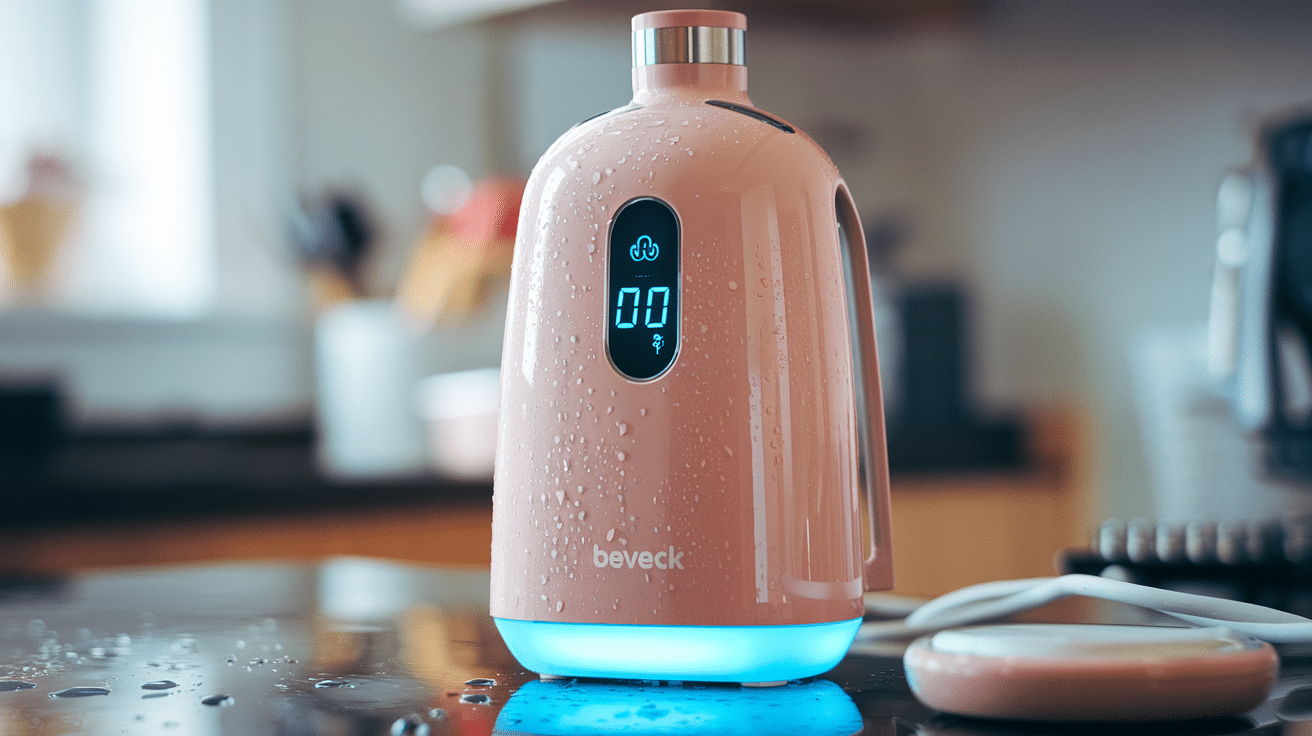
- How I Assessed the Beveck
- Design, Specs and Build Quality
- User Experience With the Beveck Bottle
- Comparing Beveck With Top Competitors
- Drawbacks and Limitations
- Making the Right Purchase Decision
- Final Thoughts
- FAQ
- Do hydrogen water bottles actually work?
- Is the Beveck 3,000 ppb claim believable?
- Is there a downside to drinking hydrogen water?
- Who should buy a different bottle instead?
- How often should I drink hydrogen water?
- Is it possible to consume too much hydrogen water?
- How should I store hydrogen water to keep the hydrogen in it?
- How do I clean my Beveck hydrogen water bottle?
- Can I use the Beveck hydrogen water bottle for cooking?
- Can I use the Beveck bottle for other beverages?
- How quickly will I notice a difference from hydrogen water?
- Can hydrogen water help with weight loss?
- Can I apply hydrogen water to my skin?
Disclosure: this review contains affiliate links. If you buy through one, I may earn a commission at no extra cost to you. It does not change what I recommend, or what I tell you is wrong with a product.

Beveck Hydrogen Water Bottle
A budget SPE/PEM bottle that advertises up to 3,000 ppb of dissolved hydrogen in a three-minute cycle. Simple one-button operation and cordless USB charging make it an easy first hydrogen bottle, but there is no display, no third-party test documentation and no published battery figure, so you cannot verify what it actually produces.
- SPE/PEM dual-chamber cell: vents oxygen and by-products out of the base
- Advertised up to 3,000 ppb hydrogen in a 3-minute cycle (manufacturer claim)
- USB rechargeable for cordless use; the connector is not USB-C
- Compact 420 ml (14 fl oz) capacity
- One-touch operation with LED indicator
- Quick 3-minute hydrogen generation
- Easy one-button operation
- Portable and travel-friendly design
- Top and bottom unscrew fully for cleaning
- No display or third-party test documentation
- No published battery capacity or charge time
- Limited to 420 ml (14 fl oz) per cycle
Hydrogen water bottles get sold on energy, recovery and better hydration. The Beveck is the cheapest way I know of to test whether any of that is worth your money. It advertises up to 3,000 ppb of dissolved hydrogen in a three-minute cycle, which is the sort of number premium bottles charge several times as much for. That claim is where this Beveck hydrogen water bottle review starts, because it is also where the chemistry gets interesting.
The Beveck sits at the bottom of a market that also includes Piurify, Echo Flask and CellPower, all selling the same basic idea: dissolve molecular hydrogen into your drinking water and you get an antioxidant effect. The research behind that idea is real but still thin, and the gap between what these bottles claim and what they deliver is wide enough to matter.
How I Assessed the Beveck
Being straight about the basis of this Beveck hydrogen water bottle review: I have not measured this bottle in a lab, and I did not run a reagent test on this unit. What follows is built from the manufacturer’s published specifications, what owners report after living with it, our wider coverage of this category, and the published chemistry of dissolved hydrogen, which is what lets me tell you which of Beveck’s numbers are plausible and which are marketing. Where a figure comes from the manufacturer, I say so. Where nobody publishes a figure, I say that too, rather than filling the gap.
If you are new to the category and want the mechanism explained properly before you compare individual models, our hydrogen water bottle guide covers how the electrolysis works and what actually separates a good cell from a bad one.
Design, Specs and Build Quality
Here is everything Beveck publishes about the bottle, in one place. Every figure below is the manufacturer’s own claim, not an independent measurement.
| Capacity | 14 fl oz / 420 ml |
|---|---|
| Advertised hydrogen output | up to 3,000 ppb (3.0 ppm) per cycle |
| Cycle time | 3 minutes |
| Cell type | SPE/PEM (solid polymer electrolyte / proton exchange membrane) |
| Power | USB rechargeable. Beveck publishes no battery capacity and no charge time, and the connector is not USB-C |
| Dimensions | 21.7 × 8 × 7.7 cm |
| Weight | 460 g |
| Controls | single button, LED indicator |
Source: manufacturer’s published product specification. Independently unverified.
Dimensions, Weight and Capacity
At 21.7 × 8 × 7.7 cm and 460 g, the Beveck is small enough to live in a bag or on a desk and heavy enough that you notice it in a coat pocket. The 14 fl oz (420 ml) fill is typical for the category: most portable portable hydrogen water bottles land between 9 and 14 fl oz, and it is the number that decides how the bottle fits your day. One cycle makes one glass. If you drink a litre of hydrogen water daily you are running four cycles and four refills, which is fine at a desk and tedious on a hike.
The bottle has a pressure release valve, which is the part that stops gas pressure building during electrolysis. That matters more than it sounds: the cell deliberately pressurises the chamber, and the valve is the safety component doing the work.
Hydrogen Output and What the Numbers Mean
The cell runs an electrolysis reaction. Electricity splits water into hydrogen and oxygen: hydrogen forms at the cathode, oxygen at the anode. In a dual-chamber SPE/PEM design like this one, a proton exchange membrane sits between the two electrodes and lets hydrogen protons cross while holding the oxygen back, so the oxygen and the by-products of the reaction — ozone and residual chlorine among them — are vented out through a port in the base instead of ending up in your glass.
How a dual-chamber SPE/PEM cell keeps oxygen and by-products out of the water you drink.
That vent is also the cheapest quality check you can run on any bottle in this category. A single-chamber device has no membrane, so both gases dissolve into the same water and you get ozone and trace chlorine along with the hydrogen. If a bottle has no exhaust hole in its base, it is almost certainly single-chamber, whatever the listing says.
Now the number. Beveck advertises up to 3,000 ppb, which is 3.0 ppm, and that figure deserves context that almost nobody selling these bottles gives you. At normal atmospheric pressure and room temperature, water saturates with hydrogen at roughly 1.6 ppm. That is a physical ceiling, not a marketing target. Anything above it, 3,000 ppb included, is supersaturated water, achieved because the bottle seals itself and lets pressure build during the cycle, exactly as Henry’s law predicts. The claim is not dishonest, but it describes the water sealed in the chamber the instant the cycle ends, not the water in your mouth a few minutes later. Treat published ppb figures as a measure of how hard the cell works, not as a dose you receive.
Beveck publishes no third-party test documentation for the 3,000 ppb figure, so there is nothing to check it against. That is normal at this end of the market and it is the main thing you give up by not spending more.
Battery Life and Charging
The Beveck runs on an internal rechargeable battery, so once it is charged you can make hydrogen water anywhere without an outlet. Beyond that, there is a gap in the specification worth naming: Beveck does not publish a battery capacity, a charge time, or a cycles-per-charge figure. Competing bottles in this category routinely quote all three. You are buying on the technology rather than on a stated endurance number.
The charging connector is not USB-C, which in 2026 means one more cable to keep track of. Minor, but it is the kind of thing that decides whether a gadget stays in use after the first month.
User Experience With the Beveck Bottle
Ease of Use and Functionality
The Beveck follows the standard pattern for hydrogen water generators at this price: fill it, press one button, wait three minutes, drink. One button is genuinely the right choice for a first bottle, because there is nothing to get wrong.
The manual is the weak point. Owners of this bottle and of comparable models consistently report that the printed instructions are vague about charging cycles, cleaning, and what the indicator light is telling them. None of that stops the bottle working, but it does mean the first week involves some guessing.
Visual Appeal and Engagement Factor
The bottle bubbles visibly while it runs, and that turns out to matter more than it should. It is immediate confirmation the cell is doing something, which is reassuring on a device whose output you otherwise cannot see, taste or verify. Owners repeatedly mention that children are drawn to the bubbling and will drink water they would otherwise refuse.
Taste and How Long the Hydrogen Lasts
Hydrogen is odourless and tasteless, so hydrogen water does not taste of anything in particular. Owners describe it as cleaner and smoother than tap water, without the mineral edge some bottled waters have. If you are sensitive to how water tastes, nothing here should bother you.
Retention is where you need to change your habits, and where a lot of hydrogen-bottle advice is simply wrong. Dissolved hydrogen starts leaving the moment you open the cap. In an open container, roughly half to two thirds of it is gone within the first thirty minutes; in an unstirred glass the half-life is measured in minutes, not hours. Sealed, cold and completely full, it holds far longer, but that is a storage condition, not a drinking one.
The practical consequence: drink it straight from the bottle, as soon as the cycle finishes. Do not brew a batch in the morning to sip through the afternoon. By lunchtime you are drinking ordinary water. This single habit does more for the result than the difference between any two bottles on this page.
Comparing Beveck With Top Competitors
The honest way to read this table is by what each bottle is for, not by which claims the biggest number. Every figure is the manufacturer’s own claim.
| Bottle | Claimed H₂ output | Cycle | Capacity | Cell | Best for |
|---|---|---|---|---|---|
| Beveck | up to 3,000 ppb | 3 min | 14 fl oz / 420 ml | SPE/PEM | Trying the category cheaply |
| Piurify Hydrogenator | up to 3,000 ppb | 3–10 min | ~14 fl oz | SPE/PEM, OLED readout | Wanting to see the output figure |
| Echo Go+ | manufacturer-rated, portable focus | 3–5 min | ~10 fl oz | SPE/PEM | Carrying it everywhere |
| Aqua Vital | budget tier | 3–5 min | larger fill | SPE/PEM | Larger capacity on a budget |
Manufacturer-published claims, gathered for comparison. None of these figures is an independent measurement, and output above roughly 1.6 ppm is supersaturated and short-lived once the cap is opened.
CellPower and Advanced PEM Technology
CellPower’s bottles use the same proton exchange membrane principle as the Beveck, and are marketed on holding a consistent 1.0 to 1.5 ppm. That range is worth noticing precisely because it sits just under the ~1.6 ppm saturation ceiling: it is a claim about water you can actually drink, rather than a peak reading inside a pressurised chamber. Beveck’s headline number is larger and less useful. If consistency matters more to you than a big figure on the box, that difference is the whole argument.
Piurify Hydrogenator and Echo Models
The Piurify Hydrogenator quotes the same 3,000 ppb as the Beveck but puts an OLED display on the bottle, so you see what the cycle produced instead of trusting the listing. That readout is the single clearest thing more money buys you here. The Echo Go+ takes the other route, trading capacity for portability, and is the better pick if the bottle is going in a gym bag every day rather than sitting on a desk.
Against both, the Beveck’s case is simple: it does the same core job with no display, no certification and no published endurance figures, for a fraction of the outlay. Whether that is a bargain or a false economy depends entirely on whether you would actually use the extra features.
Price-to-Performance Ratio Analysis
Spending more in this category buys three things, in roughly this order of usefulness: a way to verify output, better consistency as the cell ages, and longer endurance between charges. It does not buy you more hydrogen in the water you actually drink, because physics caps that at around 1.6 ppm the moment you open the cap.
That is why the Beveck’s position is defensible. As an entry-level bottle it delivers the mechanism; what it withholds is proof. If you have never owned a hydrogen bottle and do not yet know whether you will keep using one, paying for proof you cannot yet interpret is the wrong order to do things in.
Drawbacks and Limitations
Consistency of Hydrogen Production
Output from these cells drifts. The electrodes and the membrane degrade with use, and a bottle that hits its advertised figure when new will not necessarily do so a year later. Budget bottles tend to drift sooner, because the electrode coating and membrane are where cost gets cut. The Beveck gives you no way to detect this: with no display and no third-party documentation, a cell producing half what it used to looks and sounds exactly like a healthy one.
If that bothers you, a reagent test kit costs very little and settles the question in about a minute, on any bottle you own.
User Manual Clarity and Instructions
The documentation is thin, and owners consistently report being unsure about:
- How often to charge it, and whether to run it flat first
- How to clean the cell without damaging it
- What the indicator light means when a cycle behaves oddly
- Whether the bottle is working properly at all, given there is nothing to read
None of these is fatal, but together they explain most of the negative owner feedback in this category. A bottle that cannot tell you it is working invites the suspicion that it is not.
Durability and Long-Term Value
The parts that wear are the electrolysis components and the pressure release valve. The cell loses output gradually; the valve is a safety part that sees pressure on every cycle. Neither tends to fail dramatically, which is precisely the problem: performance fades quietly rather than announcing itself.
Cleaning is the one thing genuinely within your control. Scale and biofilm on the cell reduce output and are the most common avoidable cause of a bottle that stops performing. Rinse it regularly and it will last considerably longer than one that is not.
Making the Right Purchase Decision
Key Factors to Consider Before Buying
- A dual-chamber SPE/PEM cell with a vent port – this is the one specification that separates a working bottle from an expensive novelty. Check for the exhaust hole in the base
- Whether you can verify the output – a display, third-party test documentation, or your own reagent kit. Without one of the three you are trusting a listing
- Capacity against how you drink – most bottles hold 8 to 14 fl oz, so a litre a day means several cycles and several refills
- Portability – roughly 3 inches maximum diameter if it needs to fit a cup holder
- Charging – whether the connector is USB-C, and whether the maker publishes a battery figure at all
- Warranty – a lifetime warranty tells you what the maker expects the cell to survive
One thing not to weigh too heavily: a bigger advertised ppb number. Above roughly 1.6 ppm you are comparing peak sealed-chamber readings, and those converge the moment two bottles are opened.
Who Would Benefit Most From the Beveck Bottle
This is a budget, entry-level bottle, and it suits people accordingly:
- Anyone curious about hydrogen water who does not want to spend much finding out whether they will stick with it
- Desk and office use, where refilling every glass costs nothing
- Households where the bubbling gets a reluctant child drinking water
- Anyone buying a wellness gift without wanting to gamble a large sum on it
Price Analysis and Value Proposition
Hydrogen bottles split into a budget tier and a premium tier, and the gap between them is mostly verification rather than mechanism. Premium bottles add displays, published test documentation, better endurance and longer-lived cells. Budget bottles run the same reaction with none of the reassurance.
For a first bottle, that trade is reasonable. If you find yourself using it daily for six months, you will start wanting the display, and at that point you will know enough to choose properly, which you do not on day one.
Final Thoughts
So: worth it? If you are curious about hydrogen water and do not want to spend real money finding out, yes. The Beveck does the one thing it needs to do, it does it in three minutes, and it does it cheaply. If you want to know that you are actually getting 3,000 ppb, no. Nothing here proves that, and the bottles that let you check cost considerably more.
Buy it if you want to try hydrogen water without overthinking it, you will drink it straight from the bottle, and a desk-sized 14 fl oz fill suits how you drink.
Skip it if you want to verify what you are getting, you need all-day capacity, or an unverified 3,000 ppb claim and a short retention window will nag at you. Spend more on a bottle with a readout instead.
Whichever way you go, the research on molecular hydrogen is genuinely promising and genuinely unfinished. Treat any of these bottles as a small wellness experiment rather than a health intervention, and you will judge it fairly. If you want the full field, our roundup of hydrogen water bottles covers the tier above this one.
FAQ
The answers below summarise what current research suggests. They are general information, not medical advice, and hydrogen water is not a treatment for any condition. If you have a health concern, talk to a clinician.
Do hydrogen water bottles actually work?
They do dissolve hydrogen into water, and that part is straightforward chemistry you can check yourself with a reagent kit. Whether the resulting water measurably improves your health is a separate and much less settled question. Molecular hydrogen has a growing research base, including human trials, but most studies are small and researchers consistently call for larger ones. The honest position is that the technology works and the health case is promising but unfinished.
Is the Beveck 3,000 ppb claim believable?
It is plausible as a peak reading inside the sealed chamber, because pressure lets water hold more hydrogen than it can at atmospheric pressure, where the ceiling is around 1.6 ppm. It is not what reaches you if the water stands. Beveck publishes no third-party test documentation, so the figure cannot be checked independently. Treat it as an indication of how hard the cell works rather than a dose you receive.
Is there a downside to drinking hydrogen water?
The clearest downsides are practical rather than medical: the cost of the device, the small capacity, the need to drink it immediately, and the fact that the health benefits are still being researched. Molecular hydrogen itself has a good safety record in the published literature, but that is not the same as being proven to treat anything. Anyone with a medical condition should ask a clinician first.
Who should buy a different bottle instead?
Anyone who wants to see what their bottle is producing should buy one with a display or published third-party testing. Anyone who drinks a lot through the day will find 14 fl oz limiting and should look at a larger bottle. If either applies to you, the extra money is well spent.
How often should I drink hydrogen water?
There is no established dose. Studies commonly use somewhere around one to two litres a day, and smaller amounts appear in some research too. Because dissolved hydrogen escapes quickly, when you drink it matters more than how much: take it straight from the bottle after the cycle finishes rather than saving it for later.
Is it possible to consume too much hydrogen water?
Hydrogen has not shown dose-related toxicity in the published research, and excess hydrogen leaves the body through the lungs rather than accumulating. That said, no supplement is risk-free for everyone, and this is a wellness product rather than a medicine. If you are pregnant, taking medication, or managing a condition, check with a clinician.
How should I store hydrogen water to keep the hydrogen in it?
Realistically, do not store it. Open to the air, roughly half to two thirds of the dissolved hydrogen is gone within about thirty minutes. Sealed, completely full and cold, it holds much longer, but the practical answer is to drink it from the bottle straight after the cycle finishes.
How do I clean my Beveck hydrogen water bottle?
Rinse it regularly, and clean the cell periodically with a mild vinegar and water solution, then rinse thoroughly. Scale and biofilm on the electrodes are the most common avoidable reason a bottle stops producing well.
Can I use the Beveck hydrogen water bottle for cooking?
There is little point. Heat drives dissolved hydrogen out of water almost immediately, so anything you cook with it is effectively the same as cooking with ordinary water.
Can I use the Beveck bottle for other beverages?
No. These cells are designed for plain water. Sugars, acids and minerals from other drinks foul the electrodes and shorten the life of the bottle.
How quickly will I notice a difference from hydrogen water?
Reported experiences vary widely, and much of the short-term effect people describe is difficult to separate from expectation. Research into longer-term effects generally runs over weeks rather than days. Go in expecting to judge it over a month, not an afternoon.
Can hydrogen water help with weight loss?
There is early research into molecular hydrogen and metabolic markers, but it is preliminary and it does not support hydrogen water as a weight-loss method. Treat any claim that it burns fat as marketing rather than evidence.
Can I apply hydrogen water to my skin?
Some small studies have looked at hydrogen-rich water applied topically, with limited results. There is not enough evidence to recommend it for skin care, and it is not what this bottle is designed for.
