

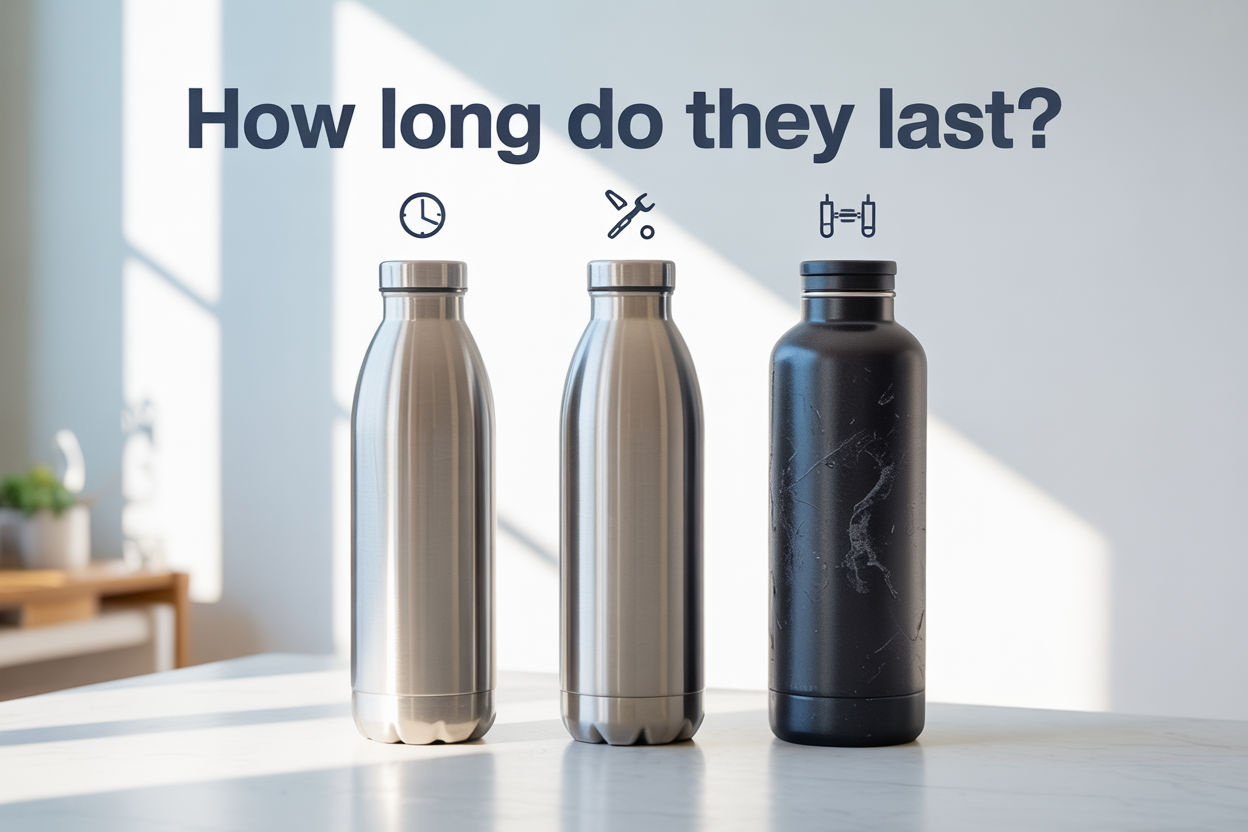
How long do insulated water bottles last? The steel body usually outlasts your interest in it. Hydro Flask, Stanley and Klean Kanteen all warrant theirs for the life of the product, and YETI and Thermos give five years. What wears out is the lid and its silicone seal, normally inside a few years, and those are replaceable parts rather than a reason to buy another bottle.
What actually ends a bottle is a hard drop that breaks the vacuum, and every warranty below excludes exactly that. If you are shopping rather than diagnosing, start with the best water bottle that stays cold.
One clarification, because this question gets asked two ways. If you meant how long a bottle keeps a drink cold rather than how many years it survives, the answer is hours and it depends on the model. Makers commonly quote up to 24 hours cold and 12 hours hot for their vacuum bottles, and those are manufacturer figures for specific products, not a property of insulated bottles in general.
- How long do insulated water bottles last?
- What the makers actually promise
- How long each material lasts
- How to test whether the vacuum still works
- Signs it is time to replace your bottle
- How to make an insulated bottle last longer
- Is a long-lasting bottle worth it?
- What to do with a bottle that has failed
- Frequently asked questions
How long do insulated water bottles last?
Nobody publishes a reliable average, and any single number you are given is a guess. The useful way to answer it is by part, because an insulated bottle is not one object with one lifespan. It is a steel shell, a vacuum between two walls, a lid assembly and a silicone gasket, and they fail on completely different timescales.
| Part | What normally happens | Replaceable? |
|---|---|---|
| Stainless steel body | Outlasts everything else. Three of the five brands below warrant it for the life of the product. | No, but rarely needs to be |
| The vacuum | Holds indefinitely unless the bottle takes a hard impact or the weld is breached. Sealed at manufacture. | No. Not repairable at home |
| Lid and its moving parts | The usual first failure. Threads wear, flip tops and straws crack with daily use. | Yes, sold as spare parts |
| Silicone gasket or O-ring | Hardens and shrinks over time, then starts to leak. The cheapest part on the bottle. | Yes, and inexpensive |
| Powder coat or exterior finish | Chips and fades. Cosmetic only, and excluded from every warranty here. | No |
Read down that table and the picture is clear enough: the bottle you throw away is almost never a bottle whose steel gave up. It is one with a lid nobody replaced, or one that hit a concrete floor. For how the two walls and the vacuum actually do their job, and whether the extra cost is justified, see are insulated water bottles worth it.
What the makers actually promise
Warranty terms are the one place where a lifespan claim has to be specific, because the company has to stand behind it. These are the published terms for five of the biggest brands, checked in October 2026.
| Brand | Covered | Term | Explicitly excluded |
|---|---|---|---|
| Hydro Flask | Bottles and other hard goods, against manufacturing defects | Limited lifetime | Misuse, damage from cleaning or modification, wear and tear, abuse |
| Stanley | Steel drinkware, including degradation of thermal performance | Life of the product | Any non stainless steel part, and normal wear such as scratches, dents and blemishes from use |
| Klean Kanteen | Manufacturing defects, for as long as the original buyer owns it | Lifetime limited | Improper use, damage from cleaning or alteration, normal wear and tear, abuse |
| YETI | Rambler drinkware, defects in material and workmanship | 5 years | Commercial use, structural alteration, stress beyond the physical limits |
| Thermos | Stainless steel vacuumware, defects in material or workmanship | 5 years | Ordinary wear and tear, color fading, abuse, neglect, accident, improper maintenance |
Three things in that table are worth more than any round number. The steel body is covered for life by three of the five, so durability is not really in question. Stanley spells out that the warranty does not cover lids, seals and straws, which confirms that those are the consumable parts. And Stanley is the only one that names thermal performance itself as covered, which means a bottle that has stopped insulating may be a claim rather than a purchase.
The reverse is just as useful. Dents are excluded by all five, so a bottle you dropped is on you. If the damage is cosmetic you may still be able to improve it yourself, which is what how to fix a dented water bottle covers.
How long each material lasts
Insulated bottles are mostly stainless steel, but the broader category is not, and the material sets the ceiling before anything else does.
| Material | Typical service life | What limits it |
|---|---|---|
| 18/8 food grade stainless steel, double walled | A decade or more; warranted for life by several brands | Impact damage to the vacuum, not the steel itself |
| Single wall stainless steel | Similar lifespan, no insulation to lose | Dents are cosmetic rather than functional |
| Tritan and similar hard plastics | A few years of regular use | Scratching, crazing, clouding, thermal cycling |
| Generic BPA free plastic | Shorter again | Thinner walls, odor retention, micro cracking |
One detail that gets written incorrectly almost everywhere: a quality stainless bottle has no interior lining. Klean Kanteen states that no plastic or epoxy lining is necessary because the steel is already food safe, and Hydro Flask confirms the inside is bare steel with the colored powder coat on the outside only. There is no coating in there to scratch through, and the insulation comes from the vacuum rather than from any surface layer.
How to test whether the vacuum still works
Hydro Flask publishes a check for its own flasks, which is the closest thing to an authoritative home test. Pour boiling water straight into the bottle, filling it to the neck, with no cap on. Wait about five minutes, then feel the outside below the neck. If you can feel warm patches, the insulation has been compromised, and on a Hydro Flask that makes the bottle eligible for a replacement. Their own wording asks you to take care pouring boiling water and not to hold the bottle while you fill it.
If you would rather not use boiling water, the slower version is simply to use the bottle and pay attention. A bottle with a failed vacuum loses its advantage within an hour or two, and you will notice.
A rattle is not the test people think it is. Hydro Flask explains that the noise comes from a small metal disc between the two walls, which is part of how the vacuum is formed, and that a loose disc does not affect the insulation or the structure of the flask. If the bottle still holds temperature, a rattle is only a noise.
Signs it is time to replace your bottle
Replace it now if any of these are true:
- It no longer holds temperature, and the boiling water check above shows warm patches.
- The body is cracked, or dented deeply enough to change its shape.
- There are deep scratches inside the bottle that you cannot clean out.
- A smell or taste survives a proper wash and a deep clean.
Deal with it, but do not replace the bottle, if:
- The lid leaks or will not seal. Replace the gasket or the lid; both are sold as parts.
- There are rust colored spots inside. That is usually surface staining rather than the steel failing, and rust in stainless steel water bottle explains how to deal with it.
- The outside is chipped, scratched or faded. Cosmetic, and excluded from every warranty anyway.
- It smells, but has not had a deep clean yet. Try that first.
How to make an insulated bottle last longer
Most of the lifespan of an insulated bottle is decided by two things: whether you drop it, and whether you look after the lid. Everything else is minor by comparison.
Wash it regularly with warm soapy water and a bottle brush, and take the lid apart to do it. Gaskets trap residue in places a quick rinse never reaches, and a gasket left dirty is a gasket that hardens early. clean an insulated water bottle walks through the routine, and how often to clean water bottle covers how frequently it is actually worth doing.
Skip the bleach. Chlorine attacks stainless steel, which is the one household cleaner that can genuinely damage the bottle rather than just the finish. Baking soda and vinegar are both useful, but use them separately rather than mixed: combined, an acid and a base neutralize each other, and once the fizzing stops you are left with little more than salty water.
Dry it properly with the lid off before you put it away, check the gasket every few months for hardening or splits, and check whether yours is dishwasher safe before it goes in one. YETI says all Rambler products are, while Stanley makes its warranty conditional on following the care instructions and Hydro Flask excludes damage caused by cleaning.
Is a long-lasting bottle worth it?
On the environmental side the arithmetic is straightforward. Earth Day Network reports that Americans buy around 50 billion water bottles a year, roughly 13 a month each, and that switching to a reusable bottle saves about 156 plastic bottles a year. Over a decade of ownership that is a four figure number of bottles not bought.
Stainless steel also keeps its value at the end. According to worldstainless, stainless can in principle be recycled indefinitely without losing its properties, and most of it is recovered at end of life. A bottle that finally does fail is scrap metal rather than landfill, provided it is handled properly, which is what recycle stainless steel water bottle is about.
On cost, the honest comparison is ordinal rather than numeric. A bottle that lasts a decade costs less per year than replacing a cheap one every couple of years, and far less than buying bottled water. Putting a dollar figure on it would only date the page.
What to do with a bottle that has failed
Work through it in order. If the lid or the gasket is the problem, buy the part. If the bottle has stopped insulating and it is from a brand that covers thermal performance, make a warranty claim before you buy anything, and keep in mind that most of these warranties ask for proof of purchase from an authorized seller. If the damage is a dent you caused, that is excluded everywhere, so the question becomes whether it still works.
And if it is genuinely finished, do not bin it. The steel is worth recovering.
Frequently asked questions
How often should I replace my insulated water bottle?
There is no fixed interval. Replace it when it stops holding temperature, when the inside keeps a smell that washing will not shift, or when the body is cracked or badly dented. A lid or a gasket that has gone hard is a part to replace, not a reason to replace the bottle.
Can dents affect my bottle’s insulation performance?
They can. A dent deep enough to push the outer wall against the inner one, or hard enough to break the weld, lets the vacuum go, and once it does the bottle will not keep drinks cold or hot. Light scratches and small cosmetic dings do not. Worth knowing before you claim: every warranty in the table above excludes dents as normal wear, and Stanley names scratches, dents and blemishes from use specifically.
How do I know if my vacuum seal is still working?
Hydro Flask publishes a check for its own flasks. Pour boiling water straight into the bottle with no cap on, wait about five minutes, then feel the outside below the neck. Warm patches mean the insulation has gone. Their own caution is to take care pouring and not to hold the bottle while you fill it.
My bottle rattles when I shake it. Is it broken?
Usually not. Hydro Flask explains that the rattle is a small metal disc sitting between the two walls, which helps form the vacuum, and that a loose one does not affect insulation or the structure of the flask. If the bottle still holds temperature, the noise is cosmetic.
Are insulated water bottles dishwasher safe?
It depends on the maker, so check yours. YETI states that all Rambler products are dishwasher safe. Stanley ties its warranty to following the care instructions, and Hydro Flask excludes damage caused by cleaning, so a dishwasher cycle on a bottle that was not built for it can cost you the claim.
Can I repair a damaged insulated water bottle?
Not the vacuum. It is sealed during manufacture and there is no home fix once it has gone. Lids, gaskets and straws are a different matter: those are sold as spare parts by most of the brands here, and Hydro Flask will replace a broken or leaking cap under its warranty.
Is it safe to use an old insulated water bottle?
Age by itself is not the problem. What matters is condition: deep scratches inside, cracks, or a smell that survives a proper wash all give bacteria somewhere to settle, and a bottle in that state is worth retiring. A bottle that cleans up properly and still seals is fine to keep using.
