
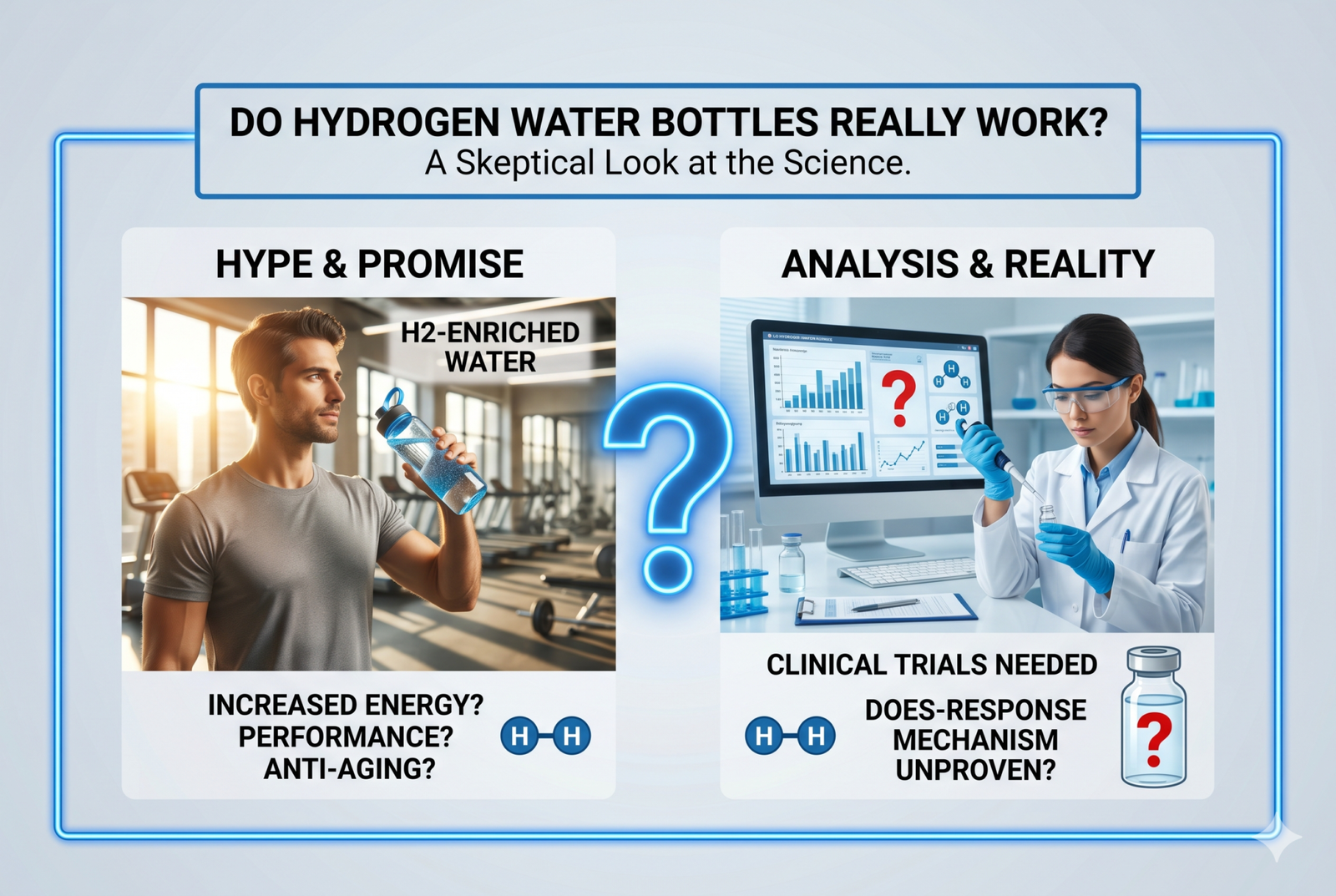
If you’ve seen hydrogen water bottles pop up on every wellness feed this year, you have probably asked the same thing everyone else is asking: do hydrogen water bottles really work, or is this just an expensive way to drink water?
Fair question. The bottles look futuristic, the claims sound impressive, and the prices are real. So before you spend real money on one, here’s the most honest breakdown you’ll find — including what the science actually says as of 2026, what it doesn’t say, and how to avoid buying a dud if you decide to try one.
The short answer: for putting dissolved hydrogen into your water, yes: a genuine SPE/PEM bottle does that reliably, and that part is not disputed. For measurably improving your health, it is a careful maybe. The evidence is strongest for oxidative stress, blood lipids and exercise fatigue, and it comes from trials that are mostly small and short. Physics also caps what any bottle can deliver: water holds only about 1.6 ppm of hydrogen at normal pressure, however large the number on the box. So: not a hoax, not a cure, and worth the money only if you buy one with that expectation.
In this guide, you’ll learn:
What Is a Hydrogen Water Bottle?
A hydrogen water bottle is a portable device that infuses regular drinking water with extra molecular hydrogen gas (H₂). That’s it — no special minerals, no alkaline pH tricks, just dissolved hydrogen gas in your water.
Water is already H₂O, which is where people get confused. It already has hydrogen in it. But the hydrogen in H₂O is chemically bonded to oxygen — it’s not the same as free-floating dissolved hydrogen gas. A hydrogen water bottle adds additional molecular hydrogen (H₂) that exists independently in the water, not as part of the water molecule itself.
Think of it like carbonated water. Carbon dioxide in sparkling water isn’t bonded to water molecules — it’s dissolved gas. Hydrogen water works the same way. The gas is in the water, not of the water.
Manufacturers quote dissolved hydrogen in parts per billion (ppb) or parts per million (ppm), and the figure on the box is usually somewhere between 1,000 and 5,000 ppb. Those numbers run into a hard physical limit that we come back to further down: at normal atmospheric pressure, water saturates at about 1.6 ppm — 1,600 ppb. Most clinical studies that reported positive results used water at or near that saturation point. If you want the full picture on how these bottles are built, what they cost and which models are worth it, start with our complete hydrogen water bottle guide.
| Plain water | Hydrogen water (PEM bottle) | Alkaline water | Hydrogen tablets | |
|---|---|---|---|---|
| What is added | Nothing | Dissolved H₂ gas | Raised pH, usually via minerals or ionization | Dissolved H₂ gas, released by a magnesium reaction |
| Typical H₂ concentration | Negligible | Up to about 1.6 ppm (saturation) | Negligible unless separately hydrogenated | Varies widely; often below a good bottle |
| How long it lasts | n/a | Half-life around two hours in an open glass | pH is stable | Same escape problem as any hydrogen water |
| What the human evidence supports | Hydration | Oxidative stress, blood lipids, exercise fatigue (mostly small trials) | Contested; benefits attributed to pH are debated | Less studied than hydrogen-rich water generally |
| Best for | Everyone, first | People who will drink it fresh, every day | A different goal entirely | Travel, or trying the idea without a device |
How Does It Actually Work? (The Technology)
There are two main technologies used in hydrogen water bottles, and knowing the difference matters because one is significantly better than the other. We take the process apart step by step in our full explainer on how these bottles work.
SPE/PEM Electrolysis (The Gold Standard)
SPE stands for Solid Polymer Electrolyte. PEM stands for Proton Exchange Membrane. Most quality bottles use this method.
When you press the button on your bottle, a small electrical current passes through the water. This splits water molecules into hydrogen gas and oxygen gas. The PEM membrane physically separates these gases — hydrogen dissolves into the water you drink, while oxygen (along with any trace chlorine or ozone) vents out through a separate chamber at the base of the bottle.
You’ll usually see a small vent hole at the bottom of a legitimate PEM bottle. If your bottle has no vent, it doesn’t have true PEM technology — and that matters for purity.
A standard cycle takes 3–10 minutes. Output is usually advertised somewhere between 1,000 and 5,000+ ppb depending on the bottle and the cycle length, though as the section on concentration explains, not all of that stays dissolved once you open the lid.
Basic Electrolysis (The Cheaper Alternative)
The cheapest bottles on the market skip the PEM membrane entirely. They still split water via electricity, but without proper gas separation, the hydrogen and oxygen stay mixed in the water. Worse, if your tap water contains chloride ions, the electrolysis can produce trace amounts of chlorine gas.
This doesn’t mean cheap bottles are necessarily dangerous at normal use levels — but they’re far less effective and their hydrogen output is unreliable.
Hydrogen Infusion Tablets (A Third Option)
Not technically a “bottle” feature, but worth mentioning. Magnesium-based tablets dropped into water react to release hydrogen gas. These are convenient for travel but typically produce lower concentrations than PEM electrolysis bottles. We put the two head to head in bottles versus hydrogen tablets.
What Does the Science Say?
Molecular hydrogen research has been ongoing since 2007, when a landmark study in Nature Medicine showed that inhaled hydrogen could protect against brain damage from ischemia-reperfusion injury. That study sparked hundreds of follow-up investigations.
As of 2026 there are well over 1,000 peer-reviewed papers on molecular hydrogen. Human testing is a much smaller subset of that: a 2023 review in Molecules counted 81 registered clinical trials of molecular hydrogen therapy in people.
A 2024 systematic review published in the International Journal of Molecular Sciences analyzed 25 human studies and concluded that preliminary results are “encouraging” for hydrogen water’s effects on exercise capacity, cardiovascular health, liver function, mental health, and oxidative stress reduction. The same review noted real limitations: many studies had small sample sizes (10–50 participants), varying hydrogen concentrations, and short durations.
What keeps hydrogen interesting to researchers is selectivity. The 2007 Nature Medicine work showed it preferentially neutralizes the most damaging reactive oxygen species (specifically hydroxyl radicals and peroxynitrite) without disrupting the beneficial oxidative processes your body needs, and later work linked it to activation of the Nrf2 antioxidant pathway.
What makes molecular hydrogen unusual as an antioxidant is selectivity. Most antioxidant supplements — vitamin C, vitamin E, resveratrol — are not selective. They scavenge free radicals broadly, which sounds good but can actually interfere with normal cell signaling. Hydrogen targets only the most destructive reactive oxygen species, leaving milder ones alone. That selectivity is what made the 2007 paper so widely cited, and it is still the mechanism most of the research is built on.
Most of these studies are still small. The science is genuinely promising. It is not yet definitive.
The dose problem nobody mentions
There is one detail that almost never survives the trip from a study abstract to a product page: the dose the trials actually used. The 6-month telomere pilot gave participants half a litre a day of water at 15 ppm. The 24-week metabolic syndrome trial used more than 5.5 millimoles (mmol) of hydrogen per day. Both are supersaturated preparations, made under pressure and kept sealed until the moment of drinking.
A portable electrolysis bottle sitting at normal atmospheric pressure cannot reach those levels. It is capped near 1.6 ppm, and the hydrogen begins diffusing out the moment you open the lid. So a fair reading of the literature is that several of the most encouraging trials tested a stronger product than the one in your bag. That is a reason for measured expectations rather than a reason to dismiss the field, but it is the single most important caveat on this page and you will rarely see a brand mention it.
The Main Benefits — Examined Honestly
1. Reduced Oxidative Stress (Best-Supported Claim)
This is the most consistently supported benefit across studies. In a study published in the Journal of Clinical Biochemistry and Nutrition, people who drank hydrogen-rich water for 8 weeks showed measurably lower oxidative stress markers than control groups.
Oxidative stress is linked to cellular aging, inflammation, cardiovascular disease, and certain cancers. If hydrogen water genuinely reduces it, even modestly, that matters.
Honest take: The evidence here is the strongest of any claimed benefit. Still needs larger trials, but the direction of findings is consistent.
2. Athletic Performance and Recovery (Moderate Evidence)
A 2019 study in the International Journal of Sports Medicine found that cyclists who drank hydrogen water before an intense cycling bout had lower levels of blood lactate, the compound linked to muscle fatigue and soreness. The same trial also recorded a lower rating of perceived exertion (RPE), so the riders felt the effort less, not just measured lower.
A 2024 meta-analysis of randomized controlled trials found that hydrogen-rich water significantly improved antioxidant potential during exercise, particularly in intermittent training protocols.
However, a separate analysis found no significant improvement in recovery from delayed-onset muscle soreness (DOMS). So the picture here is mixed. It may help with real-time fatigue during exercise but not necessarily how sore you feel two days later.
Honest take: Worth trying if you’re a competitive athlete or serious fitness enthusiast. Results vary by activity type and individual.
3. Cardiovascular Health (Promising, Early Stage)
One study found that drinking hydrogen water for 10 weeks measurably reduced LDL (“bad”) cholesterol levels. In patients with unstable angina, hydrogen water consumed alongside conventional medications helped relieve symptoms. A 2023 meta-analysis of seven clinical trials confirmed small but statistically significant improvements in total cholesterol, LDL, and triglycerides.
Molecular hydrogen appears to suppress pro-inflammatory cytokines and activate the Nrf2 antioxidant transcription factor — both relevant to heart health.
Honest take: The cardiovascular findings are consistent enough to be interesting, but none of these studies are large enough to make firm recommendations. Talk to your cardiologist before using hydrogen water as a health intervention.
4. Blood Sugar and Metabolic Health (Mixed Results)
A 24-week randomized, double-blinded, placebo-controlled trial in people with metabolic syndrome found that high-concentration hydrogen-rich water consumption reduced blood cholesterol, glucose, and hemoglobin A1c (a 2–3 month blood sugar average). It also improved waist-to-hip ratio and BMI.
A different study found no impact on fasting blood glucose. So the metabolic evidence is genuinely split.
Honest take: Some people with metabolic syndrome may benefit. Not a replacement for medication or lifestyle changes.
5. Anti-Aging (Very Preliminary)
A 6-month randomized pilot trial in adults aged 70+ found that daily hydrogen-rich water intake (0.5 liters) resulted in roughly a 4% increase in telomere length, a marker of cellular aging, along with improved lower-body strength and reduced general pain.
One earlier study found that 6 months of hydrogen water improved factors associated with aging, including increased choline (a nutrient the body uses to make acetylcholine, the neurotransmitter tied to memory, mood, and muscle control).
Honest take: Intriguing. Not enough data to make firm claims. Don’t buy a hydrogen water bottle specifically for anti-aging — but it’s a research area worth watching.
6. Mood and Mental Health (Small Studies Only)
One study found daily hydrogen water consumption for a month led to measurable improvements in mood and anxiety scores. A study of cancer patients found those treated with hydrogen water had less anxiety.
Honest take: Sample sizes are tiny. This is early-stage research. Interesting, but don’t count on it.
7. Liver Support (Some Clinical Evidence)
Studies in people with hepatitis B and nonalcoholic fatty liver disease showed that hydrogen water treatment improved liver enzyme levels (ALT, AST) and reduced liver fat markers. The 2024 systematic review specifically listed liver function as one of the more promising application areas.
Honest take: Possibly beneficial for liver health, particularly in people with existing liver conditions. More research needed.
What the Research Still Can’t Tell Us
A few honest gaps to acknowledge:
Optimal dosage is unknown. Clinical studies typically used 0.5–1.5 liters of hydrogen water per day. Nobody has systematically compared 0.5 L against 1.5 L against 3 L to find the sweet spot.
Long-term effects are unstudied. The longest studies run 6–12 months. We have no data on what happens after years of regular use.
Not everyone responds the same way. Some of the reviewed studies showed clear benefits in the treatment group; others showed no difference versus placebo. Individual variation is real and not well understood.
Manufacturer claims outpace the science. If a hydrogen water bottle brand claims it will “cure inflammation,” “reverse aging,” or “detox your body” — those are marketing claims, not science. Be skeptical of anything that specific.
The Case Against Hydrogen Water — And What It Gets Right
Search this topic for five minutes and you will hit people calling the whole category a hoax: chemists on forums, physicians answering questions publicly, nutrition researchers describing the benefits as massively oversold. They are not cranks, and two of their three main arguments are basically correct. Here they are, stated as strongly as they deserve.
“The hydrogen escapes before you can drink it.” Partly right. Dissolved hydrogen has a half-life of roughly two hours in an open 500 ml container, and far less if the water is agitated. Molecular hydrogen is the smallest molecule there is and will diffuse through most plastics. That is exactly why fresh cycling matters, and why a bottle you filled this morning is close to plain water by lunchtime. It is an argument about handling, though, not about whether the chemistry is real.
“The dose is too small to do anything.” This is the serious version of the objection, and it is the one covered above. Questions about bioavailability, meaning how much of that hydrogen is genuinely absorbed rather than exhaled or lost along the way, are legitimate and not fully settled. Anyone claiming certainty in either direction is overreaching.
“The studies are small, and some are funded by the industry.” Correct, and the researchers say so themselves. The 2024 systematic review lists its own limitations plainly: small samples, short durations, missing placebo arms, varying hydrogen concentrations, and the possibility of commercial bias where trials were supported by organisations with an interest in hydrogen products. An evidence-based reading of this field has to hold all of that at once.
Where the sceptics overreach is the jump from oversold to myth. The underlying mechanism is real and was published in one of the better-regarded medical journals; the human trials, whatever their size, keep pointing the same direction on oxidative stress and blood lipids. Overstated is not the same thing as fabricated.
How to Pick a Bottle That Delivers Real Hydrogen
Not all hydrogen water bottles do what they claim. Here is what actually matters when choosing one, and our longer buying walkthrough goes further on models and features:
Technology
Look for SPE/PEM (Solid Polymer Electrolyte / Proton Exchange Membrane) technology. This is non-negotiable for purity and effectiveness. There should be a visible vent hole at the bottom of the bottle for oxygen to escape. No vent = no real PEM separation.
Hydrogen Concentration
Here is the number most brands never print. At normal atmospheric pressure and room temperature, water saturates at roughly 1.6 mg/L of dissolved hydrogen — 1.6 ppm, or 1,600 ppb. That is a ceiling set by physics, not a difference in build quality. When a bottle advertises 5,000 ppb, or 8,000 to 9,000 ppb, that reading is taken at the moment of generation, when the water is briefly supersaturated and carrying hydrogen as fine nanobubbles. Open the lid and it falls back toward saturation.
\n\n\n\nSo read headline ppb figures as a rough proxy for how hard a bottle drives electrolysis, not as the dose you swallow. A bottle that reliably reaches saturation is already doing everything the chemistry allows. Look for third-party-tested concentration numbers rather than manufacturer claims, and treat any brand quoting a number several times the solubility limit without explaining it as a brand that is marketing rather than measuring.
Materials
The bottle body should be borosilicate glass or BPA-free food-grade plastic. The electrode should be platinum-coated titanium — this is standard in quality bottles. Avoid anything that does not specify electrode material. Electrode material is a safety question as much as a performance one. Cells with undisclosed or poorly plated metals are the ones most likely to shed material into the water over time, which is the real reason not to buy a bottle that will not tell you what its electrode is made of.
Price Range
Price tracks technology far more than branding. A bottle built around a genuine SPE/PEM cell, with a platinum-coated titanium electrode and a working vent, costs meaningfully more than the basic electrolysis units that fill marketplace listings. The very cheapest devices on those marketplaces generally will not produce clinically relevant hydrogen levels, so treat an unusually low price as a reason to check the specification rather than as a bargain.
Certifications to Look For
- CE: the manufacturer declares the device meets EU safety, health and environmental requirements. It is a self-declaration, not an independent test.
- RoHS: restricts lead, mercury, cadmium and other hazardous substances in the electronics. Useful, but it says nothing about the electrode surface that touches your water.
- NSF or independent lab testing: the only one of the three that speaks to what the bottle actually produces. Ask for a test report with a measured ppb figure and the method used.
Be clear about what these do not cover: none of the three certifies hydrogen output. A bottle can be fully CE marked and RoHS compliant and still produce almost no dissolved hydrogen. Only third-party concentration testing speaks to that.
How Long Does Hydrogen Actually Stay in Your Water?
Hydrogen gas starts escaping the moment it’s produced. Unlike CO₂ in sparkling water, which escapes over minutes to hours, molecular hydrogen is the smallest molecule in existence. It can pass through most container materials and escapes quickly once you open the bottle.
Here’s what that means practically:
- In an open glass: dissolved hydrogen has a half-life of roughly two hours at room temperature, and far less than that if the water is stirred, poured or carried around.
- In a sealed PEM bottle (still closed): Hydrogen stays reasonably concentrated for 1–2 hours after production.
- Best practice: Drink hydrogen water within 15–30 minutes of production, while the bottle is still sealed or just opened.
This also means pre-packaged hydrogen water in pouches or cans, while sometimes used in studies, has highly variable hydrogen retention depending on packaging integrity and storage time.
Don’t make a batch of hydrogen water in the morning and sip it throughout the day. Run a fresh cycle before each use. Most quality bottles cycle in 3–5 minutes.
Are Hydrogen Water Bottles Safe?
Short answer: yes, for healthy adults.
In 2014 the FDA reviewed a GRAS notice for hydrogen gas dissolved in beverages (GRAS Notice 520) and responded that it had no questions, which is the regulatory way of saying it is considered safe to drink at these levels. That is a safety finding, not an endorsement that it does anything. A 2024 systematic review concluded that hydrogen-rich water is “mostly considered safe, with minimal to no side effects reported across diverse populations.”
Reported side effects are rare and mild. Occasional light bloating in the first week is the one most often mentioned, and it typically settles as the body adapts.
A note on cheap bottles and chlorine: As mentioned earlier, low-quality bottles without PEM technology can produce trace chlorine gas during electrolysis if you use tap water with chloride content. This is the main safety concern with budget devices. The solution: either use purified/distilled water in any bottle, or buy a proper PEM bottle that vents byproducts separately.
Who should consult a doctor first:
- People taking blood thinners (hydrogen’s antioxidant effect may theoretically interact)
- Anyone undergoing chemotherapy (discuss with your oncology team)
- People with chronic kidney disease (some hydrogen water studies show kidney effects)
- Anyone with complex cardiovascular conditions
For healthy adults, no special consultation is needed before trying hydrogen water from a quality bottle.
Who Should Buy One (And Who Probably Shouldn’t)
Good fit:
- Serious athletes who want to explore natural performance support and recovery tools
- People with metabolic syndrome or high cholesterol — the cardiovascular evidence is worth a discussion with your doctor
- Anyone with elevated oxidative stress (smokers, people with high-stress jobs, those exposed to significant pollution)
- People with liver conditions — the liver support evidence is relatively consistent
- Wellness-curious people who understand the science is promising but not definitive, and are comfortable treating this as a supplement, not a medicine
Probably not worth it for:
- Someone expecting dramatic, quick results
- Anyone treating a serious medical condition without involving their doctor
- Bargain hunters shopping at the very bottom of the market (you’ll likely get an ineffective product)
- People who already struggle with consistent hydration — plain water first, hydrogen water as an upgrade
The Verdict: Do Hydrogen Water Bottles Really Work?
Here’s the honest answer: it depends on what you mean by “work.”
If “work” means “deliver dissolved molecular hydrogen to your water” — yes, quality PEM bottles reliably do this. That part isn’t disputed.
If “work” means “measurably improve specific health outcomes” — the answer is a careful maybe. The science is real. A 2024 systematic review of 25 human studies found encouraging results in multiple health areas. Eighty-one registered clinical trials have tested molecular hydrogen in people. The selective antioxidant mechanism of molecular hydrogen is genuinely interesting to researchers.
But the studies are mostly small. There are no massive, long-term randomized controlled trials confirming the same sweeping benefits marketed on most brand websites. The science is promising enough to take seriously and not definitive enough to stake dramatic health claims on.
Hydrogen water bottles are not a scam. The underlying chemistry is real. The research base is young, but it is growing and it is credible. They’re also generally safe, reasonably convenient, and increasingly affordable as the market matures.
What they are is a supplement in the truest sense: something that may support your health in meaningful ways, but won’t replace sleep, exercise, diet, or medical care.
If you go in with that expectation, and you choose a quality PEM bottle, there is a real case for giving it a try.
What to expect, and when. The trials that found something ran from eight weeks to six months, so this is a thing to judge over months rather than days. It is also worth knowing that most of those trials measured blood markers rather than how people felt, so a change you can notice day to day was never really what was being tested.
Important Disclaimer: The findings described here come from early and still-emerging research. Hydrogen water is not a medicine and is not intended to diagnose, treat, cure, or prevent any disease. Always consult a qualified healthcare professional for medical advice, especially if you have an existing health condition or take prescription medication.
Frequently Asked Questions
How much hydrogen water should I drink per day?
Most clinical studies used 0.5–1.5 liters per day. A single bottle cycle produces 200–400 ml depending on the model, so three to five cycles a day align with research-based dosing. Start with 1–2 cycles and see how you feel.
Can I use tap water in my hydrogen water bottle?
You can, but purified or filtered water is better. Tap water with high mineral content or chloride can reduce electrode efficiency and, in low-quality bottles, produce trace unwanted byproducts. If you have a quality PEM bottle, filtered tap water is fine.
Does hydrogen water taste different?
Most people notice no difference at all. Some describe hydrogen water as tasting “softer” or “smoother.” This is likely a placebo effect — blind taste tests show people can’t reliably distinguish it from regular water.
How long do hydrogen water bottles last?
The PEM membrane and electrode in a quality bottle typically last 1–3 years with regular use and proper maintenance. The battery (most bottles are USB rechargeable) usually lasts 2–5 years.
What ppm level of hydrogen water is effective?
Clinical studies showing benefits generally used concentrations around 1.0–1.6 ppm (1,000–1,600 ppb). A quality bottle should reach at least 1,000 ppb per standard cycle. Bottles advertising 3,000, 5,000 or 8,000+ ppb are quoting a peak reading taken at the instant of generation. Water saturates at about 1,600 ppb at normal pressure, so anything beyond that is supersaturated and short-lived.
Is hydrogen water the same as alkaline water?
No. Alkaline water has a higher pH (8–9.5) and achieves its benefits (debated) through different mechanisms. Hydrogen water’s potential benefits come from dissolved molecular hydrogen, not from pH. Some hydrogen water also has a slightly elevated pH as a byproduct of electrolysis, but that’s secondary.
Are hydrogen water bottles worth the money?
If you buy a genuine PEM bottle and use it consistently, it is a reasonable purchase for anyone interested in antioxidant support and the wellness benefits described above. If you buy a cheap bottle without real PEM technology, you’ll likely waste your money on a device that produces negligible hydrogen.
Can children drink hydrogen water?
No clinical studies have tested hydrogen water in children. As a general precaution, stick to plain water for children unless advised otherwise by a pediatrician.
Do doctors recommend hydrogen water?
Not as a treatment. Reviewing the evidence in January 2026, MD Anderson described hydrogen water as generally safe but said there is limited evidence it offers more long-term benefit than regular water, and that you do not need it to get hydrogen in your diet. That is a fair summary of mainstream medical opinion: safe enough to try, not something a clinician is going to prescribe.
Does hydrogen water help you lose belly fat?
There is no evidence of targeted fat loss. A 24-week trial in people with metabolic syndrome did report improvements in BMI and waist-to-hip ratio, and an 8-week trial in non-alcoholic fatty liver disease saw around a kilogram of weight change, but both were in clinical populations with existing metabolic problems. Nothing in the literature supports hydrogen water as a weight-loss device for healthy adults.
Who should not drink hydrogen water?
For healthy adults there is no known reason to avoid it. Check with a doctor first if you take blood thinners, are undergoing chemotherapy, have chronic kidney disease, or have a complex cardiovascular condition. No studies have tested it in children, so stick to plain water for them unless a pediatrician advises otherwise.